#include <WsfMaskingPattern.hpp>
Classes | |
| class | State |
Public Member Functions | |
| WsfMaskingPattern () | |
| ~WsfMaskingPattern () override | |
| virtual bool | Initialize () |
| bool | ProcessInput (UtInput &aInput) override |
| double | GetFactor (WsfStringId aStateId, WsfArticulatedPart *aPartPtr, double aViewAzPCS, double aViewElPCS, const double aViewVecWCS[3]) |
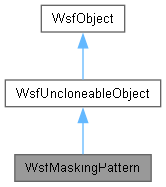
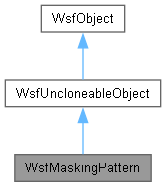
| Public Member Functions inherited from WsfUncloneableObject | |
| WsfUncloneableObject () | |
| WsfObject * | Clone () const override |
| Public Member Functions inherited from WsfObject | |
| WsfObject () | |
| This is the constructor for the WsfObject class. | |
| ~WsfObject () override | |
| This is the destructor for the WsfObject class. | |
| const char * | GetScriptClassName () const override |
| const std::string & | GetType () const |
| WsfStringId | GetTypeId () const |
| Get the string ID of the 'type' of the object. | |
| void | SetType (WsfStringId aType) |
| const std::string & | GetBaseType () const |
| WsfStringId | GetBaseTypeId () const |
| const TypeList & | GetTypeList () const |
| bool | IsA_TypeOf (WsfStringId aType) const |
| WsfObject & | operator= (const WsfObject &aRhs) |
| Assignment operator. | |
| template<typename T> | |
| void | Serialize (T &aBuff) |
| For XIO (de)serialization. | |
| const std::string & | GetName () const |
| WsfStringId | GetNameId () const |
| void | SetName (WsfStringId aName) |
Additional Inherited Members | |
| Public Types inherited from WsfObject | |
| typedef std::vector< WsfStringId > | TypeList |
| The list of types returned by GetTypeList. | |
| WsfObject (const WsfObject &aSrc) | |
| Copy constructor (for Clone()). | |
Detailed Description
Model blockage that might occur when looking at a specified direction from an articulated part.
This object can be optionally associated with an articulated part, and provides a 'masking factor' that is a function of viewing angle. The factor is a number in the range [0..1] that represents fraction of the original 'signal' that is passed.
This is typically used to represent the blockage of a signal by the structure of the platform or articulated part. A value of 1 indicates no blockage while 0 indicates complete blockage. Intermediate values might be used to represent the viewing-angle dependent factor when looking through a window.
Constructor & Destructor Documentation
◆ WsfMaskingPattern()
| WsfMaskingPattern::WsfMaskingPattern | ( | ) |
References WsfUncloneableObject::WsfUncloneableObject().
◆ ~WsfMaskingPattern()
|
override |
Member Function Documentation
◆ GetFactor()
| double WsfMaskingPattern::GetFactor | ( | WsfStringId | aStateId, |
| WsfArticulatedPart * | aPartPtr, | ||
| double | aViewAzPCS, | ||
| double | aViewElPCS, | ||
| const double | aViewVecWCS[3] ) |
Compute the masking factor.
- Parameters
-
aStateId The current state. aPartPtr The host articulated part. aViewAzPCS The azimuth viewing angle in the part coordinate system. aViewElPCS The elevation viewing angle in the part coordinate system. aViewVecWCS The unit viewing vector in the world coordinate system. This is used if a
- Returns
- The masking factor in the range [0..1]. A value of 1 indicates the view is unobstructed in the indicated direction while a value of 0 indicates total obstruction.
References WsfPlatform::GetContext(), and WsfPlatformPart::GetPlatform().
◆ Initialize()
|
virtual |
Initialize the masking pattern.
- Returns
- 'true' if successful or 'false' if the required 'default' data is not present.
References ok.
◆ ProcessInput()
|
overridevirtual |
Process input from a generic source.
Examine the current input command. If it is NOT one of the commands recognized by this class then it simply returns 'false'. If it is one of the commands recognized by this class then it processes the command and returns 'true'.
- Parameters
-
aInput a reference to a UtInput object.
- Returns
- 'true' if the command was one recognized by the class or 'false' if not.
- Exceptions
-
UtInput::ExceptionBase (or an object derived from it) if the command was recognized but contains some sort of error.
- Note
- If a derived class does not recognize the command (i.e.: the return value is false) then it should call the base class ProcessInput method. This chain should continue until either the command is recognized or the top-level base class is encountered.
Reimplemented from WsfObject.
The documentation for this class was generated from the following files: