WsfMultiresolutionTypesRegistration Class Reference
#include <WsfMultiresolutionTypes.hpp>
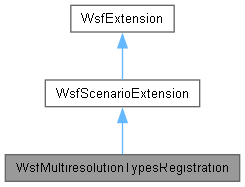
Inheritance diagram for WsfMultiresolutionTypesRegistration:
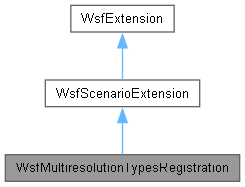
Collaboration diagram for WsfMultiresolutionTypesRegistration:
Public Member Functions | |
| void | AddedToScenario () override |
| template<typename DerivedComponent> | |
| WsfMultiresolutionTypes< DerivedComponent > & | GetMultiresolutionTypes () const |
| Public Member Functions inherited from WsfScenarioExtension | |
| WsfScenarioExtension () | |
| ~WsfScenarioExtension () override | |
| WsfScenario & | GetScenario () const |
| WsfApplication & | GetApplication () const |
| virtual bool | ProcessInput (UtInput &aInput) |
| virtual void | FileLoaded (const std::string &aFileName) |
| virtual bool | Complete () |
| virtual bool | Complete2 () |
| virtual void | SimulationCreated (WsfSimulation &aSimulation) |
| virtual bool | AlwaysCreate () |
| Public Member Functions inherited from WsfExtension | |
| virtual | ~WsfExtension ()=default |
| const std::string & | GetExtensionName () const |
Additional Inherited Members | |
| Protected Member Functions inherited from WsfExtension | |
| void | InitializeExtensionName (const std::string &aName) |
Member Function Documentation
◆ AddedToScenario()
|
overridevirtual |
Called when the extension has been added to the scenario. This is typically used to register new component type objects and object factories, e.g.:
WsfScenario& scenario(GetScenario());
WsfAntennaPatterTypes::Get(scenario).AddObjectFactor(MyAntennaPattern::ObjectFactory);
static WSF_EXPORT WsfMoverTypes & Get(WsfScenario &aScenario)
Return a modifiable reference to the type list associated with the specified scenario.
Definition WsfMoverTypes.cpp:53
bool AddCoreType(WsfStringId aId, std::unique_ptr< T > aDefinitionPtr)
Definition WsfObjectTypeList.hpp:102
WsfScenario & GetScenario() const
Definition WsfScenarioExtension.hpp:46
Script classes must NOT be registered here because they are global to the entire application. They should be registered in WsfApplication::AddedToApplication.
- Note
- GetScenario() and GetApplication() are now valid.
Reimplemented from WsfScenarioExtension.
◆ GetMultiresolutionTypes()
template<typename DerivedComponent>
|
inline |
- Exceptions
-
std::bad_cast std::out_of_range
References WsfScenarioExtension::GetScenario(), and WsfScenario::GetTypeLists().
Referenced by WsfMultiresolutionTypes< DerivedComponent >::Get(), and WsfMultiresolutionTypes< DerivedComponent >::Get().
The documentation for this class was generated from the following files: