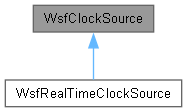
Maintain the current simulation clock. More...
#include <WsfClockSource.hpp>
Public Member Functions | |
| WsfClockSource ()=default | |
| virtual | ~WsfClockSource ()=default |
| WsfClockSource (const WsfClockSource &aSrc)=delete | |
| WsfClockSource & | operator= (const WsfClockSource &aRhs)=delete |
| WsfClockSource (WsfClockSource &&aSrc)=delete | |
| WsfClockSource & | operator= (WsfClockSource &&aRhs)=delete |
| virtual double | GetClock (double aClock) const |
| Return the current simulation clock. | |
| virtual void | ResetClock (double aAccumulatedTime=0.0) |
| Reset the simulation clock back to zero. | |
| virtual void | SetClock (double aClock) |
| Set the clock to a specified value. | |
| virtual void | SetClockRate (double aClockRate) |
| Set the clock rate multiplier. | |
| virtual double | GetClockRate () const |
| Get the clock rate multiplier. | |
| virtual void | StartClock () |
| Start the clock. | |
| virtual void | StopClock () |
| Stop (pause) the clock. | |
| virtual void | SetMaximumClock (double aClock) |
| Set the clock's maximum time. | |
| bool | IsStopped () const |
| Return whether the clock is paused. | |
Protected Attributes | |
| double | mClockRate {1.0} |
| bool | mClockPaused {false} |
| double | mMaximumClock {1.0E300} |
Detailed Description
Maintain the current simulation clock.
Constructor & Destructor Documentation
◆ WsfClockSource() [1/3]
|
default |
Referenced by operator=(), operator=(), WsfClockSource(), and WsfClockSource().
◆ ~WsfClockSource()
|
virtualdefault |
◆ WsfClockSource() [2/3]
|
delete |
References WsfClockSource().
◆ WsfClockSource() [3/3]
|
delete |
References WsfClockSource().
Member Function Documentation
◆ GetClock()
|
virtual |
Return the current simulation clock.
The return value will be the lesser of the supplied argument (aClock) and the physical simulation clock (for example, the elapsed real-time in a real-time simulation).
This allows a simulation executive (like WsfEventStepSimulation) to interleave events with a real-time clock.
Reimplemented in WsfRealTimeClockSource.
References mMaximumClock.
Referenced by operator=().
◆ GetClockRate()
|
virtual |
Get the clock rate multiplier.
References mClockRate.
Referenced by operator=(), WsfDisSetDataR::PopulateResponse(), and WsfXIO_SimTimeService::UpdateEvent::UpdateEvent().
◆ IsStopped()
|
inline |
Return whether the clock is paused.
References mClockPaused.
Referenced by WsfXIO_SimTimeService::UpdateRequestInterval().
◆ operator=() [1/2]
|
delete |
References WsfClockSource().
◆ operator=() [2/2]
|
delete |
References GetClock(), GetClockRate(), ResetClock(), SetClock(), SetClockRate(), SetMaximumClock(), StartClock(), StopClock(), and WsfClockSource().
◆ ResetClock()
|
virtual |
Reset the simulation clock back to zero.
Reimplemented in WsfRealTimeClockSource.
Referenced by operator=().
◆ SetClock()
|
virtual |
Set the clock to a specified value.
This method should be used with great caution! It should only be used when the clock is in a stopped (paused) state and should not set the clock backwards!
Reimplemented in WsfRealTimeClockSource.
Referenced by operator=(), and WsfRealTimeClockSource::SetClock().
◆ SetClockRate()
|
virtual |
Set the clock rate multiplier.
The clock rate multiplier allows SIMULATION time to flow faster or slower than the physical clock. Note that this only makes sense if the derived class is based on some concept of physical time.
Reimplemented in WsfRealTimeClockSource.
References mClockRate.
Referenced by operator=(), and WsfRealTimeClockSource::SetClockRate().
◆ SetMaximumClock()
|
virtual |
Set the clock's maximum time.
Reimplemented in WsfRealTimeClockSource.
References mMaximumClock.
Referenced by operator=(), and WsfRealTimeClockSource::SetMaximumClock().
◆ StartClock()
|
virtual |
Start the clock.
Reimplemented in WsfRealTimeClockSource.
References mClockPaused.
Referenced by operator=().
◆ StopClock()
|
virtual |
Stop (pause) the clock.
Reimplemented in WsfRealTimeClockSource.
References mClockPaused.
Referenced by operator=().
Member Data Documentation
◆ mClockPaused
|
protected |
◆ mClockRate
|
protected |
◆ mMaximumClock
|
protected |
The documentation for this class was generated from the following files: