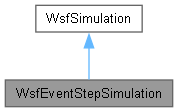
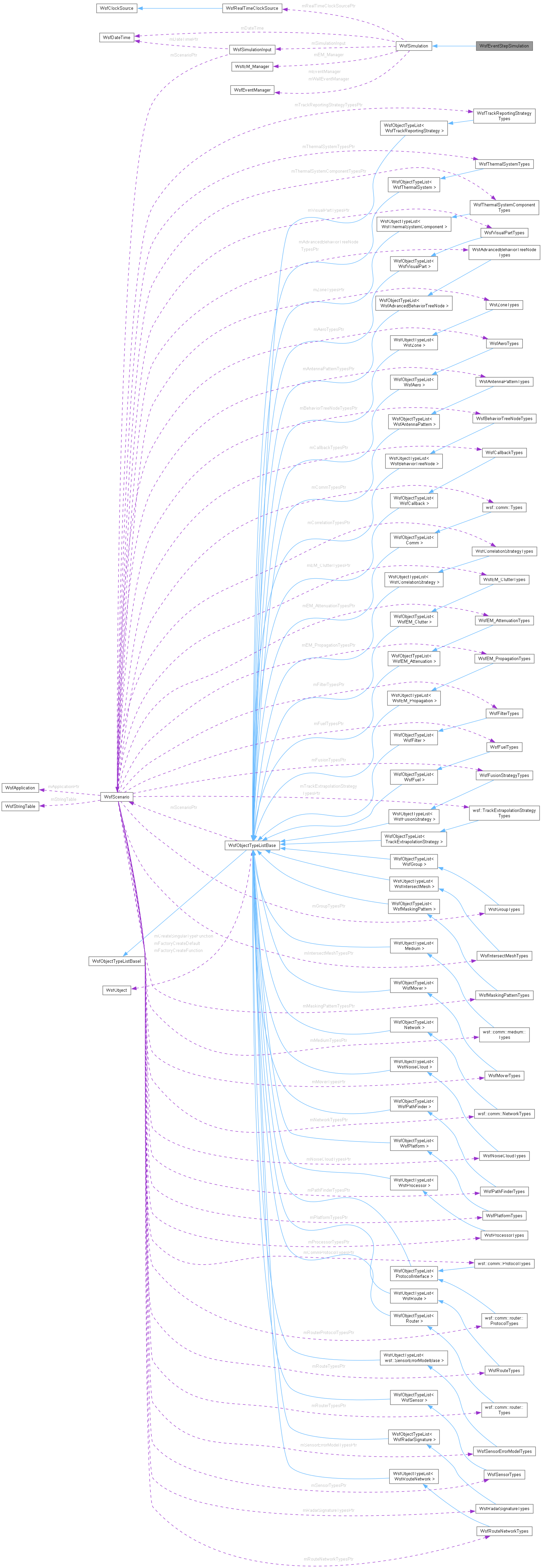
A specialization of WsfSimulation that implements an event-stepped simulation. More...
#include <WsfEventStepSimulation.hpp>
Public Member Functions | |
| WsfEventStepSimulation (WsfScenario &aScenario, unsigned int aRunNumber) | |
| ~WsfEventStepSimulation () override | |
| void | Initialize () override |
| void | Complete (double aSimTime) override |
| bool | PlatformDeleted (double aSimTime, WsfPlatform *aOldPlatformPtr) override |
| void | SetPartUpdateInterval (double aSimTime, WsfPlatformPart *aPartPtr, double aUpdateInterval) override |
| bool | TurnPartOff (double aSimTime, WsfPlatformPart *aPartPtr) override |
| bool | TurnPartOn (double aSimTime, WsfPlatformPart *aPartPtr) override |
| void | SetRealtime (double aSimTime, bool aIsRealTime) override |
| Set the optional real-time mode of the simulation. | |
| void | WaitForAdvanceTime () override |
| Public Member Functions inherited from WsfSimulation | |
| WsfSimulation (const WsfScenario &aScenario, unsigned int aRunNumber) | |
| virtual | ~WsfSimulation () |
| WsfSimulation (const WsfSimulation &aSrc)=delete | |
| WsfSimulation & | operator= (const WsfSimulation &aRhs)=delete |
| const WsfScenario & | GetScenario () const |
| WsfApplication & | GetApplication () const |
| virtual void | PrepareSimulation () |
| virtual void | AddEvent (std::unique_ptr< WsfEvent > aEventPtr) |
| template<typename T, typename... Args> | |
| T * | AddEventT (Args &&... args) |
| virtual void | AddWallEvent (std::unique_ptr< WsfEvent > aEventPtr) |
| template<typename T, typename... Args> | |
| T * | AddWallEventT (Args &&... args) |
| virtual double | AdvanceTime () |
| virtual double | AdvanceTime (double aSimTime) |
| virtual bool | ShouldExecute () const |
| virtual void | Start () |
| virtual void | Pause () |
| Pause execution of the simulation. | |
| void | PauseAndRequestAdvance (double) |
| Pause the execution of the simulation and request a time advance in scaled-and-stepped mode. | |
| virtual void | Resume () |
| Resume execution of the paused simulation. | |
| virtual void | RequestReset () |
| bool | IsActive () const |
| State | GetState () const |
| Return the simulation's current state. | |
| const std::string & | GetStateString () const |
| Return the string representation of the simulation's current state. | |
| CompletionReason | GetCompletionReason () const |
| virtual std::string | GetCompletionReasonString () const |
| virtual void | RequestTermination () |
| void | SetEndTime (double aEndTime) |
| Set the defined end time of the simulation. | |
| double | GetSimTime () const |
| Get the last time to which the simulation was updated. | |
| double | GetEndTime () const |
| Get the defined end time of the simulation. | |
| virtual double | GetNextEventTime () const |
| double | GetRealTime () const |
| bool | IsRealTime () const |
| Return whether this simulation is running real-time, or a multiple of real-time. | |
| double | GetWallTime () const |
| Get the current wall-clock time since simulation creation. | |
| double | GetTimeBehind () const |
| double | GetTimestep () const |
| double | GetSyncTimestep () const |
| void | SetIsExternallyStarted (bool aIsExternallyStarted) |
| bool | IsExternallyStarted () const |
| Return whether the simulation is to be started by an external source. | |
| bool | MultiThreadingActive () const |
| Return whether the simulation multi-threading is currently active. | |
| void | SetMultiThreadingActive (bool aMultiThreadingActive) |
| Set whether multi-threading is currently active ('true') or not ('false'). | |
| bool | IsEventStepSimulation () const |
| Return event step simulation indicator. | |
| void | SetAmAnEventStepSimulation (bool aFlag) |
| void | SetClockSource (std::unique_ptr< WsfClockSource > aClockSourcePtr) |
| const WsfClockSource * | GetClockSource () const |
| virtual double | GetClockRate () const |
| Returns the clock rate of the simulation. | |
| virtual void | SetClockRate (double aClockRate) |
| Changes the clock rate of the simulation. | |
| virtual void | SetTimeParameters (int aTimeScheme, double aSimTime, double aClockRate, double aTimeStep, bool aTimeAdvance=false) |
| Change the time parameters of the simulation. | |
| virtual bool | AddPlatform (WsfPlatform *aPlatformPtr) |
| virtual bool | AddPlatform (double aSimTime, WsfPlatform *aPlatformPtr) |
| virtual void | DeletePlatform (double aSimTime, WsfPlatform *aPlatformPtr, bool aDeleteMemory=true) |
| WsfPlatform * | GetPlatformByIndex (size_t aIndex) const |
| WsfPlatform * | GetPlatformByName (WsfStringId aNameId) const |
| bool | PlatformExists (size_t aIndex) const |
| Returns 'true' if the platform with the specified index still exists. | |
| WsfStringId | GetPlatformNameId (size_t aIndex) const |
| Return the name (ID) of a platform, even if the platform has been deleted from the simulation. | |
| WsfStringId | GetPlatformTypeId (size_t aIndex) const |
| Return the type (ID) of a platform, even if the platform has been deleted from the simulation. | |
| size_t | GetPlatformCount () const |
| WsfPlatform * | GetPlatformEntry (size_t aEntry) const |
| virtual bool | SetPartOperational (double aSimTime, WsfPlatformPart *aPartPtr, bool aOperational=true) |
| virtual void | ProcessRemovePlatformEvent (double aSimTime, WsfPlatform *aPlatformPtr, bool aDeletePlatform) |
| Called from RemovePlatformEvent to complete the processing of deleting a platform. | |
| virtual void | ProcessPlatformBrokenEvent (double aSimTime, WsfPlatform *aPlatformPtr) |
| Call from PlatformBrokenEvent to complete the processing of the broken of a platform. | |
| virtual void | SimulationStarting () |
| Deprecated form of Start();. | |
| virtual void | SimulationComplete (double aSimTime) |
| Deprecated form of Complete();. | |
| bool | IsFlexibleRealtime () const |
| Return 'true' if the simulation's real-time constraint is flexible. | |
| void | SetFlexibleRealtime () |
| WsfAdvancedBehaviorObserver & | GetAdvancedBehaviorObserver () const |
| WsfBehaviorObserver & | GetBehaviorObserver () const |
| WsfCommObserver & | GetCommObserver () const |
| WsfDisObserver & | GetDisObserver () const |
| WsfExchangeObserver & | GetExchangeObserver () const |
| WsfFuelObserver & | GetFuelObserver () const |
| WsfMoverObserver & | GetMoverObserver () const |
| WsfPlatformObserver & | GetPlatformObserver () const |
| WsfPlatformPartObserver & | GetPlatformPartObserver () const |
| WsfProcessorObserver & | GetProcessorObserver () const |
| WsfScriptStateMachineObserver & | GetScriptStateMachineObserver () const |
| WsfSensorObserver & | GetSensorObserver () const |
| WsfSimulationObserver & | GetSimulationObserver () const |
| WsfTaskObserver & | GetTaskObserver () const |
| WsfTrackObserver & | GetTrackObserver () const |
| WsfZoneObserver & | GetZoneObserver () const |
| WsfSimulationExtension * | FindExtension (const std::string &aName) const |
| WsfSimulationExtension & | GetExtension (const std::string &aName) const |
| const WsfExtensionList & | GetExtensions () const |
| void | RegisterExtension (const std::string &aName, std::unique_ptr< WsfSimulationExtension > aExtensionPtr) |
| const std::vector< std::string > & | GetExtensionNames () const |
| unsigned int | AssignUniqueId () |
| Assign the next unique identifier for WsfUniqueId. | |
| ut::Random & | GetRandom () |
| ut::Random & | LockRandom () |
| void | UnlockRandom () |
| ut::Random & | GetScriptRandom () |
| ut::Random & | LockScriptRandom () |
| void | UnlockScriptRandom () |
| wsf::TerrainInterface * | GetTerrainInterface () const |
| WsfDateTime & | GetDateTime () |
| const WsfDateTime & | GetDateTime () const |
| WsfGroupManager & | GetGroupManager () |
| wsf::comm::NetworkManager * | GetCommNetworkManager () const |
| WsfMultiThreadManager & | GetMultiThreadManager () |
| WsfPathFinderList & | GetPathFinderList () const |
| WsfScriptContext & | GetScriptContext () |
| const WsfScriptContext & | GetScriptContext () const |
| WsfLOS_Manager * | GetLOS_Manager () const |
| WsfZoneAttenuation & | GetZoneAttenuation () |
| WsfEM_Manager & | GetEM_Manager () |
| UtScriptExecutor & | GetScriptExecutor () |
| UtAtmosphere & | GetAtmosphere () const |
| Return the UtAtmosphere object used by the simulation. | |
| WsfEnvironment & | GetEnvironment () const |
| WsfSystemLog & | GetSystemLog () const |
| WsfIFF_Manager * | GetIFF_Manager () const |
| unsigned int | NextMessageSerialNumber () |
| unsigned int | NextEngagementSerialNumber () |
| unsigned int | PreviousEngagementSerialNumber () const |
| void | ReclaimPreviousEngagementSerialNumber () |
| double | CreateMessageDataTag () |
| bool | MultiThreaded () const |
| Return whether the simulation should multi-thread were appropriate. | |
| unsigned int | GetRunNumber () const |
| Get the current run number. | |
| unsigned int | GetFinalRunNumber () const |
| bool | RandomizeFrequency () const |
| bool | UseDefaultFrequency () const |
| double | GetMinimumMoverTimestep () const |
| const WsfSimulationInput & | GetSimulationInput () const |
| std::string | SubstituteOutputFileVariables (const std::string &aOutputFile) |
Protected Member Functions | |
| bool | PlatformInitialized (double aSimTime, WsfPlatform *aNewPlatformPtr) override |
| bool | PlatformIntroduced (double aSimTime, WsfPlatform *aNewPlatformPtr) override |
| void | CreateClock () override |
| bool | AddInputPlatforms () |
| virtual bool | TurnPartOffP (double aSimTime, WsfPlatformPart *aPartPtr) |
| virtual bool | TurnPartOnP (double aSimTime, WsfPlatformPart *aPartPtr) |
| virtual bool | SetPartOperationalP (double aSimTime, WsfPlatformPart *aPartPtr, bool aOperational) |
| virtual void | DispatchWallEvents () |
| Dispatch any pending wall clock events up to and including the indicated time. | |
| virtual void | DispatchSimEvents (double aSimTime) |
| virtual void | DispatchEvents (double aSimTime) |
| virtual bool | SimulationInitialized () |
| virtual bool | PlatformIsAvailable (WsfPlatform *aPlatformPtr) |
| void | AddToPlatformList (WsfPlatform *aPlatformPtr) |
| bool | DeleteFromPlatformList (WsfPlatform *aPlatformPtr) |
| bool | PlatformPointerExists (WsfPlatform *aPlatformPtr) |
| void | ResetPlatformList () |
| Reset the list to its initial (empty) state. | |
Additional Inherited Members | |
| Public Types inherited from WsfSimulation | |
| enum | State { cPENDING_INITIALIZE , cINITIALIZING , cPENDING_START , cSTARTING , cACTIVE , cPENDING_COMPLETE , cCOMPLETE } |
| An enumerated type specifying the state of the simulation. More... | |
| enum | CompletionReason { cNONE , cEND_TIME_REACHED , cRESET , cTERMINATE , cOTHER } |
| An enumerated type specifying the reason for completion of the simulation. More... | |
| static const std::string & | GetStateString (State aState) |
| Return the string representation of the provided simulation state. | |
| WsfEM_Manager | mEM_Manager |
| EM manager. | |
| WsfEventManager | mEventManager |
| Simulation event manager object. | |
| WsfEventManager | mWallEventManager |
| Wall clock-based event manager object. | |
| std::unique_ptr< WsfClockSource > | mClockSourcePtr {nullptr} |
| Pointer to the simulation clock source object. | |
| WsfRealTimeClockSource * | mRealTimeClockSourcePtr {nullptr} |
| double | mSimTime {0.0} |
| The last time to which the simulation has been updated (seconds). | |
| double | mRealTime {false} |
| double | mTimeBehind {0.0} |
| The amount of time the simulation clock is behind the real-time clock. | |
| double | mTimestep {0.0} |
| double | mSyncAccumulatedTime {0.0} |
| The wall clock time taken to execute the current synchronized time step. | |
| volatile State | mState {cPENDING_INITIALIZE} |
| The current state of the simulation. | |
| volatile CompletionReason | mCompletionReason {cNONE} |
| The reason for simulation completion. | |
| bool | mExternalEventReady {false} |
| True if an external event needs to be processed. | |
| unsigned int | mRunNumber |
| The current run number being executed. | |
| const WsfSimulationInput & | mSimulationInput |
| WsfDateTime | mDateTime |
| bool | mMultiThreaded |
| double | mMinimumMoverTimestep |
| double | mEndTime {std::numeric_limits<double>::max()} |
| The end time of the simulation (seconds). | |
| bool | mIsRealTime {false} |
Detailed Description
A specialization of WsfSimulation that implements an event-stepped simulation.
Constructor & Destructor Documentation
◆ WsfEventStepSimulation()
| WsfEventStepSimulation::WsfEventStepSimulation | ( | WsfScenario & | aScenario, |
| unsigned int | aRunNumber ) |
◆ ~WsfEventStepSimulation()
|
override |
Member Function Documentation
◆ Complete()
|
overridevirtual |
Indicate that the application has completed its simulation loop.
This performs the following action (in the order specified):
- Marks the simulation as complete.
- Stops the clock.
- Invokes SimulationComplete for each registered simulation observer.
- Deletes all remaining platforms.
- Deletes all remaining events in the event queue
- Invokes the Complete method for each registered simulation extension.
- Resets the clock back to 0.0
- Parameters
-
aSimTime The current simulation time.
Reimplemented from WsfSimulation.
References WsfMultiThreadManager::Complete(), WsfSimulation::Complete(), WsfSimulation::GetMultiThreadManager(), and WsfSimulation::MultiThreaded().
Referenced by weapon_tools().
◆ CreateClock()
|
overrideprotectedvirtual |
This is a method used to create the type of clock the simulation expects.
- Note
- See WsfEventStepSimulation for a non-trivial implementation.
Reimplemented from WsfSimulation.
References WsfSimulation::mIsRealTime, and WsfSimulation::SetClockSource().
Referenced by SetRealtime().
◆ Initialize()
|
overridevirtual |
Initialize the simulation.
This method initializes the simulation by performing the following actions:
- Invokes the Initialize method for each registered simulation extension.
- Invokes Initialize each registered simulation observer.
- Adds the 'initial state' platforms to the simulation.
- Invokes the derived class SimulationInitialized() method.
- Marks the simulation as 'pending_start'
Upon completion of this call, the application should call WsfSimulation::Start, enter a loop to execute events and then call WsfSimulation::Complete.
- Exceptions
-
WsfSimulation::InitializeError if an error is encountered.
- Note
- It is an error to call this method again without calling WsfSimulation::Complete.
Reimplemented from WsfSimulation.
References WsfSimulation::AddEvent(), WsfSimulation::GetMultiThreadManager(), WsfSimulation::GetSimTime(), WsfMultiThreadManager::Initialize(), WsfSimulation::Initialize(), WsfSimulation::mIsRealTime, WsfSimulation::mMinimumMoverTimestep, and WsfSimulation::MultiThreaded().
Referenced by weapon_tools().
◆ PlatformDeleted()
|
overridevirtual |
Virtual method invoked by the base class used to notify other platforms and observers of the impending deletion of a platform. This is called immediately prior to deleting the platform object.
- Parameters
-
aSimTime The current simulation time. aOldPlatformPtr Pointer to the platform to be deleted.
- Returns
- 'true' if successful and 'false' otherwise.
Reimplemented from WsfSimulation.
References WsfSimulation::GetMultiThreadManager(), WsfSimulation::MultiThreaded(), WsfMultiThreadManager::PlatformDeleted(), and WsfSimulation::PlatformDeleted().
◆ PlatformInitialized()
|
overrideprotectedvirtual |
Virtual method invoked by the base class just after it has called the a platforms Initialize() method.
It is provided so derived classes can perform their own unique platform initialization.
- Parameters
-
aSimTime The current simulation time. aNewPlatformPtr Pointer to the platform just initialized.
- Returns
- 'true' if successful and 'false' otherwise.
Reimplemented from WsfSimulation.
References WsfSimulation::AddEvent(), WsfPlatform::GetMover(), moverPtr, and WsfSimulation::MultiThreaded().
◆ PlatformIntroduced()
|
overrideprotectedvirtual |
Virtual method invoked by the base class after it has introduced a new platform to the simulation.
- Parameters
-
aSimTime The current simulation time. aNewPlatformPtr Pointer to the platform just introduced.
- Returns
- 'true' if successful and 'false' otherwise.
Reimplemented from WsfSimulation.
References WsfSimulation::GetMultiThreadManager(), WsfSimulation::MultiThreaded(), WsfMultiThreadManager::PlatformIntroduced(), and WsfSimulation::PlatformIntroduced().
◆ SetPartUpdateInterval()
|
overridevirtual |
Set the update interval for a platform part. This method defines how often the simulation executive will call the Update() method.
- Parameters
-
aSimTime The current simulation time. aPartPtr A pointer to the sensor whose update interval is to be changed. aUpdateInterval The new update interval. If this value is less than or equal to zero, the periodic calls to Update() will be deactivated until another call is made to reactive the periodic calls.
Reimplemented from WsfSimulation.
References WsfSimulation::AddEvent(), WsfPlatformPartEvent::cUPDATE, WsfPlatformPart::GetPartType(), WsfPlatformPart::IncrementUpdateEventEpoch(), WsfSensor::IsSlave(), WsfPlatformPart::IsTurnedOn(), WsfPlatformPart::SetUpdateInterval(), and WsfPlatformPart::UpdateEventActive().
◆ SetRealtime()
|
overridevirtual |
Set the optional real-time mode of the simulation.
- Parameters
-
aSimTime The current simulation time. aIsRealTime Whether we desire real-time behavior.
Reimplemented from WsfSimulation.
References CreateClock(), WsfSimulation::IsExternallyStarted(), WsfSimulation::mClockSourcePtr, and WsfSimulation::mIsRealTime.
◆ TurnPartOff()
|
overridevirtual |
Reimplemented from WsfSimulation.
References WsfSimulation::AddEvent(), WsfPlatformPartEvent::cTURN_OFF, WsfPlatformPart::IsTurnedOn(), and ok.
◆ TurnPartOn()
|
overridevirtual |
Reimplemented from WsfSimulation.
References WsfSimulation::AddEvent(), WsfPlatformPartEvent::cTURN_ON, WsfSensor::GetCurrentMode(), WsfSensorMode::GetFrameTime(), WsfPlatformPart::GetPartType(), WsfSimulation::GetRandom(), WsfPlatformPart::IsOperational(), WsfSimulation::IsRealTime(), WsfPlatformPart::IsTurnedOn(), WsfSimulation::MultiThreaded(), and ok.
◆ WaitForAdvanceTime()
|
overridevirtual |
Wait for the next event to occur. If running real-time and the real-time clock is running, impose a delay if the next event is too far in the future. The purpose of this routine is simply to avoid having a real-time application consume all the processor time while simply waiting for events. If the next event is 'too far' in the future, it delays a 'short' period of time and returns to the caller. It does not try to burn up all the time because external activities may cause new events to be inserted earlier in the queue.
- Note
- This routine does nothing unless the running real-time and the real-time clock is running.
Reimplemented from WsfSimulation.
References WsfSimulation::GetClockRate(), WsfSimulation::GetSimTime(), WsfEvent::GetTime(), WsfSimulation::mClockSourcePtr, WsfSimulation::mEventManager, WsfSimulation::mIsRealTime, WsfSimulation::mRealTime, WsfSimulation::mTimeBehind, and WsfObserver::SimulationTimeBehind().
The documentation for this class was generated from the following files: