#include <WsfCoverageExistingPlatformGrid.hpp>
Public Member Functions | |
| ExistingPlatformGrid (const WsfScenario &aScenario) | |
| ExistingPlatformGrid (const ExistingPlatformGrid &aOther)=default | |
| ~ExistingPlatformGrid () override=default | |
| ExistingPlatformGrid * | Clone () const override |
| bool | ProcessInput (UtInput &aInput) override |
| void | PreparePlatforms (WsfSimulation &aSimulation) override |
| const Point * | GetPoint (PointId aPointId) const override |
| std::size_t | GetSize () const override |
| void | Invoke (GridAction &aAction) const override |
| GridAsset | GetAsset (PointId aPointId) const override |
| GridAsset | GetAsset (const std::string &aPlatformName) const override |
| void | HasNullDevice (bool &aAnyNull, bool &aAllNull) const override |
| bool | CreatesNewPlatforms () const override |
| bool | IsStructured () const override |
| Public Member Functions inherited from wsf::coverage::Grid | |
| Grid (const WsfScenario &aScenario) | |
| Grid (const Grid &aOther)=default | |
| ~Grid () override=default | |
| bool | ProcessInput (UtInput &aInput) override |
| virtual std::size_t | GetNumComponents () const |
| virtual std::string | GetComponentName (std::size_t aComponentIndex) const |
| Return the name of the specified grid component. | |
| virtual std::pair< std::size_t, std::size_t > | GetComponentSizes (std::size_t aComponentIndex) const |
| virtual std::pair< std::size_t, std::size_t > | GetPointIndices (PointId aPointId) const |
| virtual void | InvokeOnComponent (GridAction &aAction, std::size_t aComponentIndex) const |
Invoke the given aAction on the points of the specified grid component. | |
| void | SetUsedFlag () |
| bool | IsUsed () const |
| bool | Initialize () |
| void | CategorizeAssets (const WsfSimulation &aSimulation, const std::string &aCategory) const |
| bool | IsInitialized () const |
| Return if this Grid has been initialized. | |
| const ut::CentralBody & | GetCentralBody () const |
| Return the central body to which this grid's point locations refer. | |
| void | SetCentralBody (const ut::CentralBody &aCentralBody) |
| Set the central body of this grid. | |
| const std::string & | GetGridDataFileName () const |
| Return the configured grid data file name. | |
| bool | GetSuppressGridPlatforms () const |
| Return if this grid is suppressing grid platforms. | |
| void | SetSuppressGridPlatforms (bool aSuppress) |
| Set if this grid suppresses grid platforms. | |
| bool | WriteGridDataFile (TextOutputWriter &aWriter) const |
| bool | WriteGridDataFile () const |
| Public Member Functions inherited from WsfObject | |
| WsfObject () | |
| This is the constructor for the WsfObject class. | |
| ~WsfObject () override | |
| This is the destructor for the WsfObject class. | |
| const char * | GetScriptClassName () const override |
| const std::string & | GetType () const |
| WsfStringId | GetTypeId () const |
| Get the string ID of the 'type' of the object. | |
| void | SetType (WsfStringId aType) |
| const std::string & | GetBaseType () const |
| WsfStringId | GetBaseTypeId () const |
| const TypeList & | GetTypeList () const |
| bool | IsA_TypeOf (WsfStringId aType) const |
| WsfObject & | operator= (const WsfObject &aRhs) |
| Assignment operator. | |
| template<typename T> | |
| void | Serialize (T &aBuff) |
| For XIO (de)serialization. | |
| const std::string & | GetName () const |
| WsfStringId | GetNameId () const |
| void | SetName (WsfStringId aName) |
Static Public Attributes | |
| static constexpr const char * | cTYPE {"WSF_EXISTING_PLATFORM_GRID"} |
Protected Member Functions | |
| bool | InitializeP () override |
| Protected Member Functions inherited from wsf::coverage::Grid | |
| PointId | GetNextAvailableId () |
| const WsfScenario & | GetScenario () const |
| WsfObject (const WsfObject &aSrc) | |
| Copy constructor (for Clone()). | |
Additional Inherited Members | |
| Public Types inherited from WsfObject | |
| typedef std::vector< WsfStringId > | TypeList |
| The list of types returned by GetTypeList. | |
Detailed Description
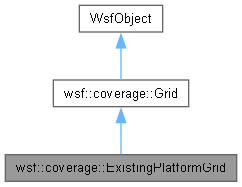
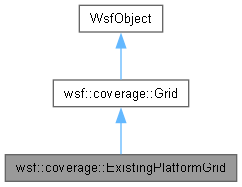
This is a grid specified through a number of existing platforms in the simulation.
Unlike grids that create new platforms to represent the interacting points for the grid, this uses existing platforms. These platforms are not required to be stationary, and they are not required to form some pattern in their locations.
Constructor & Destructor Documentation
◆ ExistingPlatformGrid() [1/2]
|
inlineexplicit |
References cTYPE, wsf::coverage::Grid::Grid(), and WsfObject::SetType().
Referenced by Clone(), and ExistingPlatformGrid().
◆ ExistingPlatformGrid() [2/2]
|
default |
References ExistingPlatformGrid().
◆ ~ExistingPlatformGrid()
|
overridedefault |
Member Function Documentation
◆ Clone()
|
inlineoverridevirtual |
Return a copy of this object. Must be implemented by all derived types. If cloning is impossible, a WsfUncloneableException should be thrown.
Implements wsf::coverage::Grid.
References ExistingPlatformGrid().
◆ CreatesNewPlatforms()
|
inlineoverridevirtual |
Return if the grid creates new platforms during initialization.
A grid should either create new platforms, or use existing platforms. This method returns if this grid creates new platforms. The behavior of some coverage classes will vary depending on the result of this method.
- Returns
- - true if this grid creates new platforms during initialization; false if it uses existing platforms.
Implements wsf::coverage::Grid.
◆ GetAsset() [1/2]
|
overridevirtual |
Return a grid asset for the given platform.
This returns the grid asset associated with the platform that has the given aPlatformName. If there is no such asset, this will return an invalid grid asset.
- Parameters
-
aPlatformName - The name of one of this grid's asset platform.
- Returns
- - The corresponding grid asset if it exists; an invalid grid asset otherwise.
Implements wsf::coverage::Grid.
References wsf::coverage::cINVALID_POINT_ID.
◆ GetAsset() [2/2]
Return a grid asset for the point with the given ID.
This returns the grid asset for the point with the given aPointId. If there is no such point, this will return an invalid grid asset.
- Parameters
-
aPointId - The ID of a point in this grid.
- Returns
- - The corresponding grid asset if it exists; an invalid grid asset otherwise.
Implements wsf::coverage::Grid.
References wsf::coverage::cINVALID_POINT_ID.
◆ GetPoint()
|
overridevirtual |
Return the Point at the given index if it exists.
This will return the Point with the given aPointId if such a point exists. This will return nullptr if this Grid has not been initialized.
- Parameters
-
aPointId - The ID of the point to retrieve.
- Returns
- - The Point if it exists; nullptr otherwise.
Implements wsf::coverage::Grid.
◆ GetSize()
|
inlineoverridevirtual |
Return the number of Points in this Grid.
This will return the number of Points in this Grid. This will return 0 if this Grid has not been initialized.
- Returns
- - The number of Points in this grid.
Implements wsf::coverage::Grid.
◆ HasNullDevice()
|
overridevirtual |
Return if this grid's assets have null devices.
This will determine if this grid has any asset with a null device, and set aAnyNull accordingly. This will also determing if all of this grid's assets have null devices, and set aAllNull accordingly.
- Parameters
-
aAnyNull [out] - Does any asset have a null device. aAllNull [out] - Do all assets have a null device.
Implements wsf::coverage::Grid.
References wsf::coverage::cNULL_COVERAGE_DEVICE_NAME.
◆ InitializeP()
|
overrideprotectedvirtual |
Grid type specific initialization.
Initialization specific to the grid type occurs in this method. In particular, validation on input quantities should occur here. The set of grid points should be defined after this method's successful return, and both GetAsset methods should return valid GridAsset instances for any point in this grid.
- Returns
- true if initialization is successful; false otherwise.
Implements wsf::coverage::Grid.
References WsfObject::GetName(), wsf::coverage::Grid::GetNextAvailableId(), wsf::coverage::Grid::GetScenario(), and ok.
◆ Invoke()
|
overridevirtual |
Invoke the given action on every Point in this Grid.
This method invokes the given action for every Point in this Grid. If this method is used before this Grid is initialized, this method will do nothing.
Implements wsf::coverage::Grid.
References wsf::coverage::GridAction::Call().
◆ IsStructured()
|
inlineoverridevirtual |
Return if the grid is structured.
Structured grids are those grids that have some positional organization of the grid points. Most grids are structured. For an example of an unstructured grid, see the ExistingPlatformGrid. To prevent a subclass from participating in overlay output from a Coverage object, IsStructured should return false.
- Returns
- true if the grid has some structure to its points; false otherwise.
Reimplemented from wsf::coverage::Grid.
◆ PreparePlatforms()
|
overridevirtual |
Prepare the platforms for this grid.
This method will create or modify the platforms associated with this grid object. In particular, this should mark created platforms as private so they are not sent over DIS. This should also set the side of created platforms so they might be easily removed from the visual tools.
- Parameters
-
aSimulation - The simulation in which this grid's platforms will participate.
Implements wsf::coverage::Grid.
References WsfObject::GetName(), and WsfSimulation::GetPlatformByName().
◆ ProcessInput()
|
overridevirtual |
Process input from a generic source.
Examine the current input command. If it is NOT one of the commands recognized by this class then it simply returns 'false'. If it is one of the commands recognized by this class then it processes the command and returns 'true'.
- Parameters
-
aInput a reference to a UtInput object.
- Returns
- 'true' if the command was one recognized by the class or 'false' if not.
- Exceptions
-
UtInput::ExceptionBase (or an object derived from it) if the command was recognized but contains some sort of error.
- Note
- If a derived class does not recognize the command (i.e.: the return value is false) then it should call the base class ProcessInput method. This chain should continue until either the command is recognized or the top-level base class is encountered.
Reimplemented from WsfObject.
References wsf::coverage::Grid::ProcessInput().
Member Data Documentation
◆ cTYPE
|
staticconstexpr |
Referenced by ExistingPlatformGrid(), and wsf::coverage::GridTypes::GridTypes().
The documentation for this class was generated from the following files: