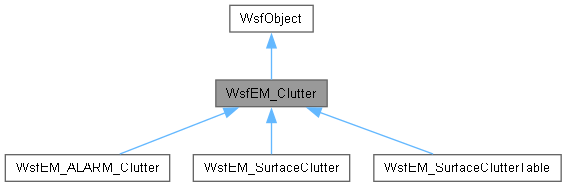
An abstract class for computing clutter power. More...
#include <WsfEM_Clutter.hpp>
Public Member Functions | |
| WsfEM_Clutter () | |
| Constructor. | |
| ~WsfEM_Clutter () override=default | |
| WsfEM_Clutter * | Clone () const override=0 |
| virtual bool | Initialize (WsfEM_Rcvr *aRcvrPtr) |
| bool | ProcessInput (UtInput &aInput) override |
| bool | DebugEnabled () const |
| Is 'debug' enabled? | |
| virtual double | ComputeClutterPower (WsfEM_Interaction &aInteraction, WsfEnvironment &aEnvironment, double aProcessingFactor)=0 |
| virtual bool | IsNullModel () const |
| Public Member Functions inherited from WsfObject | |
| WsfObject () | |
| This is the constructor for the WsfObject class. | |
| ~WsfObject () override | |
| This is the destructor for the WsfObject class. | |
| const char * | GetScriptClassName () const override |
| const std::string & | GetType () const |
| WsfStringId | GetTypeId () const |
| Get the string ID of the 'type' of the object. | |
| void | SetType (WsfStringId aType) |
| const std::string & | GetBaseType () const |
| WsfStringId | GetBaseTypeId () const |
| const TypeList & | GetTypeList () const |
| bool | IsA_TypeOf (WsfStringId aType) const |
| WsfObject & | operator= (const WsfObject &aRhs) |
| Assignment operator. | |
| template<typename T> | |
| void | Serialize (T &aBuff) |
| For XIO (de)serialization. | |
| const std::string & | GetName () const |
| WsfStringId | GetNameId () const |
| void | SetName (WsfStringId aName) |
Protected Member Functions | |
| WsfEM_Clutter (const WsfEM_Clutter &aSrc) | |
| Copy constructor. | |
| WsfEM_Clutter & | operator= (const WsfEM_Clutter &aRhs) |
| WsfObject (const WsfObject &aSrc) | |
| Copy constructor (for Clone()). | |
Additional Inherited Members | |
| Public Types inherited from WsfObject | |
| typedef std::vector< WsfStringId > | TypeList |
| The list of types returned by GetTypeList. | |
Detailed Description
An abstract class for computing clutter power.
Constructor & Destructor Documentation
◆ WsfEM_Clutter() [1/2]
| WsfEM_Clutter::WsfEM_Clutter | ( | ) |
Constructor.
References WsfObject::WsfObject().
Referenced by WsfEM_ALARM_Clutter::Clone(), Clone(), WsfEM_SurfaceClutter::Clone(), WsfEM_SurfaceClutterTable::Clone(), WsfEM_ALARM_Clutter::ObjectFactory(), WsfEM_SurfaceClutter::ObjectFactory(), WsfEM_SurfaceClutterTable::ObjectFactory(), operator=(), WsfEM_ALARM_Clutter::WsfEM_ALARM_Clutter(), WsfEM_ALARM_Clutter::WsfEM_ALARM_Clutter(), WsfEM_Clutter(), WsfEM_SurfaceClutter::WsfEM_SurfaceClutter(), WsfEM_SurfaceClutterTable::WsfEM_SurfaceClutterTable(), WsfEM_SurfaceClutterTable::WsfEM_SurfaceClutterTable(), WsfEM_ALARM_Clutter::~WsfEM_ALARM_Clutter(), and WsfEM_SurfaceClutter::~WsfEM_SurfaceClutter().
◆ ~WsfEM_Clutter()
|
overridedefault |
◆ WsfEM_Clutter() [2/2]
|
protected |
Copy constructor.
References WsfEM_Clutter(), and WsfObject::WsfObject().
Member Function Documentation
◆ Clone()
|
overridepure virtual |
Return a copy of this object. Must be implemented by all derived types. If cloning is impossible, a WsfUncloneableException should be thrown.
Implements WsfObject.
Implemented in WsfEM_ALARM_Clutter, WsfEM_SurfaceClutter, and WsfEM_SurfaceClutterTable.
References Initialize(), and WsfEM_Clutter().
◆ ComputeClutterPower()
|
pure virtual |
Compute the clutter power for an interaction.
- Parameters
-
aInteraction The current interaction. aEnvironment The environment (sea state, land formation, land coverage). aProcessingFactor The factor to be applied to the raw computed clutter power to produce the clutter power as seen by the radar AFTER is has performed clutter suppression. This value (in the range [0..1] represents the ability for the radar to attenuate (suppress) clutter returns. A value of zero indicates the clutter signal is completely attenuated while a value of one indicates that none of the clutter signal could be suppressed.
For the non-table models, the computed clutter power will be multiplied by this value to produce the return value. For table models the factor has probably already been included in the table and the value will probably be ignored.
- Returns
- The clutter power (watts).
Implemented in WsfEM_ALARM_Clutter, WsfEM_SurfaceClutter, and WsfEM_SurfaceClutterTable.
◆ DebugEnabled()
|
inline |
Is 'debug' enabled?
Referenced by WsfEM_SurfaceClutterTable::ComputeClutterPower().
◆ Initialize()
|
virtual |
Initialize the clutter object.
- Parameters
-
aRcvrPtr The receiver to which the clutter object is attached.
Reimplemented in WsfEM_ALARM_Clutter, and WsfEM_SurfaceClutter.
Referenced by Clone(), and WsfEM_ALARM_Clutter::Initialize().
◆ IsNullModel()
|
inlinevirtual |
Is the object a 'null' (no-effect) clutter model? No operational model needs to worry about this method.
- Note
- See the code in WsfEM_ClutterTypes as to why this is present.
◆ operator=()
|
protected |
References WsfObject::operator=(), and WsfEM_Clutter().
Referenced by WsfEM_SurfaceClutterTable::operator=().
◆ ProcessInput()
|
overridevirtual |
Process input from a generic source.
Examine the current input command. If it is NOT one of the commands recognized by this class then it simply returns 'false'. If it is one of the commands recognized by this class then it processes the command and returns 'true'.
- Parameters
-
aInput a reference to a UtInput object.
- Returns
- 'true' if the command was one recognized by the class or 'false' if not.
- Exceptions
-
UtInput::ExceptionBase (or an object derived from it) if the command was recognized but contains some sort of error.
- Note
- If a derived class does not recognize the command (i.e.: the return value is false) then it should call the base class ProcessInput method. This chain should continue until either the command is recognized or the top-level base class is encountered.
Reimplemented from WsfObject.
Reimplemented in WsfEM_SurfaceClutter, and WsfEM_SurfaceClutterTable.
References WsfObject::ProcessInput().
Referenced by WsfEM_ALARM_Clutter::ProcessInput(), WsfEM_SurfaceClutter::ProcessInput(), and WsfEM_SurfaceClutterTable::ProcessInput().
The documentation for this class was generated from the following files: