#include <WsfStandardApplication.hpp>
Classes | |
| class | InvalidCommandLineArgument |
| An exception that is thrown when a command line argument cannot be parsed. More... | |
| class | InputProcessingFailure |
| An exception that is thrown when a command line argument cannot be parsed. More... | |
| struct | SimulationResult |
| The result of simulation execution. More... | |
| struct | Options |
| Application options; Command line or otherwise. More... | |
Public Types | |
| enum | SimType { cEVENT_STEPPED , cFRAME_STEPPED , cREAL_TIME } |
| The simulation type requested from the command line. More... | |
| enum | RunMode { cRUN_SCENARIO , cLIST_VARIABLES , cSHOW_USAGE , cWRITE_GRAMMAR } |
| The type of run from the command line. More... | |
| Public Types inherited from WsfApplication | |
| using | PluginPaths = std::list<std::string> |
Public Member Functions | |
| WsfStandardApplication (const std::string &aApplicationName, int argc, char *argv[], const PluginPaths &aPluginPaths=PluginPaths()) | |
| ~WsfStandardApplication () override=default | |
| void | ShowUsage () |
| Displays the application command-line usage. | |
| void | ProcessCommandLine (Options &aOptions) |
| void | ProcessCommandLine (Options &aOptions, int argc, char *argv[]) |
| void | ProcessCommandLineCommands (WsfScenario &aScenario, const Options &aOptions) |
| void | ProcessInputFiles (WsfScenario &aScenario, const std::vector< std::string > &aFileList) |
| virtual std::unique_ptr< WsfSimulation > | CreateSimulation (WsfScenario &aScenario, SimType aSimulationType, unsigned int aRunNumber) |
| virtual std::unique_ptr< WsfSimulation > | CreateSimulation (WsfScenario &aScenario, const Options &aOptions, unsigned int aRunNumber) |
| bool | InitializeSimulation (WsfSimulation *aSimPtr) |
| SimulationResult | RunEventLoop (WsfSimulation *aSimPtr, Options aOptions) |
| Public Member Functions inherited from WsfApplication | |
| WsfApplication (const std::string &aApplicationName, int aArgc, char *aArgv[], const PluginPaths &aPluginPaths=PluginPaths()) | |
| virtual | ~WsfApplication () |
| const std::string & | GetApplicationName () const |
| Return the name of the application. | |
| bool | IsTestingEnabled () const |
| Returns 'true' if application is executing under the control of an automated test executive. | |
| void | GetCommandLineArguments (int &aArgc, char **&aArgv) |
| void | RemoveCommandLineOptions (int aArgc, int aArgCount) |
| void | RegisterExtension (const std::string &aName, std::unique_ptr< WsfApplicationExtension > aExtensionPtr) |
| void | ExtensionDepends (const std::string &aExtensionName, const std::string &aDependsOnExtensionName, bool aRequired) |
| bool | ExtensionIsRegistered (const std::string &aName) const |
| WsfApplicationExtension * | FindExtension (const std::string &aName) const |
| WsfApplicationExtension & | GetExtension (const std::string &aName) const |
| const WsfExtensionList & | GetExtensions () const |
| Returns all extension dependencies, added by ExtensionDepends(). | |
| void | RegisterFeature (const std::string &aFeature, const std::string &aProjectName=std::string()) |
| const std::vector< Feature > & | GetRegisteredFeatures () |
| Returns a list of registered features. | |
| UtScriptTypes * | GetScriptTypes () const |
| Return a pointer to the script types/classes. | |
| WsfSystemLog & | GetSystemLog () |
| Return a reference to the system log. | |
Protected Member Functions | |
| virtual std::string | GetUsageString () const |
| void | UpdateOptionsP (Options &aOptions, WsfSimulation *aSimPtr) |
Protected Attributes | |
| log_server::LogSubscriber | mLogServer |
| Log Server members. | |
| std::string | mLogServerHost = "localhost" |
| int | mLogServerPort = 18888 |
| bool | mShouldConnectToLogServer = false |
Detailed Description
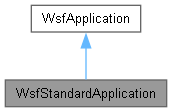
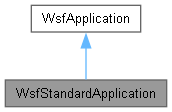
An implementation of WsfApplication that provides features common to 'standard' application.
Many (but not all) WSF applications perform a fairly common set of operations. This function of this class is to provide those features.
An application that does not wish this standard behavior can simply use WsfApplication.
Member Enumeration Documentation
◆ RunMode
◆ SimType
Constructor & Destructor Documentation
◆ WsfStandardApplication()
| WsfStandardApplication::WsfStandardApplication | ( | const std::string & | aApplicationName, |
| int | aArgc, | ||
| char * | aArgv[], | ||
| const PluginPaths & | aPluginPaths = PluginPaths() ) |
Constructor
- Parameters
-
aApplicationName The name of the application. aArgc The number of arguments. This is typically the 'argc' argument from 'main()'. aArgv The argument list. This is typically the 'argv' argument from 'main()'. aPluginPaths Optional list of paths (relative to executable) to load plugins from.
References mLogServer, and WsfApplication::WsfApplication().
◆ ~WsfStandardApplication()
|
overridedefault |
Member Function Documentation
◆ CreateSimulation() [1/2]
|
virtual |
Creates a simulation given an Options object.
- Parameters
-
aScenario The scenario to be executed. aOptions A reference to the Options object. aRunNumber The Monte-Carlo iteration number.
- Returns
- A pointer to the created simulation.
References CreateSimulation(), WsfStandardApplication::Options::mSimType, and WsfApplication::WsfScenario.
◆ CreateSimulation() [2/2]
|
virtual |
Create the specified simulation type.
- Parameters
-
aScenario The scenario to be executed. aSimulationType The type of simulation object to be created. aRunNumber The Monte-Carlo iteration number.
- Returns
- A pointer to the created simulation.
References cFRAME_STEPPED, cREAL_TIME, and WsfApplication::WsfScenario.
Referenced by CreateSimulation(), main(), and ~WsfStandardApplication().
◆ GetUsageString()
|
protectedvirtual |
References WsfApplication::GetApplicationName().
Referenced by ShowUsage().
◆ InitializeSimulation()
| bool WsfStandardApplication::InitializeSimulation | ( | WsfSimulation * | aSimPtr | ) |
Initialize a simulation.
- Parameters
-
aSimPtr Pointer to the simulation.
- Returns
- true if successful, false if a failure occurred.
References WsfSimulation::cPENDING_INITIALIZE, WsfScenario::GetClassificationString(), WsfScenario::GetFinalRunNumber(), WsfSimulation::GetRunNumber(), WsfSimulation::GetScenario(), WsfSimulation::GetState(), WsfSimulation::Initialize(), and profiling::TimedRegion::REGION.
Referenced by main(), and ~WsfStandardApplication().
◆ ProcessCommandLine() [1/2]
| void WsfStandardApplication::ProcessCommandLine | ( | Options & | aOptions | ) |
Process the command line inputs Returns 'true' if the application should continue
References WsfApplication::GetCommandLineArguments(), and ProcessCommandLine().
Referenced by main(), ProcessCommandLine(), weapon_tools(), and ~WsfStandardApplication().
◆ ProcessCommandLine() [2/2]
| void WsfStandardApplication::ProcessCommandLine | ( | Options & | aOptions, |
| int | argc, | ||
| char * | argv[] ) |
Process the command line arguments. Returns 'true' if the application should continue
References cEVENT_STEPPED, cFRAME_STEPPED, cLIST_VARIABLES, cREAL_TIME, cSHOW_USAGE, WsfApplication::FindExtension(), WsfExtensionList::GetExtensionOrder(), WsfApplication::GetExtensions(), WsfStandardApplication::Options::mFlushIO, WsfStandardApplication::Options::mInputFiles, mLogServerHost, mLogServerPort, WsfStandardApplication::Options::mMessageInterval, WsfStandardApplication::Options::mRealtimeMessageInterval, WsfStandardApplication::Options::mRunMode, mShouldConnectToLogServer, WsfStandardApplication::Options::mSimType, WsfApplicationExtension::ProcessCommandLine(), and ShowUsage().
◆ ProcessCommandLineCommands()
| void WsfStandardApplication::ProcessCommandLineCommands | ( | WsfScenario & | aScenario, |
| const Options & | aOptions ) |
Process any commands included in the command line.
- Parameters
-
aScenario The scenario that is being loaded. aOptions The options from the command line.
References cLIST_VARIABLES, cRUN_SCENARIO, cSHOW_USAGE, WsfApplication::FindExtension(), WsfExtensionList::GetExtensionOrder(), WsfApplication::GetExtensions(), WsfScenario::GetInput(), WsfStandardApplication::Options::mRunMode, WsfApplicationExtension::ProcessCommandLineCommands(), ShowUsage(), and WsfApplication::WsfScenario.
Referenced by main(), weapon_tools(), and ~WsfStandardApplication().
◆ ProcessInputFiles()
| void WsfStandardApplication::ProcessInputFiles | ( | WsfScenario & | aScenario, |
| const std::vector< std::string > & | aFileList ) |
Load the specified scenario with the input from a list of files.
- Parameters
-
aScenario The scenario to be loaded from the supplied list of input files. aFileList The list of files to be loaded into the scenario.
- Exceptions
-
exception if error is encountered.
References WsfScenario::CompleteLoad(), WsfScenario::HadUnexpectedError(), WsfScenario::LoadFromFile(), and WsfApplication::WsfScenario.
Referenced by main(), weapon_tools(), and ~WsfStandardApplication().
◆ RunEventLoop()
| WsfStandardApplication::SimulationResult WsfStandardApplication::RunEventLoop | ( | WsfSimulation * | aSimPtr, |
| Options | aOptions ) |
Execute the simulation event loop until it is complete or is reset.
- Parameters
-
aSimPtr The pointer to the simulation to execute. aOptions The options derived from the command line (or explicitly by code).
- Returns
- A SimulationRresult object that indicates the result of the simulation.
References WsfSimulation::AdvanceTime(), WsfSimulation::cEND_TIME_REACHED, WsfSimulation::Complete(), WsfSimulation::cPENDING_START, WsfSimulation::cRESET, WsfSimulation::GetCompletionReason(), WsfSimulation::GetCompletionReasonString(), profiling::TimedRegion::GetCpuTime(), WsfSimulation::GetRealTime(), WsfSimulation::GetRunNumber(), WsfSimulation::GetState(), WsfApplication::GetSystemLog(), profiling::TimedRegion::GetWallTime(), WsfSimulation::IsActive(), WsfSimulation::IsRealTime(), WsfStandardApplication::Options::mDeferredConnectionTime, mLogServer, WsfStandardApplication::Options::mMessageInterval, WsfStandardApplication::Options::mRealtimeMessageInterval, WsfStandardApplication::SimulationResult::mResetRequested, simTime, WsfSimulation::Start(), profiling::TimedRegion::StartSubregion(), profiling::TimedRegion::StopSubregion(), profiling::TimedRegion::SUBREGION, UpdateOptionsP(), WsfSimulation::WaitForAdvanceTime(), and WsfSystemLog::WriteLogEntry().
Referenced by main(), and ~WsfStandardApplication().
◆ ShowUsage()
| void WsfStandardApplication::ShowUsage | ( | ) |
Displays the application command-line usage.
References WsfApplication::FindExtension(), WsfExtensionList::GetExtensionOrder(), WsfApplication::GetExtensions(), GetUsageString(), and WsfApplicationExtension::PrintCommandLineArguments().
Referenced by ProcessCommandLine(), ProcessCommandLineCommands(), and ~WsfStandardApplication().
◆ UpdateOptionsP()
|
protected |
References WsfSimulation::FindExtension(), WsfExtInterface::GetDeferredConnectionTime(), WsfSimulation::GetSimTime(), WsfSimulation::IsRealTime(), WsfStandardApplication::Options::mDeferredConnectionTime, WsfStandardApplication::Options::mMessageInterval, and WsfSimulation::SetRealtime().
Referenced by RunEventLoop().
Member Data Documentation
◆ mLogServer
|
protected |
Log Server members.
Referenced by RunEventLoop(), and WsfStandardApplication().
◆ mLogServerHost
|
protected |
Referenced by ProcessCommandLine().
◆ mLogServerPort
|
protected |
Referenced by ProcessCommandLine().
◆ mShouldConnectToLogServer
|
protected |
Referenced by ProcessCommandLine().
The documentation for this class was generated from the following files: