#include <ApplicationExtension.hpp>
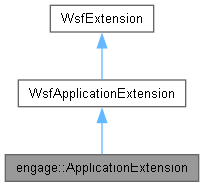
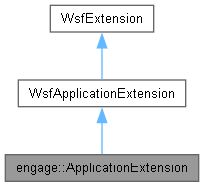
Public Member Functions | |
| ApplicationExtension () | |
| void | ScenarioCreated (WsfScenario &aScenario) override |
| void | SimulationCreated (WsfSimulation &aSimulation) override |
| void | AddedToApplication (WsfApplication &aApplication) override |
| Public Member Functions inherited from WsfApplicationExtension | |
| WsfApplicationExtension () | |
| Constructor. | |
| ~WsfApplicationExtension () override | |
| WsfApplication & | GetApplication () const |
| virtual int | ProcessCommandLine (WsfStandardApplication::Options &aOptions, int aArgc, char *aArgv[]) |
| virtual void | PrintCommandLineArguments () const |
| virtual void | PrintGrammar (std::ostream &aOut) |
| virtual void | ProcessCommandLineCommands () |
| Public Member Functions inherited from WsfExtension | |
| virtual | ~WsfExtension ()=default |
| const std::string & | GetExtensionName () const |
Additional Inherited Members | |
| Protected Member Functions inherited from WsfExtension | |
| void | InitializeExtensionName (const std::string &aName) |
Constructor & Destructor Documentation
◆ ApplicationExtension()
| engage::ApplicationExtension::ApplicationExtension | ( | ) |
Member Function Documentation
◆ AddedToApplication()
|
overridevirtual |
Called in response to WsfApplication::RegisterExtension. This is typically used to register script classes and methods, e.g.:
- Note
- GetApplication() is now valid.
Reimplemented from WsfApplicationExtension.
References engage::ExtendScriptClasses(), WsfApplication::GetScriptTypes(), and WsfApplicationExtension::WsfApplication.
◆ ScenarioCreated()
|
overridevirtual |
Called in response to the creation of a WsfScenario object. This is called at the end of the WsfScenario constructor. A derived class may provide this method to do the following:
-
Register a scenario extension to register new types and access the input stream to interpret commands, e.g.: aScenario.RegisterExtension("my_extension", new MyScenarioExtension);
-
If a scenario extension is not being created, register new type objects or object factories, e.g.: aScenario.GetMoverTypes().AddCoreType("MY_MOVER", new MyMover(aScenario));aScenario.GetAntennaPatternTypes().AddObjectFactor(MyAntennaPattern::ObjectFactory);
- Parameters
-
aScenario The scenario object that is being created.
- See also
- WsfScenarioExtension.
Reimplemented from WsfApplicationExtension.
References WsfScenario::RegisterExtension().
◆ SimulationCreated()
|
overridevirtual |
Called in response to the creation of a WsfSimulation object. This is actually called when the WsfSimulation::Initialize() is called. A derived class will override this method if it needs to concern itself the creation of a simulation.
Notes concerning creation of simulation extensions:
-
If an application extension requires a simulation extension but not a scenario extension (probably a rare occurrence), then the simulation extension should be created here, e.g.: aSimulation.RegisterExtension("my_extension", new MySimulationExtension);
- If, however, the application extension requires both a scenario extension (created by WsfApplicationExtension::ScenarioCreated) and a simulation extension, the simulation extension should be created in WsfScenarioExtension::SimulationCreated. This ensures that any dependencies registered by WsfApplication::ExtensionDepends are honored.
- Parameters
-
aSimulation The simulation object that is being created.
- See also
- WsfSimulationExtension.
Reimplemented from WsfApplicationExtension.
The documentation for this class was generated from the following files: