#include <WsfCommNetworkStar.hpp>
Public Member Functions | |
| NetworkStar ()=default | |
| NetworkStar (const std::string &aNetworkName, const Address &aAddress) | |
| ~NetworkStar () override=default | |
| NetworkStar & | operator= (const NetworkStar &aRhs)=default |
| bool | ProcessInput (UtInput &aInput) override |
| NetworkStar * | Clone () const override |
| const char * | GetScriptClassName () const override |
| Public Member Functions inherited from wsf::comm::Network | |
| Network ()=default | |
| ~Network () override=default | |
| Network (const std::string &aNetworkName, const Address &aAddress) | |
| Network (const Network &aSrc)=default | |
| Network & | operator= (const Network &aRhs)=default |
| Network (Network &&aSrc)=default | |
| bool | InitializeLinkage (WsfSimulation &aSimulation) |
| const char * | GetScriptClassName () const override |
| virtual bool | Initialize (WsfSimulation &aSim) |
| bool | AddMember (const Address &aAddress, WsfSimulation &aSimulation, const Address &aOptionalAddress=Address()) |
| bool | RemoveMember (const Address &aAddress, WsfSimulation &aSimulation, const Address &aOptionalAddress=Address()) |
| bool | AddLink (const Address &aSourceAddress, const Address &aDestinationAddress, WsfSimulation &aSimulation, const Address &aOptionalAddress=Address()) |
| bool | RemoveLink (const Address &aSourceAddress, const Address &aDestinationAddress, WsfSimulation &aSimulation, const Address &aOptionalAddress=Address()) |
| void | SetAddress (const Address &aAddress) |
| void | SetIsManaged (bool aManaged) |
| const Address & | GetAddress () const |
| size_t | GetHostsMax () const |
| bool | IsManaged () const |
| const NamedList & | GetNamedMemberList () const |
| bool | HasMember (const Address &aAddress) const |
| Public Member Functions inherited from WsfObject | |
| WsfObject () | |
| This is the constructor for the WsfObject class. | |
| ~WsfObject () override | |
| This is the destructor for the WsfObject class. | |
| const char * | GetScriptClassName () const override |
| const std::string & | GetType () const |
| WsfStringId | GetTypeId () const |
| Get the string ID of the 'type' of the object. | |
| void | SetType (WsfStringId aType) |
| const std::string & | GetBaseType () const |
| WsfStringId | GetBaseTypeId () const |
| const TypeList & | GetTypeList () const |
| bool | IsA_TypeOf (WsfStringId aType) const |
| WsfObject & | operator= (const WsfObject &aRhs) |
| Assignment operator. | |
| template<typename T> | |
| void | Serialize (T &aBuff) |
| For XIO (de)serialization. | |
| const std::string & | GetName () const |
| WsfStringId | GetNameId () const |
| void | SetName (WsfStringId aName) |
Add/Remove Hub Methods | |
These methods are specific to the star topology implementation. They allow setting or removing of the special hub member. A hub may only be added if one does not currently exist, and will result in linkage to all currently defined members. Removing a hub will remove all linkage.
| |
| NamedComm | mHubNamed {} |
| Address | mHubAddress {} |
| virtual bool | AddHub (const Address &aAddress, WsfSimulation &aSimulation) |
| virtual bool | RemoveHub (const Address &aAddress, WsfSimulation &aSimulation) |
| bool | InitializeLinkageP (WsfSimulation &aSimulation) override |
| bool | AddMemberP (const Address &aAddress, WsfSimulation &aSimulation, const Address &aOptionalAddress=Address()) override |
| bool | RemoveMemberP (const Address &aAddress, WsfSimulation &aSimulation, const Address &aOptionalAddress=Address()) override |
Additional Inherited Members | |
| Public Types inherited from wsf::comm::Network | |
| using | AddressList = std::vector<Address> |
| using | AddressLinkList = std::vector<std::pair<Address, Address>> |
| using | NamedList = std::vector<NamedComm> |
| using | NamedLinkList = std::vector<std::pair<NamedComm, NamedComm>> |
| Public Types inherited from WsfObject | |
| typedef std::vector< WsfStringId > | TypeList |
| The list of types returned by GetTypeList. | |
| static Address | GetAddressFromNamedComm (WsfStringId aPlatformName, WsfStringId aCommName, WsfSimulation &aSimulation) |
| virtual bool | AddLinkP (const Address &aSourceAddress, const Address &aDestinationAddress, WsfSimulation &aSimulation, const Address &aOptionalAddress=Address()) |
| virtual bool | RemoveLinkP (const Address &aSourceAddress, const Address &aDestinationAddress, WsfSimulation &aSimulation, const Address &aOptionalAddress=Address()) |
| virtual bool | ProcessAddressListInput (UtInput &aInput) |
| virtual bool | ProcessAddressLinkListInput (UtInput &aInput) |
| virtual bool | ProcessNamedListInput (UtInput &aInput) |
| virtual bool | ProcessNamedLinkListInput (UtInput &aInput) |
| WsfObject (const WsfObject &aSrc) | |
| Copy constructor (for Clone()). | |
| Address | mAddress {} |
| AddressList | mAddressList {} |
| AddressList | mInputAddressList {} |
| AddressLinkList | mAddressLinkList {} |
| AddressLinkList | mInputAddressLinkList {} |
| Same case as "mInputAddressList" above, except with link definitions. | |
| NamedList | mNamedList {} |
| NamedLinkList | mNamedLinkList {} |
| bool | mManaged {false} |
| True if this network is being managed by the simulation. | |
Detailed Description
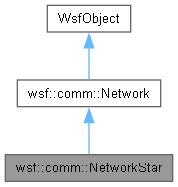
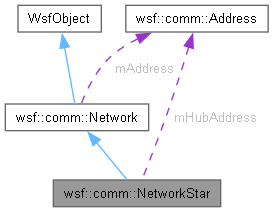
A network implementation, where all comms have bi-directional linkage to a single member.
Constructor & Destructor Documentation
◆ NetworkStar() [1/2]
|
default |
References NetworkStar().
Referenced by Clone(), NetworkStar(), and operator=().
◆ NetworkStar() [2/2]
| wsf::comm::NetworkStar::NetworkStar | ( | const std::string & | aNetworkName, |
| const Address & | aAddress ) |
References wsf::comm::Network::Network().
◆ ~NetworkStar()
|
overridedefault |
Member Function Documentation
◆ AddHub()
|
virtual |
References InitializeLinkageP(), and mHubAddress.
◆ AddMemberP()
|
overrideprotectedvirtual |
Only add links if the hub exists.
Reimplemented from wsf::comm::Network.
References WsfSimulation::GetCommNetworkManager(), WsfSimulation::GetSimTime(), mHubAddress, ok, and simTime.
Referenced by InitializeLinkageP().
◆ Clone()
|
overridevirtual |
Return a copy of this object. Must be implemented by all derived types. If cloning is impossible, a WsfUncloneableException should be thrown.
Reimplemented from wsf::comm::Network.
References NetworkStar().
Referenced by operator=().
◆ GetScriptClassName()
|
inlineoverride |
◆ InitializeLinkageP()
|
overrideprotectedvirtual |
Check for existence of hub, and convert to an address, if necessary.
The user may later set the hub, but for now, we can't initialize any links since we don't have a hub. Warn the user, but continue.
Reimplemented from wsf::comm::Network.
References AddMemberP(), wsf::comm::Network::GetAddressFromNamedComm(), WsfObject::GetType(), wsf::comm::Network::mAddressList, mHubAddress, mHubNamed, and ok.
Referenced by AddHub().
◆ operator=()
|
default |
References Clone(), NetworkStar(), and ProcessInput().
◆ ProcessInput()
|
overridevirtual |
Process input from a generic source.
Examine the current input command. If it is NOT one of the commands recognized by this class then it simply returns 'false'. If it is one of the commands recognized by this class then it processes the command and returns 'true'.
- Parameters
-
aInput a reference to a UtInput object.
- Returns
- 'true' if the command was one recognized by the class or 'false' if not.
- Exceptions
-
UtInput::ExceptionBase (or an object derived from it) if the command was recognized but contains some sort of error.
- Note
- If a derived class does not recognize the command (i.e.: the return value is false) then it should call the base class ProcessInput method. This chain should continue until either the command is recognized or the top-level base class is encountered.
Reimplemented from wsf::comm::Network.
References wsf::comm::Network::mAddress, mHubAddress, mHubNamed, wsf::comm::Network::ProcessAddressListInput(), wsf::comm::Address::ProcessInput(), and wsf::comm::Network::ProcessNamedListInput().
Referenced by operator=().
◆ RemoveHub()
|
virtual |
◆ RemoveMemberP()
|
overrideprotectedvirtual |
If there is not a hub, there are no links to remove.
Reimplemented from wsf::comm::Network.
References WsfSimulation::GetCommNetworkManager(), WsfSimulation::GetSimTime(), mHubAddress, ok, and simTime.
Member Data Documentation
◆ mHubAddress
|
protected |
Referenced by AddHub(), AddMemberP(), InitializeLinkageP(), ProcessInput(), RemoveHub(), and RemoveMemberP().
◆ mHubNamed
|
protected |
Referenced by InitializeLinkageP(), and ProcessInput().
The documentation for this class was generated from the following files: