#include <WsfSimulationInput.hpp>
Public Member Functions | |
| WsfSimulationInput (WsfScenario &aScenario) | |
| virtual | ~WsfSimulationInput () |
| virtual bool | ProcessInput (UtInput &aInput) |
| virtual void | LoadComplete () |
| double | GetMinimumMoverTimestep () const |
| bool | MultiThreaded () const |
| Return whether the simulation should multi-thread were appropriate. | |
| double | GetEndTime () const |
| Get the defined end time of the simulation. | |
| const WsfDateTime & | GetDateTime () const |
| bool | UseConstantRequiredPd () const |
| void | UseConstantRequiredPd (bool aUseConstantRequiredPd) |
Friends | |
| class | WsfSimulation |
Determine the way multiple/alternate frequencies behave in sensors. | |
| enum | ProcessPriority { cPP_BELOW_NORMAL , cPP_NORMAL , cPP_ABOVE_NORMAL , cPP_HIGH , cPP_REALTIME } |
| Process priorities for windows. More... | |
| WsfScenario * | mScenarioPtr |
| bool | mIsRealTime |
| Whether this simulation is running real-time, or a multiple of real-time. | |
| bool | mMultiThreaded |
| Thread behavior. | |
| int | mWallClockTimingMethod |
| Timing method to use for UtWallClock. | |
| double | mMinimumMoverTimestep |
| double | mEndTime |
| The end time of the simulation (seconds). | |
| double | mClockRate |
| The ratio of simulation time to real world time. | |
| WsfDateTime * | mDateTimePtr |
| bool | mUseConstantRequiredPd |
| bool | mRandomizeFrequency |
| Randomization flag for randomizing "frequency" for sensors with alternate frequency inputs in the simulation. | |
| bool | mUseDefaultFrequency |
| Force the use of the "frequency" input (default) for sensor's with alternate frequency inputs in the simulation. | |
| int | mNumberOfThreads |
| double | mBreakUpdateTime |
| bool | mDebugMultiThreading |
| ProcessPriority | mProcessPriority |
| bool | mAllowClutterCalculationShortcuts |
| See documentation for AllowCalculationShortcuts. | |
| bool | mAllowEM_PropagationCalculationShortcuts |
| See documentation for AllowCalculationShortcuts. | |
| bool | RandomizeFrequency () const |
| void | RandomizeFrequency (bool aRandomizeFrequency) |
| bool | UseDefaultFrequency () const |
| void | UseDefaultFrequency (bool aUseDefaultFrequency) |
| void | SetMultiThreaded (bool aMultiThreaded) |
| Return whether the simulation should multi-thread were appropriate. | |
| void | AllowClutterCalculationShortcuts (bool aAllowCalculationShortcuts) |
| bool | AllowClutterCalculationShortcuts () const |
| Return the current status of allowing calculation shortcuts. | |
| void | AllowEM_PropagationCalculationShortcuts (bool aAllowCalculationShortcuts) |
| bool | AllowEM_PropagationCalculationShortcuts () const |
| Return the current status of allowing calculation shortcuts. | |
| WsfScenario * | GetScenario () const |
| void | SetProcessPriority (ProcessPriority aProcessPriority) |
| Set the process priority class for windows. | |
Detailed Description
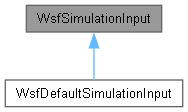
Reads simulation configuration from the input file May be extended by applications to override simulation input commands
Member Enumeration Documentation
◆ ProcessPriority
Constructor & Destructor Documentation
◆ WsfSimulationInput()
| WsfSimulationInput::WsfSimulationInput | ( | WsfScenario & | aScenario | ) |
References cPP_ABOVE_NORMAL, mAllowClutterCalculationShortcuts, mAllowEM_PropagationCalculationShortcuts, mBreakUpdateTime, mClockRate, mDateTimePtr, mDebugMultiThreading, mEndTime, mIsRealTime, mMinimumMoverTimestep, mMultiThreaded, mNumberOfThreads, mProcessPriority, mRandomizeFrequency, mScenarioPtr, mUseConstantRequiredPd, mUseDefaultFrequency, and mWallClockTimingMethod.
Referenced by WsfDefaultSimulationInput::WsfDefaultSimulationInput(), and WsfSimulation.
◆ ~WsfSimulationInput()
|
virtual |
References mDateTimePtr.
Member Function Documentation
◆ AllowClutterCalculationShortcuts() [1/2]
|
inline |
Return the current status of allowing calculation shortcuts.
References mAllowClutterCalculationShortcuts.
◆ AllowClutterCalculationShortcuts() [2/2]
|
inline |
Indicate if calculation shortcuts are allowed.
This is a static method (applicable to ALL instances) which indicates if calculation 'shortcuts' are allowed. If 'true' (the default) a model may employ tests to shorten or bypass calculations. For instance, a model may check the current signal-to-noise and bypass calculation ifWsfSimulation the S/N is already too low.
- Note
- Shortcuts should not be allowed when creating a clutter map.
References mAllowClutterCalculationShortcuts.
Referenced by WsfEM_ALARM_Clutter::ComputeClutterPower().
◆ AllowEM_PropagationCalculationShortcuts() [1/2]
|
inline |
Return the current status of allowing calculation shortcuts.
References mAllowEM_PropagationCalculationShortcuts.
◆ AllowEM_PropagationCalculationShortcuts() [2/2]
|
inline |
Indicate if calculation shortcuts are allowed.
This is a static method (applicable to ALL instances) which indicates if calculation 'shortcuts' are allowed. If 'true' (the default) a model may employ tests to shorten or bypass calculations. For instance, a model may check the current signal-to-noise and bypass calculation if the S/N is already too low.
- Note
- Shortcuts should not be allowed when creating a clutter map.
References mAllowEM_PropagationCalculationShortcuts.
◆ GetDateTime()
|
inline |
References mDateTimePtr.
◆ GetEndTime()
|
inline |
Get the defined end time of the simulation.
References mEndTime.
◆ GetMinimumMoverTimestep()
|
inline |
Return the 'minimum mover timestep'. The minimum mover timestep is the amount of time that must elapse between mover updates on a platform before the update will actually be performed. If the elapsed time is less than this value then the update will be suppressed.
A value of zero (or negative value) effectively allows all updates while a value greater than zero can result in suppressed updates.
The constructor initializes this to a negative value to allow derived classes to detect if a value has been defined in the input file.
References mMinimumMoverTimestep.
◆ GetScenario()
|
inline |
References mScenarioPtr.
◆ LoadComplete()
|
virtual |
Referenced by WsfSimulation.
◆ MultiThreaded()
|
inline |
Return whether the simulation should multi-thread were appropriate.
References mMultiThreaded.
◆ ProcessInput()
|
virtual |
Process simulation input.
- See also
- WsfObject::ProcessInput for more details.
Reimplemented in WsfDefaultSimulationInput.
References cPP_ABOVE_NORMAL, cPP_BELOW_NORMAL, cPP_HIGH, cPP_NORMAL, cPP_REALTIME, mAllowClutterCalculationShortcuts, mAllowEM_PropagationCalculationShortcuts, mBreakUpdateTime, mClockRate, mDateTimePtr, mDebugMultiThreading, mEndTime, mIsRealTime, mMinimumMoverTimestep, mMultiThreaded, mNumberOfThreads, mProcessPriority, mRandomizeFrequency, mUseConstantRequiredPd, mUseDefaultFrequency, and mWallClockTimingMethod.
Referenced by WsfDefaultSimulationInput::ProcessInput(), and WsfSimulation.
◆ RandomizeFrequency() [1/2]
|
inline |
References mRandomizeFrequency.
◆ RandomizeFrequency() [2/2]
| void WsfSimulationInput::RandomizeFrequency | ( | bool | aRandomizeFrequency | ) |
◆ SetMultiThreaded()
|
inline |
Return whether the simulation should multi-thread were appropriate.
References mMultiThreaded.
Referenced by WsfEventStepSimulationInput::ProcessInput().
◆ SetProcessPriority()
|
inline |
Set the process priority class for windows.
References mProcessPriority.
◆ UseConstantRequiredPd() [1/2]
|
inline |
Determine if the 'required Pd for detection' should be static or random.
- See also
- GetRequiredPd for more information.
- Returns
- 'true' then the constant 'required_pd' value from the sensor mode will be used (default of 0.5).
- 'false' (the default value) then the 'required_pd' will be randomly determined for each detection attempt. (Computed as 1.0 - GetSimulation()->GetRandom().Uniform()).
References mUseConstantRequiredPd.
Referenced by WsfSensor::GetRequiredPd().
◆ UseConstantRequiredPd() [2/2]
|
inline |
Set the 'Use Required Pd' value to the desired value.
- See also
- GetRequiredPd for more information.
References mUseConstantRequiredPd.
◆ UseDefaultFrequency() [1/2]
|
inline |
References mUseDefaultFrequency.
Referenced by WsfOTH_RadarSensor::OTH_Beam::Initialize(), and WsfRadarSensor::RadarBeam::Initialize().
◆ UseDefaultFrequency() [2/2]
| void WsfSimulationInput::UseDefaultFrequency | ( | bool | aUseDefaultFrequency | ) |
Friends And Related Symbol Documentation
◆ WsfSimulation
|
friend |
References LoadComplete(), ProcessInput(), WsfSimulation, and WsfSimulationInput().
Referenced by WsfSimulation.
Member Data Documentation
◆ mAllowClutterCalculationShortcuts
|
protected |
See documentation for AllowCalculationShortcuts.
Referenced by AllowClutterCalculationShortcuts(), AllowClutterCalculationShortcuts(), ProcessInput(), and WsfSimulationInput().
◆ mAllowEM_PropagationCalculationShortcuts
|
protected |
See documentation for AllowCalculationShortcuts.
Referenced by AllowEM_PropagationCalculationShortcuts(), AllowEM_PropagationCalculationShortcuts(), ProcessInput(), and WsfSimulationInput().
◆ mBreakUpdateTime
|
protected |
Referenced by ProcessInput(), and WsfSimulationInput().
◆ mClockRate
|
protected |
The ratio of simulation time to real world time.
Referenced by ProcessInput(), and WsfSimulationInput().
◆ mDateTimePtr
|
protected |
Referenced by GetDateTime(), ProcessInput(), WsfSimulationInput(), and ~WsfSimulationInput().
◆ mDebugMultiThreading
|
protected |
Referenced by ProcessInput(), and WsfSimulationInput().
◆ mEndTime
|
protected |
The end time of the simulation (seconds).
Referenced by GetEndTime(), ProcessInput(), and WsfSimulationInput().
◆ mIsRealTime
|
protected |
Whether this simulation is running real-time, or a multiple of real-time.
Referenced by ProcessInput(), and WsfSimulationInput().
◆ mMinimumMoverTimestep
|
protected |
Defines the minimum amount of time that must elapse between updates before a mover update will be allowed.
Referenced by GetMinimumMoverTimestep(), ProcessInput(), and WsfSimulationInput().
◆ mMultiThreaded
|
protected |
Thread behavior.
Referenced by MultiThreaded(), ProcessInput(), SetMultiThreaded(), and WsfSimulationInput().
◆ mNumberOfThreads
|
protected |
Referenced by ProcessInput(), and WsfSimulationInput().
◆ mProcessPriority
|
protected |
Referenced by ProcessInput(), SetProcessPriority(), and WsfSimulationInput().
◆ mRandomizeFrequency
|
protected |
Randomization flag for randomizing "frequency" for sensors with alternate frequency inputs in the simulation.
Referenced by ProcessInput(), RandomizeFrequency(), and WsfSimulationInput().
◆ mScenarioPtr
|
protected |
Referenced by GetScenario(), and WsfSimulationInput().
◆ mUseConstantRequiredPd
|
protected |
'true' if the Pd required for detection should be fixed to the sensor defined value rather than drawn from an uniform distribution.
Referenced by ProcessInput(), UseConstantRequiredPd(), UseConstantRequiredPd(), and WsfSimulationInput().
◆ mUseDefaultFrequency
|
protected |
Force the use of the "frequency" input (default) for sensor's with alternate frequency inputs in the simulation.
Referenced by ProcessInput(), UseDefaultFrequency(), and WsfSimulationInput().
◆ mWallClockTimingMethod
|
protected |
Timing method to use for UtWallClock.
Referenced by ProcessInput(), and WsfSimulationInput().
The documentation for this class was generated from the following files: