#include <WsfSensor.hpp>
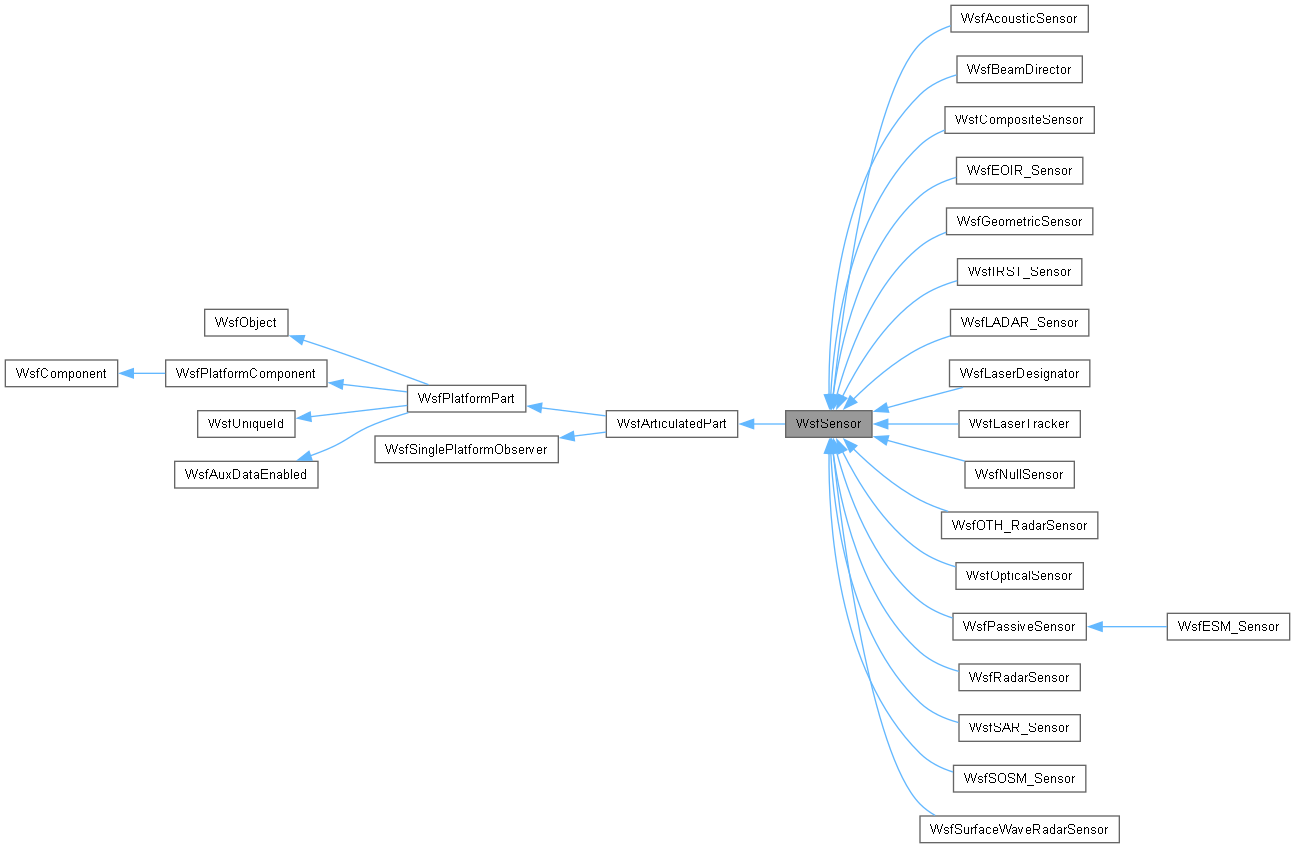
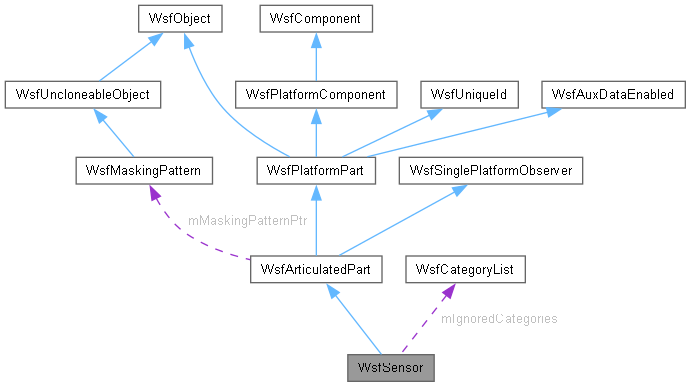
Classes | |
| class | Settings |
| class | ModeChangeEvent |
Public Types | |
| enum | { cACTIVE = 0x00000001 , cSEMI_ACTIVE = 0x00000002 , cPASSIVE = 0x00000004 , cRADIO = 0x00000010 , cINFRARED = 0x00000020 , cVISUAL = 0x00000040 , cACOUSTIC = 0x00000080 , cIMAGING = 0x00001000 } |
| using | Result = WsfSensorResult |
| Public Types inherited from WsfArticulatedPart | |
| enum | SlewMode { cSLEW_FIXED = 0 , cSLEW_AZ = 1 , cSLEW_EL = 2 , cSLEW_AZ_EL = 3 } |
| enum | SlewDirection { cUNDEFINED = 0 , cPOSITIVE = 1 , cNEGATIVE = 2 } |
| enum | { cNOT_CUED = 0x0000 , cMIN_AZ = 0x0001 , cMAX_AZ = 0x0002 , cMIN_EL = 0x0004 , cMAX_EL = 0x0008 , cAT_LIMIT_AZ_MASK = 0x0003 , cAT_LIMIT_EL_MASK = 0x000B , cAT_LIMIT_MASK = 0x000F , cCUED_AZ = 0x0010 , cCUED_EL = 0x0020 , cCUED_AZ_EL = 0x0030 , cCUED_MASK = 0x0030 } |
| enum | CueType { cCUED_TO_NOTHING , cCUED_TO_LOCATION , cCUED_TO_ANGLE } |
| Public Types inherited from WsfPlatformPart | |
| enum | { cLEVEL_ONE_DEBUG = 0x00000001 , cLEVEL_TWO_DEBUG = 0x00000002 } |
| using | InternalMessageQueue = std::queue<WsfMessage*> |
| using | RecipientMessageQueue = std::queue<std::pair<WsfPlatformPart*, WsfMessage*>> |
| Public Types inherited from WsfObject | |
| typedef std::vector< WsfStringId > | TypeList |
| The list of types returned by GetTypeList. | |
| Public Types inherited from WsfComponentT< WsfPlatform > | |
| typedef WsfPlatform | ParentType |
| This is needed to support the WsfComponentList template. | |
Public Member Functions | |
| WsfSensor (const WsfScenario &aScenario) | |
| ~WsfSensor () override | |
| Public Member Functions inherited from WsfArticulatedPart | |
| WsfArticulatedPart (const WsfScenario &aScenario, int aPartType) | |
| WsfArticulatedPart (const WsfArticulatedPart &aSrc) | |
| ~WsfArticulatedPart () override | |
| void | SetPositionRateECS (const double aDX, const double aDY, const double aDZ) |
| void | GetCurrentPositionRateECS (double &aDX, double &aDY, double &aDZ) const |
| double | GetDX () const |
| double | GetDY () const |
| double | GetDZ () const |
| void | EnableArticulationUpdates (double aSimTime, double aInterval) |
| void | DisableArticulationUpdates (double aSimTime) |
| void | SetArticulationUpdateInterval (double aUpdateInterval) |
| double | GetArticulationUpdateInterval () const |
| unsigned int | GetArticulationUpdateEventEpoch () const |
| void | IncrementArticulationUpdateEventEpoch () |
| bool | ArticulationUpdateEventActive () const |
| Is an 'Update' event active? | |
| void | SetArticulationUpdateEventActive (bool aUpdateEventActive) |
| Indicate if the 'Update' event is active. | |
| virtual double | TimeToCue (double aDesiredAz, double aDesiredEl) const |
| const char * | GetScriptClassName () const override |
| void | OnPlatformUpdated (double, WsfPlatform *) override |
| SlewMode | GetSlewMode () const |
| Get the allowed slewing mode. | |
| double | GetAzSlewRate () const |
| Get the current azimuth slew rate. | |
| double | GetElSlewRate () const |
| Get the current elevation slew rate. | |
| double | GetMaxAzSlewRate () const |
| Get the maximum allowable azimuth slew rate. | |
| double | GetMaxElSlewRate () const |
| Get the maximum allowable elevation slew rate. | |
| double | GetMinAzSlew () const |
| Gets the minimum azimuth slew limit. | |
| double | GetMaxAzSlew () const |
| Gets the maximum azimuth slew limit. | |
| double | GetMinElSlew () const |
| Gets the minimum elevation slew limit. | |
| double | GetMaxElSlew () const |
| Gets the maximum elevation slew limit. | |
| int | GetSlewState () const |
| Get the slew limit state. | |
| void | SetSlewMode (SlewMode aSlewMode) |
| Set the allowed slewing mode. | |
| void | SetSlewRates (double aAzSlewRate, double aElSlewRate) |
| Set the angular slew rates, limited by the maximum slew rates. | |
| void | SetAzSlewLimits (double aMinAzSlew, double aMaxAzSlew) |
| Set the azimuth slew limits. | |
| void | SetElSlewLimits (double aMinElSlew, double aMaxElSlew) |
| Set the elevation slew limits. | |
| void | SetAzimuthSlewDirection (SlewDirection aAzSlewDirection) |
| Set the azimuth slew direction. | |
| bool | IsSlewing () const |
| bool | WithinSlewLimits (double aThisToTgtAz, double aThisToTgtEl) const |
| SlewMode | GetCueMode () const |
| Get the allowed cueing mode. | |
| double | GetAzCueRate () const |
| Get the azimuth cue rate. | |
| double | GetElCueRate () const |
| Get the elevation cue rate. | |
| double | GetMinAzCue () const |
| Gets the minimum azimuth cue limit. | |
| double | GetMaxAzCue () const |
| Gets the maximum azimuth cue limit. | |
| double | GetMinElCue () const |
| Gets the minimum elevation cue limit. | |
| double | GetMaxElCue () const |
| Gets the maximum elevation cue limit. | |
| void | SetCueMode (SlewMode aCueMode) |
| Set the allowed cueing mode. | |
| void | SetCueRates (double aAzCueRate, double aElCueRate) |
| Set the angular cueing rates. | |
| void | SetAzCueLimits (double aMinAzCue, double aMaxAzCue) |
| Set the azimuth cueing limits. | |
| void | SetElCueLimits (double aMinElCue, double aMaxElCue) |
| Set the elevation cueing limits. | |
| double | GetRoll () const |
| void | SetRoll (double aRoll) |
| Set the platform-relative (ECS) roll angle of the articulated part. | |
| double | GetPitch () const |
| void | SetPitch (double aPitch) |
| double | GetYaw () const |
| void | SetYaw (double aYaw) |
| Set the platform-relative (ECS) yaw angle of the articulated part. | |
| double | GetTilt () const |
| void | SetTilt (double aTilt) |
| void | GetCurrentOrientationECS (double &aYaw, double &aPitch, double &aRoll) |
| void | GetLOS_UnitVectorWCS (double aUnitLOS_WCS[3]) |
| Get the current WCS Frame Line-Of-Sight unit vector. | |
| CueType | GetCueType () const |
| bool | IsCued () const |
| Get the cued status. | |
| void | ClearCueing () |
| bool | GetActualCuedOrientation (double &aAzimuth, double &aElevation) const |
| void | GetCurrentCuedOrientation (double &aAzimuth, double &aElevation) const |
| bool | GetCuedLocationWCS (double aCuedLocationWCS[3]) const |
| void | SetCuedLocationWCS (const double aCuedLocationWCS[3]) |
| bool | GetCuedOrientation (double &aAzimuth, double &aElevation) const |
| void | SetCuedOrientation (double aAzimuth, double aElevation) |
| void | GetAbsoluteCuedOrientation (double &aAzimuth, double &aElevation, double aBaseNED[3]) |
| void | ClearTransientCue () |
| bool | TransientCueActive () const |
| bool | GetTransientCuedLocationWCS (double aCuedLocationWCS[3]) const |
| void | SetTransientCuedLocationWCS (const double aCuedLocationWCS[3]) |
| WsfStringId | GetMaskingPatternState () const |
| void | SetMaskingPatternState (WsfStringId aMaskingPatternStateId) |
| double | GetMaskingPatternFactor (double aViewAzPCS, double aViewElPCS, const double aViewVecWCS[3]) |
| void | SetIsPrivate (bool aIsPrivate) |
| bool | IsPrivate () const |
| Public Member Functions inherited from WsfPlatformPart | |
| WsfPlatformPart (const WsfScenario &aScenario, int aPartType) | |
| WsfPlatformPart & | operator= (const WsfPlatformPart &aRhs)=delete |
| ~WsfPlatformPart () override | |
| bool | DebugEnabled () const |
| Returns 'true' if debugging is enabled for this instance. | |
| void | SetDebugEnabled (bool aDebugEnabled) |
| unsigned int | GetDebugMask () |
| bool | IsExternallyControlled () const |
| virtual void | SetExternallyControlled (double aSimTime, bool aIsExternallyControlled) |
| int | GetPartType () const |
| const char * | GetScriptClassName () const override |
| WsfSimulation * | GetSimulation () const |
| const WsfScenario & | GetScenario () const |
| WsfStringId | GetComponentName () const override |
| void | ComponentParentChanged (WsfPlatform *aPlatformPtr) override |
| WsfPlatform * | GetPlatform () const |
| double | GetLastStatusChangeTime () const |
| void | SetLastStatusChangeTime (double aSimTime) |
| Allows a system to set the time at which the device was initialized. | |
| bool | CanBeMadeOperational () const |
| Returns an indication that this system can be made operational. | |
| bool | CanBeMadeNonOperational () const |
| Returns an indication that this system can be made non-operational. | |
| bool | CanBeTurnedOn () const |
| Returns an indication that this system can be turned on. | |
| bool | CanBeTurnedOff () const |
| Returns an indication that this system can be turned off. | |
| bool | IsTurnedOn () const |
| bool | InitiallyTurnedOn () const |
| Is the system to be turned 'on' when added to the simulation? | |
| void | SetInitiallyTurnedOn (bool aInitiallyTurnedOn) |
| Sets if the system is turned on when added to the simulation. | |
| virtual void | Restore (double aSimTime) |
| bool | IsOperational () const |
| bool | SetOperational (double aSimTime, bool aMakeOperational) |
| double | GetDamageFactor () const |
| bool | SetDamageFactor (double aSimTime, double aDamageFactor) |
| bool | IsCritical () const |
| void | SetCritical (bool aValue) |
| virtual void | OnPlatformBrokenEvent (double aSimTime) |
| Owning platform has issued a broken event. | |
| bool | IsBroken () const |
| WsfInternalLinks & | GetInternalLinks () |
| Return the internal links for this part. | |
| virtual bool | HasInternalLinks () const |
| Does this platform part have a communication link to other platform parts? | |
| virtual bool | ProcessMessage (double aSimTime, const WsfMessage &aMessage) |
| virtual bool | ReceiveMessage (double aSimTime, const WsfMessage &aMessage) |
| virtual void | SendMessage (double aSimTime, const WsfMessage &aMessage) |
| virtual void | SendMessageTo (double aSimTime, const WsfMessage &aMessage, WsfStringId aRecipientId) |
| void | SendMessageToProcessor (double aSimTime, const WsfMessage &aMessage, WsfStringId aRecipientId) |
| virtual void | SendQueuedMessages (double aSimTime) |
| const WsfCategoryList & | GetCategories () const |
| Get the categories to which this part belongs. | |
| void | AddCategory (WsfStringId aCategoryId) |
| Adds the provided category to the platform part's category list. | |
| bool | IsCategoryMember (WsfStringId aCategoryId) const |
| const WsfGroupList & | GetGroups () const |
| Get the groups to which this platform part belongs. | |
| void | JoinGroup (WsfGroup *aGroupPtr) |
| Join the given group. | |
| void | LeaveGroup (WsfGroup *aGroupPtr) |
| Leave the given group. | |
| bool | IsGroupMember (WsfStringId aGroupId) |
| unsigned int | GetUpdateEventEpoch () const |
| void | IncrementUpdateEventEpoch () |
| bool | UpdateEventActive () const |
| Is an 'Update' event active? | |
| void | SetUpdateEventActive (bool aUpdateEventActive) |
| Indicate if the 'Update' event is active. | |
| Public Member Functions inherited from WsfObject | |
| WsfObject () | |
| This is the constructor for the WsfObject class. | |
| ~WsfObject () override | |
| This is the destructor for the WsfObject class. | |
| const char * | GetScriptClassName () const override |
| const std::string & | GetType () const |
| WsfStringId | GetTypeId () const |
| Get the string ID of the 'type' of the object. | |
| void | SetType (WsfStringId aType) |
| const std::string & | GetBaseType () const |
| WsfStringId | GetBaseTypeId () const |
| const TypeList & | GetTypeList () const |
| bool | IsA_TypeOf (WsfStringId aType) const |
| WsfObject & | operator= (const WsfObject &aRhs) |
| Assignment operator. | |
| template<typename T> | |
| void | Serialize (T &aBuff) |
| For XIO (de)serialization. | |
| const std::string & | GetName () const |
| WsfStringId | GetNameId () const |
| void | SetName (WsfStringId aName) |
| Public Member Functions inherited from WsfComponentT< WsfPlatform > | |
| WsfComponentT () | |
| WsfComponentT (const WsfComponentT &) noexcept | |
| WsfComponentT & | operator= (const WsfComponentT &) noexcept |
| ~WsfComponentT () override=default | |
| ParentType * | GetComponentParent () const |
| void | SetComponentParent (ParentType *aParentPtr) |
| Public Member Functions inherited from WsfComponent | |
| virtual | ~WsfComponent ()=default |
| template<typename T> | |
| bool | QueryInterfaceT (T *&aRolePtr) |
| bool | ComponentHasRole (int aRole) |
| Returns true if the component has the specified role. | |
| Public Member Functions inherited from WsfUniqueId | |
| WsfUniqueId () | |
| Construtor initializes the unique identifier to 0. | |
| WsfUniqueId (const WsfUniqueId &) | |
| Copy constructor initializes the unique identifier to 0. | |
| WsfUniqueId & | operator= (const WsfUniqueId &) |
| unsigned int | GetUniqueId () const |
| Get the unique identifier assigned to this object. | |
| template<typename T> | |
| void | Serialize (T &aBuff) |
| For XIO (de)serialization. | |
| Public Member Functions inherited from WsfAuxDataEnabled | |
| WsfAuxDataEnabled ()=default | |
| WsfAuxDataEnabled (const WsfAuxDataEnabled &aSrc)=default | |
| WsfAuxDataEnabled & | operator= (const WsfAuxDataEnabled &aRhs) |
| WsfAuxDataEnabled (WsfAuxDataEnabled &&)=default | |
| WsfAuxDataEnabled & | operator= (WsfAuxDataEnabled &&)=default |
| virtual | ~WsfAuxDataEnabled () noexcept |
| void | SetAuxData (const WsfAttributeContainer &aAuxData) |
| void | DeleteAuxData () |
| Delete the aux data container from the object. | |
| void | MergeAuxData (const WsfAuxDataEnabled &aSrc) |
| Merge the object's aux data with aux data from an existing object. | |
| void | UpdateAuxData (const WsfAuxDataEnabled &aSrc) |
| Update the object's aux data with aux data from an existing object. | |
| bool | HasAuxData () const |
| Returns true if this object has aux data. | |
| bool | ProcessInput (UtInput &aInput) |
| template<typename T> | |
| void | Serialize (T &aBuff) |
| (De)serialization for XIO | |
| WsfAttributeContainer & | GetAuxData () |
| const WsfAttributeContainer & | GetAuxData () const noexcept |
| const WsfAttributeContainer & | GetAuxDataConst () const noexcept |
| Public Member Functions inherited from WsfSinglePlatformObserver | |
| virtual | ~WsfSinglePlatformObserver () |
| virtual void | OnPlatformDeleting (double aSimTime, WsfPlatform *aPlatformPtr) |
| Called before the platform is actually deleted. | |
| virtual void | OnPlatformDeleted (double aSimTime, WsfPlatform *aPlatformPtr) |
| Called just before the platform is removed from the simulation. | |
Component list support. | |
A processor contains a list of components. | |
| using | ComponentList = WsfComponentListT<WsfSensorComponent> |
| ComponentList & | GetComponents () |
| const ComponentList & | GetComponents () const |
Methods for simulation control of the update interval. | |
| |
| bool | mThreadSafe |
| std::unique_ptr< WsfSensorModeList > | mModeListPtr |
| std::unique_ptr< WsfSensorScheduler > | mSchedulerPtr |
| std::unique_ptr< WsfSensorTracker > | mTrackerPtr |
| double | mNextUpdateTime |
| The time when the next call to Update() SHOULD occur. | |
| int | mMessageLength |
| The logical length (in bits) of report messages that originate from this sensor. | |
| int | mMessagePriority |
| The priority of report messages that originate from this sensor. | |
| WsfStringId | mZoneAttenuationModifier |
| If non-zero, the name of ID of the category to be used for zone-based attenuation. | |
| WsfCategoryList | mIgnoredCategories |
| Categories which this sensor should ignore. | |
| std::vector< WsfStringId > | mIgnoredSides |
| The sides (teams) which this sensor should ignore. | |
| unsigned int | mIgnoredDomains |
| A bit mask of ignored domains. | |
| bool | mIgnoreSameSide |
| 'true' if the sensor should not detect platforms on the same side. | |
| void | SetUpdateInterval (double aUpdateInterval) override |
| unsigned int | GetUpdateEventEpoch () const |
| void | IncrementUpdateEventEpoch () |
| bool | UpdateEventActive () const |
| Is an 'Update' event active? | |
| void | SetUpdateEventActive (bool aUpdateEventActive) |
| Indicate if the 'Update' event is active. | |
| void | AdjustNextUpdateTime (double aNextUpdateTime) |
| double | GetNextUpdateTime () const |
| void | SetNextUpdateTime (double aSimTime, double aNextUpdateTime) |
| void | GetMessageParameters (int &aMessageLength, int &aMessagePriority) const |
| Get the base level message parameters (may get overridden by the mode). | |
| WsfStringId | GetZoneAttenuationModifier () const |
| Get the zone attenuation modifier. | |
| bool | SendDis () |
| Return mSendDis flag. | |
| ut::Random & | GetRandom () |
| Get the sensor's random number generator. | |
| virtual bool | GetFilteredDoppler () const |
| bool | ScriptAllowDetection (double aSimTime, WsfPlatform *aTargetPtr, WsfSensorResult &aResult) |
| If a script exists, allows it to impose further constraints on a sensor detection. | |
| WsfSensor (const WsfSensor &aSrc) | |
| Copy constructor (for Clone()). | |
| WsfSensor & | operator= (const WsfSensor &aSrc)=delete |
| void | SetClass (int aClass) |
| Set the 'classification' of the sensor. | |
| void | SetModeList (std::unique_ptr< WsfSensorModeList > aModeListPtr) |
| UtScriptContext * | GetScriptAccessibleContext () const override |
| Return the context from the script. | |
| void | SetPlatform (WsfPlatform *aPlatformPtr) override |
Component infrastructure methods not provided by WsfPlatformPart. | |
| WsfComponent * | CloneComponent () const override |
| const int * | GetComponentRoles () const override |
| void * | QueryInterface (int aRole) override |
| int | GetComponentInitializationOrder () const override |
| bool | AllowDetectionChancesFor (WsfPlatform *aPlatformPtr) |
| void | AddIgnoredCategory (const std::string &aCategory) |
| virtual bool | AttemptToDetect (double aSimTime, WsfPlatform *aTargetPtr, Settings &aSettings, WsfSensorResult &aResult) |
Common infrastructure methods. | |
| const char * | GetScriptClassName () const override |
| WsfSensor * | Clone () const override=0 |
| bool | PreInitialize (double aSimTime) override |
| bool | Initialize (double aSimTime) override |
| bool | Initialize2 (double aSimTime) override |
| void | PlatformAdded (double aSimTime, WsfPlatform *aPlatformPtr) override |
| void | PlatformDeleted (WsfPlatform *aPlatformPtr) override |
| void | PreInput () override |
| bool | ProcessInput (UtInput &aInput) override |
| void | Update (double aSimTime) override |
| void | UpdatePosition (double aSimTime) override |
| virtual void | PerformScheduledDetections (double aSimTime) |
Thread safe methods. | |
| bool | ThreadSafe () const |
| Returns true if the sensor update is thread safe. | |
| void | SetThreadSafe () |
| void | SetNotThreadSafe () |
Calibration data methods. | |
| bool | ShowCalibrationData () const |
| Returns true if the sensor calibration should be output. | |
| void | SetShowCalibrationData (bool aShowCalibrationData) |
Methods to attach, delete and notify to sensor observers. | |
Observers receive notification of sensor updates, detection attempts and deletion. | |
| void | AttachObserver (WsfSingleSensorObserver *aObserverPtr) |
| void | DetachObserver (WsfSingleSensorObserver *aObserverPtr) |
| void | NotifyDeleted () |
| void | NotifyTrackInitiated (double aSimTime, const WsfTrack &aTrack) |
| void | NotifyTrackUpdated (double aSimTime, const WsfTrack &aTrack) |
| void | NotifyTrackDropped (double aSimTime, const WsfTrack &aTrack) |
| void | NotifyTargetUpdated (double aSimTime, WsfPlatform *aTargetPtr, WsfSensorResult &aResult) |
| void | NotifyTurnedOff (double aSimTime) |
| void | NotifyTurnedOn (double aSimTime) |
| virtual void | NotifySensorDetectionAttempted (double aSimTime, WsfPlatform *aTargetPtr, WsfSensorResult &aResult) |
Methods to query the class of a sensor. | |
These methods should be only be used to determine the general way in which a sensor operates. | |
| int | GetClass () const |
| Returns the sensor class information. | |
| bool | IsClassActive () const |
| Is the sensor an 'active' sensor? | |
| bool | IsClassPassive () const |
| Is the sensor a 'passive' sensor? | |
| bool | IsClassSemiActive () const |
| Is the sensor a 'semi-active' sensor. | |
| bool | IsClassAcoustic () const |
| Is this an 'acoustic' sensor? | |
| bool | IsClassInfrared () const |
| Is this an 'infrared' sensor? | |
| bool | IsClassRadio () const |
| Is this a 'radio frequency' sensor? | |
| bool | IsClassVisual () const |
| Is this a 'visual' sensor? | |
| bool | IsClassImaging () const |
| Does this sensor produce an image? | |
Status methods. | |
| void | TurnOff (double aSimTime) override |
| void | TurnOn (double aSimTime) override |
| void | SetNonOperational (double aSimTime) override |
| void | SetOperational (double aSimTime) override |
| void | PartBroken (double aSimTime) override |
| double | GetUpdateInterval () const override |
Transmitter/receiver access methods. | |
These methods support accessing the underlying transmitter and receiver components. | |
| virtual size_t | GetEM_RcvrCount () const |
| virtual WsfEM_Rcvr & | GetEM_Rcvr (size_t aIndex) const |
| virtual size_t | GetEM_RcvrCount (size_t aModeIndex) const |
| virtual WsfEM_Rcvr & | GetEM_Rcvr (size_t aModeIndex, size_t aIndex) const |
| virtual size_t | GetEM_XmtrCount () const |
| virtual WsfEM_Xmtr & | GetEM_Xmtr (size_t aIndex) const |
| virtual size_t | GetEM_XmtrCount (size_t aModeIndex) const |
| virtual WsfEM_Xmtr & | GetEM_Xmtr (size_t aModeIndex, size_t aIndex) const |
Field of view methods. | |
Determines if the platform is within the sensor field of view. | |
| virtual bool | WithinFieldOfView (double aSimTime, WsfPlatform *aPlatformPtr) |
| virtual bool | WithinFieldOfView (double aSimTime, WsfTrack *aTrackPtr) |
Mode selection methods. | |
These methods support the control of a multi-mode sensor.
| |
| virtual WsfStringId | GetCurrentModeName () const |
| Return the string ID of the string associated with the name of the current mode. | |
| virtual WsfSensorMode * | GetCurrentMode () const |
| virtual size_t | GetModeCount () const |
| Get the number of modes associated with the sensor. | |
| virtual WsfSensorMode * | GetModeEntry (size_t aModeIndex) const |
| virtual size_t | GetModeIndex (WsfStringId aModeNameId) const |
| virtual WsfStringId | GetModeName (size_t aModeIndex) const |
| virtual void | DeselectMode (double aSimTime, WsfStringId aModeNameId) |
| virtual void | SelectMode (double aSimTime, WsfStringId aModeNameId) |
| virtual void | ScheduleModeChange (double aSimTime, bool aSelectModeFlag, WsfStringId aModeNameId) |
| virtual bool | IsModeChangeScheduled () const |
| virtual double | GetModeSelectDelay () const |
| WsfSensorModeList * | GetModeList () const |
Track request methods | |
These methods support the control of a cued sensor. | |
| virtual int | GetActiveRequestCount () const |
| Get the number of requests being maintained in all modes. | |
| virtual int | GetActiveRequestCount (WsfStringId aModeNameId) const |
| virtual int | GetMaximumRequestCount () const |
| virtual int | GetMaximumRequestCount (WsfStringId aModeNameId) const |
| virtual bool | HaveRequestFor (const WsfTrackId &aTrackId) const |
| Has a tracking request for the specified track ID been submitted. | |
| virtual bool | StartTracking (double aSimTime, const WsfTrack &aTrack, WsfStringId aModeNameId) |
| virtual bool | StopTracking (double aSimTime, const WsfTrackId &aRequestId) |
| Indicate the sensor should no longer track the specified track. | |
Track status notification methods. | |
These methods are called from sensor components to inform the simulation about the change in status of a track. | |
| virtual int | GetActiveTrackCount () const |
| Return the number of active tracks the sensor is maintaining. | |
| virtual void | GetActiveTrackList (WsfTrackList &aActiveTrackList) const |
| Return the active tracks the sensor is maintaining. | |
| virtual int | GetMaximumTrackCount () const |
| Return the maximum number of tracks the sensor can maintain. | |
| virtual void | SendTrackCoastMessage (double aSimTime, const WsfTrack *aTrackPtr) |
| virtual void | SendTrackDropMessage (double aSimTime, const WsfTrack *aTrackPtr) |
| virtual void | SendTrackUpdateMessage (double aSimTime, const WsfTrack *aTrackPtr) |
| virtual void | SetMessageParameters (WsfStringId aModeNameId, WsfMessage &aMessage) |
| virtual void | TrackCoasted (double aSimTime, WsfTrack *aTrackPtr) |
| virtual void | TrackDropped (double aSimTime, WsfTrack *aTrackPtr) |
| virtual void | TrackUpdated (double aSimTime, WsfTrack *aTrackPtr) |
Slave status methods. | |
A 'slave sensor' is one whose detection opportunities are controlled by some other sensor that is defined to be the 'master'. The Update() method of a slave sensor will never be called by the simulation. | |
| bool | IsSlave () const |
| Get the current 'slave' status of a sensor. | |
| void | SetIsSlave (double aSimTime, bool aIsSlave) |
Sensor scheduler and tracker maintenance. | |
The 'scheduler' is responsible for determining when detection chances are to be performed to be performed against targets. The 'tracker' takes the detection results and creates tracks. | |
| WsfSensorScheduler * | GetScheduler () const |
| void | SetScheduler (std::unique_ptr< WsfSensorScheduler > aSchedulerPtr) |
| std::unique_ptr< WsfSensorScheduler > | SwapScheduler (std::unique_ptr< WsfSensorScheduler > aSchedulerPtr) |
| WsfSensorTracker * | GetTracker () const |
| void | SetTracker (std::unique_ptr< WsfSensorTracker > aTrackerPtr) |
| std::unique_ptr< WsfSensorTracker > | SwapTracker (std::unique_ptr< WsfSensorTracker > aTrackerPtr) |
Determine the 'required Pd for detection' for a detection event. | |
| static double | GetRequiredPd (const WsfSensorMode *aModePtr) |
Additional Inherited Members | |
| UtCallbackListN< void(double)> | SlewComplete |
| Static Public Attributes inherited from WsfArticulatedPart | |
| static constexpr double | cINFINITE_SLEW_RATE = 1.0E+12 * UtMath::cRAD_PER_DEG |
| static constexpr double | cALMOST_FULL_CIRCLE = 359.999 * UtMath::cRAD_PER_DEG |
| Static Public Attributes inherited from WsfAuxDataEnabled | |
| static UtCallbackListN< void(const WsfAuxDataEnabled *)> | AuxDataAccessed |
| static UtCallbackListN< void(const WsfAuxDataEnabled *)> | AuxDataDestroyed |
| bool | FullCircle () const |
| virtual double | GetAzimuthRotationRate () const |
| virtual double | GetElevationRotationRate () const |
| void | SlewToOrientation (double aSimTime, double aDesiredAz, double aDesiredEl) |
| virtual void | TimeToRotate (double &aDeltaAz, double &aDeltaEl, double &aAzRate, double &aElRate, double &aTimeToAz, double &aTimeToEl) const |
| void | UpdateCuedOrientation (double aSimTime) |
| bool | UpdateOrientation (double aSimTime) |
| WsfPlatformPart (const WsfPlatformPart &aSrc) | |
| Copy constructor (for Clone()). | |
| WsfObject (const WsfObject &aSrc) | |
| Copy constructor (for Clone()). | |
| Protected Member Functions inherited from WsfUniqueId | |
| void | AssignUniqueId (WsfSimulation *aSimulationPtr) |
| WsfMaskingPattern * | mMaskingPatternPtr |
| The masking factor. | |
| WsfStringId | mMaskingPatternName |
| WsfStringId | mMaskingPatternStateId |
| double | mYaw |
| The orientation of the device coordinate system. | |
| double | mPitch |
| double | mRoll |
| double | mDX |
| The velocity of the part. | |
| double | mDY |
| double | mDZ |
| double | mTilt |
| The tilt angle above below the scan plane. | |
| double | mAzSlewRate |
| The slewing rates and limits of the device with respect to the device coordinate system. | |
| double | mElSlewRate |
| double | mMaxAzSlewRate |
| double | mMaxElSlewRate |
| double | mMinAzSlew |
| double | mMaxAzSlew |
| double | mMinElSlew |
| double | mMaxElSlew |
| SlewMode | mSlewMode |
| SlewDirection | mAzSlewDirection |
| int | mSlewState |
| double | mAzCueRate |
| The cueing rates and limits of the device with respect to the device coordinate system. | |
| double | mElCueRate |
| double | mMinAzCue |
| double | mMaxAzCue |
| double | mMinElCue |
| double | mMaxElCue |
| SlewMode | mCueMode |
| The directions (az and/or el) in which cueing can be performed. | |
| CueType | mCueType |
| bool | mTransientCueActive |
| 'true' if the transient cue is defined | |
| double | mCuedLocationWCS [3] |
| The cued location if mCueType is cCUED_TO_LOCATION. | |
| double | mCuedAz |
| The cued azimuth if mCueType == cCUED_TO_ANGLE. | |
| double | mCuedEl |
| The cued elevation if mCueType == cCUED_TO_ANGLE. | |
| double | mTransientCuedLocationWCS [3] |
| The transient cue, if mTransientCueActive is true. | |
| double | mActualCuedAz |
| The actual cued location, subject to the slewing limits. | |
| double | mActualCuedEl |
| double | mCurrentAz |
| double | mCurrentEl |
| double | mLastAzElUpdateTime |
| The time when the current az/el were last updated. | |
| double | mLastUpdateTime |
| The time when the x/y/z position was last updated. | |
| bool | mSlewMethodCoordinated |
| 'true' if slcue rates are dynamically adjusted so the target angles are reached simultaneously. | |
| bool | mIsSlewing |
| 'true' if the part is slewing to satisfy a cueing request. | |
| bool | mIsPrivate |
| 'true' if the part is considered 'private' and not to visible to external simulations. | |
Detailed Description
A base class for all types of sensing systems. A sensor acts as the 'sensory organs' (eyes, ears, etc.) of a platform.
A sensor is considered to be a collection of 'modes', where each mode is defined to be a particular set of operating characteristics. A sensor is implemented by:
- Creating a subclass of WsfSensor. This is generally a very simple class that populates a few base class members.
- Creating a subclass of WsfSensorMode. This is generally where everything happens. Here one creates the WsfSensorMode::AttemptsToDetect method that performs the actual detection chances.
Note that ALL sensors are inherently 'multi-mode' even if they only support one mode. WsfSensorModeList provides all of the basic support for defining modes from the input stream and selecting and deselecting modes at run time.
In addition, there are a a couple of support classes.
- WsfSensorScheduler which controls how detection chances are scheduled. WsfDefaultSensorScheduler provides an implementation for that is applicable for most all scanning and tracking sensors.
- WsfSensorTracker which controls the initiating, updating and deleting tracks based on the results of sensor detection attempts. WsfDefaultSensorTracker provides an implementation that is usable for most scanning and tracking sensors.
The use of a scheduler and tracker are not required. For instance, an imaging sensor looks at everything at once during the detection cycle and produces an image instead of a track.
The common detection mechanism is implemented by the abstract virtual method WsfSensorMode::AttemptToDetect. Every sensor mode implementation must provide this method and it should be implemented using the following pattern:
a) Ensure the target is marked as 'concealed'. b) Ensure the target is in range. c) Ensure the target is not masked by the horizon. d) Ensure the target is in the field of view. e) Compute the probability of detection (sensor specific). f) If detectable then ensure the target is not masked by the terrain.
Note that the above pattern performs the simplest (least computationally expensive) operations first. Subsequent steps should be bypassed if an operation fails. Note that terrain masking is performed last as it is the most computationally intensive.
- See also
- WsfSensorMode
- WsfSensorScheduler
- WsfSensorTracker
- WsfDefaultSensorScheduler
- WsfDefaultSensorTracker
- WsfSebsirModeList
Member Typedef Documentation
◆ ComponentList
◆ Result
| using WsfSensor::Result = WsfSensorResult |
'Result' used to be a nested class but it needed to be pulled out to support components. A typedef is used here so existing code will continue to compile.
Member Enumeration Documentation
◆ anonymous enum
| anonymous enum |
An enumeration that defines the general classification of a sensor. Sensors are often classified by the spectrum in which they operate and if they are 'active' or 'passive'. It is the responsibility of the sensor constructor to define this field.
The 'classification' of a sensor may be tested using the 'IsClass' methods.
Constructor & Destructor Documentation
◆ WsfSensor() [1/2]
| WsfSensor::WsfSensor | ( | const WsfScenario & | aScenario | ) |
References mIgnoredCategories, mIgnoredDomains, mIgnoredSides, mIgnoreSameSide, mMessageLength, mMessagePriority, mModeListPtr, mNextUpdateTime, mSchedulerPtr, mThreadSafe, mTrackerPtr, mZoneAttenuationModifier, WsfPlatformPart::SetInitiallyTurnedOn(), WsfArticulatedPart::WsfArticulatedPart(), and WsfSensor().
Referenced by WsfPassiveSensor::PassiveMode::AddInteractor(), WsfCompositeSensor::CompositeMode::AttemptToDetect(), WsfAcousticSensor::Clone(), WsfBeamDirector::Clone(), WsfCompositeSensor::Clone(), WsfEOIR_Sensor::Clone(), WsfESM_Sensor::Clone(), WsfGeometricSensor::Clone(), WsfIRST_Sensor::Clone(), WsfLADAR_Sensor::Clone(), WsfLaserDesignator::Clone(), WsfLaserTracker::Clone(), WsfNullSensor::Clone(), WsfOpticalSensor::Clone(), WsfOTH_RadarSensor::Clone(), WsfPassiveSensor::Clone(), WsfRadarSensor::Clone(), WsfSAR_Sensor::Clone(), Clone(), WsfSOSM_Sensor::Clone(), WsfSurfaceWaveRadarSensor::Clone(), WsfCompositeSensor::CompositeMode::Deselect(), GetRequiredPd(), WsfCompositeSensor::GetSensorIndex(), WsfCompositeSensor::Initialize(), WsfCompositeSensor::IsA_ConstituentSensor(), WsfSensor::ModeChangeEvent::ModeChangeEvent(), WsfCompositeSensor::operator=(), WsfEOIR_Sensor::operator=(), WsfIRST_Sensor::operator=(), WsfLADAR_Sensor::operator=(), WsfLaserDesignator::operator=(), WsfLaserTracker::operator=(), WsfOpticalSensor::operator=(), WsfOTH_RadarSensor::operator=(), WsfRadarSensor::operator=(), operator=(), WsfSOSM_Sensor::operator=(), WsfSurfaceWaveRadarSensor::operator=(), WsfCompositeSensor::ProcessMessage(), WsfCompositeSensor::CompositeMode::Select(), WsfCompositeSensor::SensorDetectionChanged(), WsfCompositeSensor::SensorTurnedOff(), WsfCompositeSensor::UpdateXmtrRcvrLists(), WsfAcousticSensor::WsfAcousticSensor(), WsfAcousticSensor::WsfAcousticSensor(), WsfBeamDirector::WsfBeamDirector(), WsfCompositeSensor::WsfCompositeSensor(), WsfCompositeSensor::WsfCompositeSensor(), WsfEOIR_Sensor::WsfEOIR_Sensor(), WsfEOIR_Sensor::WsfEOIR_Sensor(), WsfGeometricSensor::WsfGeometricSensor(), WsfGeometricSensor::WsfGeometricSensor(), WsfIRST_Sensor::WsfIRST_Sensor(), WsfIRST_Sensor::WsfIRST_Sensor(), WsfLADAR_Sensor::WsfLADAR_Sensor(), WsfLADAR_Sensor::WsfLADAR_Sensor(), WsfLaserDesignator::WsfLaserDesignator(), WsfLaserDesignator::WsfLaserDesignator(), WsfLaserTracker::WsfLaserTracker(), WsfLaserTracker::WsfLaserTracker(), WsfNullSensor::WsfNullSensor(), WsfNullSensor::WsfNullSensor(), WsfOpticalSensor::WsfOpticalSensor(), WsfOpticalSensor::WsfOpticalSensor(), WsfOTH_RadarSensor::WsfOTH_RadarSensor(), WsfOTH_RadarSensor::WsfOTH_RadarSensor(), WsfPassiveSensor::WsfPassiveSensor(), WsfPassiveSensor::WsfPassiveSensor(), WsfRadarSensor::WsfRadarSensor(), WsfRadarSensor::WsfRadarSensor(), WsfSAR_Sensor::WsfSAR_Sensor(), WsfSensor(), WsfSensor(), WsfSOSM_Sensor::WsfSOSM_Sensor(), WsfSOSM_Sensor::WsfSOSM_Sensor(), WsfSurfaceWaveRadarSensor::WsfSurfaceWaveRadarSensor(), WsfSurfaceWaveRadarSensor::WsfSurfaceWaveRadarSensor(), WsfBeamDirector::~WsfBeamDirector(), WsfESM_Sensor::~WsfESM_Sensor(), WsfGeometricSensor::~WsfGeometricSensor(), and WsfPassiveSensor::~WsfPassiveSensor().
◆ ~WsfSensor()
|
override |
References NotifyDeleted().
◆ WsfSensor() [2/2]
|
protected |
Copy constructor (for Clone()).
References if(), mIgnoredCategories, mIgnoredDomains, mIgnoredSides, mIgnoreSameSide, mMessageLength, mMessagePriority, mModeListPtr, mNextUpdateTime, mSchedulerPtr, mThreadSafe, mTrackerPtr, mZoneAttenuationModifier, WsfArticulatedPart::WsfArticulatedPart(), and WsfSensor().
Member Function Documentation
◆ AddIgnoredCategory()
| void WsfSensor::AddIgnoredCategory | ( | const std::string & | aCategory | ) |
Add the given category to those ignored by this sensor.
- Parameters
-
aCategory The category to add to the set of ignored categories.
References mIgnoredCategories.
◆ AdjustNextUpdateTime()
| void WsfSensor::AdjustNextUpdateTime | ( | double | aNextUpdateTime | ) |
Adjust the 'Next Update Time' to account for time losses in the simulation.
This is called by fixed-frame rate simulations when they need to indicate the frame took too long.
References mNextUpdateTime.
◆ AllowDetectionChancesFor()
| bool WsfSensor::AllowDetectionChancesFor | ( | WsfPlatform * | aPlatformPtr | ) |
Should detection chances against the specified target be allowed?
Determine if the specified platform is a member of any category which is to be ignored by this sensor. This is used to eliminate sensing chances that are not of interest. Judicious use of this capability can greatly improve the performance of the simulation.
- Parameters
-
aPlatformPtr Pointer to the target platform.
- Returns
- 'true' if detection chances are allowed. 'false' if the target platform was a member of any category that is ignored by this sensor.
References WsfPlatform::GetCategories(), WsfPlatform::GetSideId(), WsfPlatform::GetSpatialDomain(), WsfPlatform::IsExternalShadow(), mIgnoredCategories, mIgnoredDomains, and mIgnoredSides.
Referenced by WsfEOIR_Sensor::PlatformAdded(), and PlatformAdded().
◆ AttachObserver()
| void WsfSensor::AttachObserver | ( | WsfSingleSensorObserver * | aObserverPtr | ) |
Referenced by wsf::UCI_SensorComponent::Attach(), and WsfCoherentSensorProcessor::SensorAdded().
◆ AttemptToDetect()
|
virtual |
Attempt to detect another platform.
This provides the common interface used to determine if a sensor can detect another platform. The base class implementation simply invokes the mode-specific AttemptsToDetect method for the currently selected mode.
- Parameters
-
aSimTime [input] The current simulation time. aTargetPtr [input] The target to attempt to detect. aSettings [input] A Settings object that indicates the operational settings to be used for the detection attempt. aResult [output] A Result object that contains detailed information about the result detection attempt.
- Returns
- true if the target can be detected. This should be the same as testing ((aResult.mCheckedStatus != 0) && (aResult.mFailedStatus == 0)).
Reimplemented in WsfNullSensor, WsfPassiveSensor, and WsfSAR_Sensor.
References WsfSensorMode::AttemptToDetect(), WsfSensor::Settings::mModeIndex, and WsfSensorMode::UpdateSensorCueingLimits().
Referenced by WsfCompositeSensor::CompositeMode::AttemptToDetect(), WsfLADAR_Sensor::LADAR_Mode::AttemptToDetect(), WsfOTH_RadarSensor::OTH_Beam::AttemptToDetect(), WsfRadarSensor::RadarBeam::AttemptToDetect(), WsfSAR_Sensor::AttemptToDetect(), WsfSurfaceWaveRadarSensor::RadarMode::AttemptToDetect(), WsfOTH_RadarSensor::PerformScheduledDetections(), WsfRadarSensor::PerformScheduledDetections(), PerformScheduledDetections(), and WsfEOIR_Sensor::Update().
◆ Clone()
|
overridepure virtual |
Clone this object.
- Returns
- a pointer to the new object.
Implements WsfObject.
Implemented in WsfAcousticSensor, WsfBeamDirector, WsfCompositeSensor, WsfEOIR_Sensor, WsfESM_Sensor, WsfGeometricSensor, WsfIRST_Sensor, WsfLADAR_Sensor, WsfLaserDesignator, WsfLaserTracker, WsfNullSensor, WsfOpticalSensor, WsfOTH_RadarSensor, WsfPassiveSensor, WsfRadarSensor, WsfSAR_Sensor, WsfSOSM_Sensor, and WsfSurfaceWaveRadarSensor.
References PerformScheduledDetections(), and WsfSensor().
Referenced by WsfExtEmission::AddSensor().
◆ CloneComponent()
|
inlineoverridevirtual |
Clones a component. May return null if component does not support clone.
Implements WsfComponent.
References WsfObject::Clone().
◆ DeselectMode()
|
virtual |
Deselect the sensor mode given the string ID of the name of the desired mode.
- Parameters
-
aSimTime The current simulation time. aModeNameId The string ID of the mode to be deselected.
- Note
- This method does nothing unless a the sensor is a multi-mode sensor. Deselecting a mode with a single-mode sensor is accomplished by selecting a new mode.
References GetModeCount(), WsfPlatformPart::GetSimulation(), mModeListPtr, mSchedulerPtr, and WsfObserver::SensorModeDeactivated().
Referenced by WsfDisEmission::UpdateSensor().
◆ DetachObserver()
| void WsfSensor::DetachObserver | ( | WsfSingleSensorObserver * | aObserverPtr | ) |
Referenced by WsfCoherentSensorProcessor::SensorRemoved().
◆ GetActiveRequestCount() [1/2]
|
virtual |
Get the number of requests being maintained in all modes.
References mModeListPtr, and mSchedulerPtr.
Referenced by WsfAssetPerception::AssetSystem::AssetSystem(), and WsfTaskManager::ReleaseResource().
◆ GetActiveRequestCount() [2/2]
|
virtual |
Get the number of requests the sensor mode is currently maintaining.
- Parameters
-
aModeNameId The name (string ID) of the mode.
- Returns
- The number of track requests that are currently being maintained for the specified mode.
References mSchedulerPtr.
◆ GetActiveTrackCount()
|
virtual |
Return the number of active tracks the sensor is maintaining.
References mTrackerPtr.
Referenced by WsfBMRWRSensorInfoRecord::GetRWRActiveTrackCount().
◆ GetActiveTrackList()
|
virtual |
Return the active tracks the sensor is maintaining.
References mTrackerPtr.
Referenced by WsfBMRWRSensorInfoRecord::GetRWRActiveTrackList().
◆ GetClass()
|
inline |
Returns the sensor class information.
Referenced by WsfCompositeSensor::Initialize(), wsf::UCI_AMTI_Component::InjectConditionally(), wsf::UCI_ESM_Component::InjectConditionally(), wsf::UCI_IRST_Component::InjectConditionally(), and WsfXIO_ObjectInfoLoad::Load_Sensor().
◆ GetComponentInitializationOrder()
|
inlineoverridevirtual |
Forces a specific initialization order. Components are initialized in increasing initialization order value.
Reimplemented from WsfComponent.
References cWSF_INITIALIZE_ORDER_SENSOR.
◆ GetComponentRoles()
|
overridevirtual |
Returns a zero-terminated array of component roles. Note that the array should be in decreasing order of specificity and should generally the inheritance hierarchy. The first entry should be the components 'primary' role. For example a sensor would do the following:
Reimplemented from WsfArticulatedPart.
References cWSF_COMPONENT_ARTICULATED_PART, cWSF_COMPONENT_NULL, cWSF_COMPONENT_PLATFORM_PART, and cWSF_COMPONENT_SENSOR.
◆ GetComponents() [1/2]
|
inline |
Referenced by WsfSensorComponent::AttemptToDetect(), WsfSensorComponent::ComputeMeasurementErrors(), WsfTRIMSIM_Processor::ComputeMeasurementErrors(), WsfSensorComponent::ComputeSphericalMeasurementErrors(), WsfCTD_SensorComponent::Find(), WsfEW_SensorComponent::Find(), WsfExclusionSensorComponent::Find(), WsfMoonLOS_SensorComponent::Find(), WsfSolarElevationAtTargetSensorComponent::Find(), WsfSolarIlluminationComponent::Find(), WsfTRIMSIM_SensorComponent::Find(), WsfCTD_SensorComponent::FindOrCreate(), WsfEW_SensorComponent::FindOrCreate(), WsfExclusionSensorComponent::FindOrCreate(), WsfMoonLOS_SensorComponent::FindOrCreate(), WsfSolarElevationAtTargetSensorComponent::FindOrCreate(), WsfSolarIlluminationComponent::FindOrCreate(), WsfTRIMSIM_SensorComponent::FindOrCreate(), WsfSensorComponent::PostAttemptToDetect(), WsfSensorComponent::PostPerformScheduledDetections(), WsfSensorComponent::PrePerformScheduledDetections(), WsfSensorBeam::ProcessInput(), WsfSensorMode::ProcessInput(), and WsfSensorComponent::UpdateTrack().
◆ GetComponents() [2/2]
|
inline |
◆ GetCurrentMode()
|
virtual |
References GetModeEntry(), and mModeListPtr.
Referenced by WsfTRIMSIM_Processor::AttemptToDetect(), WsfRF_Repeater::CheckDetectAndUpdate(), WsfTRIMSIM_Processor::ComputeMeasurementErrors(), WsfBeamDirector::GetEM_Rcvr(), WsfBeamDirector::GetEM_Rcvr(), WsfBeamDirector::GetEM_Xmtr(), WsfBeamDirector::GetEM_Xmtr(), UCI_Util::GetKinematics(), WsfBeamDirector::GetMaxRange(), WsfBeamDirector::GetTargetsInFOV(), WsfBeamDirector::GetTrackingState(), WsfBeamDirector::IsImaging(), WsfBeamDirector::IsTracking(), WsfBeamDirector::PointAtTarget(), WsfExclusionSensorComponent::PostAttemptToDetect(), WsfMoonLOS_SensorComponent::PostAttemptToDetect(), WsfSolarElevationAtTargetSensorComponent::PostAttemptToDetect(), WsfSolarIlluminationComponent::PostAttemptToDetect(), WsfEventPipeInterface::SendPartStatus(), WsfBeamDirector::TurnOff(), WsfEventStepSimulation::TurnPartOn(), WsfBeamDirector::Update(), WsfEW_SimpleFT_Effect::UpdateEffects(), WsfEW_FalseTargetEffect::UpdateFT(), and UpdatePosition().
◆ GetCurrentModeName()
|
virtual |
Return the string ID of the string associated with the name of the current mode.
References WsfModeList::GetDefaultModeNameId(), and mModeListPtr.
Referenced by WsfXIO_PlatformInfoService::FillPartState(), WsfEOIR_Sensor::Update(), WsfCompositeSensor::UpdateCompositeTrack(), and WsfEW_AgilityEffect::UpdateEffects().
◆ GetEM_Rcvr() [1/2]
|
virtual |
Get the attributes for the receiver with a specified index.
- Parameters
-
aIndex The index of the receiver whose attributes are being requested. This must be in the range [0, GetEM_RcvrCount() - 1].
- Note
- It is an error to call this method if the sensor does not have any receivers (i.e.: GetEM_RcvrCount() == 0).
Reimplemented in WsfAcousticSensor, WsfBeamDirector, WsfCompositeSensor, WsfEOIR_Sensor, WsfGeometricSensor, WsfIRST_Sensor, WsfLADAR_Sensor, WsfLaserTracker, WsfOpticalSensor, WsfOTH_RadarSensor, WsfPassiveSensor, WsfRadarSensor, WsfSAR_Sensor, WsfSOSM_Sensor, and WsfSurfaceWaveRadarSensor.
References WsfEM_Rcvr::cRF_SENSOR.
Referenced by WsfBMSensorInfoRecord::GetAzExtent(), WsfCompositeSensor::GetEM_Rcvr(), WsfOTH_RadarSensor::GetEM_Rcvr(), WsfOTH_RadarSensor::GetEM_Rcvr(), WsfRadarSensor::GetEM_Rcvr(), WsfRadarSensor::GetEM_Rcvr(), WsfDefaultSensorTracker::ProcessSensorDetectionChanged(), WsfDisInterface::UpdateSystemFromSensor(), WsfTRIMSIM_SensorComponent::UpdateTrack(), WsfCompositeSensor::UpdateXmtrRcvrLists(), WithinFieldOfView(), and WithinFieldOfView().
◆ GetEM_Rcvr() [2/2]
|
virtual |
Get the attributes for the receiver with a specified index.
- Parameters
-
aModeIndex The index of the mode containing the receiver. aIndex The index of the receiver whose attributes are being requested. This must be in the range [0, GetEM_RcvrCount() - 1].
- Note
- It is an error to call this method if the sensor does not have any transmitters (i.e.: GetEM_RcvrCount() == 0).
Reimplemented in WsfOTH_RadarSensor, and WsfRadarSensor.
References WsfEM_Rcvr::cRF_SENSOR.
◆ GetEM_RcvrCount() [1/2]
|
virtual |
Return the number of receivers associated with the sensor.
- Returns
- The number of receivers associated with the sensor. This can be zero.
Reimplemented in WsfAcousticSensor, WsfBeamDirector, WsfCompositeSensor, WsfEOIR_Sensor, WsfGeometricSensor, WsfIRST_Sensor, WsfLADAR_Sensor, WsfLaserTracker, WsfOpticalSensor, WsfOTH_RadarSensor, WsfPassiveSensor, WsfRadarSensor, WsfSAR_Sensor, WsfSOSM_Sensor, and WsfSurfaceWaveRadarSensor.
Referenced by WsfBMSensorInfoRecord::GetAzExtent(), WsfCompositeSensor::GetEM_RcvrCount(), WsfDisInterface::UpdateSystemFromSensor(), WsfCompositeSensor::UpdateXmtrRcvrLists(), WithinFieldOfView(), and WithinFieldOfView().
◆ GetEM_RcvrCount() [2/2]
|
virtual |
Return the number of receivers associated with the sensor.
- Parameters
-
aModeIndex The index of the mode containing the receiver.
- Returns
- The number of receivers associated with the sensor. This can be zero.
Reimplemented in WsfOTH_RadarSensor, and WsfRadarSensor.
◆ GetEM_Xmtr() [1/2]
|
virtual |
Get the attributes for the transmitter with a specified index.
- Parameters
-
aIndex The index of the transmitter whose attributes are being requested. This must be in the range [0, GetEM_XmtrCount() - 1].
- Note
- It is an error to call this method if the sensor does not have any transmitters (i.e.: GetEM_XmtrCount() == 0).
Reimplemented in WsfBeamDirector, WsfCompositeSensor, WsfLADAR_Sensor, WsfLaserDesignator, WsfOTH_RadarSensor, WsfRadarSensor, WsfSAR_Sensor, and WsfSurfaceWaveRadarSensor.
References WsfEM_Xmtr::cXF_SENSOR.
Referenced by Utility::CueSensorToTarget(), WsfBMSensorInfoRecord::GetAzExtent(), WsfBeamDirector::GetAzFOV(), WsfBeamDirector::GetElFOV(), WsfCompositeSensor::GetEM_Xmtr(), WsfOTH_RadarSensor::GetEM_Xmtr(), WsfOTH_RadarSensor::GetEM_Xmtr(), WsfRadarSensor::GetEM_Xmtr(), WsfRadarSensor::GetEM_Xmtr(), SAM_LaunchComputerGenerator::Initialize(), WsfDefaultSensorTracker::ProcessSensorDetectionChanged(), WsfDisEmission::UpdateSensor(), WsfDisInterface::UpdateSystemFromSensor(), and WsfCompositeSensor::UpdateXmtrRcvrLists().
◆ GetEM_Xmtr() [2/2]
|
virtual |
Get the attributes for the transmitter with a specified index.
- Parameters
-
aModeIndex The index of the mode containing the transmitter. aIndex The index of the transmitter whose attributes are being requested. This must be in the range [0, GetEM_XmtrCount() - 1].
- Note
- It is an error to call this method if the sensor does not have any transmitters (i.e.: GetEM_XmtrCount() == 0).
Reimplemented in WsfOTH_RadarSensor, and WsfRadarSensor.
References WsfEM_Xmtr::cXF_SENSOR.
◆ GetEM_XmtrCount() [1/2]
|
virtual |
Return the number of transmitters associated with the sensor.
- Returns
- The number of transmitters associated with the sensor. This can be zero.
Reimplemented in WsfBeamDirector, WsfCompositeSensor, WsfLADAR_Sensor, WsfLaserDesignator, WsfOTH_RadarSensor, WsfRadarSensor, WsfSAR_Sensor, and WsfSurfaceWaveRadarSensor.
Referenced by Utility::CueSensorToTarget(), WsfBMSensorInfoRecord::GetAzExtent(), WsfCompositeSensor::GetEM_XmtrCount(), SAM_LaunchComputerGenerator::Initialize(), WsfDisEmission::UpdateSensor(), WsfDisInterface::UpdateSystemFromSensor(), and WsfCompositeSensor::UpdateXmtrRcvrLists().
◆ GetEM_XmtrCount() [2/2]
|
virtual |
Return the number of transmitters associated with the sensor.
- Parameters
-
aModeIndex The index of the mode containing the transmitter.
- Returns
- The number of transmitters associated with the sensor. This can be zero.
Reimplemented in WsfOTH_RadarSensor, and WsfRadarSensor.
◆ GetFilteredDoppler()
|
inlinevirtual |
◆ GetMaximumRequestCount() [1/2]
|
virtual |
Get the maximum number of requests that can be maintained in all modes.
- Note
- This does not consider possible interactions between modes that may limit the number of requests.
References mModeListPtr, and mSchedulerPtr.
Referenced by WsfTaskManager::AcquireResource(), WsfAssetPerception::AssetSystem::AssetSystem(), WsfDisArticulatedPart::UpdateArticulationRecords(), and WsfDisEmission::UpdateSensor().
◆ GetMaximumRequestCount() [2/2]
|
virtual |
Get the maximum number of requests the sensor mode can maintain.
- Parameters
-
aModeNameId The name (string ID) of the mode.
- Returns
- The maximum number of track requests that can be maintained by the specified mode.
References mSchedulerPtr.
◆ GetMaximumTrackCount()
|
virtual |
Return the maximum number of tracks the sensor can maintain.
References mTrackerPtr.
◆ GetMessageParameters()
|
inline |
Get the base level message parameters (may get overridden by the mode).
References mMessageLength, and mMessagePriority.
◆ GetModeCount()
|
virtual |
Get the number of modes associated with the sensor.
References mModeListPtr.
Referenced by WsfTaskManager::AcquireResource(), DeselectMode(), FlightPathAnalysisFunction::Execute(), HorizontalMapFunction::Execute(), WsfXIO_PlatformInfoService::FillPartState(), GetModeName(), WsfXIO_ObjectInfoLoad::Load_Sensor(), wsf::event::utils::PrintSensorResult(), wsf::event::utilsCSV::PrintSensorResult(), SelectMode(), and WsfSAR_Sensor::TurnOff().
◆ GetModeEntry()
|
virtual |
Referenced by WsfCompositeSensor::CompositeMode::AttemptToDetect(), WsfTRIMSIM_Processor::AttemptToDetect(), WsfCompositeSensor::CompositeMode::Deselect(), WsfEW_SensorComponent::EW_Beam::DetectJamStrobes(), WsfXIO_PlatformInfoService::FillPartState(), GetCurrentMode(), WsfCompositeSensor::Initialize(), WsfCTD_SensorComponent::Initialize(), WsfEW_SensorComponent::Initialize(), WsfXIO_ObjectInfoLoad::Load_Sensor(), WsfEW_SensorComponent::PrePerformScheduledDetections(), WsfCompositeSensor::CompositeMode::Select(), SelectMode(), SetMessageParameters(), WsfDefaultSensorTracker::TargetBlocked(), WsfBeamDirector::TurnOn(), TurnOn(), WsfEW_SensorComponent::EW_Mode::UpdateFalseTargetInteractors(), WsfDisInterface::UpdateSystemFromSensor(), and WsfTRIMSIM_SensorComponent::UpdateTrack().
◆ GetModeIndex()
|
virtual |
Return the index of the mode with the specified name (ID).
- Parameters
-
aModeNameId The string ID of the name whose index is requested. If this value is zero then 0 will be returned.
- Returns
- If 0 was specified for aModeNameId then 0 will be returned. If the mode exists the value will be the index of the mode in the range 0 <= index < GetModeCount(). If the mode does not exist then the value of GetModeCount() will be returned.
References mModeListPtr.
Referenced by WsfTaskManager::AcquireResource(), WsfBeamDirector::WsfBeamDirectorMode::AttemptToDetect(), WsfCompositeSensor::CompositeMode::AttemptToDetect(), WsfPassiveSensor::PassiveMode::CanDetect(), WsfCompositeSensor::CompositeMode::Deselect(), WsfPassiveSensor::PassiveMode::EmitterActiveCallback(), FlightPathAnalysisFunction::Execute(), HorizontalMapFunction::Execute(), WsfCompositeSensor::CompositeMode::Select(), and SetMessageParameters().
◆ GetModeList()
|
inline |
Return a pointer to the mode list.
- Returns
- A pointer to the mode list. This may be zero if the sensor does not support mode lists
- Note
- This is not valid until Initialize has been called.
- This return value is non-const, but the list should only be modified with GREAT care.
References mModeListPtr.
Referenced by WsfCompositeSensor::Initialize(), WsfDefaultSensorScheduler::Initialize(), WsfDefaultSensorTracker::Initialize(), WsfPhysicalScanSensorScheduler::Initialize(), WsfSectorScanSensorScheduler::Initialize(), WsfSpinSensorScheduler::Initialize(), WsfMoonLOS_SensorComponent::ProcessModeInput(), and WsfDisEmission::UpdateSensor().
◆ GetModeName()
|
virtual |
Return the string ID of the string associated with the name of the mode with the specified index.
- Parameters
-
aModeIndex The index of the desired mode such that 0 <= aModeIndex < GetModeCount().
References WsfModeList::GetDefaultModeNameId(), GetModeCount(), and mModeListPtr.
Referenced by WsfEW_SensorComponent::AttemptToDetectFalseTarget(), wsf::event::utils::PrintSensorResult(), wsf::event::utilsCSV::PrintSensorResult(), and UT_DEFINE_SCRIPT_METHOD().
◆ GetModeSelectDelay()
|
virtual |
References mModeListPtr.
Referenced by WsfEW_AgilityEffect::UpdateEffects().
◆ GetNextUpdateTime()
|
inline |
◆ GetRandom()
|
inline |
Get the sensor's random number generator.
Referenced by wsf::AbsoluteSensorErrorModel::ComputeMeasurementErrors(), WsfPassiveSensor::PassiveMode::PassiveErrorModel::ComputeMeasurementErrors(), and GetRequiredPd().
◆ GetRequiredPd()
|
static |
Get the 'required Pd for detection' to be used for a detection event.
The value returned by this method will be one of the following:
- If UseConstantPdRequired() is 'true' then it will return the value stored in the sensor mode.
- If UseConstantPdRequired() is 'false' then it will return a random value for each call. (Computed as 1.0 - GetSimulation()->GetRandom().Uniform());
- Note
- The 'required_pd' is meaningless for sensors that are binary detectors (i.e.: the Pd from a detection attempt is either 0 or 1).
- This only applies to detection attempts made via Update()/PerformScheduledDetections() (i.e.: during a standard simulation run). It does not apply for direct calls to AttemptToDetect().
Return the Pd required for the following detection event to be considered successful.
This method is typically called during a Monte-Carlo simulation to select the Pd required for a successful detection on an upcoming detection event. By default the returned value is 1.0 - GetSimulation()->GetRandom().Uniform(), however the fixed Pd (stored within the sensor mode) may be selected via simulation input ('use_constant_required_pd true') (thus eliminating any randomness)
- Note
- The 'required_pd' is meaningless for sensors that are binary detectors (i.e.: the Pd from a detection attempt is either 0 or 1).
- This only applies to detection attempts made via Update()/PerformScheduledDetections() (i.e.: during a standard simulation run). It does not apply for direct calls to AttemptToDetect().
References GetRandom(), WsfSensorMode::GetRequiredPd(), WsfSensorMode::GetSensor(), WsfPlatformPart::GetSimulation(), WsfSimulation::GetSimulationInput(), WsfSimulationInput::UseConstantRequiredPd(), and WsfSensor().
Referenced by WsfCompositeSensor::CompositeMode::AttemptToDetect(), WsfTRIMSIM_Processor::AttemptToDetect(), WsfPassiveSensor::PassiveMode::CanDetect(), WsfPassiveSensor::PassiveMode::EmitterActiveCallback(), WsfOTH_RadarSensor::PerformScheduledDetections(), WsfRadarSensor::PerformScheduledDetections(), PerformScheduledDetections(), and WsfEOIR_Sensor::Update().
◆ GetScheduler()
|
inline |
Return a pointer to the sensor scheduler.
- Returns
- The pointer to the sensor scheduler, which can be zero if there is no scheduler.
References mSchedulerPtr.
Referenced by WsfXIO_SensorService::HandleRequest().
◆ GetScriptAccessibleContext()
|
overrideprotected |
Return the context from the script.
Referenced by operator=().
◆ GetScriptClassName()
|
override |
◆ GetTracker()
|
inline |
Return a pointer to the sensor tracker.
- Returns
- The pointer to the sensor tracker, which can be zero if there is no tracker.
References mTrackerPtr.
◆ GetUpdateEventEpoch()
|
inline |
Get the current update event 'epoch'. The event 'epoch' is used to recognize and ignore obsolete events.
◆ GetUpdateInterval()
|
inlineoverridevirtual |
Get the update interval for sensing chances.
- Returns
- Update interval.
Implements WsfPlatformPart.
Referenced by WsfPhysicalScanSensorScheduler::Initialize(), WsfSectorScanSensorScheduler::Initialize(), WsfEOIR_Sensor::Update(), WsfLaserTracker::Update(), and WsfSAR_Sensor::Update().
◆ GetZoneAttenuationModifier()
|
inline |
Get the zone attenuation modifier.
References mZoneAttenuationModifier.
Referenced by WsfAcousticSensor::AcousticMode::AttemptToDetect(), WsfGeometricSensor::GeometricMode::AttemptToDetect(), WsfLADAR_Sensor::LADAR_Mode::AttemptToDetect(), WsfOpticalSensor::OpticalMode::AttemptToDetect(), WsfOTH_RadarSensor::OTH_Mode::AttemptToDetect(), WsfPassiveSensor::PassiveMode::AttemptToDetect(), WsfRadarSensor::RadarMode::AttemptToDetect(), WsfSAR_Sensor::SAR_Mode::AttemptToDetect(), WsfTRIMSIM_Processor::AttemptToDetect(), WsfPassiveSensor::PassiveMode::CanDetect(), and WsfPassiveSensor::PassiveMode::EmitterActiveCallback().
◆ HaveRequestFor()
|
virtual |
Has a tracking request for the specified track ID been submitted.
References mSchedulerPtr.
Referenced by WsfTaskManager::ReleaseResource().
◆ IncrementUpdateEventEpoch()
|
inline |
Increment the 'epoch' for the update event. This should be called whenever the update interval is changed or if the sensor is turned off or on.
◆ Initialize()
|
overridevirtual |
Perform phase 1 initialization. This is called by WsfPlatform::Initialize() during phase 1 initialization of the platform. The component should complete validation of input data that could not be done by ProcessInput, as well as any other functions to prepare for simulation use (subject to the next paragraph).
The order in which components are initialized is defined by GetComponentInitializationOrder. In general a component implementation of this method should not be dependent on the state of another component, i.e.: it should not assume that the other components Initialize() method has been called. If such a dependency exists one should use Initialize2() if possible, or specify a value GetComponentInitializationOrder to force things to initialize in a particular order.
- Parameters
-
aSimTime The current simulation time.
- Returns
- true if successful or false if unsuccessful (bad input data, etc.)
- Note
- This method should NOT add any other components to the platform. This MUST be done in PreInitialize().
Reimplemented from WsfArticulatedPart.
Reimplemented in WsfSOSM_Sensor, and WsfSurfaceWaveRadarSensor.
References WsfPlatformPart::DebugEnabled(), WsfPlatformPart::GetPlatform(), WsfSimulation::GetRandom(), WsfPlatformPart::GetSimulation(), WsfArticulatedPart::Initialize(), mIgnoredSides, mIgnoreSameSide, mModeListPtr, mSchedulerPtr, mTrackerPtr, and ok.
Referenced by WsfExtEmission::AddSensor(), WsfAcousticSensor::Initialize(), WsfBeamDirector::Initialize(), WsfCompositeSensor::Initialize(), WsfEOIR_Sensor::Initialize(), WsfGeometricSensor::Initialize(), WsfIRST_Sensor::Initialize(), WsfLADAR_Sensor::Initialize(), WsfLaserDesignator::Initialize(), WsfLaserTracker::Initialize(), WsfOpticalSensor::Initialize(), WsfOTH_RadarSensor::Initialize(), WsfPassiveSensor::Initialize(), WsfRadarSensor::Initialize(), WsfSAR_Sensor::Initialize(), WsfSOSM_Sensor::Initialize(), and WsfSurfaceWaveRadarSensor::Initialize().
◆ Initialize2()
|
overridevirtual |
Perform phase 2 initialization of the part. This is invoked by WsfPlatform::Initialize() during phase 2 initialization of the platform. During phase 2, platform components may assume that the platform location has been defined, initial tracks have been loaded and that all components have completed phase 1 initialization.
- Parameters
-
aSimTime The current simulation time.
- Returns
- 'true' if successful or 'false' if some sort of error occurred.
Reimplemented from WsfPlatformPart.
References WsfComponent::Initialize2(), and ok.
Referenced by WsfCompositeSensor::Initialize2().
◆ IsClassAcoustic()
|
inline |
Is this an 'acoustic' sensor?
References cACOUSTIC.
◆ IsClassActive()
|
inline |
Is the sensor an 'active' sensor?
References cACTIVE.
Referenced by WsfExtData::WriteEmitterTypes().
◆ IsClassImaging()
|
inline |
Does this sensor produce an image?
References cIMAGING.
◆ IsClassInfrared()
|
inline |
Is this an 'infrared' sensor?
References cINFRARED.
◆ IsClassPassive()
|
inline |
Is the sensor a 'passive' sensor?
References cPASSIVE.
◆ IsClassRadio()
|
inline |
Is this a 'radio frequency' sensor?
References cRADIO.
Referenced by WsfExtData::WriteEmitterTypes().
◆ IsClassSemiActive()
|
inline |
Is the sensor a 'semi-active' sensor.
References cSEMI_ACTIVE.
◆ IsClassVisual()
|
inline |
Is this a 'visual' sensor?
References cVISUAL.
◆ IsModeChangeScheduled()
|
virtual |
References mModeListPtr.
Referenced by WsfEW_AgilityEffect::UpdateEffects().
◆ IsSlave()
|
inline |
Get the current 'slave' status of a sensor.
Referenced by WsfPlatformPartEvent::Execute(), WsfEventStepSimulation::SetPartUpdateInterval(), and WsfMultiThreadManager::TurnSensorOn().
◆ NotifyDeleted()
| void WsfSensor::NotifyDeleted | ( | ) |
Referenced by ~WsfSensor().
◆ NotifySensorDetectionAttempted()
|
virtual |
Notify observers that a detection attempt has just occurred.
- Parameters
-
aSimTime [input] The current simulation time. aTargetPtr [input] The target that is trying to be detected. aResult [input] On input this contains the current relative geometry information.
References WsfPlatformPart::GetSimulation(), and WsfObserver::SensorDetectionAttempt().
Referenced by WsfEOIR_IRST_SensorMode::EndDetectionAttempt().
◆ NotifyTargetUpdated()
| void WsfSensor::NotifyTargetUpdated | ( | double | aSimTime, |
| WsfPlatform * | aTargetPtr, | ||
| WsfSensorResult & | aResult ) |
Notify observers that a target update has just occurred.
- Parameters
-
aSimTime [input] The current simulation time. aTargetPtr [input] The target that is trying to be detected. aResult [input] On input this contains the current relative geometry information.
Referenced by WsfOTH_RadarSensor::PerformScheduledDetections(), WsfRadarSensor::PerformScheduledDetections(), and PerformScheduledDetections().
◆ NotifyTrackDropped()
| void WsfSensor::NotifyTrackDropped | ( | double | aSimTime, |
| const WsfTrack & | aTrack ) |
Referenced by SendTrackDropMessage().
◆ NotifyTrackInitiated()
| void WsfSensor::NotifyTrackInitiated | ( | double | aSimTime, |
| const WsfTrack & | aTrack ) |
Referenced by SendTrackUpdateMessage().
◆ NotifyTrackUpdated()
| void WsfSensor::NotifyTrackUpdated | ( | double | aSimTime, |
| const WsfTrack & | aTrack ) |
Referenced by SendTrackUpdateMessage().
◆ NotifyTurnedOff()
| void WsfSensor::NotifyTurnedOff | ( | double | aSimTime | ) |
References WsfPlatformPart::GetSimulation(), and WsfObserver::SensorTurnedOff().
Referenced by TurnOff().
◆ NotifyTurnedOn()
| void WsfSensor::NotifyTurnedOn | ( | double | aSimTime | ) |
References WsfPlatformPart::GetSimulation(), and WsfObserver::SensorTurnedOn().
Referenced by TurnOn().
◆ operator=()
References GetScriptAccessibleContext(), SetClass(), SetModeList(), and WsfSensor().
◆ PartBroken()
|
overridevirtual |
Inform the internal systems that this part is broken.
- Parameters
-
aSimTime The current simulation time.
Reimplemented from WsfPlatformPart.
References WsfPlatformPart::GetSimulation(), WsfPlatformPart::PartBroken(), and WsfObserver::SensorBroken().
◆ PerformScheduledDetections()
|
virtual |
Process detections attempts under the control of a scheduler.
This is a convenience method to process any required detections as directed by a sensor scheduler.
- Parameters
-
aSimTime The current simulation time.
Reimplemented in WsfLaserDesignator, WsfOTH_RadarSensor, and WsfRadarSensor.
References WsfSensorMode::ApplyMeasurementErrors(), AttemptToDetect(), WsfArticulatedPart::ClearTransientCue(), WsfEM_Interaction::cRCVR_RANGE_LIMITS, WsfSimulation::GetPlatformByIndex(), GetRequiredPd(), WsfPlatformPart::GetSimulation(), WsfEM_Interaction::mCheckedStatus, WsfEM_Interaction::mFailedStatus, WsfSensorResult::mModeIndex, mModeListPtr, mNextUpdateTime, mSchedulerPtr, mTrackerPtr, NotifyTargetUpdated(), WsfSensorResult::Reset(), settings(), SetUpdateInterval(), targetIndex(), and WsfSensorMode::WithinDetectionRange().
Referenced by Clone(), WsfAcousticSensor::Update(), WsfBeamDirector::WsfBeamDirectorMode::Update(), WsfCompositeSensor::Update(), WsfGeometricSensor::Update(), WsfIRST_Sensor::Update(), WsfLADAR_Sensor::Update(), WsfOpticalSensor::Update(), WsfPassiveSensor::Update(), WsfSOSM_Sensor::Update(), and WsfSurfaceWaveRadarSensor::Update().
◆ PlatformAdded()
|
overridevirtual |
Some other platform has been added to the simulation.
This is invoked (via WsfPlatform::PlatformAdded) whenever another platform has been added to the simulation.
- Parameters
-
aSimTime The current simulation time. aPlatformPtr Pointer to the platform being added.
Reimplemented from WsfPlatformPart.
Reimplemented in WsfSurfaceWaveRadarSensor.
References AllowDetectionChancesFor(), mSchedulerPtr, and WsfPlatformPart::PlatformAdded().
Referenced by WsfEOIR_Sensor::PlatformAdded(), WsfOTH_RadarSensor::PlatformAdded(), WsfRadarSensor::PlatformAdded(), WsfSAR_Sensor::PlatformAdded(), WsfSurfaceWaveRadarSensor::PlatformAdded(), and WsfSensorsManagerFovSensorScheduler::TurnOn().
◆ PlatformDeleted()
|
overridevirtual |
Some other platform has been deleted from the simulation.
This is invoked (via WsfPlatform::PlatformDeleted) whenever another platform has been deleted from the simulation.
- Parameters
-
aPlatformPtr Pointer to the platform being deleted.
Reimplemented from WsfPlatformPart.
Reimplemented in WsfSOSM_Sensor.
References mSchedulerPtr, and WsfPlatformPart::PlatformDeleted().
Referenced by WsfEOIR_Sensor::PlatformDeleted(), WsfLaserDesignator::PlatformDeleted(), WsfOpticalSensor::PlatformDeleted(), WsfSAR_Sensor::PlatformDeleted(), and WsfSOSM_Sensor::PlatformDeleted().
◆ PreInitialize()
|
overridevirtual |
Perform pre-initializion function. This is called by WsfPlatform::Initialize prior to actually initializing the components on a platform (i.e.: calling Initialize and Initialize2 for each component). The primary reason for this method is to allow components to add other components that will then be subsequently initialized. The component may examine the component list and add components, but it must not assume ANYTHING about the actual state of the component.
- Parameters
-
aSimTime The current simulation time.
- Returns
- true if successful or false if unsuccessful (bad input data, etc.)
Reimplemented from WsfComponent.
References WsfPlatformPart::GetScenario(), ok, WsfComponent::PreInitialize(), and WsfComponentFactoryList< PARENT_TYPE >::PreInitialize().
◆ PreInput()
|
overridevirtual |
Perform pre-input processing. This is called in certain contexts just before input processing is FIRST done for a component (See WsfObjectTypeListBase::LoadComponentP.) The primary motivation is to allow the newly created component to invoke the type/role-specific PreInput method in the component factories, which may in turn add any sub-components that MAY be required for input processing or for run-time.
This is currently implemented only for platform level components such as WsfComm, WsfProcessor, WsfSensor and some components implemented in optional projects. You can look at the PreInput methods in each of these and see they are very simple.
The reason for this is that WsfObjectTypeListBase::LoadComponentP cannot simply invoke the PreInput methods in the component factories. PreInput is only defined in the template WsfComponentFactoryT<>, and the PreInput method in the template defines a method whose argument is a reference to the object being created. There is no way for LoadComponentP to do this in general. Delegating it to to component solves the problem.
- Note
- This method may get called more than once as input objects derive from other input type-objects.
Reimplemented from WsfComponent.
References WsfPlatformPart::GetScenario(), and WsfComponentFactoryList< PARENT_TYPE >::PreInput().
◆ ProcessInput()
|
overridevirtual |
Process input from a generic source.
Examine the current input command. If it is NOT one of the commands recognized by this class then it simply returns 'false'. If it is one of the commands recognized by this class then it processes the command and returns 'true'.
- Parameters
-
aInput a reference to a UtInput object.
- Returns
- 'true' if the command was one recognized by the class or 'false' if not.
- Exceptions
-
UtInput::ExceptionBase (or an object derived from it) if the command was recognized but contains some sort of error.
- Note
- If a derived class does not recognize the command (i.e.: the return value is false) then it should call the base class ProcessInput method. This chain should continue until either the command is recognized or the top-level base class is encountered.
Reimplemented from WsfArticulatedPart.
Reimplemented in WsfSOSM_Sensor, and WsfSurfaceWaveRadarSensor.
References WsfPlatformPart::GetScenario(), WsfSensorSchedulerTypes::LoadInstance(), mIgnoredCategories, mIgnoredDomains, mIgnoredSides, mIgnoreSameSide, mMessageLength, mMessagePriority, mModeListPtr, mSchedulerPtr, mTrackerPtr, mZoneAttenuationModifier, WsfArticulatedPart::ProcessInput(), WsfAuxDataEnabled::ProcessInput(), WsfComponentFactoryList< PARENT_TYPE >::ProcessInput(), and WsfTypes::StringToEnum().
Referenced by WsfBeamDirector::ProcessInput(), WsfCompositeSensor::ProcessInput(), WsfEOIR_Sensor::ProcessInput(), WsfGeometricSensor::ProcessInput(), WsfLADAR_Sensor::ProcessInput(), WsfLaserDesignator::ProcessInput(), WsfLaserTracker::ProcessInput(), WsfNullSensor::ProcessInput(), WsfOTH_RadarSensor::ProcessInput(), WsfPassiveSensor::ProcessInput(), WsfRadarSensor::ProcessInput(), WsfSAR_Sensor::ProcessInput(), WsfSOSM_Sensor::ProcessInput(), and WsfSurfaceWaveRadarSensor::ProcessInput().
◆ QueryInterface()
|
overridevirtual |
Requests a component's role interface. A component can support one or more roles.
- Parameters
-
aRole The role whose interface is to be returned.
- Returns
- A pointer to the object if it supports the indicated role, or 'null' if it does not. Usage: WsfProcessor* procPtrOrNull = (WsfProcessor*)componentPtr->QueryComponentInterface(cWSF_COMPONENT_PROCESSOR);
Reimplemented from WsfArticulatedPart.
References cWSF_COMPONENT_ARTICULATED_PART, cWSF_COMPONENT_PLATFORM_PART, cWSF_COMPONENT_SENSOR, WsfArticulatedPart::WsfArticulatedPart(), and WsfPlatformPart::WsfPlatformPart().
◆ ScheduleModeChange()
|
virtual |
Schedule a mode change using the simulation event process.
- Parameters
-
aSimTime The current simulation time. aSelectModeFlag The current mode selection flag, 'true' = select mode, 'false' = deselect mode aModeNameId The mode name ID to change to.
References WsfSimulation::AddEvent(), WsfSensor::ModeChangeEvent::cDESELECT, WsfSensor::ModeChangeEvent::cSELECT, WsfPlatformPart::GetSimulation(), and mModeListPtr.
Referenced by WsfEW_AgilityEffect::UpdateEffects().
◆ ScriptAllowDetection()
| bool WsfSensor::ScriptAllowDetection | ( | double | aSimTime, |
| WsfPlatform * | aTargetPtr, | ||
| WsfSensorResult & | aResult ) |
If a script exists, allows it to impose further constraints on a sensor detection.
Check whether a pre-detection script should allow or deny an attempted detection.
References WsfSensorResult::cSCRIPT_CONSTRAINT, WsfSensorResult::Detected(), and WsfEM_Interaction::mCheckedStatus.
Referenced by WsfEOIR_IRST_SensorMode::EndDetectionAttempt().
◆ SelectMode()
|
virtual |
Select the sensor mode given the string ID of the name of the desired mode.
- Parameters
-
aSimTime The current simulation time. aModeNameId The string ID of the mode to be selected.
References WsfSensorMode::GetMaximumRequestCount(), GetModeCount(), GetModeEntry(), WsfPlatformPart::GetSimulation(), mModeListPtr, mSchedulerPtr, WsfObserver::SensorModeActivated(), WsfObserver::SensorModeDeactivated(), and WsfSensorMode::UpdateSensorCueingLimits().
Referenced by WsfBeamDirector::TurnOn(), and WsfLaserTracker::Update().
◆ SendDis()
|
inline |
Return mSendDis flag.
◆ SendTrackCoastMessage()
|
virtual |
A common method to inform interested parties that the track has been coasted. This will inform simulation observers and attached processors that a track has been dropped.
- Parameters
-
aSimTime [input] The current simulation time. aTrackPtr [input] A pointer to the track being dropped.
References WsfPlatformPart::GetSimulation(), and WsfObserver::SensorTrackCoasted().
Referenced by TrackCoasted().
◆ SendTrackDropMessage()
|
virtual |
A common method to inform interested parties that the track has been dropped. This will inform simulation observers and attached processors that a track has been dropped.
- Parameters
-
aSimTime [input] The current simulation time. aTrackPtr [input] A pointer to the track being dropped.
References WsfPlatformPart::GetPlatform(), WsfPlatformPart::GetSimulation(), WsfTrack::GetTargetIndex(), WsfTrack::GetTrackId(), NotifyTrackDropped(), WsfPlatformPart::SendMessage(), and WsfObserver::SensorTrackDropped().
Referenced by TrackDropped().
◆ SendTrackUpdateMessage()
|
virtual |
A common method to inform interested parties that the track has been updated. This will inform simulation observers and attached processors that a track has been updated.
- Parameters
-
aSimTime [input] The current simulation time. aTrackPtr [input] A pointer to the track being updated.
References WsfPlatformPart::GetPlatform(), WsfTrack::GetSensorModeId(), WsfPlatformPart::GetSimulation(), WsfTrack::GetUpdateCount(), NotifyTrackInitiated(), NotifyTrackUpdated(), WsfPlatformPart::SendMessage(), WsfObserver::SensorTrackInitiated(), WsfObserver::SensorTrackUpdated(), and SetMessageParameters().
Referenced by TrackUpdated().
◆ SetClass()
|
protected |
Set the 'classification' of the sensor.
Referenced by WsfCompositeSensor::Initialize(), WsfOTH_RadarSensor::Initialize(), WsfRadarSensor::Initialize(), operator=(), WsfAcousticSensor::WsfAcousticSensor(), WsfBeamDirector::WsfBeamDirector(), WsfEOIR_Sensor::WsfEOIR_Sensor(), WsfGeometricSensor::WsfGeometricSensor(), WsfIRST_Sensor::WsfIRST_Sensor(), WsfLADAR_Sensor::WsfLADAR_Sensor(), WsfLaserDesignator::WsfLaserDesignator(), WsfLaserTracker::WsfLaserTracker(), WsfOpticalSensor::WsfOpticalSensor(), WsfOTH_RadarSensor::WsfOTH_RadarSensor(), WsfPassiveSensor::WsfPassiveSensor(), WsfRadarSensor::WsfRadarSensor(), WsfSAR_Sensor::WsfSAR_Sensor(), WsfSOSM_Sensor::WsfSOSM_Sensor(), and WsfSurfaceWaveRadarSensor::WsfSurfaceWaveRadarSensor().
◆ SetIsSlave()
| void WsfSensor::SetIsSlave | ( | double | aSimTime, |
| bool | aIsSlave ) |
Indicate if the sensor is a slave sensor.
- Parameters
-
aSimTime The current simulation time. aIsSlave true if the sensor is to be declared a slave sensor.
References WsfObject::GetName(), WsfPlatformPart::GetPlatform(), and WsfPlatformPart::IsTurnedOn().
Referenced by WsfCompositeSensor::Initialize().
◆ SetMessageParameters()
|
virtual |
Set the message parameters. This method will set the length and priority for the report message. The data will come from either the mode or the base sensor.
- Parameters
-
aModeNameId The name (ID) of the mode producing the report message. aMessage The message whose length and priority are to be established.
References WsfSensorMode::GetMessageLength(), WsfSensorMode::GetMessagePriority(), GetModeEntry(), GetModeIndex(), mMessageLength, mMessagePriority, mModeListPtr, WsfMessage::SetPriority(), and WsfMessage::SetSizeBits().
Referenced by SendTrackUpdateMessage(), and WsfEOIR_Sensor::Update().
◆ SetModeList()
|
protected |
Set the pointer to the 'mode list'.
- Parameters
-
aModeListPtr Pointer to the new mode list object. The sensor assumes ownership of the object. Any existing mode list will be deleted.
References mModeListPtr.
Referenced by WsfCompositeSensor::Initialize(), operator=(), WsfAcousticSensor::WsfAcousticSensor(), WsfBeamDirector::WsfBeamDirector(), WsfEOIR_Sensor::WsfEOIR_Sensor(), WsfESM_Sensor::WsfESM_Sensor(), WsfGeometricSensor::WsfGeometricSensor(), WsfIRST_Sensor::WsfIRST_Sensor(), WsfLADAR_Sensor::WsfLADAR_Sensor(), WsfLaserDesignator::WsfLaserDesignator(), WsfLaserTracker::WsfLaserTracker(), WsfOpticalSensor::WsfOpticalSensor(), WsfOTH_RadarSensor::WsfOTH_RadarSensor(), WsfPassiveSensor::WsfPassiveSensor(), WsfRadarSensor::WsfRadarSensor(), WsfSAR_Sensor::WsfSAR_Sensor(), WsfSOSM_Sensor::WsfSOSM_Sensor(), and WsfSurfaceWaveRadarSensor::WsfSurfaceWaveRadarSensor().
◆ SetNextUpdateTime()
| void WsfSensor::SetNextUpdateTime | ( | double | aSimTime, |
| double | aNextUpdateTime ) |
Set the 'Next Update Time'.
This is called by sensor schedulers to perform an out-of-band update to the 'next update time' (an out-of-band update is one that occurs outside Update()/PerformScheduledDetection()). This typically occurs when the user makes a 'StartTracking' request. In such a case the scheduler may need to want to force an Update to occur before the currently scheduled update (as defined by 'next update time'.
References WsfPlatformPart::GetSimulation(), mNextUpdateTime, and WsfSimulation::SetPartUpdateInterval().
◆ SetNonOperational()
|
overridevirtual |
Set the system status as Non-Operational.
- Parameters
-
aSimTime The current simulation time.
Reimplemented from WsfPlatformPart.
References WsfPlatformPart::GetSimulation(), WsfObserver::SensorNonOperational(), and WsfPlatformPart::SetNonOperational().
◆ SetNotThreadSafe()
|
inline |
References mThreadSafe.
◆ SetOperational()
|
overridevirtual |
Set the system status as Operational.
- Parameters
-
aSimTime The current simulation time.
Reimplemented from WsfPlatformPart.
References WsfPlatformPart::GetSimulation(), WsfObserver::SensorOperational(), and WsfPlatformPart::SetOperational().
◆ SetPlatform()
|
overrideprotectedvirtual |
Set the context's parent as soon as possible. This allows scripts compiled later to use the parent's variables.
Reimplemented from WsfArticulatedPart.
References WsfPlatform::GetScriptContext(), and WsfArticulatedPart::SetPlatform().
Referenced by WsfBeamDirector::Initialize().
◆ SetScheduler()
| void WsfSensor::SetScheduler | ( | std::unique_ptr< WsfSensorScheduler > | aSchedulerPtr | ) |
Define the object that is to assign sensing chances.
- Parameters
-
aSchedulerPtr Pointer to the new scheduler object. The sensor assumes ownership of the object. Any existing scheduler will be deleted.
References mSchedulerPtr.
Referenced by WsfCompositeSensor::Initialize(), WsfAcousticSensor::WsfAcousticSensor(), WsfBeamDirector::WsfBeamDirector(), WsfEOIR_Sensor::WsfEOIR_Sensor(), WsfGeometricSensor::WsfGeometricSensor(), WsfIRST_Sensor::WsfIRST_Sensor(), WsfLADAR_Sensor::WsfLADAR_Sensor(), WsfLaserDesignator::WsfLaserDesignator(), WsfLaserTracker::WsfLaserTracker(), WsfOpticalSensor::WsfOpticalSensor(), WsfOTH_RadarSensor::WsfOTH_RadarSensor(), WsfPassiveSensor::WsfPassiveSensor(), WsfRadarSensor::WsfRadarSensor(), WsfSOSM_Sensor::WsfSOSM_Sensor(), and WsfSurfaceWaveRadarSensor::WsfSurfaceWaveRadarSensor().
◆ SetShowCalibrationData()
|
inline |
◆ SetThreadSafe()
|
inline |
References mThreadSafe.
◆ SetTracker()
| void WsfSensor::SetTracker | ( | std::unique_ptr< WsfSensorTracker > | aTrackerPtr | ) |
Define the object that is to process detections and generate tracks.
- Parameters
-
aTrackerPtr Pointer to the new tracker object. The sensor assumes ownership of the object. Any existing tracker will be deleted.
References mTrackerPtr.
Referenced by WsfCompositeSensor::Initialize(), WsfAcousticSensor::WsfAcousticSensor(), WsfBeamDirector::WsfBeamDirector(), WsfGeometricSensor::WsfGeometricSensor(), WsfIRST_Sensor::WsfIRST_Sensor(), WsfLADAR_Sensor::WsfLADAR_Sensor(), WsfLaserDesignator::WsfLaserDesignator(), WsfLaserTracker::WsfLaserTracker(), WsfOpticalSensor::WsfOpticalSensor(), WsfOTH_RadarSensor::WsfOTH_RadarSensor(), WsfPassiveSensor::WsfPassiveSensor(), WsfRadarSensor::WsfRadarSensor(), WsfSOSM_Sensor::WsfSOSM_Sensor(), and WsfSurfaceWaveRadarSensor::WsfSurfaceWaveRadarSensor().
◆ SetUpdateEventActive()
|
inline |
Indicate if the 'Update' event is active.
◆ SetUpdateInterval()
|
inlineoverridevirtual |
Set the time interval between the periodic calls to Update(). A value of less than or equal to zero indicates periodic updates are not to be performed.
- Parameters
-
aUpdateInterval The new update interval.
- Note
- Users should call WsfSimulation::GetInstance().SetSensorUpdateInterval() to set the interval.
Implements WsfPlatformPart.
Referenced by WsfLaserDesignator::PerformScheduledDetections(), WsfOTH_RadarSensor::PerformScheduledDetections(), WsfRadarSensor::PerformScheduledDetections(), PerformScheduledDetections(), and WsfNullSensor::WsfNullSensor().
◆ ShowCalibrationData()
|
inline |
Returns true if the sensor calibration should be output.
◆ StartTracking()
|
virtual |
Request that the sensor start tracking the specified track.
- Parameters
-
aSimTime The current simulation time. aTrack The track from which the sensor is initially supposed to start looking. aModeNameId The mode to be used tracking.
- Returns
- 'true' if the tracking request was honored or 'false' if not.
References mSchedulerPtr.
Referenced by WsfTaskManager::AcquireResource(), WsfBeamDirector::WsfBeamDirectorMode::Select(), and WsfWeaponTrackProcessor::Update().
◆ StopTracking()
|
virtual |
Indicate the sensor should no longer track the specified track.
References mSchedulerPtr, and mTrackerPtr.
Referenced by WsfTaskManager::ReleaseResource().
◆ SwapScheduler()
| std::unique_ptr< WsfSensorScheduler > WsfSensor::SwapScheduler | ( | std::unique_ptr< WsfSensorScheduler > | aSchedulerPtr | ) |
Define the object that is to assign sensing chances.
- Parameters
-
aSchedulerPtr Pointer to the new scheduler object. The sensor assumes ownership of the object.
- Returns
- The pointer to the previous scheduler object. The caller assumes ownership of the object.
References mSchedulerPtr, and std::swap().
◆ SwapTracker()
| std::unique_ptr< WsfSensorTracker > WsfSensor::SwapTracker | ( | std::unique_ptr< WsfSensorTracker > | aTrackerPtr | ) |
Define the object that is to process detections and generate tracks.
- Parameters
-
aTrackerPtr Pointer to the new tracker object. The sensor assumes ownership of the object.
- Returns
- The pointer to the previous tracker object. The caller assumes ownership of the object.
References mTrackerPtr, and std::swap().
◆ ThreadSafe()
|
inline |
Returns true if the sensor update is thread safe.
References mThreadSafe.
Referenced by WsfMultiThreadManager::TurnSensorOn().
◆ TrackCoasted()
|
virtual |
The sensor tracker has coasted a track. This method is a hook that is called when a derived sensor (or one of it's constituents such as the tracker) is coasting a track. The default method simply calls SendTrackCoastMessage inform simulation observers and send a message to attached processors.
This method is often provided by derived classes that want to use an existing sensor and simply want to change how information is reported.
- Parameters
-
aSimTime [input] The current simulation time. aTrackPtr [input] A pointer to the track being coasted.
References WsfPlatformPart::IsExternallyControlled(), and SendTrackCoastMessage().
◆ TrackDropped()
|
virtual |
The sensor tracker has dropped a track. This method is a hook that is called when a derived sensor (or one of it's constituents such as the tracker) is dropping a track. The default method simply calls SendTrackDropMessage inform simulation observers and send a message to attached processors.
This method is often provided by derived classes that want to use an existing sensor and simply want to change how information is reported.
- Parameters
-
aSimTime [input] The current simulation time. aTrackPtr [input] A pointer to the track being dropped.
References WsfPlatformPart::IsExternallyControlled(), and SendTrackDropMessage().
Referenced by WsfCompositeSensor::DropContributorTrack().
◆ TrackUpdated()
|
virtual |
The sensor tracker has updated a track. This method is a hook that is called when a derived sensor (or one of it's constituents such as the tracker) has updated a track. The default method simply calls SendTrackUpdateMessage inform simulation observers and send a message to attached processors.
This method is often provided by derived classes that want to use an existing sensor and simply want to change how information is reported.
- Parameters
-
aSimTime [input] The current simulation time. aTrackPtr [input] A pointer to the track being updated.
References WsfPlatformPart::IsExternallyControlled(), and SendTrackUpdateMessage().
Referenced by WsfCompositeSensor::UpdateCompositeTrack().
◆ TurnOff()
|
overridevirtual |
Turn the sensor off.
Sensing chances will no longer be performed.
- Parameters
-
aSimTime The current simulation time.
- Note
- This method should not be invoked directly by application code. Use the WsfSimulation::TurnSensorOff method.
Reimplemented from WsfPlatformPart.
References WsfPlatformPart::IsTurnedOn(), mModeListPtr, mSchedulerPtr, mTrackerPtr, NotifyTurnedOff(), and WsfPlatformPart::TurnOff().
Referenced by WsfBeamDirector::TurnOff(), WsfCompositeSensor::TurnOff(), WsfEOIR_Sensor::TurnOff(), WsfLaserDesignator::TurnOff(), WsfLaserTracker::TurnOff(), WsfPassiveSensor::TurnOff(), and WsfSAR_Sensor::TurnOff().
◆ TurnOn()
|
overridevirtual |
Turn the sensor on.
Sensing chances can now be performed.
- Parameters
-
aSimTime The current simulation time.
- Note
- This method should not be invoked directly by application code. Use the WsfSimulation::TurnSensorOn method.
Reimplemented from WsfPlatformPart.
References WsfArticulatedPart::GetMaxAzSlew(), WsfArticulatedPart::GetMaxElSlew(), WsfSensorMode::GetMaximumRequestCount(), WsfArticulatedPart::GetMinAzSlew(), WsfArticulatedPart::GetMinElSlew(), GetModeEntry(), WsfArticulatedPart::GetSlewMode(), WsfMode::IsSelected(), WsfPlatformPart::IsTurnedOn(), mModeListPtr, mNextUpdateTime, mSchedulerPtr, mTrackerPtr, NotifyTurnedOn(), WsfArticulatedPart::SetAzCueLimits(), WsfArticulatedPart::SetCueMode(), WsfArticulatedPart::SetElCueLimits(), WsfPlatformPart::TurnOn(), and WsfSensorMode::UpdateSensorCueingLimits().
Referenced by WsfBeamDirector::TurnOn(), WsfCompositeSensor::TurnOn(), WsfEOIR_Sensor::TurnOn(), WsfLaserDesignator::TurnOn(), WsfLaserTracker::TurnOn(), and WsfSAR_Sensor::TurnOn().
◆ Update()
|
overridevirtual |
Update the state of the sensor. This method should perform any actions that are necessary so that the system reflects its condition at the supplied time. //!
- Parameters
-
aSimTime The current simulation time.
Reimplemented from WsfPlatformPart.
Reimplemented in WsfSOSM_Sensor, and WsfSurfaceWaveRadarSensor.
References WsfArticulatedPart::UpdatePosition().
Referenced by WsfMultiThreadManager::SimulationUpdateThread::DoWork(), WsfAcousticSensor::Update(), WsfBeamDirector::Update(), WsfCompositeSensor::Update(), WsfEOIR_Sensor::Update(), WsfGeometricSensor::Update(), WsfIRST_Sensor::Update(), WsfLADAR_Sensor::Update(), WsfLaserDesignator::Update(), WsfLaserTracker::Update(), WsfOpticalSensor::Update(), WsfOTH_RadarSensor::Update(), WsfPassiveSensor::Update(), WsfRadarSensor::Update(), WsfSAR_Sensor::Update(), WsfSOSM_Sensor::Update(), and WsfSurfaceWaveRadarSensor::Update().
◆ UpdateEventActive()
|
inline |
Is an 'Update' event active?
◆ UpdatePosition()
|
overridevirtual |
Update the position and orientation of the part.
This should always be called by the host platform before calling any of the geometry computation methods.
- Parameters
-
aSimTime The current simulation time.
Reimplemented from WsfArticulatedPart.
References GetCurrentMode(), and WsfArticulatedPart::UpdatePosition().
Referenced by WsfSAR_Sensor::AttemptToDetect(), WsfEW_SensorComponent::AttemptToDetectFalseTarget(), WsfEOIR_IRST_SensorMode::BeginDetectionAttempt(), WsfSAR_Sensor::CanImageNow(), WsfSAR_Sensor::SAR_Mode::ComputeGeometry(), WsfOTH_RadarSensor::PerformScheduledDetections(), and WsfRadarSensor::PerformScheduledDetections().
◆ WithinFieldOfView() [1/2]
|
virtual |
Reimplemented in WsfCompositeSensor.
References WsfEM_XmtrRcvr::GetAntenna(), GetEM_Rcvr(), GetEM_RcvrCount(), WsfPlatform::Update(), and WsfEM_Antenna::WithinFieldOfView().
Referenced by UT_DEFINE_SCRIPT_METHOD(), UT_DEFINE_SCRIPT_METHOD(), WsfPlatformScriptMethods::UT_DEFINE_SCRIPT_METHOD_EXT(), and WsfPlatformScriptMethods::UT_DEFINE_SCRIPT_METHOD_EXT().
◆ WithinFieldOfView() [2/2]
|
virtual |
Reimplemented in WsfCompositeSensor.
References WsfEM_XmtrRcvr::GetAntenna(), GetEM_Rcvr(), GetEM_RcvrCount(), WsfMeasurement::GetExtrapolatedLocationWCS(), and WsfEM_Antenna::WithinFieldOfView().
Member Data Documentation
◆ mIgnoredCategories
|
protected |
Categories which this sensor should ignore.
Referenced by AddIgnoredCategory(), AllowDetectionChancesFor(), ProcessInput(), WsfSensor(), and WsfSensor().
◆ mIgnoredDomains
|
protected |
A bit mask of ignored domains.
Referenced by AllowDetectionChancesFor(), ProcessInput(), WsfSensor(), and WsfSensor().
◆ mIgnoredSides
|
protected |
The sides (teams) which this sensor should ignore.
Referenced by AllowDetectionChancesFor(), Initialize(), ProcessInput(), WsfSensor(), and WsfSensor().
◆ mIgnoreSameSide
|
protected |
'true' if the sensor should not detect platforms on the same side.
Referenced by Initialize(), ProcessInput(), WsfSensor(), and WsfSensor().
◆ mMessageLength
|
protected |
The logical length (in bits) of report messages that originate from this sensor.
Referenced by GetMessageParameters(), WsfCompositeSensor::Initialize(), ProcessInput(), SetMessageParameters(), WsfEOIR_Sensor::Update(), WsfSensor(), and WsfSensor().
◆ mMessagePriority
|
protected |
The priority of report messages that originate from this sensor.
Referenced by GetMessageParameters(), WsfCompositeSensor::Initialize(), ProcessInput(), SetMessageParameters(), WsfSensor(), and WsfSensor().
◆ mModeListPtr
|
protected |
Referenced by WsfSAR_Sensor::AttemptToDetect(), WsfSAR_Sensor::CanImageNow(), DeselectMode(), GetActiveRequestCount(), GetCurrentMode(), GetCurrentModeName(), WsfSAR_Sensor::GetDwellTime(), WsfAcousticSensor::GetEM_Rcvr(), WsfEOIR_Sensor::GetEM_Rcvr(), WsfGeometricSensor::GetEM_Rcvr(), WsfIRST_Sensor::GetEM_Rcvr(), WsfLADAR_Sensor::GetEM_Rcvr(), WsfLaserTracker::GetEM_Rcvr(), WsfOpticalSensor::GetEM_Rcvr(), WsfOTH_RadarSensor::GetEM_Rcvr(), WsfPassiveSensor::GetEM_Rcvr(), WsfRadarSensor::GetEM_Rcvr(), WsfSAR_Sensor::GetEM_Rcvr(), WsfSOSM_Sensor::GetEM_Rcvr(), WsfSurfaceWaveRadarSensor::GetEM_Rcvr(), WsfOTH_RadarSensor::GetEM_RcvrCount(), WsfPassiveSensor::GetEM_RcvrCount(), WsfRadarSensor::GetEM_RcvrCount(), WsfLADAR_Sensor::GetEM_Xmtr(), WsfLaserDesignator::GetEM_Xmtr(), WsfOTH_RadarSensor::GetEM_Xmtr(), WsfRadarSensor::GetEM_Xmtr(), WsfSAR_Sensor::GetEM_Xmtr(), WsfSurfaceWaveRadarSensor::GetEM_Xmtr(), WsfOTH_RadarSensor::GetEM_XmtrCount(), WsfRadarSensor::GetEM_XmtrCount(), GetMaximumRequestCount(), GetModeCount(), GetModeIndex(), GetModeList(), GetModeName(), GetModeSelectDelay(), WsfPassiveSensor::GetNumberofFrequencyBands(), WsfSAR_Sensor::GetResolution(), WsfAcousticSensor::Initialize(), WsfBeamDirector::Initialize(), WsfCompositeSensor::Initialize(), WsfEOIR_Sensor::Initialize(), WsfGeometricSensor::Initialize(), WsfIRST_Sensor::Initialize(), WsfLADAR_Sensor::Initialize(), WsfLaserDesignator::Initialize(), WsfLaserTracker::Initialize(), WsfOpticalSensor::Initialize(), WsfOTH_RadarSensor::Initialize(), WsfPassiveSensor::Initialize(), WsfRadarSensor::Initialize(), WsfSAR_Sensor::Initialize(), Initialize(), WsfSOSM_Sensor::Initialize(), WsfSurfaceWaveRadarSensor::Initialize(), IsModeChangeScheduled(), WsfLaserDesignator::PerformScheduledDetections(), WsfOTH_RadarSensor::PerformScheduledDetections(), WsfRadarSensor::PerformScheduledDetections(), PerformScheduledDetections(), WsfSAR_Sensor::PlatformAdded(), ProcessInput(), ScheduleModeChange(), SelectMode(), WsfSAR_Sensor::SetDwellTime(), SetMessageParameters(), SetModeList(), WsfSAR_Sensor::SetResolution(), WsfPassiveSensor::TuneFrequencyBand(), TurnOff(), WsfSAR_Sensor::TurnOn(), TurnOn(), WsfEOIR_Sensor::Update(), WsfSAR_Sensor::Update(), WsfSensor(), and WsfSensor().
◆ mNextUpdateTime
|
protected |
The time when the next call to Update() SHOULD occur.
Referenced by AdjustNextUpdateTime(), GetNextUpdateTime(), WsfLaserDesignator::PerformScheduledDetections(), WsfOTH_RadarSensor::PerformScheduledDetections(), WsfRadarSensor::PerformScheduledDetections(), PerformScheduledDetections(), SetNextUpdateTime(), TurnOn(), WsfAcousticSensor::Update(), WsfCompositeSensor::Update(), WsfEOIR_Sensor::Update(), WsfGeometricSensor::Update(), WsfIRST_Sensor::Update(), WsfLADAR_Sensor::Update(), WsfLaserDesignator::Update(), WsfLaserTracker::Update(), WsfOpticalSensor::Update(), WsfOTH_RadarSensor::Update(), WsfPassiveSensor::Update(), WsfRadarSensor::Update(), WsfSAR_Sensor::Update(), WsfSOSM_Sensor::Update(), WsfSurfaceWaveRadarSensor::Update(), WsfSensor(), and WsfSensor().
◆ mSchedulerPtr
|
protected |
Referenced by DeselectMode(), GetActiveRequestCount(), GetActiveRequestCount(), GetMaximumRequestCount(), GetMaximumRequestCount(), GetScheduler(), HaveRequestFor(), Initialize(), WsfLaserDesignator::PerformScheduledDetections(), WsfOTH_RadarSensor::PerformScheduledDetections(), WsfRadarSensor::PerformScheduledDetections(), PerformScheduledDetections(), PlatformAdded(), PlatformDeleted(), WsfBeamDirector::PointAtTarget(), ProcessInput(), SelectMode(), SetScheduler(), StartTracking(), StopTracking(), SwapScheduler(), WsfBeamDirector::TurnOff(), TurnOff(), TurnOn(), WsfEOIR_Sensor::Update(), WsfSensor(), and WsfSensor().
◆ mThreadSafe
|
protected |
Identifies the sensor as thread safe; sensor updates can be multi-threaded Certain types of derived sensors may have dependencies that may not make them thread-safe.
Referenced by SetNotThreadSafe(), SetThreadSafe(), ThreadSafe(), WsfPassiveSensor::WsfPassiveSensor(), WsfSensor(), and WsfSensor().
◆ mTrackerPtr
|
protected |
Referenced by GetActiveTrackCount(), GetActiveTrackList(), GetMaximumTrackCount(), GetTracker(), Initialize(), WsfLaserDesignator::PerformScheduledDetections(), WsfOTH_RadarSensor::PerformScheduledDetections(), WsfRadarSensor::PerformScheduledDetections(), PerformScheduledDetections(), ProcessInput(), SetTracker(), StopTracking(), SwapTracker(), TurnOff(), TurnOn(), WsfLaserTracker::Update(), WsfSensor(), and WsfSensor().
◆ mZoneAttenuationModifier
|
protected |
If non-zero, the name of ID of the category to be used for zone-based attenuation.
Referenced by GetZoneAttenuationModifier(), ProcessInput(), WsfSensor(), and WsfSensor().
The documentation for this class was generated from the following files: