#include <WsfCommNetworkRing.hpp>
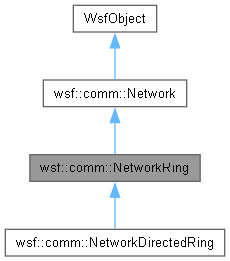
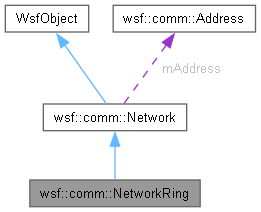
Public Member Functions | |
| NetworkRing ()=default | |
| NetworkRing (const std::string &aNetworkName, const Address &aAddress) | |
| ~NetworkRing () override=default | |
| NetworkRing & | operator= (const NetworkRing &aRhs)=default |
| bool | ProcessInput (UtInput &aInput) override |
| NetworkRing * | Clone () const override |
| const char * | GetScriptClassName () const override |
| Public Member Functions inherited from wsf::comm::Network | |
| Network ()=default | |
| ~Network () override=default | |
| Network (const std::string &aNetworkName, const Address &aAddress) | |
| Network (const Network &aSrc)=default | |
| Network & | operator= (const Network &aRhs)=default |
| Network (Network &&aSrc)=default | |
| bool | InitializeLinkage (WsfSimulation &aSimulation) |
| const char * | GetScriptClassName () const override |
| virtual bool | Initialize (WsfSimulation &aSim) |
| bool | AddMember (const Address &aAddress, WsfSimulation &aSimulation, const Address &aOptionalAddress=Address()) |
| bool | RemoveMember (const Address &aAddress, WsfSimulation &aSimulation, const Address &aOptionalAddress=Address()) |
| bool | AddLink (const Address &aSourceAddress, const Address &aDestinationAddress, WsfSimulation &aSimulation, const Address &aOptionalAddress=Address()) |
| bool | RemoveLink (const Address &aSourceAddress, const Address &aDestinationAddress, WsfSimulation &aSimulation, const Address &aOptionalAddress=Address()) |
| void | SetAddress (const Address &aAddress) |
| void | SetIsManaged (bool aManaged) |
| const Address & | GetAddress () const |
| size_t | GetHostsMax () const |
| bool | IsManaged () const |
| const NamedList & | GetNamedMemberList () const |
| bool | HasMember (const Address &aAddress) const |
| Public Member Functions inherited from WsfObject | |
| WsfObject () | |
| This is the constructor for the WsfObject class. | |
| ~WsfObject () override | |
| This is the destructor for the WsfObject class. | |
| const char * | GetScriptClassName () const override |
| const std::string & | GetType () const |
| WsfStringId | GetTypeId () const |
| Get the string ID of the 'type' of the object. | |
| void | SetType (WsfStringId aType) |
| const std::string & | GetBaseType () const |
| WsfStringId | GetBaseTypeId () const |
| const TypeList & | GetTypeList () const |
| bool | IsA_TypeOf (WsfStringId aType) const |
| WsfObject & | operator= (const WsfObject &aRhs) |
| Assignment operator. | |
| template<typename T> | |
| void | Serialize (T &aBuff) |
| For XIO (de)serialization. | |
| const std::string & | GetName () const |
| WsfStringId | GetNameId () const |
| void | SetName (WsfStringId aName) |
Protected Member Functions | |
| bool | InitializeLinkageP (WsfSimulation &aSimulation) override |
| bool | AddMemberP (const Address &aAddress, WsfSimulation &aSimulation, const Address &aOptionalAddress=Address()) override |
| bool | RemoveMemberP (const Address &aAddress, WsfSimulation &aSimulation, const Address &aOptionalAddress=Address()) override |
| virtual bool | AddLinkP (const Address &aSourceAddress, const Address &aDestinationAddress, WsfSimulation &aSimulation, const Address &aOptionalAddress=Address()) |
| virtual bool | RemoveLinkP (const Address &aSourceAddress, const Address &aDestinationAddress, WsfSimulation &aSimulation, const Address &aOptionalAddress=Address()) |
| virtual bool | ProcessAddressListInput (UtInput &aInput) |
| virtual bool | ProcessAddressLinkListInput (UtInput &aInput) |
| virtual bool | ProcessNamedListInput (UtInput &aInput) |
| virtual bool | ProcessNamedLinkListInput (UtInput &aInput) |
| WsfObject (const WsfObject &aSrc) | |
| Copy constructor (for Clone()). | |
Additional Inherited Members | |
| Public Types inherited from wsf::comm::Network | |
| using | AddressList = std::vector<Address> |
| using | AddressLinkList = std::vector<std::pair<Address, Address>> |
| using | NamedList = std::vector<NamedComm> |
| using | NamedLinkList = std::vector<std::pair<NamedComm, NamedComm>> |
| Public Types inherited from WsfObject | |
| typedef std::vector< WsfStringId > | TypeList |
| The list of types returned by GetTypeList. | |
| static Address | GetAddressFromNamedComm (WsfStringId aPlatformName, WsfStringId aCommName, WsfSimulation &aSimulation) |
| Address | mAddress {} |
| AddressList | mAddressList {} |
| AddressList | mInputAddressList {} |
| AddressLinkList | mAddressLinkList {} |
| AddressLinkList | mInputAddressLinkList {} |
| Same case as "mInputAddressList" above, except with link definitions. | |
| NamedList | mNamedList {} |
| NamedLinkList | mNamedLinkList {} |
| bool | mManaged {false} |
| True if this network is being managed by the simulation. | |
Detailed Description
A network implementation, where all members have bi-directional linkage to two other unique members in the network.
- Note
- If at least three comms are not defined by the user, this network will not establish its links.
Constructor & Destructor Documentation
◆ NetworkRing() [1/2]
|
default |
References NetworkRing().
Referenced by Clone(), wsf::comm::NetworkDirectedRing::NetworkDirectedRing(), NetworkRing(), and operator=().
◆ NetworkRing() [2/2]
| wsf::comm::NetworkRing::NetworkRing | ( | const std::string & | aNetworkName, |
| const Address & | aAddress ) |
References wsf::comm::Network::Network().
◆ ~NetworkRing()
|
overridedefault |
Member Function Documentation
◆ AddMemberP()
|
overrideprotectedvirtual |
It takes at least three members to make this topology.
If the pending size is 3 (current size == 2), then we currently don't have any links in this network, and need to establish links for all members, not just the currently added member. (Note - This will only occur during runtime, as either there are sufficient members to establish linkage or not at initialization - this is a condition of members being added or removed during a simulation run.)
The ring is established, add this member to the "end" of the ring. Since this is an "incremental" add, we have to delete links where we insert the new member.
A special insertion location has been specified and located. If the location isn't at the end (where we ordinarily insert), then handle it, otherwise continue processing at the "end" of the ring.
Insert the new member at the "end" of the ring.
Reimplemented from wsf::comm::Network.
References WsfSimulation::GetCommNetworkManager(), WsfSimulation::GetSimTime(), wsf::comm::Network::mAddressList, ok, and simTime.
◆ Clone()
|
overridevirtual |
Return a copy of this object. Must be implemented by all derived types. If cloning is impossible, a WsfUncloneableException should be thrown.
Reimplemented from wsf::comm::Network.
References NetworkRing().
Referenced by operator=().
◆ GetScriptClassName()
|
inlineoverride |
◆ InitializeLinkageP()
|
overrideprotectedvirtual |
Linkage initialized by this implementation will order the members of the ring by the order in which they were processed via ProcessInput(). Thus, the order in which the user lists members matters in this case. For programmatic or script method control of addition or removal at specific locations, see the Add/RemoveMemberRing methods.
No linkage necessary for insufficient members.
Note: We don't incrementally add the members one at a time in the ring topology to avoid creating and removing links with every add. This will either cause a bunch of output we don't want, or we have to suppress it, neither of which is favorable. Instead, we'll just do it all here in one pass if the minimum conditions are correct, so that event output actually reflects the true state of the network without a bunch of noise.
Complete the ring by connecting the first and last members.
Reimplemented from wsf::comm::Network.
References WsfSimulation::GetCommNetworkManager(), WsfSimulation::GetSimTime(), wsf::comm::Network::mAddressList, ok, and simTime.
◆ operator=()
|
default |
References Clone(), NetworkRing(), and ProcessInput().
◆ ProcessInput()
|
overridevirtual |
Process input from a generic source.
Examine the current input command. If it is NOT one of the commands recognized by this class then it simply returns 'false'. If it is one of the commands recognized by this class then it processes the command and returns 'true'.
- Parameters
-
aInput a reference to a UtInput object.
- Returns
- 'true' if the command was one recognized by the class or 'false' if not.
- Exceptions
-
UtInput::ExceptionBase (or an object derived from it) if the command was recognized but contains some sort of error.
- Note
- If a derived class does not recognize the command (i.e.: the return value is false) then it should call the base class ProcessInput method. This chain should continue until either the command is recognized or the top-level base class is encountered.
Reimplemented from wsf::comm::Network.
References wsf::comm::Network::mAddress, wsf::comm::Network::ProcessAddressListInput(), wsf::comm::Address::ProcessInput(), and wsf::comm::Network::ProcessNamedListInput().
Referenced by operator=().
◆ RemoveMemberP()
|
overrideprotectedvirtual |
No links to remove is size is already less than 3
If the size is exactly 3, we lose all linkage.
Remove the member and its connections, and add connections between adjacent members.
The removed member is at the "end" of the ring.
Re-connect
The removed member is at the "beginning" of the ring.
Re-connect
Re-connect
Reimplemented from wsf::comm::Network.
References WsfSimulation::GetCommNetworkManager(), WsfSimulation::GetSimTime(), wsf::comm::Network::mAddressList, ok, and simTime.
The documentation for this class was generated from the following files: