#include <WsfTimeDelayQueue.hpp>
Classes | |
| class | Request |
| class | RequestQueue |
| A queue of pending requests that have not been assigned to a server. More... | |
| class | FIFO_Queue |
| Adapter class for a First-In, First-Out (FIFO) queue. More... | |
| class | LIFO_Queue |
| Adapter class for a Last-In, First-Out (LIFO) queue. More... | |
| class | PriorityQueue |
| Adapter class for a priority queue. More... | |
| class | CompleteRequestEvent |
| An event scheduled to complete the request at the end of its delay time. More... | |
Public Types | |
| enum | QueuingMethod { cFIRST_IN_FIRST_OUT , cLAST_IN_FIRST_OUT , cPRIORITY , cNONE } |
| Queuing method. More... | |
Public Member Functions | |
| WsfTimeDelayQueue ()=default | |
| WsfTimeDelayQueue (const WsfTimeDelayQueue &aSrc) | |
| Copy constructor. | |
| WsfTimeDelayQueue & | operator= (const WsfTimeDelayQueue &)=delete |
| virtual | ~WsfTimeDelayQueue () |
| Destructor. | |
Internal methods. | |
The following are used for event processing. | |
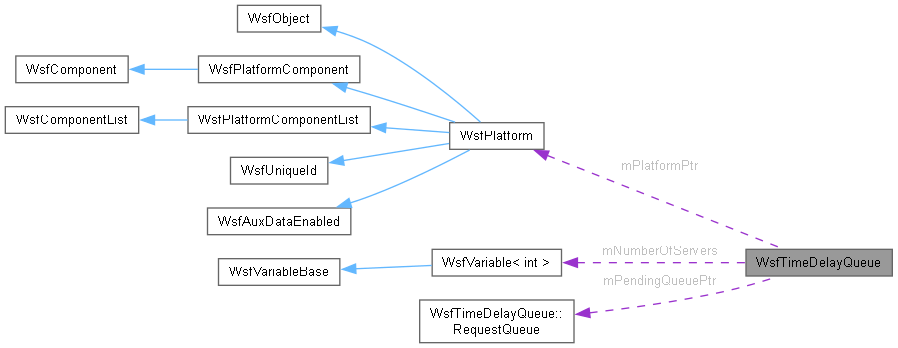
| WsfPlatform * | mPlatformPtr {nullptr} |
| Pointer to the platform that owns the queue. | |
| WsfVariable< int > | mNumberOfServers {1} |
| The number of servers. | |
| std::vector< Request * > | mServers |
| QueuingMethod | mQueuingMethod {cFIRST_IN_FIRST_OUT} |
| The method of queuing requests when a server is not available. | |
| RequestQueue * | mPendingQueuePtr {nullptr} |
| Pointer to the adapter that implements the queuing methodology. | |
| unsigned int | mEventEpoch {1} |
| The current event scheduling epoch. | |
| virtual Request * | CompleteRequest (double aSimTime, Request *aRequestPtr, size_t aServerIndex) |
| unsigned int | GetEventEpoch () const |
| Return the current event scheduling epoch. | |
| WsfPlatform * | GetPlatform () const |
| Return the platform associated with the request queue. | |
| WsfSimulation * | GetSimulation () const |
| void | CleanUp () |
| Clean up all internal memory. | |
Framework Methods | |
| virtual WsfTimeDelayQueue * | Clone () const |
| Create a clone of this object. | |
| virtual bool | Initialize (double aSimTime, WsfPlatform *aPlatformPtr, WsfPlatformPart *aPlatformPartPtr, WsfScriptContext *aContextPtr) |
| virtual bool | ProcessInput (UtInput &aInput) |
| virtual void | TurnOff (double aSimTime) |
| virtual void | TurnOn (double aSimTime) |
| void | SetNumberOfServers (int aNumberOfServers) |
| virtual void | SubmitRequest (double aSimTime, Request *aRequestPtr) |
Detailed Description
A class that implements a queue where the work performed by the servers is represented by a time delay.
The caller submits an object of derived from Request which represents the work to be performed. The request includes a specification of the amount of time needed to complete the work and the definition of a method that is called when the request has been completed. If a server is available then it will be assigned to that server, otherwise it will be put on a pending queue for the next available server.
To perform the 'work', the server will schedule an event for the completion time of the work (time work started + time needed for the request). When the event executes, it invokes Request::CompleteRequest to allow the submitter to detect that the time delay has expired and to perform any actions associated with the completion. The server is then release and will then be free to select the next highest priority pending request.
This is typically used to implement the concept of 'thinking time' or 'processing time'.
At the current time only a single first-in-first-out server is allocated.
Member Enumeration Documentation
◆ QueuingMethod
Constructor & Destructor Documentation
◆ WsfTimeDelayQueue() [1/2]
|
default |
◆ WsfTimeDelayQueue() [2/2]
| WsfTimeDelayQueue::WsfTimeDelayQueue | ( | const WsfTimeDelayQueue & | aSrc | ) |
Copy constructor.
References mEventEpoch, mNumberOfServers, mPendingQueuePtr, mPlatformPtr, mQueuingMethod, mServers, and WsfTimeDelayQueue().
◆ ~WsfTimeDelayQueue()
|
virtual |
Destructor.
References CleanUp(), and mPendingQueuePtr.
Member Function Documentation
◆ CleanUp()
|
protected |
Clean up all internal memory.
References mPendingQueuePtr.
Referenced by TurnOff(), and ~WsfTimeDelayQueue().
◆ Clone()
|
virtual |
◆ CompleteRequest()
|
virtual |
Complete the processing of a request.
- Parameters
-
aSimTime The current simulation time. aRequestPtr Pointer to the request that is being completed. aServerIndex The index of the server that is completing its request.
- Returns
- A pointer to the request to be processed. If zero then there is no more work for the server to do. If the pointer is non-zero then the request is either the next unprocessed element from the request queue, or is the same request if the request extended its processing time.
References WsfTimeDelayQueue::Request::CompleteRequest(), mPendingQueuePtr, and mServers.
Referenced by operator=().
◆ GetEventEpoch()
|
inline |
Return the current event scheduling epoch.
References mEventEpoch.
Referenced by WsfTimeDelayQueue::CompleteRequestEvent::CompleteRequestEvent().
◆ GetPlatform()
|
inline |
Return the platform associated with the request queue.
References mPlatformPtr.
Referenced by WsfTimeDelayQueue::CompleteRequestEvent::CompleteRequestEvent().
◆ GetSimulation()
| WsfSimulation * WsfTimeDelayQueue::GetSimulation | ( | ) | const |
References mPlatformPtr.
Referenced by WsfTimeDelayQueue::CompleteRequestEvent::Execute(), and SubmitRequest().
◆ Initialize()
|
virtual |
Initialize the object.
- Parameters
-
aSimTime The current simulation time. aPlatformPtr The platform that owns the request processor. aPlatformPartPtr The platform part that owns the request processor (may be zero) aContextPtr Pointer to the script context used for resolving 'reference values' (e.g.: 'number_of_servers /variable NUMBER_OF_SERVERS'). A null pointer may be provided, in which case the global script context is used.
- Returns
- true if successful and false if not.
References cFIRST_IN_FIRST_OUT, cLAST_IN_FIRST_OUT, cNONE, cPRIORITY, mNumberOfServers, mPendingQueuePtr, mPlatformPtr, mQueuingMethod, mServers, and ok.
Referenced by operator=().
◆ operator=()
|
delete |
References Clone(), CompleteRequest(), Initialize(), ProcessInput(), SetNumberOfServers(), SubmitRequest(), TurnOff(), TurnOn(), and WsfTimeDelayQueue().
◆ ProcessInput()
|
virtual |
References cFIRST_IN_FIRST_OUT, cLAST_IN_FIRST_OUT, cNONE, cPRIORITY, mNumberOfServers, and mQueuingMethod.
Referenced by operator=().
◆ SetNumberOfServers()
| void WsfTimeDelayQueue::SetNumberOfServers | ( | int | aNumberOfServers | ) |
Set the number of servers available to process requests. This is essentially the number of requests that can be processed simultaneously.
- Parameters
-
aNumberOfServers The number of servers. A value less than or equal to zero or >= std::numeric_limits<int>::max() will be treated as infinite.
- Note
- This is only effective prior to Initialize being called.
References mNumberOfServers, and mPlatformPtr.
Referenced by operator=().
◆ SubmitRequest()
|
virtual |
Submit a request for processing by the next available processor.
- Parameters
-
aSimTime The current simulation time. aRequestPtr The request to be processed.
References WsfSimulation::AddEvent(), cNONE, GetSimulation(), mPendingQueuePtr, mQueuingMethod, mServers, and WsfTimeDelayQueue::Request::TimeRequired().
Referenced by operator=().
◆ TurnOff()
|
virtual |
Indicate that the request processor has been turned off.
- Parameters
-
aSimTime The current simulation time.
References CleanUp(), and mEventEpoch.
Referenced by operator=().
◆ TurnOn()
|
virtual |
Indicate that the request processor has been turned on.
- Parameters
-
aSimTime The current simulation time.
References mEventEpoch.
Referenced by operator=().
Member Data Documentation
◆ mEventEpoch
|
protected |
The current event scheduling epoch.
Referenced by GetEventEpoch(), TurnOff(), TurnOn(), and WsfTimeDelayQueue().
◆ mNumberOfServers
|
protected |
The number of servers.
Referenced by Initialize(), ProcessInput(), SetNumberOfServers(), and WsfTimeDelayQueue().
◆ mPendingQueuePtr
|
protected |
Pointer to the adapter that implements the queuing methodology.
Referenced by CleanUp(), CompleteRequest(), Initialize(), SubmitRequest(), WsfTimeDelayQueue(), and ~WsfTimeDelayQueue().
◆ mPlatformPtr
|
protected |
Pointer to the platform that owns the queue.
Referenced by GetPlatform(), GetSimulation(), Initialize(), SetNumberOfServers(), and WsfTimeDelayQueue().
◆ mQueuingMethod
|
protected |
The method of queuing requests when a server is not available.
Referenced by Initialize(), ProcessInput(), SubmitRequest(), and WsfTimeDelayQueue().
◆ mServers
|
protected |
The current request being processed by each server. If an entry is zero then the server is not busy.
Referenced by CompleteRequest(), Initialize(), SubmitRequest(), and WsfTimeDelayQueue().
The documentation for this class was generated from the following files: