#include <Set.hpp>
Public Member Functions | |
| Set (const std::string &aSTF, const std::vector< Field > &aFields) noexcept | |
| virtual | ~Set ()=default |
| const std::string & | GetType () const noexcept |
| Return the Set Identifiers/Set Text Format of the set instance. | |
| bool | IsEmpty () const noexcept |
| int | GetFieldCount () const noexcept |
| const Field & | GetField (size_t aIndex) const |
| Returns a field at a index position in the Set. | |
| const std::string & | GetFieldContent (size_t aIndex) const |
| Returns the Contents of a field at specified index. | |
| const std::string | GetReconstructedSet () const noexcept |
| Public Member Functions inherited from usmtf::Validatable | |
| bool | IsValid () const noexcept |
| Public Member Functions inherited from usmtf::ErrorManager | |
| virtual | ~ErrorManager ()=default |
| bool | HasErrors () const noexcept |
| void | LogErrors (std::ostream &aOut) const noexcept |
| const std::vector< ValidationError > & | GetErrors () const |
Protected Attributes | |
| std::string | mSetTextFormat |
| std::vector< Field > | mFields |
Additional Inherited Members | |
| Protected Member Functions inherited from usmtf::ErrorManager | |
| void | AddError (const ValidationError &aError) noexcept |
| void | AddError (const std::string &aFailureReason, const std::string &aValueValidatied, const std::string &aOptionalSuggestion="") noexcept |
| void | AddError (const std::string &aErrorMessage) noexcept |
| void | AddErrors (const std::vector< ValidationError > &aErrors) noexcept |
| void | ClearErrors () noexcept |
Detailed Description
Set Identifiers or Set Text Format
Every Set starts with a set identifier, a keyword that identifies the set, its reason for existence and the format it supports.
Set
A set is a predetermined field or sequence of fields, preceded by a set identifier, containing all the required information concerning an aspect of the subject of a formatted message. All sets begin with a set identifier, have one or more fields, and terminate with the end-of-set marker (//).
i.e. ACMID/ACM:ATC/NAME:BBR-22/ORBIT/USE:CLSB//
There are three types of set formats:
- linear
- columnar
- Free Text
For more detailed account of a set please see section 4.3.7 and 5.2.1 of the MIL-STD-6040 standard. We have a copy under 1_Mtfrules.pdf
Sets are collection of related data, the sentence of the USMTF if you will.
Every Set besides columnar sets can be considered linear. Even columnar fields are laid out in the same way.
Constructor & Destructor Documentation
◆ Set()
|
noexcept |
References mFields, and mSetTextFormat.
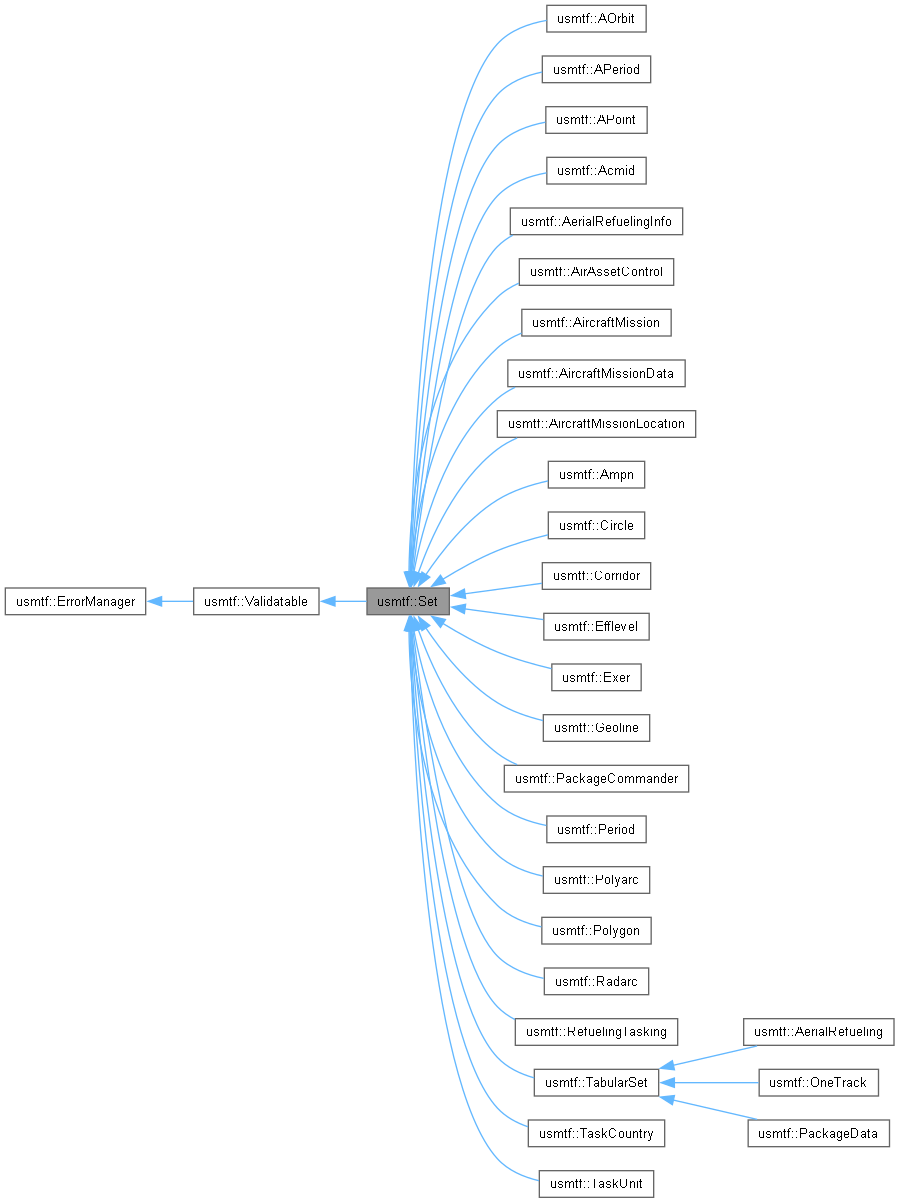
Referenced by usmtf::Acmid::Acmid(), usmtf::AerialRefuelingInfo::AerialRefuelingInfo(), usmtf::AirAssetControl::AirAssetControl(), usmtf::AircraftMission::AircraftMission(), usmtf::AircraftMissionData::AircraftMissionData(), usmtf::AircraftMissionLocation::AircraftMissionLocation(), usmtf::Ampn::Ampn(), usmtf::AOrbit::AOrbit(), usmtf::APeriod::APeriod(), usmtf::APoint::APoint(), usmtf::Circle::Circle(), usmtf::Corridor::Corridor(), usmtf::Efflevel::Efflevel(), usmtf::Exer::Exer(), usmtf::Geoline::Geoline(), usmtf::PackageCommander::PackageCommander(), usmtf::Period::Period(), usmtf::Polyarc::Polyarc(), usmtf::Polygon::Polygon(), usmtf::Radarc::Radarc(), usmtf::RefuelingTasking::RefuelingTasking(), usmtf::TabularSet::TabularSet(), usmtf::TaskCountry::TaskCountry(), and usmtf::TaskUnit::TaskUnit().
◆ ~Set()
|
virtualdefault |
References GetField(), GetFieldContent(), GetFieldCount(), GetReconstructedSet(), GetType(), and IsEmpty().
Member Function Documentation
◆ GetField()
| const Field & usmtf::Set::GetField | ( | size_t | aIndex | ) | const |
Returns a field at a index position in the Set.
References mFields.
Referenced by usmtf::Acmid::Acmid(), usmtf::AerialRefuelingInfo::AerialRefuelingInfo(), usmtf::AirAssetControl::AirAssetControl(), usmtf::AircraftMissionData::AircraftMissionData(), usmtf::AircraftMissionLocation::AircraftMissionLocation(), usmtf::Ampn::Ampn(), usmtf::AOrbit::AOrbit(), usmtf::APeriod::APeriod(), usmtf::APoint::APoint(), usmtf::Circle::Circle(), usmtf::Corridor::Corridor(), usmtf::Efflevel::Efflevel(), usmtf::TabularSet::GetField(), GetFieldContent(), usmtf::PackageCommander::PackageCommander(), usmtf::Period::Period(), usmtf::Radarc::Radarc(), usmtf::USMTF_Parser::ReadMessage(), usmtf::RefuelingTasking::RefuelingTasking(), usmtf::TaskUnit::TaskUnit(), and ~Set().
◆ GetFieldContent()
| const std::string & usmtf::Set::GetFieldContent | ( | size_t | aIndex | ) | const |
Returns the Contents of a field at specified index.
References usmtf::Field::GetContent(), GetField(), usmtf::Validatable::IsValid(), and usmtf::NULL_FIELD.
Referenced by usmtf::AerialRefuelingInfo::AerialRefuelingInfo(), usmtf::AircraftMission::AircraftMission(), usmtf::AircraftMissionLocation::AircraftMissionLocation(), usmtf::Acmid::GetAirspaceControlMeansIdentifier(), usmtf::Ampn::GetAmplificationText(), usmtf::Exer::GetExerciseMessageAdditionalIdentifier(), usmtf::TabularSet::GetFieldContent(), usmtf::Exer::GetNickname(), usmtf::TaskCountry::TaskCountry(), usmtf::TaskUnit::TaskUnit(), and ~Set().
◆ GetFieldCount()
|
noexcept |
◆ GetReconstructedSet()
|
noexcept |
◆ GetType()
|
noexcept |
Return the Set Identifiers/Set Text Format of the set instance.
References mSetTextFormat.
Referenced by usmtf::USMTF_Parser::ReadMessage(), and ~Set().
◆ IsEmpty()
|
noexcept |
Member Data Documentation
◆ mFields
|
protected |
Referenced by usmtf::AircraftMissionData::AircraftMissionData(), GetField(), GetFieldCount(), GetReconstructedSet(), IsEmpty(), and Set().
◆ mSetTextFormat
The documentation for this class was generated from the following files: