#include <WsfEM_RF_Type1Attenuation.hpp>
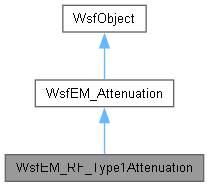
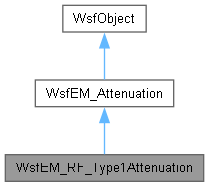
Public Member Functions | |
| WsfEM_RF_Type1Attenuation () | |
| WsfEM_RF_Type1Attenuation (const WsfEM_RF_Type1Attenuation &aSrc) | |
| ~WsfEM_RF_Type1Attenuation () override=default | |
| WsfEM_RF_Type1Attenuation & | operator= (const WsfEM_RF_Type1Attenuation &)=delete |
| WsfEM_Attenuation * | Clone () const override |
| bool | Initialize (WsfEM_XmtrRcvr *aXmtrRcvrPtr) override |
| Public Member Functions inherited from WsfEM_Attenuation | |
| WsfEM_Attenuation () | |
| ~WsfEM_Attenuation () override | |
| virtual bool | Initialize (WsfEM_Xmtr *aXmtrPtr) |
| bool | ProcessInput (UtInput &aInput) override |
| const char * | GetScriptClassName () const override |
| bool | DebugEnabled () const |
| Is 'debug' enabled? | |
| virtual bool | IsNullModel () const |
| virtual bool | AcceptsInlineBlockInput () const |
| virtual double | ComputeAttenuationFactor (WsfEM_Interaction &aInteraction, WsfEnvironment &aEnvironment, WsfEM_Interaction::Geometry aGeometry) |
| Public Member Functions inherited from WsfObject | |
| WsfObject () | |
| This is the constructor for the WsfObject class. | |
| ~WsfObject () override | |
| This is the destructor for the WsfObject class. | |
| const char * | GetScriptClassName () const override |
| const std::string & | GetType () const |
| WsfStringId | GetTypeId () const |
| Get the string ID of the 'type' of the object. | |
| void | SetType (WsfStringId aType) |
| const std::string & | GetBaseType () const |
| WsfStringId | GetBaseTypeId () const |
| const TypeList & | GetTypeList () const |
| bool | IsA_TypeOf (WsfStringId aType) const |
| WsfObject & | operator= (const WsfObject &aRhs) |
| Assignment operator. | |
| template<typename T> | |
| void | Serialize (T &aBuff) |
| For XIO (de)serialization. | |
| const std::string & | GetName () const |
| WsfStringId | GetNameId () const |
| void | SetName (WsfStringId aName) |
Static Public Member Functions | |
| static WsfEM_Attenuation * | ObjectFactory (const std::string &aTypeName) |
Protected Member Functions | |
| double | ComputeAttenuationFactorP (double aRange, double aElevation, double aAltitude, double aFrequency) override |
| Protected Member Functions inherited from WsfEM_Attenuation | |
| WsfEM_Attenuation (const WsfEM_Attenuation &aSrc) | |
| void | GetAltitudesAndGroundRange (WsfEM_Interaction &aInteraction, WsfEM_Interaction::Geometry aGeometry, double &aAltitude1, double &aAltitude2, double &aGroundRange) |
| void | GetRangeElevationAltitude (WsfEM_Interaction &aInteraction, WsfEM_Interaction::Geometry aGeometry, double &aRange, double &aElevation, double &aAltitude) |
| WsfObject (const WsfObject &aSrc) | |
| Copy constructor (for Clone()). | |
Additional Inherited Members | |
| Public Types inherited from WsfObject | |
| typedef std::vector< WsfStringId > | TypeList |
| The list of types returned by GetTypeList. | |
| Protected Attributes inherited from WsfEM_Attenuation | |
| bool | mDebugEnabled |
| bool | mSortEndPoints |
Detailed Description
An RF attenuation model that can include the effects of dust, rain and clouds.
This model utilizes frequency-dependent lookup-tables and formulas to compute the attenuation of the atmosphere, dust, rain and clouds on RF signals in the 1 - 90 GHZ frequency range.
- Note
- This model was provided for a specific project application. It is assumed that the sensor is on an aircraft at a reasonable high altitude looking down at ground targets.
Constructor & Destructor Documentation
◆ WsfEM_RF_Type1Attenuation() [1/2]
| WsfEM_RF_Type1Attenuation::WsfEM_RF_Type1Attenuation | ( | ) |
Referenced by Clone(), ObjectFactory(), operator=(), and WsfEM_RF_Type1Attenuation().
◆ WsfEM_RF_Type1Attenuation() [2/2]
| WsfEM_RF_Type1Attenuation::WsfEM_RF_Type1Attenuation | ( | const WsfEM_RF_Type1Attenuation & | aSrc | ) |
References WsfEM_RF_Type1Attenuation().
◆ ~WsfEM_RF_Type1Attenuation()
|
overridedefault |
Member Function Documentation
◆ Clone()
|
overridevirtual |
Return a copy of this object. Must be implemented by all derived types. If cloning is impossible, a WsfUncloneableException should be thrown.
Implements WsfEM_Attenuation.
References WsfEM_Attenuation::WsfEM_Attenuation(), and WsfEM_RF_Type1Attenuation().
◆ ComputeAttenuationFactorP()
|
overrideprotectedvirtual |
Compute the attenuation loss factor along a specified path.
- Parameters
-
aRange The range over which the signal will travel (meters) aElevation The elevation angle above the horizontal plane that is tangent to the Earth's surface (radians) aAltitude The altitude of the lowest point between the two points under consideration. This altitude must be lowest as some models assume it. aFrequency The frequency of the signal (hertz).
- Returns
- The fraction of the signal that remains at the end of the path, in the range [0, 1].
- Note
- This form is NOT called directly by the routines in WsfEM_Interaction (they call the 3-argument form). The base class 3-argument form calls this form, which as a signature that is typical for many RF models.
- This form is protected and can ONLY be called by the base class 3-argument form.
Reimplemented from WsfEM_Attenuation.
◆ Initialize()
|
overridevirtual |
Initialize the attenuation object.
- Parameters
-
aXmtrRcvrPtr The transmitter/receiver to which the attenuation object is attached.
Reimplemented from WsfEM_Attenuation.
References WsfEM_XmtrRcvr::GetPlatform(), and WsfPlatform::GetScenario().
◆ ObjectFactory()
|
static |
Factory method for WsfEM_Attenuation. This is called by WsfEM_Attenuation::LoadInstance to determine if a model represented by this class is being requested.
References WsfEM_Attenuation::WsfEM_Attenuation(), and WsfEM_RF_Type1Attenuation().
◆ operator=()
|
delete |
References WsfEM_Attenuation::WsfEM_Attenuation(), and WsfEM_RF_Type1Attenuation().
The documentation for this class was generated from the following files: