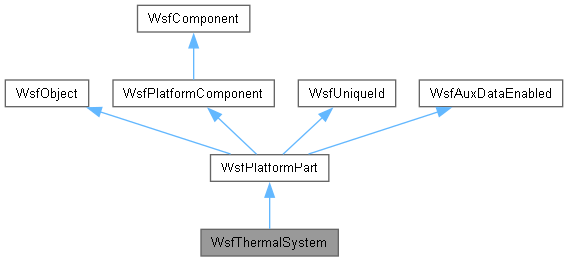
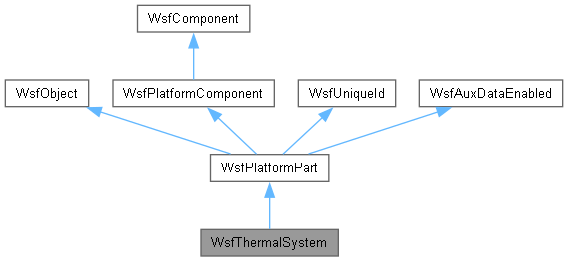
|
| | WsfThermalSystem (const WsfScenario &aScenario) |
| | WsfThermalSystem (const WsfThermalSystem &aSrc) |
| WsfThermalSystem & | operator= (const WsfThermalSystem &)=delete |
| | ~WsfThermalSystem () override |
| WsfObject * | Clone () const override |
| bool | ProcessInput (UtInput &aInput) override |
| bool | Initialize (double aSimTime) override |
| WsfComponent * | CloneComponent () const override |
| const int * | GetComponentRoles () const override |
| void * | QueryInterface (int aRole) override |
| double | GetUpdateInterval () const override |
| void | SetUpdateInterval (double aUpdateInterval) override |
| virtual double | TransferHeat (double aSimTime, double aHeatTransfer) |
| | Given heat transfer to the system, return the new temperature.
|
| bool | IsValid () const |
| | Return whether the system is "valid", i.e., is being utilized.
|
| bool | IsSimple () const |
| | Return whether we are configuring this system with "simple" inputs.
|
| double | GetTemperature () const |
| void | SetTemperature (double aTemperature) |
| double | GetHeatSink () const |
| void | PrintInfo (double aLowTemp, double aHighTemp) const |
| double | GetRequiredHeatForTemperature (double aTemperature) const |
| double | GetEnergy (double aLowTemp, double aHighTemp) const |
| void | SetPowerDissipated (double aPowerDissipated) |
| void | SetLowTemperature (double aLowTemperature) |
| double | GetLowTemperature () const |
| void | SetHighTemperature (double aHighTemperature) |
| double | GetHighTemperature () const |
| | WsfPlatformPart (const WsfScenario &aScenario, int aPartType) |
| WsfPlatformPart & | operator= (const WsfPlatformPart &aRhs)=delete |
| | ~WsfPlatformPart () override |
| bool | DebugEnabled () const |
| | Returns 'true' if debugging is enabled for this instance.
|
| void | SetDebugEnabled (bool aDebugEnabled) |
| unsigned int | GetDebugMask () |
| bool | IsExternallyControlled () const |
| virtual void | SetExternallyControlled (double aSimTime, bool aIsExternallyControlled) |
| int | GetPartType () const |
| const char * | GetScriptClassName () const override |
| WsfSimulation * | GetSimulation () const |
| const WsfScenario & | GetScenario () const |
| WsfStringId | GetComponentName () const override |
| void | ComponentParentChanged (WsfPlatform *aPlatformPtr) override |
| bool | Initialize2 (double aSimTime) override |
| virtual void | Update (double aSimTime) |
| WsfPlatform * | GetPlatform () const |
| virtual void | SetPlatform (WsfPlatform *aPlatformPtr) |
| virtual void | PlatformAdded (double aSimTime, WsfPlatform *aPlatformPtr) |
| virtual void | PlatformDeleted (WsfPlatform *aPlatformPtr) |
| double | GetLastStatusChangeTime () const |
| void | SetLastStatusChangeTime (double aSimTime) |
| | Allows a system to set the time at which the device was initialized.
|
| bool | CanBeMadeOperational () const |
| | Returns an indication that this system can be made operational.
|
| bool | CanBeMadeNonOperational () const |
| | Returns an indication that this system can be made non-operational.
|
| bool | CanBeTurnedOn () const |
| | Returns an indication that this system can be turned on.
|
| bool | CanBeTurnedOff () const |
| | Returns an indication that this system can be turned off.
|
| bool | IsTurnedOn () const |
| bool | InitiallyTurnedOn () const |
| | Is the system to be turned 'on' when added to the simulation?
|
| void | SetInitiallyTurnedOn (bool aInitiallyTurnedOn) |
| | Sets if the system is turned on when added to the simulation.
|
| virtual void | TurnOff (double aSimTime) |
| virtual void | TurnOn (double aSimTime) |
| virtual void | SetOperational (double aSimTime) |
| virtual void | SetNonOperational (double aSimTime) |
| virtual void | PartBroken (double aSimTime) |
| virtual void | Restore (double aSimTime) |
| bool | IsOperational () const |
| bool | SetOperational (double aSimTime, bool aMakeOperational) |
| double | GetDamageFactor () const |
| bool | SetDamageFactor (double aSimTime, double aDamageFactor) |
| bool | IsCritical () const |
| void | SetCritical (bool aValue) |
| virtual void | OnPlatformBrokenEvent (double aSimTime) |
| | Owning platform has issued a broken event.
|
| bool | IsBroken () const |
| WsfInternalLinks & | GetInternalLinks () |
| | Return the internal links for this part.
|
| virtual bool | HasInternalLinks () const |
| | Does this platform part have a communication link to other platform parts?
|
| virtual bool | ProcessMessage (double aSimTime, const WsfMessage &aMessage) |
| virtual bool | ReceiveMessage (double aSimTime, const WsfMessage &aMessage) |
| virtual void | SendMessage (double aSimTime, const WsfMessage &aMessage) |
| virtual void | SendMessageTo (double aSimTime, const WsfMessage &aMessage, WsfStringId aRecipientId) |
| void | SendMessageToProcessor (double aSimTime, const WsfMessage &aMessage, WsfStringId aRecipientId) |
| virtual void | SendQueuedMessages (double aSimTime) |
| const WsfCategoryList & | GetCategories () const |
| | Get the categories to which this part belongs.
|
| void | AddCategory (WsfStringId aCategoryId) |
| | Adds the provided category to the platform part's category list.
|
| bool | IsCategoryMember (WsfStringId aCategoryId) const |
| const WsfGroupList & | GetGroups () const |
| | Get the groups to which this platform part belongs.
|
| void | JoinGroup (WsfGroup *aGroupPtr) |
| | Join the given group.
|
| void | LeaveGroup (WsfGroup *aGroupPtr) |
| | Leave the given group.
|
| bool | IsGroupMember (WsfStringId aGroupId) |
| unsigned int | GetUpdateEventEpoch () const |
| void | IncrementUpdateEventEpoch () |
| bool | UpdateEventActive () const |
| | Is an 'Update' event active?
|
| void | SetUpdateEventActive (bool aUpdateEventActive) |
| | Indicate if the 'Update' event is active.
|
| | WsfObject () |
| | This is the constructor for the WsfObject class.
|
| | ~WsfObject () override |
| | This is the destructor for the WsfObject class.
|
| const char * | GetScriptClassName () const override |
| const std::string & | GetType () const |
| WsfStringId | GetTypeId () const |
| | Get the string ID of the 'type' of the object.
|
| void | SetType (WsfStringId aType) |
| const std::string & | GetBaseType () const |
| WsfStringId | GetBaseTypeId () const |
| const TypeList & | GetTypeList () const |
| bool | IsA_TypeOf (WsfStringId aType) const |
| WsfObject & | operator= (const WsfObject &aRhs) |
| | Assignment operator.
|
| template<typename T> |
| void | Serialize (T &aBuff) |
| | For XIO (de)serialization.
|
| const std::string & | GetName () const |
| WsfStringId | GetNameId () const |
| void | SetName (WsfStringId aName) |
| | WsfComponentT () |
| | WsfComponentT (const WsfComponentT &) noexcept |
| WsfComponentT & | operator= (const WsfComponentT &) noexcept |
| | ~WsfComponentT () override=default |
| ParentType * | GetComponentParent () const |
| void | SetComponentParent (ParentType *aParentPtr) |
| virtual | ~WsfComponent ()=default |
| virtual int | GetComponentInitializationOrder () const |
| template<typename T> |
| bool | QueryInterfaceT (T *&aRolePtr) |
| bool | ComponentHasRole (int aRole) |
| | Returns true if the component has the specified role.
|
| virtual bool | PreInitialize (double aSimTime) |
| virtual void | PreInput () |
| | WsfUniqueId () |
| | Construtor initializes the unique identifier to 0.
|
| | WsfUniqueId (const WsfUniqueId &) |
| | Copy constructor initializes the unique identifier to 0.
|
| WsfUniqueId & | operator= (const WsfUniqueId &) |
| unsigned int | GetUniqueId () const |
| | Get the unique identifier assigned to this object.
|
| template<typename T> |
| void | Serialize (T &aBuff) |
| | For XIO (de)serialization.
|
| | WsfAuxDataEnabled ()=default |
| | WsfAuxDataEnabled (const WsfAuxDataEnabled &aSrc)=default |
| WsfAuxDataEnabled & | operator= (const WsfAuxDataEnabled &aRhs) |
| | WsfAuxDataEnabled (WsfAuxDataEnabled &&)=default |
| WsfAuxDataEnabled & | operator= (WsfAuxDataEnabled &&)=default |
| virtual | ~WsfAuxDataEnabled () noexcept |
| void | SetAuxData (const WsfAttributeContainer &aAuxData) |
| void | DeleteAuxData () |
| | Delete the aux data container from the object.
|
| void | MergeAuxData (const WsfAuxDataEnabled &aSrc) |
| | Merge the object's aux data with aux data from an existing object.
|
| void | UpdateAuxData (const WsfAuxDataEnabled &aSrc) |
| | Update the object's aux data with aux data from an existing object.
|
| bool | HasAuxData () const |
| | Returns true if this object has aux data.
|
| bool | ProcessInput (UtInput &aInput) |
| template<typename T> |
| void | Serialize (T &aBuff) |
| | (De)serialization for XIO
|
| WsfAttributeContainer & | GetAuxData () |
| const WsfAttributeContainer & | GetAuxData () const noexcept |
| const WsfAttributeContainer & | GetAuxDataConst () const noexcept |
The thermal system is comprised of various thermal components. Heat is transferred to these components, and a basic caliorimetric calculation is performed to determine the change in temperature of the system. This is a very simple representation, in that it is one dimensional and time-independent, So we are not worried about time-dependent heat transfer, only the transfer itself (we assume the transfer "works" on the timescales in which we are interested).