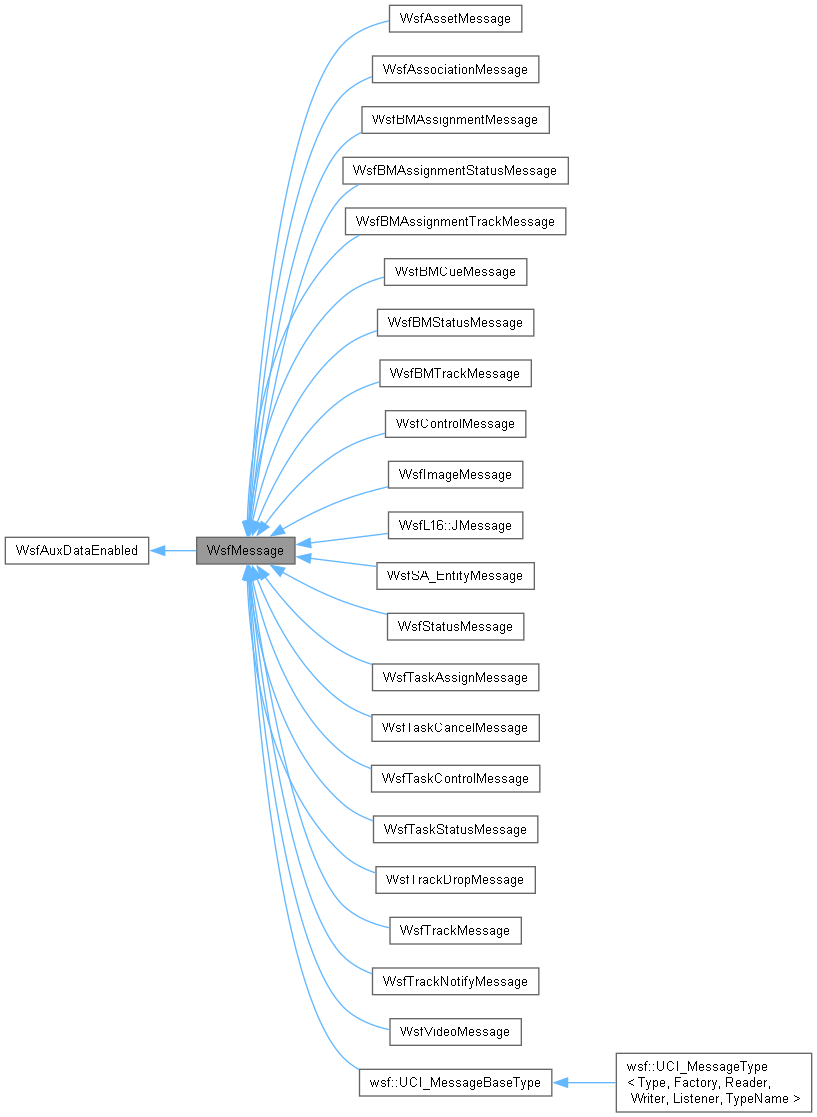
A base class for messages sent among simulation communication objects, processors and sensors. More...
#include <WsfMessage.hpp>
Public Member Functions | |
| WsfMessage (WsfStringId aType) | |
| Constructor for XIO (de)serialization. | |
| WsfMessage (WsfStringId aType, const wsf::comm::Address &aSrcAddr, WsfSimulation &aSimulation) | |
| WsfMessage (WsfPlatform *aPlatformPtr) | |
| WsfMessage (WsfStringId aType, WsfPlatform *aPlatformPtr) | |
| WsfMessage (WsfStringId aType, WsfStringId aSubType, WsfPlatform *aPlatformPtr) | |
| WsfMessage (WsfSimulation &aSimulation) | |
| WsfMessage & | operator= (const WsfMessage &aRhs)=default |
| ~WsfMessage () override | |
| virtual WsfMessage * | Clone () const |
| const char * | GetScriptClassName () const override |
| WsfSimulation * | GetSimulation () const |
| Get the simulation that owns the message. | |
| void | SetSimulation (WsfSimulation *aSimulationPtr) |
| WsfStringId | GetOriginator () const |
| void | SetOriginator (WsfPlatform *aPlatformPtr) |
| Set the originator of this message. | |
| size_t | GetOriginatorIndex () const |
| int | GetSizeBits () const |
| void | SetSizeBits (int aSizeBits) |
| int | GetSizeBytes () const |
| void | SetSizeBytes (int aSizeBytes) |
| unsigned int | GetSerialNumber () const |
| void | SetSerialNumber (unsigned int aSerialNumber) |
| double | GetDataTag () const |
| void | SetDataTag (double aDataTag) |
| WsfStringId | GetStaticType () const |
| WsfStringId | GetType () const |
| void | SetType (WsfStringId aType) |
| WsfStringId | GetSubType () const |
| void | SetSubType (WsfStringId aSubType) |
| int | GetPriority () const |
| void | SetPriority (int aPriority) |
| const wsf::comm::Address & | GetSrcAddr () const |
| void | SetSrcAddr (const wsf::comm::Address &aSrcAddr) |
| const wsf::comm::Address & | GetDstAddr () const |
| void | SetDstAddr (const wsf::comm::Address &aDstAddr) |
| const wsf::comm::Address & | GetNextHopAddr () const |
| void | SetNextHopAddr (const wsf::comm::Address &aNextHopAddr) |
| virtual bool | CanBeReplacedBy (const WsfMessage &aMessage) const |
| Public Member Functions inherited from WsfAuxDataEnabled | |
| WsfAuxDataEnabled ()=default | |
| WsfAuxDataEnabled (const WsfAuxDataEnabled &aSrc)=default | |
| WsfAuxDataEnabled & | operator= (const WsfAuxDataEnabled &aRhs) |
| WsfAuxDataEnabled (WsfAuxDataEnabled &&)=default | |
| WsfAuxDataEnabled & | operator= (WsfAuxDataEnabled &&)=default |
| virtual | ~WsfAuxDataEnabled () noexcept |
| void | SetAuxData (const WsfAttributeContainer &aAuxData) |
| void | DeleteAuxData () |
| Delete the aux data container from the object. | |
| void | MergeAuxData (const WsfAuxDataEnabled &aSrc) |
| Merge the object's aux data with aux data from an existing object. | |
| void | UpdateAuxData (const WsfAuxDataEnabled &aSrc) |
| Update the object's aux data with aux data from an existing object. | |
| bool | HasAuxData () const |
| Returns true if this object has aux data. | |
| bool | ProcessInput (UtInput &aInput) |
| template<typename T> | |
| void | Serialize (T &aBuff) |
| (De)serialization for XIO | |
| WsfAttributeContainer & | GetAuxData () |
| const WsfAttributeContainer & | GetAuxData () const noexcept |
| const WsfAttributeContainer & | GetAuxDataConst () const noexcept |
Static Public Member Functions | |
| static WsfStringId | GetTypeId () |
Static Public Attributes | |
| static constexpr size_t | cBITS_IN_BYTE = 8U |
| Static Public Attributes inherited from WsfAuxDataEnabled | |
| static UtCallbackListN< void(const WsfAuxDataEnabled *)> | AuxDataAccessed |
| static UtCallbackListN< void(const WsfAuxDataEnabled *)> | AuxDataDestroyed |
Optional Group Specification Accessor/Mutator | |
Provides the ability to set the group identification for a message. Used by the communications framework for identifying where a message is supposed to go without using addressing for legacy support. This is only for internal usage, and must be placed on the WsfMessage object as legacy usage of comms still utilizes the WsfMessage object instead of WsfCommMessage.
| |
| WsfStringId | GetGroup () const |
| void | SetGroup (WsfStringId aGroup) const |
| void | PrintDataTagPrecise (std::ostream &aStream, std::streamsize aPrecision) const |
| template<typename T> | |
| void | Serialize (T &aBuff) |
| (De)serializer for XIO | |
| WSF_EXPORT std::ostream & | operator<< (std::ostream &aOut, const WsfMessage &aMessage) |
| WsfMessage (const WsfMessage &aSrc)=default | |
Component Info Interface | |
These optional methods define an interface that can be used by subclasses to provide additional information on the component that either generated the message or the data contained in the message. They can be used to filter messages based on the information returned. The methods in the base class will return a null (0) WsfStringId. | |
| virtual WsfStringId | GetComponentNameId () const |
| virtual WsfStringId | GetComponentTypeId () const |
| virtual WsfStringId | GetComponentModeId () const |
Detailed Description
A base class for messages sent among simulation communication objects, processors and sensors.
Constructor & Destructor Documentation
◆ WsfMessage() [1/7]
| WsfMessage::WsfMessage | ( | WsfStringId | aType | ) |
Constructor for XIO (de)serialization.
Referenced by WsfAssetMessage::CanBeReplacedBy(), CanBeReplacedBy(), WsfSA_EntityMessage::CanBeReplacedBy(), WsfTrackMessage::CanBeReplacedBy(), wsf::UCI_MessageType< Type, Factory, Reader, Writer, Listener, TypeName >::Clone(), WsfAssetMessage::Clone(), WsfAssociationMessage::Clone(), WsfControlMessage::Clone(), WsfImageMessage::Clone(), WsfL16::JMessage::Clone(), Clone(), WsfSA_EntityMessage::Clone(), WsfStatusMessage::Clone(), WsfTaskAssignMessage::Clone(), WsfTaskCancelMessage::Clone(), WsfTaskControlMessage::Clone(), WsfTaskStatusMessage::Clone(), WsfTrackDropMessage::Clone(), WsfTrackMessage::Clone(), WsfTrackNotifyMessage::Clone(), WsfVideoMessage::Clone(), WsfL16::JMessage::JMessage(), WsfL16::JMessage::JMessage(), operator<<, WsfL16::JMessage::operator=(), operator=(), WsfTaskAssignMessage::operator=(), wsf::UCI_MessageBaseType::UCI_MessageBaseType(), WsfAssetMessage::WsfAssetMessage(), WsfAssetMessage::WsfAssetMessage(), WsfAssetMessage::WsfAssetMessage(), WsfAssociationMessage::WsfAssociationMessage(), WsfAssociationMessage::WsfAssociationMessage(), WsfAssociationMessage::WsfAssociationMessage(), WsfBMAssignmentMessage::WsfBMAssignmentMessage(), WsfBMAssignmentMessage::WsfBMAssignmentMessage(), WsfBMAssignmentMessage::WsfBMAssignmentMessage(), WsfBMAssignmentMessage::WsfBMAssignmentMessage(), WsfBMAssignmentStatusMessage::WsfBMAssignmentStatusMessage(), WsfBMAssignmentStatusMessage::WsfBMAssignmentStatusMessage(), WsfBMAssignmentStatusMessage::WsfBMAssignmentStatusMessage(), WsfBMAssignmentStatusMessage::WsfBMAssignmentStatusMessage(), WsfBMAssignmentTrackMessage::WsfBMAssignmentTrackMessage(), WsfBMAssignmentTrackMessage::WsfBMAssignmentTrackMessage(), WsfBMAssignmentTrackMessage::WsfBMAssignmentTrackMessage(), WsfBMAssignmentTrackMessage::WsfBMAssignmentTrackMessage(), WsfBMCueMessage::WsfBMCueMessage(), WsfBMCueMessage::WsfBMCueMessage(), WsfBMCueMessage::WsfBMCueMessage(), WsfBMCueMessage::WsfBMCueMessage(), WsfBMStatusMessage::WsfBMStatusMessage(), WsfBMStatusMessage::WsfBMStatusMessage(), WsfBMStatusMessage::WsfBMStatusMessage(), WsfBMStatusMessage::WsfBMStatusMessage(), WsfBMTrackMessage::WsfBMTrackMessage(), WsfBMTrackMessage::WsfBMTrackMessage(), WsfBMTrackMessage::WsfBMTrackMessage(), WsfBMTrackMessage::WsfBMTrackMessage(), WsfControlMessage::WsfControlMessage(), WsfControlMessage::WsfControlMessage(), WsfControlMessage::WsfControlMessage(), WsfImageMessage::WsfImageMessage(), WsfImageMessage::WsfImageMessage(), WsfMessage(), WsfMessage(), WsfMessage(), WsfSA_EntityMessage::WsfSA_EntityMessage(), WsfSA_EntityMessage::WsfSA_EntityMessage(), WsfSA_EntityMessage::WsfSA_EntityMessage(), WsfSA_EntityMessage::WsfSA_EntityMessage(), WsfStatusMessage::WsfStatusMessage(), WsfStatusMessage::WsfStatusMessage(), WsfStatusMessage::WsfStatusMessage(), WsfStatusMessage::WsfStatusMessage(), WsfTaskAssignMessage::WsfTaskAssignMessage(), WsfTaskAssignMessage::WsfTaskAssignMessage(), WsfTaskAssignMessage::WsfTaskAssignMessage(), WsfTaskCancelMessage::WsfTaskCancelMessage(), WsfTaskCancelMessage::WsfTaskCancelMessage(), WsfTaskCancelMessage::WsfTaskCancelMessage(), WsfTaskControlMessage::WsfTaskControlMessage(), WsfTaskControlMessage::WsfTaskControlMessage(), WsfTaskStatusMessage::WsfTaskStatusMessage(), WsfTaskStatusMessage::WsfTaskStatusMessage(), WsfTaskStatusMessage::WsfTaskStatusMessage(), WsfTrackDropMessage::WsfTrackDropMessage(), WsfTrackDropMessage::WsfTrackDropMessage(), WsfTrackMessage::WsfTrackMessage(), WsfTrackMessage::WsfTrackMessage(), WsfTrackMessage::WsfTrackMessage(), WsfTrackMessage::WsfTrackMessage(), WsfTrackNotifyMessage::WsfTrackNotifyMessage(), WsfVideoMessage::WsfVideoMessage(), and WsfVideoMessage::~WsfVideoMessage().
◆ WsfMessage() [2/7]
| WsfMessage::WsfMessage | ( | WsfStringId | aType, |
| const wsf::comm::Address & | aSrcAddr, | ||
| WsfSimulation & | aSimulation ) |
Constructor
- Parameters
-
aType The message type as a string ID. aSrcAddr The address of the interface that originated the message. aSimulation The simulation
References WsfSimulation::GetCommNetworkManager(), WsfSimulation::GetPlatformByName(), and platformPtr.
◆ WsfMessage() [3/7]
| WsfMessage::WsfMessage | ( | WsfPlatform * | aPlatformPtr | ) |
◆ WsfMessage() [4/7]
| WsfMessage::WsfMessage | ( | WsfStringId | aType, |
| WsfPlatform * | aPlatformPtr ) |
Constructor.
- Parameters
-
aType The message type as a string ID. aPlatformPtr The originator of the message.
References WsfMessage().
◆ WsfMessage() [5/7]
| WsfMessage::WsfMessage | ( | WsfStringId | aType, |
| WsfStringId | aSubType, | ||
| WsfPlatform * | aPlatformPtr ) |
Constructor.
- Parameters
-
aType The message type as a string ID. aSubType The message sub-type as a string ID. aPlatformPtr The originator of the message.
References GetSimulation().
◆ WsfMessage() [6/7]
| WsfMessage::WsfMessage | ( | WsfSimulation & | aSimulation | ) |
Constructor. //!
- Parameters
-
aSimulation The simulation
◆ ~WsfMessage()
|
override |
◆ WsfMessage() [7/7]
|
protecteddefault |
References WsfMessage().
Member Function Documentation
◆ CanBeReplacedBy()
|
virtual |
Can this message be replaced by the new message.
This routine can be used by communications devices to determine if a message that is to be sent should replace a message is in the queue for transmission. For example, a new track update message should replace any queued track update message for the same track ID.
- Parameters
-
aMessage The new message.
- Returns
- 'true' if the supplied message is a replacement for this message.
- Note
- The default implementation returns 'false' (the message cannot replace the current message).
Reimplemented in WsfAssetMessage, WsfSA_EntityMessage, and WsfTrackMessage.
References WsfMessage().
◆ Clone()
|
virtual |
Clone this object by creating an identical copy and returning a pointer to it.
- Returns
- A pointer to the cloned object.
Reimplemented in wsf::UCI_MessageType< Type, Factory, Reader, Writer, Listener, TypeName >, WsfAssetMessage, WsfAssociationMessage, WsfBMAssignmentMessage, WsfBMAssignmentStatusMessage, WsfBMAssignmentTrackMessage, WsfBMCueMessage, WsfBMStatusMessage, WsfBMTrackMessage, WsfControlMessage, WsfImageMessage, WsfL16::JMessage, WsfSA_EntityMessage, WsfStatusMessage, WsfTaskAssignMessage, WsfTaskCancelMessage, WsfTaskControlMessage, WsfTaskStatusMessage, WsfTrackDropMessage, WsfTrackMessage, WsfTrackNotifyMessage, and WsfVideoMessage.
References WsfMessage().
Referenced by WsfXIO_AutoDisMapping::HandleDisMessage(), WsfDefaultDisseminationImpl::on_message(), operator=(), WsfTaskManager::PendingMessage::operator=(), WsfPlatformPart::SendMessage(), WsfPlatformPart::SendMessageTo(), and WsfPlatformPart::SendMessageToProcessor().
◆ GetComponentModeId()
|
inlinevirtual |
- Returns
- The string ID of the related component's mode
Reimplemented in WsfImageMessage, WsfTrackMessage, and WsfVideoMessage.
Referenced by WsfMessageProcessor::Selector::Matches().
◆ GetComponentNameId()
|
inlinevirtual |
- Returns
- The string ID of the related component's name
Reimplemented in WsfImageMessage, WsfTrackMessage, and WsfVideoMessage.
Referenced by WsfMessageProcessor::Selector::Matches().
◆ GetComponentTypeId()
|
inlinevirtual |
- Returns
- The string ID of the related component's type
Reimplemented in WsfImageMessage, WsfTrackMessage, and WsfVideoMessage.
Referenced by WsfMessageProcessor::Selector::Matches().
◆ GetDataTag()
|
inline |
Get the data tag of the underlying data. This is an optional value that may be used to identify the contents of the message. When an object (e.g.: a track or an image) is sent in a message, the data tag from the object is copied to the message. This allows the data to be tracked through the network, even though it may happen through several messages, with interruptions.
- Returns
- The data tag attached to the message. This will be zero if it none has been assigned.
Referenced by PrintDataTagPrecise().
◆ GetDstAddr()
|
inline |
Get the address of the final destination interface for which this message in destined.
- Returns
- The address of the destination interface.
Referenced by WsfXIO_AutoDisMapping::ForwardMessage(), WsfTaskManager::GetMessageSender(), operator<<, and WsfRIPRProcessor::ReceiveMessage().
◆ GetGroup()
|
inline |
◆ GetNextHopAddr()
|
inline |
Get the address of the next-hop interface for which this message in destined.
- Returns
- The address of the next-hop interface.
Referenced by WsfXIO_AutoDisMapping::ForwardMessage().
◆ GetOriginator()
|
inline |
Get the platform name identifier of the message originator.
- Returns
- The Platform Name ID of the message originator.
Referenced by WsfTaskManager::GetMessageSender(), WsfDirectionFinderProcessor::ProcessMessage(), and WsfTrackProcessor::ProcessMessage().
◆ GetOriginatorIndex()
|
inline |
Get the platform index of the message originator.
- Returns
- The platform index of the message originator.
◆ GetPriority()
|
inline |
Get the priority of the message.
- Returns
- Returns the message's priority as an integer (0 being the lowest priority).
Referenced by WsfMessageTable::SetMessageProp().
◆ GetScriptClassName()
|
override |
Referenced by operator=().
◆ GetSerialNumber()
|
inline |
Get the serial number of this message.
- Returns
- The serial number of the message.
Referenced by WsfTaskManager::MessageAcknowledged(), operator<<, WsfMessageProcessor::ProcessMessage(), WsfQuantumTaskerProcessor::ProcessTaskAssignMessage(), WsfTaskManager::ProcessTaskAssignMessage(), WsfTaskManager::ProcessTaskCancelMessage(), WsfQuantumTaskerProcessor::ProcessTaskStatusMessage(), WsfTaskManager::ProcessTaskStatusMessage(), WsfMessageProcessor::ReceiveMessage(), and WsfTaskManager::SendTaskMessage().
◆ GetSimulation()
|
inline |
Get the simulation that owns the message.
Referenced by WsfTaskCancelMessage::GetAssignee(), WsfTaskControlMessage::GetAssignee(), WsfTaskStatusMessage::GetAssignee(), WsfTaskCancelMessage::GetAssigner(), WsfTaskControlMessage::GetAssigner(), WsfTaskStatusMessage::GetAssigner(), WsfBMTrackMessage::GetIFF(), WsfStatusMessage::GetPlatform(), WsfBMTrackMessage::GetReportingSensorType(), WsfAssociationMessage::GetSensorPlatform(), WsfBMAssignmentStatusMessage::GetSystemicCantcoScope(), WsfBMStatusMessage::GetSystemStatus(), WsfBMTrackMessage::GetTrackingStatus(), WsfBMTrackMessage::SetIFF(), WsfBMTrackMessage::SetReportingSensorType(), WsfBMStatusMessage::SetSystemStatus(), WsfBMTrackMessage::SetTrackingStatus(), wsf::UCI_MessageType< Type, Factory, Reader, Writer, Listener, TypeName >::UCI_MessageType(), wsf::UCI_MessageType< Type, Factory, Reader, Writer, Listener, TypeName >::UCI_MessageType(), wsf::UCI_MessageType< Type, Factory, Reader, Writer, Listener, TypeName >::UCI_MessageType(), and WsfMessage().
◆ GetSizeBits()
|
inline |
Get the length of the message in bits .
- Returns
- The length of the message in bits.
Referenced by operator<<, and WsfMessageTable::SetMessageProp().
◆ GetSizeBytes()
|
inline |
Get the length of the message in bytes .
- Returns
- The length of the message in bytes.
References cBITS_IN_BYTE.
◆ GetSrcAddr()
|
inline |
Get the address of the source interface that sent this message.
- Returns
- The address of the source interface.
Referenced by WsfXIO_AutoDisMapping::ForwardMessage(), and WsfMessageProcessor::Selector::Matches().
◆ GetStaticType()
|
inline |
Get the 'static type' of the message. Initially the static type is the same as the message type, but the static type may not be changed.
- Returns
- The static message type as a string ID.
◆ GetSubType()
|
inline |
Get the 'sub-type' of the message.
- Returns
- The message sub-type as a string ID.
Referenced by WsfControlMessage::GetFunction(), WsfStatusMessage::GetStatus(), WsfStatusMessage::GetStatusId(), WsfMessageProcessor::Selector::Matches(), WsfDefaultAssetManagerImpl::on_message(), WsfMessageProcessor::ProcessMessage(), WsfRIPRProcessor::ProcessMessage(), WsfScriptMessageHandler::ProcessMessage(), WsfMessageProcessor::ReceiveMessage(), WsfInternalLinks::SendMessage(), WsfInternalLinks::SendMessage(), and WsfMessageTable::SetMessageProp().
◆ GetType()
|
inline |
Get the 'type' of the message.
- Returns
- The message type as a string ID.
Referenced by WsfAssetMessage::CanBeReplacedBy(), WsfSA_EntityMessage::CanBeReplacedBy(), WsfTrackMessage::CanBeReplacedBy(), WsfTaskManager::CheckMessageAcknowledged(), WsfTaskManager::DropFromPurgedTaskList(), WsfXIO_AutoDisMapping::HandleDisMessage(), WsfXIO_MessageService::HandleMessage(), WsfMessageProcessor::Selector::Matches(), WsfDefaultAssetManagerImpl::on_message(), wsf::event::utils::PrintMessageData(), wsf::event::utilsCSV::PrintMessageData(), wsf::UCI_Computer::ProcessMessage(), wsf::UCI_IRST_Component::ProcessMessage(), wsf::UCI_PartComponent::ProcessMessage(), WsfCompositeSensor::ProcessMessage(), WsfCuedLaserWeapon::ProcessMessage(), WsfDirectionFinderProcessor::ProcessMessage(), WsfImageProcessor::ProcessMessage(), WsfMessageProcessor::ProcessMessage(), WsfPerceptionProcessor::ProcessMessage(), WsfPlatformPart::ProcessMessage(), WsfRF_Jammer::ProcessMessage(), WsfRIPRProcessor::ProcessMessage(), WsfSA_Perceive::ProcessMessage(), WsfScriptMessageHandler::ProcessMessage(), WsfTaskManager::ProcessMessage(), WsfTrackProcessor::ProcessMessage(), WsfTrackStateController::ProcessMessage(), WsfUplinkProcessor::ProcessMessage(), WsfWeaponTrackProcessor::ProcessMessage(), wsf::UCI_AMTI_Component::ReceiveMessage(), wsf::UCI_ESM_Component::ReceiveMessage(), wsf::UCI_WeaponComponent::ReceiveMessage(), WsfFusionCenter::ReceiveMessage(), WsfImageProcessor::ReceiveMessage(), WsfMessageProcessor::ReceiveMessage(), WsfRIPRProcessor::ReceiveMessage(), WsfTaskManager::ReceiveMessage(), WsfInternalLinks::SendMessage(), WsfInternalLinks::SendMessage(), and WsfMessageTable::SetMessageProp().
◆ GetTypeId()
|
static |
Get the message type ID for messages of this class.
- Returns
- The integer message type ID for messages of this type.
Referenced by WsfScriptMessageClass::Create(), and operator=().
◆ operator=()
|
default |
References Clone(), GetScriptClassName(), GetTypeId(), and WsfMessage().
Referenced by WsfControlMessage::operator=().
◆ PrintDataTagPrecise()
| void WsfMessage::PrintDataTagPrecise | ( | std::ostream & | aStream, |
| std::streamsize | aPrecision ) const |
Print function to output a data tag at the provided decimal precision
- Parameters
-
aStream The output stream to which to print the data tag aPrecision The desired print precision
References GetDataTag().
◆ Serialize()
|
inline |
(De)serializer for XIO
References WsfAuxDataEnabled::Serialize().
Referenced by WsfAssetMessage::Serialize(), WsfAssociationMessage::Serialize(), WsfControlMessage::Serialize(), WsfSA_EntityMessage::Serialize(), WsfStatusMessage::Serialize(), WsfTaskAssignMessage::Serialize(), WsfTaskCancelMessage::Serialize(), WsfTaskControlMessage::Serialize(), WsfTaskStatusMessage::Serialize(), WsfTrackDropMessage::Serialize(), and WsfTrackMessage::Serialize().
◆ SetDataTag()
|
inline |
Set the 'data tag' to be associated with the data in the message.
- Parameters
-
aDataTag The data tag to be attached to the message.
Referenced by WsfTrackMessage::SetTrack(), WsfImageMessage::WsfImageMessage(), and WsfVideoMessage::WsfVideoMessage().
◆ SetDstAddr()
|
inline |
Set the address of the final destination interface for which this message is destined.
- Parameters
-
aDstAddr The address of the destination interface.
Referenced by WsfXIO_AutoDisMapping::ForwardMessage().
◆ SetGroup()
|
inline |
- Note
- Removal for AFSIM 3.0
Referenced by WsfL16::ComputerPart::SendJMessage(), WsfBMDisseminateC2::SendMessage(), and WsfTaskManager::SendTaskMessage().
◆ SetNextHopAddr()
| void WsfMessage::SetNextHopAddr | ( | const wsf::comm::Address & | aNextHopAddr | ) |
Set the address of the next-hop interface for which this message is destined.
- Parameters
-
aNextHopAddr The address of the next-hop interface.
Referenced by WsfXIO_AutoDisMapping::ForwardMessage().
◆ SetOriginator()
| void WsfMessage::SetOriginator | ( | WsfPlatform * | aPlatformPtr | ) |
Set the originator of this message.
References WsfPlatform::GetIndex(), and WsfObject::GetNameId().
Referenced by WsfXIO_AutoDisMapping::HandleDisMessage().
◆ SetPriority()
|
inline |
Sets the priority of the message.
- Parameters
-
aPriority The message's priority (0 being the lowest priority).
Referenced by WsfSensorProcessor::SendTrackUpdateMessage(), WsfSensor::SetMessageParameters(), and WsfMessageTable::SetMessageProp().
◆ SetSerialNumber()
|
inline |
Set the serial number of this message. The simulation object should be used to get the next available serial number to ensure uniqueness.
- Parameters
-
aSerialNumber The serial number for this message.
Referenced by WsfScriptAssetMessageClass::Create(), WsfScriptMessageClass::Create(), and WsfScriptSA_EntityMessage::Create().
◆ SetSimulation()
|
inline |
Set the simulation that owns the message.
- Note
- This should be used ONLY where a message is being created and will be populated later. This prevents the need to have a lot of specialized constructors.
Referenced by WsfScriptAssetMessageClass::Create(), WsfScriptMessageClass::Create(), WsfScriptSA_EntityMessage::Create(), WsfXIO_AutoDisMapping::HandleDisMessage(), and WsfBMTrackMessage::WsfBMTrackMessage().
◆ SetSizeBits()
|
inline |
Set the message size in bits.
- Parameters
-
aSizeBits The message size in bits.
Referenced by WsfL16::JMessage::JMessage(), WsfSensorProcessor::SendTrackUpdateMessage(), WsfSensor::SetMessageParameters(), WsfMessageTable::SetMessageProp(), UT_DEFINE_SCRIPT_METHOD(), WsfImageMessage::WsfImageMessage(), and WsfVideoMessage::WsfVideoMessage().
◆ SetSizeBytes()
|
inline |
Set the message size in bytes.
- Parameters
-
aSizeBytes The message size in bytes.
References cBITS_IN_BYTE.
◆ SetSrcAddr()
| void WsfMessage::SetSrcAddr | ( | const wsf::comm::Address & | aSrcAddr | ) |
Set the address of the source interface that sent this message.
- Parameters
-
aSrcAddr The address of the source interface.
References platformPtr.
Referenced by WsfXIO_AutoDisMapping::ForwardMessage().
◆ SetSubType()
|
inline |
Set the 'sub-type' of the message.
- Parameters
-
aSubType The message sub-type as a string ID.
Referenced by WsfControlMessage::SetFunction(), WsfStatusMessage::SetStatus(), and WsfStatusMessage::SetStatusId().
◆ SetType()
|
inline |
Set the 'type' of the message.
- Parameters
-
aType The message type as a string ID.
Friends And Related Symbol Documentation
◆ operator<<
|
friend |
References GetDstAddr(), GetSerialNumber(), GetSizeBits(), and WsfMessage().
Member Data Documentation
◆ cBITS_IN_BYTE
|
staticconstexpr |
Referenced by GetSizeBytes(), and SetSizeBytes().
The documentation for this class was generated from the following files: