#include <WsfCommNetworkAdHoc.hpp>
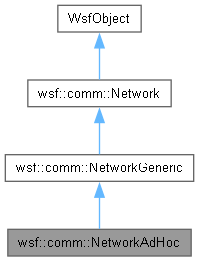
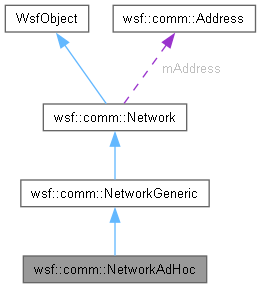
Public Types | |
| using | NamedRateMap = std::unordered_map<NamedComm, WsfRandomVariable> |
| using | AddressRateMap = std::unordered_map<Address, WsfRandomVariable> |
| Public Types inherited from wsf::comm::Network | |
| using | AddressList = std::vector<Address> |
| using | AddressLinkList = std::vector<std::pair<Address, Address>> |
| using | NamedList = std::vector<NamedComm> |
| using | NamedLinkList = std::vector<std::pair<NamedComm, NamedComm>> |
| Public Types inherited from WsfObject | |
| typedef std::vector< WsfStringId > | TypeList |
| The list of types returned by GetTypeList. | |
Public Member Functions | |
| NetworkAdHoc ()=default | |
| ~NetworkAdHoc () override=default | |
| NetworkAdHoc (const NetworkAdHoc &aSrc) | |
| NetworkAdHoc & | operator= (const NetworkAdHoc &aRhs) |
| NetworkAdHoc (const std::string &aNetworkName, const Address &aAddress) | |
| bool | ProcessInput (UtInput &aInput) override |
| NetworkAdHoc * | Clone () const override |
| const char * | GetScriptClassName () const override |
| bool | Initialize (WsfSimulation &aSim) override |
| void | ChangeRate (WsfSimulation &aSim, const WsfRandomVariable &aRate) |
| void | AddNamedRate (const NamedComm &aComm, const WsfRandomVariable &aRate, WsfSimulation *aSimPtr=nullptr) |
| void | AddAddressRate (const Address &aAddress, const WsfRandomVariable &aRate, WsfSimulation *aSimPtr=nullptr) |
| bool | RemoveNamedRate (const NamedComm &aComm) |
| bool | RemoveAddressRate (const Address &aAddress) |
| WsfRandomVariable * | GetNamedRate (const NamedComm &aComm) |
| WsfRandomVariable * | GetAddressRate (const Address &aAddress) |
| Public Member Functions inherited from wsf::comm::NetworkGeneric | |
| NetworkGeneric ()=default | |
| NetworkGeneric (const std::string &aNetworkName, const Address &aAddress) | |
| ~NetworkGeneric () override=default | |
| NetworkGeneric (const NetworkGeneric &aSrc)=default | |
| NetworkGeneric & | operator= (const NetworkGeneric &aRhs)=default |
| NetworkGeneric (NetworkGeneric &&aRhs)=default | |
| bool | ProcessInput (UtInput &aInput) override |
| NetworkGeneric * | Clone () const override |
| const char * | GetScriptClassName () const override |
| Public Member Functions inherited from wsf::comm::Network | |
| Network ()=default | |
| ~Network () override=default | |
| Network (const std::string &aNetworkName, const Address &aAddress) | |
| Network (const Network &aSrc)=default | |
| Network & | operator= (const Network &aRhs)=default |
| Network (Network &&aSrc)=default | |
| bool | InitializeLinkage (WsfSimulation &aSimulation) |
| const char * | GetScriptClassName () const override |
| bool | AddMember (const Address &aAddress, WsfSimulation &aSimulation, const Address &aOptionalAddress=Address()) |
| bool | RemoveMember (const Address &aAddress, WsfSimulation &aSimulation, const Address &aOptionalAddress=Address()) |
| bool | AddLink (const Address &aSourceAddress, const Address &aDestinationAddress, WsfSimulation &aSimulation, const Address &aOptionalAddress=Address()) |
| bool | RemoveLink (const Address &aSourceAddress, const Address &aDestinationAddress, WsfSimulation &aSimulation, const Address &aOptionalAddress=Address()) |
| void | SetAddress (const Address &aAddress) |
| void | SetIsManaged (bool aManaged) |
| const Address & | GetAddress () const |
| size_t | GetHostsMax () const |
| bool | IsManaged () const |
| const NamedList & | GetNamedMemberList () const |
| bool | HasMember (const Address &aAddress) const |
| Public Member Functions inherited from WsfObject | |
| WsfObject () | |
| This is the constructor for the WsfObject class. | |
| ~WsfObject () override | |
| This is the destructor for the WsfObject class. | |
| const char * | GetScriptClassName () const override |
| const std::string & | GetType () const |
| WsfStringId | GetTypeId () const |
| Get the string ID of the 'type' of the object. | |
| void | SetType (WsfStringId aType) |
| const std::string & | GetBaseType () const |
| WsfStringId | GetBaseTypeId () const |
| const TypeList & | GetTypeList () const |
| bool | IsA_TypeOf (WsfStringId aType) const |
| WsfObject & | operator= (const WsfObject &aRhs) |
| Assignment operator. | |
| template<typename T> | |
| void | Serialize (T &aBuff) |
| For XIO (de)serialization. | |
| const std::string & | GetName () const |
| WsfStringId | GetNameId () const |
| void | SetName (WsfStringId aName) |
Protected Member Functions | |
| bool | ProcessNamedRate (UtInput &aInput) |
| Input methods for member-specific update rates. | |
| bool | ProcessAddressRate (UtInput &aInput) |
| void | Update (WsfSimulation &aSim) |
| void | Update (WsfSimulation &aSim, const NamedComm &aComm) |
| void | Update (WsfSimulation &aSim, const Address &aAddress) |
| Protected Member Functions inherited from wsf::comm::NetworkGeneric | |
| bool | InitializeLinkageP (WsfSimulation &aSimulation) override |
| bool | AddLinkP (const Address &aSourceAddress, const Address &aDestinationAddress, WsfSimulation &aSimulation, const Address &aOptionalAddress=Address()) override |
| bool | RemoveLinkP (const Address &aSourceAddress, const Address &aDestinationAddress, WsfSimulation &aSimulation, const Address &aOptionalAddress=Address()) override |
| bool | RemoveMemberP (const Address &aAddress, WsfSimulation &aSimulation, const Address &aOptionalAddress=Address()) override |
| virtual bool | AddMemberP (const Address &aAddress, WsfSimulation &aSimulation, const Address &aOptionalAddress=Address()) |
| virtual bool | ProcessAddressListInput (UtInput &aInput) |
| virtual bool | ProcessAddressLinkListInput (UtInput &aInput) |
| virtual bool | ProcessNamedListInput (UtInput &aInput) |
| virtual bool | ProcessNamedLinkListInput (UtInput &aInput) |
| WsfObject (const WsfObject &aSrc) | |
| Copy constructor (for Clone()). | |
Additional Inherited Members | |
| static Address | GetAddressFromNamedComm (WsfStringId aPlatformName, WsfStringId aCommName, WsfSimulation &aSimulation) |
| Address | mAddress {} |
| AddressList | mAddressList {} |
| AddressList | mInputAddressList {} |
| AddressLinkList | mAddressLinkList {} |
| AddressLinkList | mInputAddressLinkList {} |
| Same case as "mInputAddressList" above, except with link definitions. | |
| NamedList | mNamedList {} |
| NamedLinkList | mNamedLinkList {} |
| bool | mManaged {false} |
| True if this network is being managed by the simulation. | |
Detailed Description
NetworkAdHoc is a network type that, like the generic network, has no specific topology associated with it. However, this network type can alter the truth based (network manager) links within the network during the simulation run based on the query of comm model implementation dependent checks on connectivity with peers (via Comm::CanSendTo()). Thus, this network type dynamically updates the simulation truth state during runtime.
Note that this is not a replacement for a formal ad-hoc routing protocol. Such protocols are generally reactive based on the discovery (and loss of connectivity) of other nodes, and as such this network type can drive such a protocol.
Member Typedef Documentation
◆ AddressRateMap
| using wsf::comm::NetworkAdHoc::AddressRateMap = std::unordered_map<Address, WsfRandomVariable> |
◆ NamedRateMap
| using wsf::comm::NetworkAdHoc::NamedRateMap = std::unordered_map<NamedComm, WsfRandomVariable> |
These definitions provide the containers used to associate update rates for specific members in the network. They can be provided either via a named comm pair, or an address. An update rate for a specific member overrides the generic update rate.
Constructor & Destructor Documentation
◆ NetworkAdHoc() [1/3]
|
default |
Referenced by Clone(), NetworkAdHoc(), operator=(), and ~NetworkAdHoc().
◆ ~NetworkAdHoc()
|
overridedefault |
References Clone(), NetworkAdHoc(), operator=(), and ProcessInput().
◆ NetworkAdHoc() [2/3]
| wsf::comm::NetworkAdHoc::NetworkAdHoc | ( | const NetworkAdHoc & | aSrc | ) |
References NetworkAdHoc(), and wsf::comm::NetworkGeneric::NetworkGeneric().
◆ NetworkAdHoc() [3/3]
| wsf::comm::NetworkAdHoc::NetworkAdHoc | ( | const std::string & | aNetworkName, |
| const Address & | aAddress ) |
References wsf::comm::NetworkGeneric::NetworkGeneric().
Member Function Documentation
◆ AddAddressRate()
| void wsf::comm::NetworkAdHoc::AddAddressRate | ( | const Address & | aAddress, |
| const WsfRandomVariable & | aRate, | ||
| WsfSimulation * | aSimPtr = nullptr ) |
References WsfSimulation::AddEvent(), WsfSimulation::GetSimTime(), and Update().
Referenced by ProcessAddressRate().
◆ AddNamedRate()
| void wsf::comm::NetworkAdHoc::AddNamedRate | ( | const NamedComm & | aComm, |
| const WsfRandomVariable & | aRate, | ||
| WsfSimulation * | aSimPtr = nullptr ) |
Mutators for member-specific rate containers Returns true if add/remove operation successful Presence of optional simulation pointer indicates the need to schedule the event.
References WsfSimulation::AddEvent(), WsfSimulation::GetSimTime(), and Update().
Referenced by ProcessNamedRate().
◆ ChangeRate()
| void wsf::comm::NetworkAdHoc::ChangeRate | ( | WsfSimulation & | aSim, |
| const WsfRandomVariable & | aRate ) |
Change the update rate Note: This only occurs after the next update. If the update rate is set to never fire, this will schedule the first update event from the time of this call.
References WsfSimulation::AddEvent(), WsfSimulation::GetSimTime(), WsfRandomVariable::SetGenerator(), and Update().
◆ Clone()
|
overridevirtual |
Return a copy of this object. Must be implemented by all derived types. If cloning is impossible, a WsfUncloneableException should be thrown.
Reimplemented from wsf::comm::Network.
References NetworkAdHoc().
Referenced by ~NetworkAdHoc().
◆ GetAddressRate()
| WsfRandomVariable * wsf::comm::NetworkAdHoc::GetAddressRate | ( | const Address & | aAddress | ) |
Referenced by Update().
◆ GetNamedRate()
| WsfRandomVariable * wsf::comm::NetworkAdHoc::GetNamedRate | ( | const NamedComm & | aComm | ) |
Find methods for specified member rate Returns nullptr if rate is not found
Referenced by Update().
◆ GetScriptClassName()
|
inlineoverride |
◆ Initialize()
|
overridevirtual |
Reimplemented from wsf::comm::Network.
References WsfSimulation::AddEvent(), WsfSimulation::GetSimTime(), simTime, and Update().
◆ operator=()
| NetworkAdHoc & wsf::comm::NetworkAdHoc::operator= | ( | const NetworkAdHoc & | aRhs | ) |
References NetworkAdHoc(), and wsf::comm::NetworkGeneric::operator=().
Referenced by ~NetworkAdHoc().
◆ ProcessAddressRate()
|
protected |
References AddAddressRate(), wsf::comm::Address::ProcessInput(), WsfRandomVariable::ProcessInput(), and RemoveAddressRate().
Referenced by ProcessInput().
◆ ProcessInput()
|
overridevirtual |
Process input from a generic source.
Examine the current input command. If it is NOT one of the commands recognized by this class then it simply returns 'false'. If it is one of the commands recognized by this class then it processes the command and returns 'true'.
- Parameters
-
aInput a reference to a UtInput object.
- Returns
- 'true' if the command was one recognized by the class or 'false' if not.
- Exceptions
-
UtInput::ExceptionBase (or an object derived from it) if the command was recognized but contains some sort of error.
- Note
- If a derived class does not recognize the command (i.e.: the return value is false) then it should call the base class ProcessInput method. This chain should continue until either the command is recognized or the top-level base class is encountered.
Reimplemented from wsf::comm::Network.
References ProcessAddressRate(), wsf::comm::NetworkGeneric::ProcessInput(), and ProcessNamedRate().
Referenced by ~NetworkAdHoc().
◆ ProcessNamedRate()
|
protected |
Input methods for member-specific update rates.
References AddNamedRate(), wsf::comm::Network::NamedComm::mCommName, wsf::comm::Network::NamedComm::mPlatformName, WsfRandomVariable::ProcessInput(), and RemoveNamedRate().
Referenced by ProcessInput().
◆ RemoveAddressRate()
| bool wsf::comm::NetworkAdHoc::RemoveAddressRate | ( | const Address & | aAddress | ) |
Referenced by ProcessAddressRate().
◆ RemoveNamedRate()
| bool wsf::comm::NetworkAdHoc::RemoveNamedRate | ( | const NamedComm & | aComm | ) |
Referenced by ProcessNamedRate().
◆ Update() [1/3]
|
protected |
Update Methods These methods drive the connectivity updates for the network. The Update method with only the sim parameter is called for the generic update interval, while each member that has a specified rate uses the appropriate Update call. These methods are only called from within the class at appropriate times (via a scheduled event) and will reschedule the event as necessary.
References WsfSimulation::AddEvent(), wsf::comm::Network::AddLink(), GetAddressRate(), wsf::comm::NetworkManager::GetComm(), WsfSimulation::GetCommNetworkManager(), GetNamedRate(), WsfSimulation::GetSimTime(), wsf::comm::Network::mAddressList, wsf::comm::Network::RemoveLink(), and Update().
Referenced by AddAddressRate(), AddNamedRate(), ChangeRate(), Initialize(), Update(), Update(), and Update().
◆ Update() [2/3]
|
protected |
◆ Update() [3/3]
|
protected |
References WsfSimulation::AddEvent(), wsf::comm::Network::AddLink(), wsf::comm::NetworkManager::GetComm(), WsfSimulation::GetCommNetworkManager(), WsfSimulation::GetPlatformByName(), WsfSimulation::GetSimTime(), wsf::comm::Network::mAddressList, wsf::comm::Network::NamedComm::mCommName, wsf::comm::Network::NamedComm::mPlatformName, platformPtr, wsf::comm::Network::RemoveLink(), and Update().
The documentation for this class was generated from the following files: