#include <WsfComm.hpp>
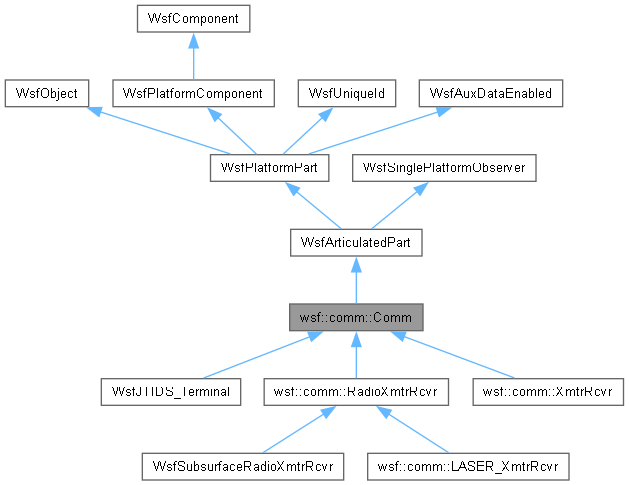
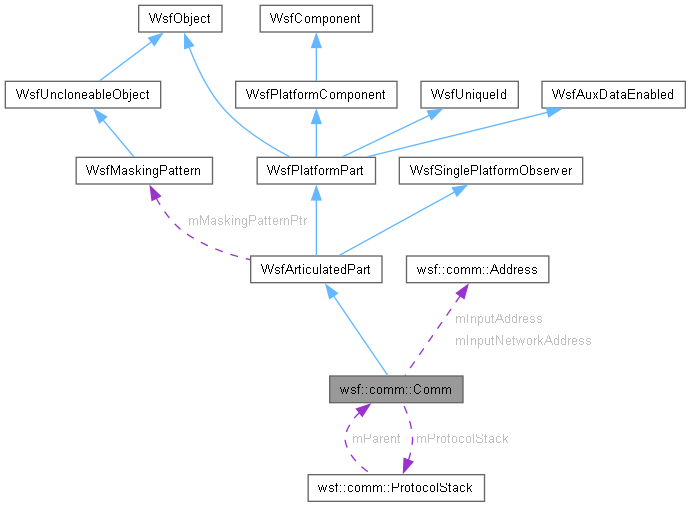
Classes | |
| struct | Gateway |
Public Types | |
| enum | CommType { cCT_XMT_ONLY = 0x0001 , cCT_RCV_ONLY = 0x0002 , cCT_XMT_RCV = cCT_XMT_ONLY | cCT_RCV_ONLY } |
| enum class | MulticastConformanceLevel : size_t { cLEVEL_0 , cLEVEL_1 , cLEVEL_2 } |
| using | LinkAddress = std::vector<wsf::comm::Address> |
| using | LinkPair = std::vector<std::pair<std::string, std::string>> |
| Public Types inherited from WsfArticulatedPart | |
| enum | SlewMode { cSLEW_FIXED = 0 , cSLEW_AZ = 1 , cSLEW_EL = 2 , cSLEW_AZ_EL = 3 } |
| enum | SlewDirection { cUNDEFINED = 0 , cPOSITIVE = 1 , cNEGATIVE = 2 } |
| enum | { cNOT_CUED = 0x0000 , cMIN_AZ = 0x0001 , cMAX_AZ = 0x0002 , cMIN_EL = 0x0004 , cMAX_EL = 0x0008 , cAT_LIMIT_AZ_MASK = 0x0003 , cAT_LIMIT_EL_MASK = 0x000B , cAT_LIMIT_MASK = 0x000F , cCUED_AZ = 0x0010 , cCUED_EL = 0x0020 , cCUED_AZ_EL = 0x0030 , cCUED_MASK = 0x0030 } |
| enum | CueType { cCUED_TO_NOTHING , cCUED_TO_LOCATION , cCUED_TO_ANGLE } |
| Public Types inherited from WsfPlatformPart | |
| enum | { cLEVEL_ONE_DEBUG = 0x00000001 , cLEVEL_TWO_DEBUG = 0x00000002 } |
| using | InternalMessageQueue = std::queue<WsfMessage*> |
| using | RecipientMessageQueue = std::queue<std::pair<WsfPlatformPart*, WsfMessage*>> |
| Public Types inherited from WsfObject | |
| typedef std::vector< WsfStringId > | TypeList |
| The list of types returned by GetTypeList. | |
| Public Types inherited from WsfComponentT< WsfPlatform > | |
| typedef WsfPlatform | ParentType |
| This is needed to support the WsfComponentList template. | |
Public Member Functions | |
| Comm (const WsfScenario &aScenario, CommType aCommType=cCT_XMT_RCV) | |
| ~Comm () override=default | |
| Comm & | operator= (const Comm &aRhs)=delete |
| Public Member Functions inherited from WsfArticulatedPart | |
| WsfArticulatedPart (const WsfScenario &aScenario, int aPartType) | |
| WsfArticulatedPart (const WsfArticulatedPart &aSrc) | |
| ~WsfArticulatedPart () override | |
| void | SetPositionRateECS (const double aDX, const double aDY, const double aDZ) |
| void | GetCurrentPositionRateECS (double &aDX, double &aDY, double &aDZ) const |
| double | GetDX () const |
| double | GetDY () const |
| double | GetDZ () const |
| void | EnableArticulationUpdates (double aSimTime, double aInterval) |
| void | DisableArticulationUpdates (double aSimTime) |
| void | SetArticulationUpdateInterval (double aUpdateInterval) |
| double | GetArticulationUpdateInterval () const |
| unsigned int | GetArticulationUpdateEventEpoch () const |
| void | IncrementArticulationUpdateEventEpoch () |
| bool | ArticulationUpdateEventActive () const |
| Is an 'Update' event active? | |
| void | SetArticulationUpdateEventActive (bool aUpdateEventActive) |
| Indicate if the 'Update' event is active. | |
| virtual double | TimeToCue (double aDesiredAz, double aDesiredEl) const |
| const int * | GetComponentRoles () const override |
| void * | QueryInterface (int aRole) override |
| const char * | GetScriptClassName () const override |
| bool | Initialize (double aSimTime) override |
| bool | ProcessInput (UtInput &aInput) override |
| void | SetPlatform (WsfPlatform *aPlatformPtr) override |
| virtual void | UpdatePosition (double aSimTime) |
| void | OnPlatformUpdated (double, WsfPlatform *) override |
| SlewMode | GetSlewMode () const |
| Get the allowed slewing mode. | |
| double | GetAzSlewRate () const |
| Get the current azimuth slew rate. | |
| double | GetElSlewRate () const |
| Get the current elevation slew rate. | |
| double | GetMaxAzSlewRate () const |
| Get the maximum allowable azimuth slew rate. | |
| double | GetMaxElSlewRate () const |
| Get the maximum allowable elevation slew rate. | |
| double | GetMinAzSlew () const |
| Gets the minimum azimuth slew limit. | |
| double | GetMaxAzSlew () const |
| Gets the maximum azimuth slew limit. | |
| double | GetMinElSlew () const |
| Gets the minimum elevation slew limit. | |
| double | GetMaxElSlew () const |
| Gets the maximum elevation slew limit. | |
| int | GetSlewState () const |
| Get the slew limit state. | |
| void | SetSlewMode (SlewMode aSlewMode) |
| Set the allowed slewing mode. | |
| void | SetSlewRates (double aAzSlewRate, double aElSlewRate) |
| Set the angular slew rates, limited by the maximum slew rates. | |
| void | SetAzSlewLimits (double aMinAzSlew, double aMaxAzSlew) |
| Set the azimuth slew limits. | |
| void | SetElSlewLimits (double aMinElSlew, double aMaxElSlew) |
| Set the elevation slew limits. | |
| void | SetAzimuthSlewDirection (SlewDirection aAzSlewDirection) |
| Set the azimuth slew direction. | |
| bool | IsSlewing () const |
| bool | WithinSlewLimits (double aThisToTgtAz, double aThisToTgtEl) const |
| SlewMode | GetCueMode () const |
| Get the allowed cueing mode. | |
| double | GetAzCueRate () const |
| Get the azimuth cue rate. | |
| double | GetElCueRate () const |
| Get the elevation cue rate. | |
| double | GetMinAzCue () const |
| Gets the minimum azimuth cue limit. | |
| double | GetMaxAzCue () const |
| Gets the maximum azimuth cue limit. | |
| double | GetMinElCue () const |
| Gets the minimum elevation cue limit. | |
| double | GetMaxElCue () const |
| Gets the maximum elevation cue limit. | |
| void | SetCueMode (SlewMode aCueMode) |
| Set the allowed cueing mode. | |
| void | SetCueRates (double aAzCueRate, double aElCueRate) |
| Set the angular cueing rates. | |
| void | SetAzCueLimits (double aMinAzCue, double aMaxAzCue) |
| Set the azimuth cueing limits. | |
| void | SetElCueLimits (double aMinElCue, double aMaxElCue) |
| Set the elevation cueing limits. | |
| double | GetRoll () const |
| void | SetRoll (double aRoll) |
| Set the platform-relative (ECS) roll angle of the articulated part. | |
| double | GetPitch () const |
| void | SetPitch (double aPitch) |
| double | GetYaw () const |
| void | SetYaw (double aYaw) |
| Set the platform-relative (ECS) yaw angle of the articulated part. | |
| double | GetTilt () const |
| void | SetTilt (double aTilt) |
| void | GetCurrentOrientationECS (double &aYaw, double &aPitch, double &aRoll) |
| void | GetLOS_UnitVectorWCS (double aUnitLOS_WCS[3]) |
| Get the current WCS Frame Line-Of-Sight unit vector. | |
| CueType | GetCueType () const |
| bool | IsCued () const |
| Get the cued status. | |
| void | ClearCueing () |
| bool | GetActualCuedOrientation (double &aAzimuth, double &aElevation) const |
| void | GetCurrentCuedOrientation (double &aAzimuth, double &aElevation) const |
| bool | GetCuedLocationWCS (double aCuedLocationWCS[3]) const |
| void | SetCuedLocationWCS (const double aCuedLocationWCS[3]) |
| bool | GetCuedOrientation (double &aAzimuth, double &aElevation) const |
| void | SetCuedOrientation (double aAzimuth, double aElevation) |
| void | GetAbsoluteCuedOrientation (double &aAzimuth, double &aElevation, double aBaseNED[3]) |
| void | ClearTransientCue () |
| bool | TransientCueActive () const |
| bool | GetTransientCuedLocationWCS (double aCuedLocationWCS[3]) const |
| void | SetTransientCuedLocationWCS (const double aCuedLocationWCS[3]) |
| WsfStringId | GetMaskingPatternState () const |
| void | SetMaskingPatternState (WsfStringId aMaskingPatternStateId) |
| double | GetMaskingPatternFactor (double aViewAzPCS, double aViewElPCS, const double aViewVecWCS[3]) |
| void | SetIsPrivate (bool aIsPrivate) |
| bool | IsPrivate () const |
| Public Member Functions inherited from WsfPlatformPart | |
| WsfPlatformPart (const WsfScenario &aScenario, int aPartType) | |
| WsfPlatformPart & | operator= (const WsfPlatformPart &aRhs)=delete |
| ~WsfPlatformPart () override | |
| const int * | GetComponentRoles () const override |
| void * | QueryInterface (int aRole) override |
| bool | DebugEnabled () const |
| Returns 'true' if debugging is enabled for this instance. | |
| void | SetDebugEnabled (bool aDebugEnabled) |
| unsigned int | GetDebugMask () |
| bool | IsExternallyControlled () const |
| virtual void | SetExternallyControlled (double aSimTime, bool aIsExternallyControlled) |
| int | GetPartType () const |
| const char * | GetScriptClassName () const override |
| WsfSimulation * | GetSimulation () const |
| const WsfScenario & | GetScenario () const |
| WsfStringId | GetComponentName () const override |
| void | ComponentParentChanged (WsfPlatform *aPlatformPtr) override |
| bool | Initialize (double aSimTime) override |
| bool | Initialize2 (double aSimTime) override |
| bool | ProcessInput (UtInput &aInput) override |
| WsfPlatform * | GetPlatform () const |
| virtual void | PlatformAdded (double aSimTime, WsfPlatform *aPlatformPtr) |
| virtual void | PlatformDeleted (WsfPlatform *aPlatformPtr) |
| double | GetLastStatusChangeTime () const |
| void | SetLastStatusChangeTime (double aSimTime) |
| Allows a system to set the time at which the device was initialized. | |
| bool | CanBeMadeOperational () const |
| Returns an indication that this system can be made operational. | |
| bool | CanBeMadeNonOperational () const |
| Returns an indication that this system can be made non-operational. | |
| bool | CanBeTurnedOn () const |
| Returns an indication that this system can be turned on. | |
| bool | CanBeTurnedOff () const |
| Returns an indication that this system can be turned off. | |
| bool | IsTurnedOn () const |
| bool | InitiallyTurnedOn () const |
| Is the system to be turned 'on' when added to the simulation? | |
| void | SetInitiallyTurnedOn (bool aInitiallyTurnedOn) |
| Sets if the system is turned on when added to the simulation. | |
| virtual void | Restore (double aSimTime) |
| bool | IsOperational () const |
| bool | SetOperational (double aSimTime, bool aMakeOperational) |
| double | GetDamageFactor () const |
| bool | SetDamageFactor (double aSimTime, double aDamageFactor) |
| bool | IsCritical () const |
| void | SetCritical (bool aValue) |
| virtual void | OnPlatformBrokenEvent (double aSimTime) |
| Owning platform has issued a broken event. | |
| bool | IsBroken () const |
| WsfInternalLinks & | GetInternalLinks () |
| Return the internal links for this part. | |
| virtual bool | HasInternalLinks () const |
| Does this platform part have a communication link to other platform parts? | |
| virtual bool | ProcessMessage (double aSimTime, const WsfMessage &aMessage) |
| virtual bool | ReceiveMessage (double aSimTime, const WsfMessage &aMessage) |
| virtual void | SendMessage (double aSimTime, const WsfMessage &aMessage) |
| virtual void | SendMessageTo (double aSimTime, const WsfMessage &aMessage, WsfStringId aRecipientId) |
| void | SendMessageToProcessor (double aSimTime, const WsfMessage &aMessage, WsfStringId aRecipientId) |
| virtual void | SendQueuedMessages (double aSimTime) |
| const WsfCategoryList & | GetCategories () const |
| Get the categories to which this part belongs. | |
| void | AddCategory (WsfStringId aCategoryId) |
| Adds the provided category to the platform part's category list. | |
| bool | IsCategoryMember (WsfStringId aCategoryId) const |
| const WsfGroupList & | GetGroups () const |
| Get the groups to which this platform part belongs. | |
| void | JoinGroup (WsfGroup *aGroupPtr) |
| Join the given group. | |
| void | LeaveGroup (WsfGroup *aGroupPtr) |
| Leave the given group. | |
| bool | IsGroupMember (WsfStringId aGroupId) |
| unsigned int | GetUpdateEventEpoch () const |
| void | IncrementUpdateEventEpoch () |
| bool | UpdateEventActive () const |
| Is an 'Update' event active? | |
| void | SetUpdateEventActive (bool aUpdateEventActive) |
| Indicate if the 'Update' event is active. | |
| Public Member Functions inherited from WsfObject | |
| WsfObject () | |
| This is the constructor for the WsfObject class. | |
| ~WsfObject () override | |
| This is the destructor for the WsfObject class. | |
| const char * | GetScriptClassName () const override |
| const std::string & | GetType () const |
| WsfStringId | GetTypeId () const |
| Get the string ID of the 'type' of the object. | |
| void | SetType (WsfStringId aType) |
| const std::string & | GetBaseType () const |
| WsfStringId | GetBaseTypeId () const |
| const TypeList & | GetTypeList () const |
| bool | IsA_TypeOf (WsfStringId aType) const |
| WsfObject & | operator= (const WsfObject &aRhs) |
| Assignment operator. | |
| template<typename T> | |
| void | Serialize (T &aBuff) |
| For XIO (de)serialization. | |
| const std::string & | GetName () const |
| WsfStringId | GetNameId () const |
| void | SetName (WsfStringId aName) |
| Public Member Functions inherited from WsfComponentT< WsfPlatform > | |
| WsfComponentT () | |
| WsfComponentT (const WsfComponentT &) noexcept | |
| WsfComponentT & | operator= (const WsfComponentT &) noexcept |
| ~WsfComponentT () override=default | |
| ParentType * | GetComponentParent () const |
| void | SetComponentParent (ParentType *aParentPtr) |
| Public Member Functions inherited from WsfComponent | |
| virtual | ~WsfComponent ()=default |
| template<typename T> | |
| bool | QueryInterfaceT (T *&aRolePtr) |
| bool | ComponentHasRole (int aRole) |
| Returns true if the component has the specified role. | |
| Public Member Functions inherited from WsfUniqueId | |
| WsfUniqueId () | |
| Construtor initializes the unique identifier to 0. | |
| WsfUniqueId (const WsfUniqueId &) | |
| Copy constructor initializes the unique identifier to 0. | |
| WsfUniqueId & | operator= (const WsfUniqueId &) |
| unsigned int | GetUniqueId () const |
| Get the unique identifier assigned to this object. | |
| template<typename T> | |
| void | Serialize (T &aBuff) |
| For XIO (de)serialization. | |
| Public Member Functions inherited from WsfAuxDataEnabled | |
| WsfAuxDataEnabled ()=default | |
| WsfAuxDataEnabled (const WsfAuxDataEnabled &aSrc)=default | |
| WsfAuxDataEnabled & | operator= (const WsfAuxDataEnabled &aRhs) |
| WsfAuxDataEnabled (WsfAuxDataEnabled &&)=default | |
| WsfAuxDataEnabled & | operator= (WsfAuxDataEnabled &&)=default |
| virtual | ~WsfAuxDataEnabled () noexcept |
| void | SetAuxData (const WsfAttributeContainer &aAuxData) |
| void | DeleteAuxData () |
| Delete the aux data container from the object. | |
| void | MergeAuxData (const WsfAuxDataEnabled &aSrc) |
| Merge the object's aux data with aux data from an existing object. | |
| void | UpdateAuxData (const WsfAuxDataEnabled &aSrc) |
| Update the object's aux data with aux data from an existing object. | |
| bool | HasAuxData () const |
| Returns true if this object has aux data. | |
| bool | ProcessInput (UtInput &aInput) |
| template<typename T> | |
| void | Serialize (T &aBuff) |
| (De)serialization for XIO | |
| WsfAttributeContainer & | GetAuxData () |
| const WsfAttributeContainer & | GetAuxData () const noexcept |
| const WsfAttributeContainer & | GetAuxDataConst () const noexcept |
| Public Member Functions inherited from WsfSinglePlatformObserver | |
| virtual | ~WsfSinglePlatformObserver () |
| virtual void | OnPlatformDeleting (double aSimTime, WsfPlatform *aPlatformPtr) |
| Called before the platform is actually deleted. | |
| virtual void | OnPlatformDeleted (double aSimTime, WsfPlatform *aPlatformPtr) |
| Called just before the platform is removed from the simulation. | |
Friends | |
| class | Event |
Component list support. | |
A comm contains a list of components. | |
| using | ComponentList = WsfComponentListT<WsfComponentT<Comm>> |
| ComponentList & | GetComponents () |
| const ComponentList & | GetComponents () const |
Send/Receive Action Call | |
Implementation defined methods for collecting common actions taken for message transmission/reception upon determination of the success or failure of a transmission/reception via Send/Receive call functionality. | |
| ProtocolStack | mProtocolStack |
| Protocol stack used by this comm device. | |
| Address | mInputAddress |
| A user supplied address indicated for use with this interface. May be null if not specified. | |
| std::string | mInputNetwork |
| A user supplied network, for indicating which network this interface should join. | |
| Address | mInputNetworkAddress |
| A user supplied network address, for indicating which network this interface should join. | |
| size_t | mNumChannels |
| virtual bool | SendActions (double aSimTime, bool aSendStatus, Message &aMessage) |
| virtual bool | ReceiveActions (double aSimTime, bool aReceiveStatus, Comm *aXmtrPtr, Message &aMessage) |
| virtual void | PrintDebugReception (double aSimTime, const Message &aMessage) const |
| Displays debug info associated with message reception. | |
| Comm (const Comm &aSrc) | |
| Copy constructor (for Clone()). | |
| void | SetUpdateInterval (double aInterval) override |
| double | GetUpdateInterval () const override |
| void | SetClassId (WsfStringId aClassId) |
| virtual bool | ValidateGateway () |
| Helper method for ensuring/setting valid gateways. | |
Component infrastructure methods not provided by WsfPlatformPart. | |
| WsfComponent * | CloneComponent () const override |
| const int * | GetComponentRoles () const override |
| void * | QueryInterface (int aRole) override |
| int | GetComponentInitializationOrder () const override |
Common infrastructure methods. | |
| const char * | GetScriptClassName () const override |
| Comm * | Clone () const override |
| Standard Clone() method. | |
| bool | PreInitialize (double aSimTime) override |
| bool | Initialize (double aSimTime) override |
| bool | Initialize2 (double aSimTime) override |
| void | PreInput () override |
| bool | ProcessInput (UtInput &aInput) override |
| void | Update (double aSimTime) override |
| virtual void | Setup () |
| virtual void | PendingStart () |
Status methods. | |
| void | PartBroken (double aSimTime) override |
| void | SetNonOperational (double aSimTime) override |
| void | SetOperational (double aSimTime) override |
| void | TurnOff (double aSimTime) override |
| void | TurnOn (double aSimTime) override |
Link Methods | |
Specifies linkage to this interface. | |
| virtual void | AddLinkAddress (const Address &aAddress) |
| virtual void | AddLink (const std::string &aPlatformName, const std::string &aCommName) |
Gateway Methods | |
| const Address & | GetGateway () const |
| const std::string & | GetGatewayRemotePlatform () const |
| const std::string & | GetGatewayRemoteComm () const |
| void | SetGateway (const Address &aAddress) |
CanSendTo | |
The CanSendTo method provides an interface for use with all comm objects as a unified entry point to determine whether or not another comm device can receive a transmission from this comm object. The determination of this may rely on many factors based on the actual implementation of each comm device. For example, the base case may only check that the receiving comm is on and is able to receive. More advanced versions may rely on the existence of specific hardware, or even EM interactions. | |
| virtual bool | CanSendTo (double aSimTime, Comm *aRcvrPtr, Message *aMessagePtr=nullptr) |
Send/Receive methods | |
| |
| virtual bool | Receive (double aSimTime, Comm *aXmtrPtr, Message &aMessage) |
| virtual bool | Send (double aSimTime, std::unique_ptr< WsfMessage > aMessagePtr, const Address &aAddress) |
| virtual WSF_DEPRECATED bool | Send (double aSimTime, const WsfMessage &aMessage, const Address &aAddress) final |
Comm event methods. | |
| virtual bool | ProcessLayerMessage (double aSimTime, size_t aLayerIndex, layer::Message aLayerMessage, Message *aCommMessagePtr) |
| Process a layer event. | |
| CommType | GetCommType () const |
| Returns the comm device's true type as was intended on construction. | |
| WsfStringId | GetClassId () const |
| const Address & | GetAddress () const |
| const Address & | GetInputAddress () const |
| Returns the user indicated interface address. | |
| const std::string & | GetNetwork () const |
| size_t | GetNumChannels () const |
| const std::string & | GetInputNetwork () const |
| Returns the user indicated network membership. | |
| const Address & | GetInputNetworkAddress () const |
| Returns the user indicated network membership in address format. | |
| const LinkAddress & | GetLinkAddresses () const |
| Returns the user suppled interface linkage in address format. | |
| const LinkPair & | GetLinkPairs () const |
| Returns the user supplied interface linkage in platform/comm name format. | |
| void | SetAddress (const Address &aAddress) |
| void | SetNetwork (const std::string &aNetwork) |
| virtual std::string | GetFullName () const |
| Returns comm device name as a string. | |
| virtual bool | CanReceive () const |
| virtual bool | CanSend () const |
| void | SetReceiveEnabled (bool aIsEnabled) |
| void | SetTransmitEnabled (bool aIsEnabled) |
| router::Router * | GetRouter () const |
| void | SetRouter (router::Router *aRouterPtr) |
| const std::string & | GetRouterName () const |
| void | SetRouterName (const std::string &aRouterName) |
| std::vector< ProtocolInterface * > | GetSortedProtocols () const |
Multicast Methods | |
| MulticastConformanceLevel | GetMulticastLevel () const |
| virtual void | SetMulticastLevel () |
| ProtocolStack & | GetProtocolStack () |
| Accessor/mutator for protocol stack. | |
| const ProtocolStack & | GetProtocolStack () const |
Send/Receive Setup Calls | |
Send/Receive method hooks Implementation defined methods for collecting common actions taken for message transmission/reception. In the base implementation, the send method takes a newly created comm::Message from a standard WsfMessage and performs necessary setup for comm framework utilization prior/during the public Send call. In the receive setup method, the base implementation simply checks that the comm is on and prints debug information, if applicable. | |
| virtual bool | SendSetup (double aSimTime, Message &aMessage, const Address &aAddress) |
| virtual bool | ReceiveSetup (double aSimTime, Comm *aXmtrPtr, Message &aMessage) |
Additional Inherited Members | |
| UtCallbackListN< void(double)> | SlewComplete |
| Static Public Attributes inherited from WsfArticulatedPart | |
| static constexpr double | cINFINITE_SLEW_RATE = 1.0E+12 * UtMath::cRAD_PER_DEG |
| static constexpr double | cALMOST_FULL_CIRCLE = 359.999 * UtMath::cRAD_PER_DEG |
| Static Public Attributes inherited from WsfAuxDataEnabled | |
| static UtCallbackListN< void(const WsfAuxDataEnabled *)> | AuxDataAccessed |
| static UtCallbackListN< void(const WsfAuxDataEnabled *)> | AuxDataDestroyed |
| bool | FullCircle () const |
| virtual double | GetAzimuthRotationRate () const |
| virtual double | GetElevationRotationRate () const |
| void | SlewToOrientation (double aSimTime, double aDesiredAz, double aDesiredEl) |
| virtual void | TimeToRotate (double &aDeltaAz, double &aDeltaEl, double &aAzRate, double &aElRate, double &aTimeToAz, double &aTimeToEl) const |
| void | UpdateCuedOrientation (double aSimTime) |
| bool | UpdateOrientation (double aSimTime) |
| WsfPlatformPart (const WsfPlatformPart &aSrc) | |
| Copy constructor (for Clone()). | |
| WsfObject (const WsfObject &aSrc) | |
| Copy constructor (for Clone()). | |
| Protected Member Functions inherited from WsfUniqueId | |
| void | AssignUniqueId (WsfSimulation *aSimulationPtr) |
| WsfMaskingPattern * | mMaskingPatternPtr |
| The masking factor. | |
| WsfStringId | mMaskingPatternName |
| WsfStringId | mMaskingPatternStateId |
| double | mYaw |
| The orientation of the device coordinate system. | |
| double | mPitch |
| double | mRoll |
| double | mDX |
| The velocity of the part. | |
| double | mDY |
| double | mDZ |
| double | mTilt |
| The tilt angle above below the scan plane. | |
| double | mAzSlewRate |
| The slewing rates and limits of the device with respect to the device coordinate system. | |
| double | mElSlewRate |
| double | mMaxAzSlewRate |
| double | mMaxElSlewRate |
| double | mMinAzSlew |
| double | mMaxAzSlew |
| double | mMinElSlew |
| double | mMaxElSlew |
| SlewMode | mSlewMode |
| SlewDirection | mAzSlewDirection |
| int | mSlewState |
| double | mAzCueRate |
| The cueing rates and limits of the device with respect to the device coordinate system. | |
| double | mElCueRate |
| double | mMinAzCue |
| double | mMaxAzCue |
| double | mMinElCue |
| double | mMaxElCue |
| SlewMode | mCueMode |
| The directions (az and/or el) in which cueing can be performed. | |
| CueType | mCueType |
| bool | mTransientCueActive |
| 'true' if the transient cue is defined | |
| double | mCuedLocationWCS [3] |
| The cued location if mCueType is cCUED_TO_LOCATION. | |
| double | mCuedAz |
| The cued azimuth if mCueType == cCUED_TO_ANGLE. | |
| double | mCuedEl |
| The cued elevation if mCueType == cCUED_TO_ANGLE. | |
| double | mTransientCuedLocationWCS [3] |
| The transient cue, if mTransientCueActive is true. | |
| double | mActualCuedAz |
| The actual cued location, subject to the slewing limits. | |
| double | mActualCuedEl |
| double | mCurrentAz |
| double | mCurrentEl |
| double | mLastAzElUpdateTime |
| The time when the current az/el were last updated. | |
| double | mLastUpdateTime |
| The time when the x/y/z position was last updated. | |
| bool | mSlewMethodCoordinated |
| 'true' if slcue rates are dynamically adjusted so the target angles are reached simultaneously. | |
| bool | mIsSlewing |
| 'true' if the part is slewing to satisfy a cueing request. | |
| bool | mIsPrivate |
| 'true' if the part is considered 'private' and not to visible to external simulations. | |
Detailed Description
A base class for communications systems. Comm provides a common interface among all communication devices.
Member Typedef Documentation
◆ ComponentList
◆ LinkAddress
| using wsf::comm::Comm::LinkAddress = std::vector<wsf::comm::Address> |
Vectors indicating linkage to this interface, in different user input formats for dynamic and static specification.
◆ LinkPair
| using wsf::comm::Comm::LinkPair = std::vector<std::pair<std::string, std::string>> |
Member Enumeration Documentation
◆ CommType
◆ MulticastConformanceLevel
|
strong |
Enum for multicast conformance level. Based on the presence (or lack thereof) of multicasting protocols on the comm and/or the associated router. As such, the value used to describe any particular comm implementation is not set until the comm framework has been processed, starting with Initialize2()
| Enumerator | |
|---|---|
| cLEVEL_0 | |
| cLEVEL_1 | |
| cLEVEL_2 | |
Constructor & Destructor Documentation
◆ Comm() [1/2]
| wsf::comm::Comm::Comm | ( | const WsfScenario & | aScenario, |
| CommType | aCommType = cCT_XMT_RCV ) |
References cCT_RCV_ONLY, cCT_XMT_ONLY, wsf::comm::medium::cGUIDED, Comm(), wsf::comm::medium::ContainerComponent< PARENT >::FindOrCreate(), mInputAddress, mInputNetwork, mInputNetworkAddress, mNumChannels, mProtocolStack, WsfPlatformPart::SetInitiallyTurnedOn(), and WsfArticulatedPart::WsfArticulatedPart().
Referenced by CanSendTo(), wsf::comm::RadioXmtrRcvr::CanSendTo(), Clone(), wsf::comm::RadioXmtrRcvr::Clone(), wsf::comm::XmtrRcvr::Clone(), Comm(), Comm(), GetScriptClassName(), operator=(), wsf::comm::XmtrRcvr::operator=(), wsf::comm::RadioXmtrRcvr::RadioXmtrRcvr(), Receive(), ReceiveActions(), WsfJTIDS_Terminal::ReceiveActions(), ReceiveSetup(), wsf::comm::RadioXmtrRcvr::ReceiveSetup(), ValidateGateway(), WsfJTIDS_Terminal::WsfJTIDS_Terminal(), WsfJTIDS_Terminal::WsfJTIDS_Terminal(), wsf::comm::XmtrRcvr::XmtrRcvr(), and wsf::comm::RadioXmtrRcvr::~RadioXmtrRcvr().
◆ ~Comm()
|
overridedefault |
◆ Comm() [2/2]
|
protected |
Copy constructor (for Clone()).
References Comm(), mInputAddress, mInputNetwork, mInputNetworkAddress, mNumChannels, mProtocolStack, and WsfArticulatedPart::WsfArticulatedPart().
Member Function Documentation
◆ AddLink()
|
inlinevirtual |
◆ AddLinkAddress()
|
inlinevirtual |
◆ CanReceive()
|
inlinevirtual |
Returns whether the comm device can currently transmit or receive. This determination can be based on may factors and can be modified by derived classes.
Referenced by CanSendTo(), and wsf::comm::RadioXmtrRcvr::CanSendTo().
◆ CanSend()
|
inlinevirtual |
Referenced by wsf::comm::medium::ModeUnguided::GetTransmissionTime().
◆ CanSendTo()
|
virtual |
Reimplemented in wsf::comm::RadioXmtrRcvr.
References CanReceive(), Comm(), GetClassId(), and GetRouter().
Referenced by wsf::comm::medium::Unguided::TransmitMessage(), and UT_DEFINE_SCRIPT_METHOD().
◆ Clone()
|
overridevirtual |
Standard Clone() method.
Implements WsfObject.
Reimplemented in wsf::comm::LASER_XmtrRcvr, wsf::comm::RadioXmtrRcvr, wsf::comm::XmtrRcvr, WsfJTIDS_Terminal, and WsfSubsurfaceRadioXmtrRcvr.
References Comm().
Referenced by CloneComponent(), GetScriptClassName(), and WsfXIO_AutoDisMapping::NewDisPlatform().
◆ CloneComponent()
|
inlineoverridevirtual |
Clones a component. May return null if component does not support clone.
Implements WsfComponent.
References Clone().
◆ GetAddress()
|
inline |
Returns the comm device's unique address.
- Returns
- Returns the comm device's unique address.
Referenced by wsf::comm::router::Router::AddInterface(), wsf::comm::router::OSPF_Area::AddRemovedInterfaceBDR(), wsf::comm::router::OSPF_Area::AddRemovedInterfaceDR(), wsf::comm::router::Router::AutomateAddedLinkage(), wsf::comm::router::Router::Broadcast(), wsf::comm::router::OSPF_Area::ElectionDR(), wsf::comm::Network::GetAddressFromNamedComm(), getLinkedAndReachablePlatformParts(), wsf::comm::NetworkManager::InitializeUserLinks(), wsf::comm::router::ProtocolAdHoc::PerfectCommAdded(), wsf::comm::router::Router::PerfectCommAdded(), wsf::comm::router::Router::PerfectCommDisabled(), wsf::comm::router::Router::PerfectCommEnabled(), wsf::comm::router::ProtocolAdHoc::PerfectCommRemoved(), wsf::comm::router::Router::PerfectCommRemoved(), wsf::event::utils::PrintCommData(), WsfUplinkProcessor::ProcessMessage(), wsf::comm::DatalinkLayer::PurgeQueue(), wsf::comm::router::Router::Receive(), ReceiveActions(), wsf::comm::router::ProtocolAdHoc::Send(), wsf::comm::router::ProtocolLegacy::Send(), wsf::comm::router::ProtocolMulticast::Send(), wsf::comm::router::ProtocolOSPF::Send(), wsf::comm::router::rip::RIPv2::Send(), wsf::comm::router::Router::Send(), WsfRIPRJob::SendMessageBidJob(), WsfRIPRProcessor::SendMessageJobAward(), WsfRIPRJob::SendMessageSetProgress(), WsfRIPRJob::SendMessageUnbidJob(), SendSetup(), WsfTaskManager::SendTaskMessage(), wsf::comm::medium::Guided::TransmitMessage(), wsf::comm::medium::Unguided::TransmitMessage(), ValidateGateway(), and wsf::comm::router::Router::ValidateGateway().
◆ GetClassId()
|
inline |
Get the class ID associated with the object (poor mans RTTI).
- Returns
- Returns the associated class ID.
Referenced by wsf::comm::Component::CanInteractWith(), wsf::comm::ComponentHW::CanInteractWith(), CanSendTo(), WsfJTIDS_Terminal::ReceiveSetup(), and WsfL16::Interface::SendJMessage().
◆ GetCommType()
|
inline |
Returns the comm device's true type as was intended on construction.
◆ GetComponentInitializationOrder()
|
inlineoverridevirtual |
Forces a specific initialization order. Components are initialized in increasing initialization order value.
Reimplemented from WsfComponent.
References cWSF_INITIALIZE_ORDER_COMM.
◆ GetComponentRoles()
|
overridevirtual |
Returns a zero-terminated array of component roles. Note that the array should be in decreasing order of specificity and should generally the inheritance hierarchy. The first entry should be the components 'primary' role. For example a sensor would do the following:
Implements WsfComponent.
References cWSF_COMPONENT_ARTICULATED_PART, cWSF_COMPONENT_COMM, cWSF_COMPONENT_NULL, and cWSF_COMPONENT_PLATFORM_PART.
◆ GetComponents() [1/2]
|
inline |
Referenced by wsf::comm::Component::AttemptToReceive(), wsf::comm::Component::AttemptToTransmit(), wsf::comm::ComponentHW_LASER::CanSendTo(), wsf::comm::ComponentHW::Find(), wsf::comm::ComponentHW_JTIDS::Find(), wsf::comm::ComponentHW_LASER::Find(), wsf::comm::ComponentHW_Subsurface::Find(), wsf::comm::ProtocolIGMP::Find(), wsf::xio::CommComponent::Find(), WsfEW_CommComponent::Find(), wsf::comm::ComponentHW::FindOrCreate(), wsf::comm::ComponentHW_JTIDS::FindOrCreate(), wsf::comm::ComponentHW_LASER::FindOrCreate(), wsf::comm::ComponentHW_Subsurface::FindOrCreate(), wsf::comm::ProtocolIGMP::FindOrCreate(), wsf::xio::CommComponent::FindOrCreate(), WsfEW_CommComponent::FindOrCreate(), GetSortedProtocols(), wsf::comm::ProtocolIGMP::Initialize(), wsf::comm::LASER_XmtrRcvr::LASER_XmtrRcvr(), wsf::comm::ProtocolTypes::LoadProtocolComponent(), PendingStart(), wsf::comm::Component::Receive(), wsf::comm::Component::Send(), SetMulticastLevel(), Setup(), TurnOff(), TurnOn(), and WsfSubsurfaceRadioXmtrRcvr::WsfSubsurfaceRadioXmtrRcvr().
◆ GetComponents() [2/2]
|
inline |
◆ GetFullName()
|
virtual |
Returns comm device name as a string.
A convenience function that appends the comm device's name to the platform's name.
- Returns
- "<platform_name>.<comm_name>",
Need to check platform pointer, as this may be a nullptr when instantiated as a type.
References WsfObject::GetName(), and WsfPlatformPart::GetPlatform().
Referenced by wsf::comm::NetworkManager::AddComm(), wsf::comm::NetworkManager::AddComm(), wsf::comm::router::Router::AddInterface(), wsf::comm::DatalinkLayer::AddToQueue(), wsf::comm::NetworkManager::InitializeUserLinks(), wsf::comm::NetworkManager::ManageComm(), PrintDebugReception(), wsf::comm::DatalinkLayer::PurgeQueue(), wsf::comm::PhysicalLayer::Send(), SetGateway(), Setup(), wsf::comm::DatalinkLayer::TransmitComplete(), wsf::comm::DatalinkLayer::TransmitFailed(), wsf::comm::medium::Guided::TransmitMessage(), and wsf::comm::medium::Unguided::TransmitMessage().
◆ GetGateway()
|
inline |
◆ GetGatewayRemoteComm()
|
inline |
◆ GetGatewayRemotePlatform()
|
inline |
◆ GetInputAddress()
|
inline |
Returns the user indicated interface address.
References mInputAddress.
◆ GetInputNetwork()
|
inline |
Returns the user indicated network membership.
References mInputNetwork.
◆ GetInputNetworkAddress()
|
inline |
Returns the user indicated network membership in address format.
References mInputNetworkAddress.
◆ GetLinkAddresses()
|
inline |
Returns the user suppled interface linkage in address format.
Referenced by wsf::comm::NetworkManager::InitializeUserLinks().
◆ GetLinkPairs()
|
inline |
Returns the user supplied interface linkage in platform/comm name format.
Referenced by wsf::comm::NetworkManager::InitializeUserLinks().
◆ GetMulticastLevel()
|
inline |
Referenced by wsf::comm::router::ProtocolMulticast::Send().
◆ GetNetwork()
|
inline |
Returns the comm device's network membership.
- Returns
- Returns the comm device's network name.
Referenced by wsf::comm::router::OSPF_Area::AddRemovedInterfaceBDR(), wsf::comm::router::OSPF_Area::AddRemovedInterfaceDR(), wsf::comm::router::Router::AutomateAddedLinkage(), wsf::comm::router::Router::Broadcast(), wsf::comm::NetworkManager::InitializeUserLinks(), WsfXIO_ObjectInfoLoad::Load_Comm(), and WsfTaskManager::SendTaskMessage().
◆ GetNumChannels()
|
inline |
Returns the number of channels this comm can support (hardware definition).
References mNumChannels.
◆ GetProtocolStack() [1/2]
|
inline |
Accessor/mutator for protocol stack.
References mProtocolStack.
Referenced by WsfJTIDS_Terminal::Initialize(), wsf::comm::LASER_XmtrRcvr::LASER_XmtrRcvr(), wsf::comm::NetworkLayer::ProcessLayerMessage(), and WsfJTIDS_Terminal::TurnOff().
◆ GetProtocolStack() [2/2]
|
inline |
References mProtocolStack.
◆ GetRouter()
|
inline |
Gets/sets the router this comm is assigned to.
- Note
- Setting the router interface should only be done by the router itself under normal circumstances. The router pointer is provided as a convenience method, and can be modified by adding/removing the comm via the router methods.
Referenced by wsf::comm::router::Router::AddInterface(), CanSendTo(), wsf::comm::RadioXmtrRcvr::CanSendTo(), wsf::comm::NetworkManager::InitializeUserLinks(), wsf::comm::NetworkLayer::Receive(), wsf::comm::NetworkLayer::Send(), and wsf::comm::PhysicalLayer::Send().
◆ GetRouterName()
|
inline |
Referenced by wsf::comm::router::Router::AddInterface().
◆ GetScriptClassName()
|
override |
References Clone(), Comm(), Initialize(), Initialize2(), PartBroken(), PendingStart(), PreInitialize(), PreInput(), ProcessInput(), SetNonOperational(), SetOperational(), Setup(), TurnOff(), and TurnOn().
◆ GetSortedProtocols()
| std::vector< ProtocolInterface * > wsf::comm::Comm::GetSortedProtocols | ( | ) | const |
This method call handles the query of protocols associated with this comm object (via the component list) and provides a list to these protocols in their order of precedence of operation.
References WsfComponentList::RoleIterator< T >::AtEnd(), GetComponents(), and wsf::comm::ProtocolInterface::GetPriority().
Referenced by wsf::comm::ApplicationLayer::Receive(), wsf::comm::DatalinkLayer::Receive(), wsf::comm::NetworkLayer::Receive(), wsf::comm::PhysicalLayer::Receive(), wsf::comm::PresentationLayer::Receive(), wsf::comm::SessionLayer::Receive(), wsf::comm::TransportLayer::Receive(), wsf::comm::ApplicationLayer::Send(), wsf::comm::DatalinkLayer::Send(), wsf::comm::NetworkLayer::Send(), wsf::comm::PhysicalLayer::Send(), wsf::comm::PresentationLayer::Send(), wsf::comm::SessionLayer::Send(), and wsf::comm::TransportLayer::Send().
◆ GetUpdateInterval()
|
inlineoverrideprotectedvirtual |
Get interval at which Update() is called. This value is set by calling WsfSimulation::GetInstance().SetProcessorUpdateInterval();
Implements WsfPlatformPart.
◆ Initialize()
|
overridevirtual |
Perform phase 1 initialization. This is called by WsfPlatform::Initialize() during phase 1 initialization of the platform. The component should complete validation of input data that could not be done by ProcessInput, as well as any other functions to prepare for simulation use (subject to the next paragraph).
The order in which components are initialized is defined by GetComponentInitializationOrder. In general a component implementation of this method should not be dependent on the state of another component, i.e.: it should not assume that the other components Initialize() method has been called. If such a dependency exists one should use Initialize2() if possible, or specify a value GetComponentInitializationOrder to force things to initialize in a particular order.
- Parameters
-
aSimTime The current simulation time.
- Returns
- true if successful or false if unsuccessful (bad input data, etc.)
- Note
- This method should NOT add any other components to the platform. This MUST be done in PreInitialize().
Add this comm to be managed by the network manager
Reimplemented from WsfComponent.
Reimplemented in WsfJTIDS_Terminal.
References wsf::comm::NetworkManager::AddManagedComm(), WsfPlatformPart::DebugEnabled(), wsf::comm::medium::ContainerComponent< PARENT >::Find(), WsfSimulation::GetCommNetworkManager(), WsfPlatformPart::GetSimulation(), WsfArticulatedPart::Initialize(), mProtocolStack, and ok.
Referenced by GetScriptClassName(), and WsfJTIDS_Terminal::Initialize().
◆ Initialize2()
|
overridevirtual |
Perform phase 2 initialization. This is called by WsfPlatform::Initialize() during phase 2 of platform initialization. This method is typically used when a component may have some dependency on another component having completed its phase 1 initialization. The component should be ready for use in the simulation upon completion of this method.
The order in which components are initialized is defined by GetComponentInitializationOrder.
- Parameters
-
aSimTime The current simulation time.
- Returns
- true if successful or false if unsuccessful.
- Note
- This method MUST NOT add any other components to the platform. This MUST be done in PreInitialize().
Reimplemented from WsfComponent.
References WsfComponent::Initialize2(), mProtocolStack, and ok.
Referenced by GetScriptClassName().
◆ operator=()
◆ PartBroken()
|
overridevirtual |
Status change to Broken. Terminally, mortally wounded.
- Parameters
-
aSimTime The current simulation time.
- Note
- This method should not be invoked directly by application code.
Reimplemented from WsfPlatformPart.
References WsfObserver::CommBroken(), WsfPlatformPart::GetSimulation(), and WsfPlatformPart::PartBroken().
Referenced by GetScriptClassName().
◆ PendingStart()
|
virtual |
References GetComponents().
Referenced by GetScriptClassName().
◆ PreInitialize()
|
overridevirtual |
Perform pre-initializion function. This is called by WsfPlatform::Initialize prior to actually initializing the components on a platform (i.e.: calling Initialize and Initialize2 for each component). The primary reason for this method is to allow components to add other components that will then be subsequently initialized. The component may examine the component list and add components, but it must not assume ANYTHING about the actual state of the component.
- Parameters
-
aSimTime The current simulation time.
- Returns
- true if successful or false if unsuccessful (bad input data, etc.)
Reimplemented from WsfComponent.
References WsfPlatformPart::GetScenario(), ok, WsfComponent::PreInitialize(), and WsfComponentFactoryList< PARENT_TYPE >::PreInitialize().
Referenced by GetScriptClassName().
◆ PreInput()
|
overridevirtual |
Perform pre-input processing. This is called in certain contexts just before input processing is FIRST done for a component (See WsfObjectTypeListBase::LoadComponentP.) The primary motivation is to allow the newly created component to invoke the type/role-specific PreInput method in the component factories, which may in turn add any sub-components that MAY be required for input processing or for run-time.
This is currently implemented only for platform level components such as WsfComm, WsfProcessor, WsfSensor and some components implemented in optional projects. You can look at the PreInput methods in each of these and see they are very simple.
The reason for this is that WsfObjectTypeListBase::LoadComponentP cannot simply invoke the PreInput methods in the component factories. PreInput is only defined in the template WsfComponentFactoryT<>, and the PreInput method in the template defines a method whose argument is a reference to the object being created. There is no way for LoadComponentP to do this in general. Delegating it to to component solves the problem.
- Note
- This method may get called more than once as input objects derive from other input type-objects.
Reimplemented from WsfComponent.
References WsfPlatformPart::GetScenario(), and WsfComponentFactoryList< PARENT_TYPE >::PreInput().
Referenced by GetScriptClassName().
◆ PrintDebugReception()
|
protectedvirtual |
Displays debug info associated with message reception.
Reimplemented in WsfJTIDS_Terminal.
References GetFullName(), and wsf::comm::Message::SourceMessage().
Referenced by ReceiveSetup().
◆ ProcessInput()
|
overridevirtual |
Process input from a generic source.
Examine the current input command. If it is NOT one of the commands recognized by this class then it simply returns 'false'. If it is one of the commands recognized by this class then it processes the command and returns 'true'.
- Parameters
-
aInput a reference to a UtInput object.
- Returns
- 'true' if the command was one recognized by the class or 'false' if not.
- Exceptions
-
UtInput::ExceptionBase (or an object derived from it) if the command was recognized but contains some sort of error.
- Note
- If a derived class does not recognize the command (i.e.: the return value is false) then it should call the base class ProcessInput method. This chain should continue until either the command is recognized or the top-level base class is encountered.
Reimplemented from WsfObject.
References WsfPlatformPart::GetScenario(), mInputAddress, mInputNetwork, mInputNetworkAddress, mNumChannels, mProtocolStack, WsfComponentFactoryList< PARENT_TYPE >::ProcessAddOrEditCommand(), WsfComponentFactoryList< PARENT_TYPE >::ProcessDeleteCommand(), wsf::comm::Address::ProcessInput(), WsfArticulatedPart::ProcessInput(), and WsfComponentFactoryList< PARENT_TYPE >::ProcessInput().
Referenced by GetScriptClassName().
◆ ProcessLayerMessage()
|
virtual |
Process a layer event.
References mProtocolStack.
◆ QueryInterface()
|
overridevirtual |
Requests a component's role interface. A component can support one or more roles.
- Parameters
-
aRole The role whose interface is to be returned.
- Returns
- A pointer to the object if it supports the indicated role, or 'null' if it does not. Usage: WsfProcessor* procPtrOrNull = (WsfProcessor*)componentPtr->QueryComponentInterface(cWSF_COMPONENT_PROCESSOR);
Implements WsfComponent.
References cWSF_COMPONENT_ARTICULATED_PART, cWSF_COMPONENT_COMM, cWSF_COMPONENT_PLATFORM_PART, WsfArticulatedPart::WsfArticulatedPart(), and WsfPlatformPart::WsfPlatformPart().
◆ Receive()
Receive a message. It is the responsibility of the receiver to actually determine if the message can be received (i.e. line-of-sight, enough power, etc).
- Parameters
-
aSimTime The current simulation time. aXmtrPtr The comm device that sent the message. aMessage The received message.
- Returns
- true if the message was received or false if it could not.
References Comm(), mProtocolStack, wsf::comm::Component::Receive(), ReceiveActions(), and ReceiveSetup().
◆ ReceiveActions()
|
virtual |
Reimplemented in WsfJTIDS_Terminal.
References Comm(), GetAddress(), wsf::comm::Message::GetResult(), WsfPlatformPart::GetSimulation(), WsfObserver::MessageDiscarded(), WsfObserver::MessageReceived(), WsfPlatformPart::SendMessage(), and wsf::comm::Message::SourceMessage().
Referenced by Receive().
◆ ReceiveSetup()
Reimplemented in wsf::comm::RadioXmtrRcvr, and WsfJTIDS_Terminal.
References Comm(), WsfPlatformPart::DebugEnabled(), WsfPlatformPart::IsTurnedOn(), and PrintDebugReception().
Referenced by Receive(), wsf::comm::RadioXmtrRcvr::ReceiveSetup(), and WsfJTIDS_Terminal::ReceiveSetup().
◆ Send() [1/2]
|
finalvirtual |
Deprecated in favor of passing a unique_ptr to Send so that send doesn't have to perform a deepcopy of the message.
References Send().
◆ Send() [2/2]
|
virtual |
Send a message to a specific platform.
- Parameters
-
aSimTime The current simulation time. aMessagePtr The message to be sent. aAddress The comm address to whom the message is to be sent.
References mProtocolStack, wsf::comm::Component::Send(), SendActions(), SendSetup(), and wsf::comm::Message::SourceMessage().
Referenced by wsf::comm::ProtocolIGMP::JoinGroup(), wsf::comm::ProtocolIGMP::LeaveGroup(), WsfUplinkProcessor::ProcessMessage(), Send(), WsfRIPRJob::SendMessageBidJob(), WsfRIPRProcessor::SendMessageJobAward(), WsfRIPRJob::SendMessageSetProgress(), WsfRIPRJob::SendMessageUnbidJob(), and WsfTaskManager::SendTaskMessage().
◆ SendActions()
|
virtual |
Referenced by Send().
◆ SendSetup()
|
virtual |
Reimplemented in WsfJTIDS_Terminal.
References GetAddress(), WsfScenario::GetMessageTable(), WsfPlatformPart::GetScenario(), WsfObject::GetTypeId(), WsfPlatformPart::IsTurnedOn(), WsfMessageTable::SetMessageProp(), and wsf::comm::Message::SourceMessage().
Referenced by Send(), and WsfJTIDS_Terminal::SendSetup().
◆ SetAddress()
|
inline |
Sets the comm devices' unique address.
- Parameters
-
aAddress The unique address.
Referenced by wsf::comm::NetworkManager::AddComm(), and wsf::comm::NetworkManager::AddComm().
◆ SetClassId()
|
inlineprotected |
Sets the class ID associated with this object (poor mans RTTI).
- Parameters
-
aClassId Sets the associated class ID.
Referenced by wsf::comm::LASER_XmtrRcvr::LASER_XmtrRcvr(), wsf::comm::RadioXmtrRcvr::RadioXmtrRcvr(), WsfJTIDS_Terminal::WsfJTIDS_Terminal(), WsfSubsurfaceRadioXmtrRcvr::WsfSubsurfaceRadioXmtrRcvr(), and wsf::comm::XmtrRcvr::XmtrRcvr().
◆ SetGateway()
| void wsf::comm::Comm::SetGateway | ( | const Address & | aAddress | ) |
References GetFullName(), wsf::comm::Comm::Gateway::mAddress, and ValidateGateway().
◆ SetMulticastLevel()
|
virtual |
The set method for multicast level is determined by the availability of particular protocols. It should be called to set the multicast conformance level if any protocols change or the defined router for this interface is modified.
References cLEVEL_0, cLEVEL_1, cLEVEL_2, cWSF_COMPONENT_COMM_PROTOCOL_IGMP, cWSF_COMPONENT_COMM_ROUTER_PROTOCOL_MULTICAST, WsfComponentListT< COMPONENT_TYPE >::GetComponentEntryByRole(), and GetComponents().
Referenced by SetRouter(), and Setup().
◆ SetNetwork()
|
inline |
Referenced by wsf::comm::NetworkManager::AddComm(), and wsf::comm::NetworkManager::AddComm().
◆ SetNonOperational()
|
overridevirtual |
Status change to non-operational.
- Parameters
-
aSimTime The current simulation time.
- Note
- This method should not be invoked directly by application code.
Reimplemented from WsfPlatformPart.
References WsfObserver::CommNonOperational(), WsfPlatformPart::GetSimulation(), and WsfPlatformPart::SetNonOperational().
Referenced by GetScriptClassName().
◆ SetOperational()
|
overridevirtual |
Status change to Operational.
- Parameters
-
aSimTime The current simulation time.
- Note
- This method should not be invoked directly by application code.
Reimplemented from WsfPlatformPart.
References WsfObserver::CommOperational(), WsfPlatformPart::GetSimulation(), and WsfPlatformPart::SetOperational().
Referenced by GetScriptClassName().
◆ SetReceiveEnabled()
|
inline |
Sets the current state of the device to receive or transmit.
- Parameters
-
aIsEnabled True if the comm device is enabled.
◆ SetRouter()
| void wsf::comm::Comm::SetRouter | ( | router::Router * | aRouterPtr | ) |
References SetMulticastLevel().
Referenced by wsf::comm::router::Router::AddInterface(), and wsf::comm::router::Router::RemoveInterface().
◆ SetRouterName()
|
inline |
◆ SetTransmitEnabled()
|
inline |
◆ Setup()
|
virtual |
Set the multicast conformance level
References GetComponents(), GetFullName(), SetMulticastLevel(), and ValidateGateway().
Referenced by GetScriptClassName().
◆ SetUpdateInterval()
|
inlineoverrideprotectedvirtual |
Set the time interval between the periodic calls to Update(). A value of less than or equal to zero indicates periodic updates are not to be performed.
- Parameters
-
aUpdateInterval The new update interval.
- Note
- Users should call WsfSimulation::GetInstance().SetProcessorUpdateInterval() to set the interval.
Implements WsfPlatformPart.
◆ TurnOff()
|
overridevirtual |
Turn off the communication device.
- Parameters
-
aSimTime The current simulation time.
- Note
- This method should not be invoked directly by application code. Use the WsfSimulation::TurnCommOff method.
Reimplemented from WsfPlatformPart.
Reimplemented in WsfJTIDS_Terminal.
References WsfObserver::CommTurnedOff(), GetComponents(), WsfPlatformPart::GetSimulation(), and WsfPlatformPart::TurnOff().
Referenced by GetScriptClassName(), and WsfJTIDS_Terminal::TurnOff().
◆ TurnOn()
|
overridevirtual |
Turn on the communication device.
- Parameters
-
aSimTime The current simulation time.
- Note
- This method should not be invoked directly by application code. Use the WsfSimulation::TurnCommOn method.
Reimplemented from WsfPlatformPart.
References WsfObserver::CommTurnedOn(), GetComponents(), WsfPlatformPart::GetSimulation(), and WsfPlatformPart::TurnOn().
Referenced by GetScriptClassName().
◆ Update()
|
overridevirtual |
Update the state of the communications system. This method should perform any actions that are necessary so that the system reflects its condition at the supplied time.
- Parameters
-
aSimTime The current simulation time.
Reimplemented from WsfPlatformPart.
◆ ValidateGateway()
|
protectedvirtual |
Helper method for ensuring/setting valid gateways.
References Comm(), GetAddress(), wsf::comm::NetworkManager::GetComm(), WsfSimulation::GetCommNetworkManager(), WsfObject::GetName(), WsfPlatformPart::GetPlatform(), WsfSimulation::GetPlatformByName(), WsfPlatformPart::GetSimulation(), and platformPtr.
Referenced by SetGateway(), and Setup().
Friends And Related Symbol Documentation
◆ Event
Member Data Documentation
◆ mInputAddress
|
protected |
A user supplied address indicated for use with this interface. May be null if not specified.
Addressing user or implementation variables These are the variables used by the network manager to drive addressing and network membership. These are typically provided by user input, or may be modified by a comm derivation to drive how the comm is ultimately addressed in the simulation.
Referenced by Comm(), Comm(), GetInputAddress(), and ProcessInput().
◆ mInputNetwork
|
protected |
A user supplied network, for indicating which network this interface should join.
Referenced by Comm(), Comm(), GetInputNetwork(), ProcessInput(), and WsfJTIDS_Terminal::WsfJTIDS_Terminal().
◆ mInputNetworkAddress
|
protected |
A user supplied network address, for indicating which network this interface should join.
Referenced by Comm(), Comm(), GetInputNetworkAddress(), and ProcessInput().
◆ mNumChannels
|
protected |
The number of channels, or simultaneous transmissions, that this comm model is capable of supporting. Note that this value may limit or be limited by the actual medium being used by this comm, which is determined at runtime.
Referenced by Comm(), Comm(), GetNumChannels(), and ProcessInput().
◆ mProtocolStack
|
protected |
Protocol stack used by this comm device.
Referenced by Comm(), Comm(), GetProtocolStack(), GetProtocolStack(), Initialize(), Initialize2(), wsf::comm::LASER_XmtrRcvr::LASER_XmtrRcvr(), ProcessInput(), ProcessLayerMessage(), wsf::comm::RadioXmtrRcvr::RadioXmtrRcvr(), Receive(), Send(), WsfJTIDS_Terminal::WsfJTIDS_Terminal(), and wsf::comm::XmtrRcvr::XmtrRcvr().
The documentation for this class was generated from the following files: