WsfXIO_TimeSynchronization Class Reference
#include <WsfXIO_SimTimeRequest.hpp>
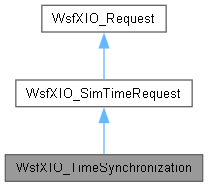
Inheritance diagram for WsfXIO_TimeSynchronization:
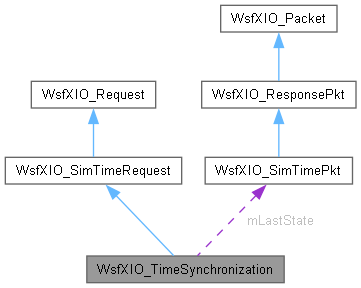
Collaboration diagram for WsfXIO_TimeSynchronization:
Public Member Functions | |
| WsfXIO_TimeSynchronization (WsfXIO_Connection *aConnectionPtr, WsfSimulation *aSimulationPtr) | |
| ~WsfXIO_TimeSynchronization () override | |
| void | JumpToRemoteTime (bool aDoJump) |
| void | SetTiming (double aTargetTimeOffset, double aMinimumTimeError, double aMaximumTimeError, double aTimerUpdateInterval) |
| void | HandleResponse (WsfXIO_ResponsePkt &aPkt) override |
| void | SetSmoothRate (bool aSmoothRate) |
| void | SetSyncPackets (bool aDoSync) |
| WsfClockSource * | GetClockSource () const |
| void | SetClockSource (WsfClockSource *aClockSourcePtr) |
| Public Member Functions inherited from WsfXIO_SimTimeRequest | |
| WsfXIO_SimTimeRequest (WsfXIO_Connection *aConnectionPtr, WsfXIO_RequestSimTimePkt::TimerType aTimerType=WsfXIO_RequestSimTimePkt::cSIM_TIME_INTERVAL, double aInterval=1.0, bool aIsReliable=true) | |
| void | SetUpdateInterval (double aSimTimeInterval) |
| double | GetUpdateInterval () const |
| void | SetTimerType (WsfXIO_RequestSimTimePkt::TimerType aTimerType) |
| Public Member Functions inherited from WsfXIO_Request | |
| WsfXIO_Request (WsfXIO_Connection *aConnectionPtr, bool aIsReliable=true) | |
| void | SendRequest (WsfXIO_RequestDataPkt &aPkt) |
| Sends the request to the remote application. | |
| WsfXIO_Connection * | GetConnection () const |
| Returns the connection to the application from which data is requested. | |
| bool | IsReliable () const |
| Returns 'true' if data for this request is to be sent reliably. | |
| int | GetRequestId () const |
| Returns the request's locally unique ID. | |
| void | SetRequestManager (WsfXIO_RequestManager *aRequestManagerPtr) |
| Sets the owner of this request. | |
| void | SendResponse (WsfXIO_ResponsePkt &aPkt) |
Public Attributes | |
| WsfXIO_SimTimePkt | mLastState |
Additional Inherited Members | |
| Protected Member Functions inherited from WsfXIO_Request | |
| virtual | ~WsfXIO_Request () |
| void | SetRequestId (unsigned int aRequestId) |
| void | SetRemotelyDestroyed () |
| bool | IsRemotelyDestroyed () const |
| void | SetIsReliable (bool aIsReliable) |
Detailed Description
WsfXIO_TimeSynchronization attempts to synchronize the local simulation clock with a remote simulation
- Controls the local clock when remote simulation pauses, resumes or changes clock rate.
- Upon timing errors, local clock is adjusted to reflect remote clock.
- Configures the connection to translate the WsfXIO_Packet::GetTimeStamp() value into local time.
- Timing parameters allow for a delayed synchronization where the local clock is behind the remote clock. In this situation, received packets marked with the cSYNCHRONIZED flag will be buffered processed at the correct simulation time for the packet time stamp.
- Note
- WsfXIO_TimeSynchronization is currently limited to realtime simulations
Constructor & Destructor Documentation
◆ WsfXIO_TimeSynchronization()
| WsfXIO_TimeSynchronization::WsfXIO_TimeSynchronization | ( | WsfXIO_Connection * | aConnectionPtr, |
| WsfSimulation * | aSimulationPtr ) |
◆ ~WsfXIO_TimeSynchronization()
|
override |
Member Function Documentation
◆ GetClockSource()
|
inline |
◆ HandleResponse()
|
overridevirtual |
Reimplemented from WsfXIO_Request.
References WsfXIO_SimTimeRequest::GetUpdateInterval(), WsfXIO_SimTimePkt::mClockRate, mLastState, and WsfXIO_SimTimePkt::mSimTime.
◆ JumpToRemoteTime()
|
inline |
◆ SetClockSource()
| void WsfXIO_TimeSynchronization::SetClockSource | ( | WsfClockSource * | aClockSourcePtr | ) |
◆ SetSmoothRate()
|
inline |
◆ SetSyncPackets()
|
inline |
◆ SetTiming()
| void WsfXIO_TimeSynchronization::SetTiming | ( | double | aTargetTimeOffset, |
| double | aMinimumTimeError, | ||
| double | aMaximumTimeError, | ||
| double | aTimerUpdateInterval ) |
Sets the parameters for the synchronization.
- Parameters
-
aTargetTimeOffset Desired amount of time offset between this application and the remote application. aMinimumTimeError Minimum value of TError before the simulation clock is advanced aMaximumTimeError Maximum value of TError before the simulation clock is paused aTimerUpdateInterval Time interval between clock updates.
- Note
- TError = LocalTime - AdjustedRemoteTime + TargetTimeOffset AdjustedRemoteTime = (RemoteTime + InitialTimeOffset) InitialTimeOffset = (LocalTime - RemoteTime) at startup
References WsfXIO_SimTimeRequest::SetUpdateInterval().
Member Data Documentation
◆ mLastState
| WsfXIO_SimTimePkt WsfXIO_TimeSynchronization::mLastState |
Referenced by HandleResponse().
The documentation for this class was generated from the following files: