#include <WsfMultiresolutionMultirunTable.hpp>
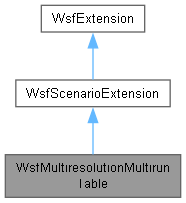
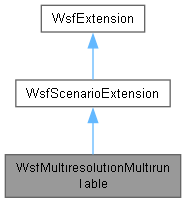
Public Member Functions | |
| WsfMultiresolutionMultirunTable ()=default | |
| WsfMultiresolutionMultirunTable (UtInput &aInput, int aRunNumber) | |
| Public Member Functions inherited from WsfScenarioExtension | |
| WsfScenarioExtension () | |
| ~WsfScenarioExtension () override | |
| WsfScenario & | GetScenario () const |
| WsfApplication & | GetApplication () const |
| virtual void | AddedToScenario () |
| virtual void | FileLoaded (const std::string &aFileName) |
| virtual bool | Complete () |
| virtual bool | Complete2 () |
| virtual bool | AlwaysCreate () |
| Public Member Functions inherited from WsfExtension | |
| virtual | ~WsfExtension ()=default |
| const std::string & | GetExtensionName () const |
Framework methods. | |
| bool | ProcessInput (UtInput &aInput) override |
| void | SimulationCreated (WsfSimulation &aSimulation) override |
| ut::optional< double > | GetFidelity (const wsf::multiresolution::PlatformComponentName &aPlatformComponentName) const |
| static WsfMultiresolutionMultirunTable * | Find (const WsfScenario &aScenario) |
Additional Inherited Members | |
| Protected Member Functions inherited from WsfExtension | |
| void | InitializeExtensionName (const std::string &aName) |
Detailed Description
Contains a table of fidelity values which can be mapped onto multiresolution models based on the run number used with Monte Carlo iterations. Usage is that when SimulationCreated is called, any subsequent calls to GetFidelity will return values for the run number (Monte Carlo iteration) associated with the WsfSimulation passed on the call to SimulationCreated.
Constructor & Destructor Documentation
◆ WsfMultiresolutionMultirunTable() [1/2]
|
default |
References Find(), GetFidelity(), WsfMultiresolutionMultirunTable(), and WsfScenarioExtension::WsfScenario.
Referenced by Find(), and WsfMultiresolutionMultirunTable().
◆ WsfMultiresolutionMultirunTable() [2/2]
| WsfMultiresolutionMultirunTable::WsfMultiresolutionMultirunTable | ( | UtInput & | aInput, |
| int | aRunNumber ) |
- Note
- This ctor is for testing. Typical use of this class would be to default construct and use ProcessInput. Then, for each new simulation, SimulationCreated will be called to set up the map of fidelity values corresponding to the current run number.
References ProcessInput().
Member Function Documentation
◆ Find()
|
static |
◆ GetFidelity()
| ut::optional< double > WsfMultiresolutionMultirunTable::GetFidelity | ( | const wsf::multiresolution::PlatformComponentName & | aPlatformComponentName | ) | const |
- Returns
- The assigned fidelity value for this particular simulation (with a given run number set on a call to SimulationCreated) for the specified platform and component given by aPlatform and aComponent.
Referenced by WsfMultiresolutionPlatformComponent< DerivedComponent >::GetFidelity(), and WsfMultiresolutionMultirunTable().
◆ ProcessInput()
|
overridevirtual |
Process potential input for the extension. This method examines the current input command to determine if it is one that is recognized by the extension. If it is one recognized by the extension then it processes the command and returns 'true', otherwise it returns 'false'.
- Parameters
-
aInput a reference to a UtInput object.
- Returns
- 'true' if the command was one recognized by the extension or 'false' if not.
- Exceptions
-
UtInput::ExceptionBase (or an object derived from it) if the command was recognized but contains some sort of error.
Reimplemented from WsfScenarioExtension.
References wsf::multiresolution::ComponentTypeRequiresNameMap().
Referenced by WsfMultiresolutionMultirunTable().
◆ SimulationCreated()
|
overridevirtual |
Called when a simulation has been created. (Technically this is called upon entry to WsfSimulation::Initialize()). This is typically used when a scenario extension also requires a simulation extension. The method would typically register the simulation extension as follows:
- Parameters
-
aSimulation The simulation that is being created. See note below!
- Note
- This is called upon entry to WsfSimulation::Initialize() and nothing can be assumed about the state of the simulation.
Reimplemented from WsfScenarioExtension.
References WsfSimulation::GetRunNumber().
The documentation for this class was generated from the following files: