#include <WsfControlMessage.hpp>
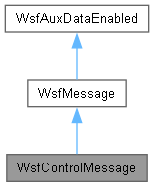
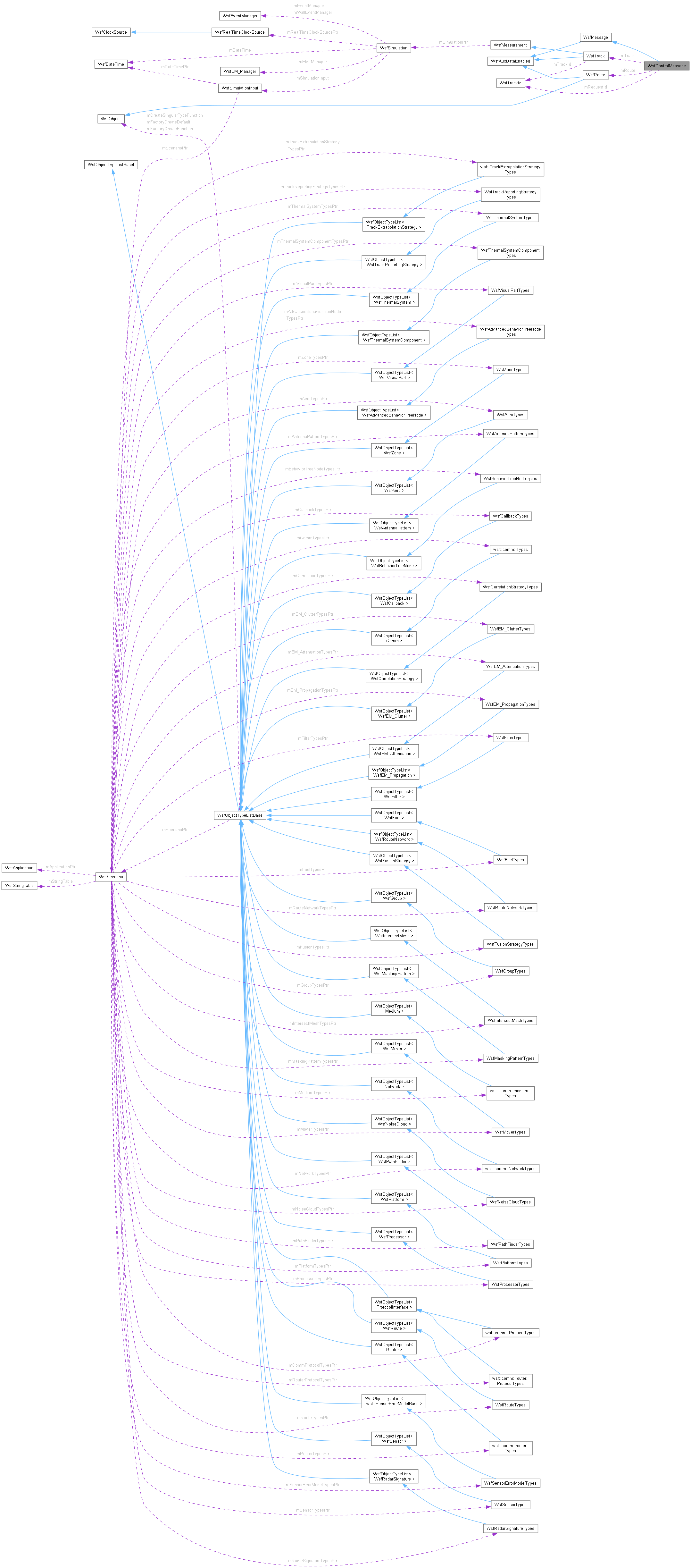
Public Member Functions | |
| WsfControlMessage () | |
| Constructor, for XIO (de)serialization. | |
| WsfControlMessage (WsfPlatform *aPlatformPtr) | |
| WsfMessage * | Clone () const override |
| const char * | GetScriptClassName () const override |
| Public Member Functions inherited from WsfMessage | |
| WsfMessage (WsfStringId aType) | |
| Constructor for XIO (de)serialization. | |
| WsfMessage (WsfStringId aType, const wsf::comm::Address &aSrcAddr, WsfSimulation &aSimulation) | |
| WsfMessage (WsfPlatform *aPlatformPtr) | |
| WsfMessage (WsfStringId aType, WsfPlatform *aPlatformPtr) | |
| WsfMessage (WsfStringId aType, WsfStringId aSubType, WsfPlatform *aPlatformPtr) | |
| WsfMessage (WsfSimulation &aSimulation) | |
| WsfMessage & | operator= (const WsfMessage &aRhs)=default |
| ~WsfMessage () override | |
| const char * | GetScriptClassName () const override |
| WsfSimulation * | GetSimulation () const |
| Get the simulation that owns the message. | |
| void | SetSimulation (WsfSimulation *aSimulationPtr) |
| WsfStringId | GetOriginator () const |
| void | SetOriginator (WsfPlatform *aPlatformPtr) |
| Set the originator of this message. | |
| size_t | GetOriginatorIndex () const |
| int | GetSizeBits () const |
| void | SetSizeBits (int aSizeBits) |
| int | GetSizeBytes () const |
| void | SetSizeBytes (int aSizeBytes) |
| unsigned int | GetSerialNumber () const |
| void | SetSerialNumber (unsigned int aSerialNumber) |
| double | GetDataTag () const |
| void | SetDataTag (double aDataTag) |
| WsfStringId | GetStaticType () const |
| WsfStringId | GetType () const |
| void | SetType (WsfStringId aType) |
| WsfStringId | GetSubType () const |
| void | SetSubType (WsfStringId aSubType) |
| int | GetPriority () const |
| void | SetPriority (int aPriority) |
| const wsf::comm::Address & | GetSrcAddr () const |
| void | SetSrcAddr (const wsf::comm::Address &aSrcAddr) |
| const wsf::comm::Address & | GetDstAddr () const |
| void | SetDstAddr (const wsf::comm::Address &aDstAddr) |
| const wsf::comm::Address & | GetNextHopAddr () const |
| void | SetNextHopAddr (const wsf::comm::Address &aNextHopAddr) |
| virtual bool | CanBeReplacedBy (const WsfMessage &aMessage) const |
| WsfStringId | GetGroup () const |
| void | SetGroup (WsfStringId aGroup) const |
| void | PrintDataTagPrecise (std::ostream &aStream, std::streamsize aPrecision) const |
| template<typename T> | |
| void | Serialize (T &aBuff) |
| (De)serializer for XIO | |
| virtual WsfStringId | GetComponentNameId () const |
| virtual WsfStringId | GetComponentTypeId () const |
| virtual WsfStringId | GetComponentModeId () const |
| Public Member Functions inherited from WsfAuxDataEnabled | |
| WsfAuxDataEnabled ()=default | |
| WsfAuxDataEnabled (const WsfAuxDataEnabled &aSrc)=default | |
| WsfAuxDataEnabled & | operator= (const WsfAuxDataEnabled &aRhs) |
| WsfAuxDataEnabled (WsfAuxDataEnabled &&)=default | |
| WsfAuxDataEnabled & | operator= (WsfAuxDataEnabled &&)=default |
| virtual | ~WsfAuxDataEnabled () noexcept |
| void | SetAuxData (const WsfAttributeContainer &aAuxData) |
| void | DeleteAuxData () |
| Delete the aux data container from the object. | |
| void | MergeAuxData (const WsfAuxDataEnabled &aSrc) |
| Merge the object's aux data with aux data from an existing object. | |
| void | UpdateAuxData (const WsfAuxDataEnabled &aSrc) |
| Update the object's aux data with aux data from an existing object. | |
| bool | HasAuxData () const |
| Returns true if this object has aux data. | |
| bool | ProcessInput (UtInput &aInput) |
| template<typename T> | |
| void | Serialize (T &aBuff) |
| (De)serialization for XIO | |
| WsfAttributeContainer & | GetAuxData () |
| const WsfAttributeContainer & | GetAuxData () const noexcept |
| const WsfAttributeContainer & | GetAuxDataConst () const noexcept |
Static Public Member Functions | |
| static std::unique_ptr< UtScriptClass > | CreateScriptClass (const std::string &aClassName, UtScriptTypes *aScriptTypesPtr) |
| static WsfStringId | GetTypeId () |
| Static Public Member Functions inherited from WsfMessage | |
| static WsfStringId | GetTypeId () |
Route methods. | |
A message may or may not have an associated route. | |
| WsfTrackId | mRequestId |
| WsfStringId | mResourceId |
| String ID of the resource. | |
| WsfTrack | mTrack |
| The associated track. | |
| WsfRoute | mRoute |
| The associated route. | |
| const WsfRoute & | GetRoute () const |
| Return the route (const form). | |
| WsfRoute & | GetRoute () |
| Return the route (non-const form). | |
| void | SetRoute (const WsfRoute &aRoute) |
| template<typename T> | |
| void | Serialize (T &aBuff) |
| For XIO (de)serialization. | |
| WsfControlMessage (const WsfControlMessage &aSrc) | |
| Copy constructor. | |
| WsfControlMessage & | operator= (const WsfControlMessage &aRhs) |
Message function methods. | |
The message function is a string ID that represents the function (or command) that is to be performed. The functions and their interpretation are defined by convention. | |
| WsfStringId | GetFunction () const |
| Get the function (string form). | |
| void | SetFunction (WsfStringId aFunction) |
| Set the function (string form). | |
Request ID methods. | |
A command typically has an associated request ID. These methods are concerned with the identifier of the request. | |
| const WsfTrackId & | GetRequestId () const |
| Get the request ID to which the status applies. | |
| void | SetRequestId (const WsfTrackId &aRequestId) |
| Set the request ID to which the status applies. | |
Resource methods. | |
A command may have an associated resource (sensor, etc.). The resource is a string ID of the required resource. | |
| WsfStringId | GetResourceId () const |
| std::string | GetResource () const |
| Get the resource (string form). | |
| void | SetResourceId (WsfStringId aResourceId) |
| Set the resource (string ID form). | |
| void | SetResource (const std::string &aResource) |
| Set the resource (string form). | |
Track methods. | |
A message may or may not have an associated track. The track may represent a target to be attacked, a sensor cue, etc. | |
| const WsfTrack & | GetTrack () const |
| Return the track (const form). | |
| WsfTrack & | GetTrack () |
| Return the track (non-const form). | |
| void | SetTrack (const WsfTrack &aTrack) |
Additional Inherited Members | |
| Static Public Attributes inherited from WsfMessage | |
| static constexpr size_t | cBITS_IN_BYTE = 8U |
| Static Public Attributes inherited from WsfAuxDataEnabled | |
| static UtCallbackListN< void(const WsfAuxDataEnabled *)> | AuxDataAccessed |
| static UtCallbackListN< void(const WsfAuxDataEnabled *)> | AuxDataDestroyed |
| WsfMessage (const WsfMessage &aSrc)=default | |
Detailed Description
A 'control message' provides the ability for a platform to direct another platform.
The 'control message' provides the ability of a platform to direct another platform (i.e.: issue an order for change-route, return-home, refuel, etc).
Constructor & Destructor Documentation
◆ WsfControlMessage() [1/3]
| WsfControlMessage::WsfControlMessage | ( | ) |
Constructor, for XIO (de)serialization.
References GetTypeId(), mRequestId, mResourceId, mRoute, mTrack, and WsfMessage::WsfMessage().
Referenced by Clone(), operator=(), and WsfControlMessage().
◆ WsfControlMessage() [2/3]
| WsfControlMessage::WsfControlMessage | ( | WsfPlatform * | aPlatformPtr | ) |
Constructor (create a control message)
- Parameters
-
aPlatformPtr The originator of the message.
References GetTypeId(), mRequestId, mResourceId, mRoute, mTrack, and WsfMessage::WsfMessage().
◆ WsfControlMessage() [3/3]
|
protected |
Copy constructor.
References mRequestId, mResourceId, mRoute, mTrack, WsfControlMessage(), and WsfMessage::WsfMessage().
Member Function Documentation
◆ Clone()
|
overridevirtual |
Clone this object by creating an identical copy and returning a pointer to it.
- Returns
- A pointer to the cloned object.
Reimplemented from WsfMessage.
References WsfControlMessage(), and WsfMessage::WsfMessage().
◆ CreateScriptClass()
|
static |
Create the 'class' object for the script system. This is invoked once by WsfScriptManager to create the 'class' object that defines the interface to instances of this class from the script system.
Referenced by WsfScriptManager::RegisterTypes().
◆ GetFunction()
| WsfStringId WsfControlMessage::GetFunction | ( | ) | const |
Get the function (string form).
References WsfMessage::GetSubType().
◆ GetRequestId()
|
inline |
Get the request ID to which the status applies.
References mRequestId.
◆ GetResource()
| std::string WsfControlMessage::GetResource | ( | ) | const |
Get the resource (string form).
References mResourceId.
◆ GetResourceId()
|
inline |
Get the resource (string ID form).
- Returns
- The string ID of the resource. The value will be 0 if no resource was supplied.
References mResourceId.
◆ GetRoute() [1/2]
|
inline |
Return the route (non-const form).
References mRoute.
◆ GetRoute() [2/2]
|
inline |
Return the route (const form).
References mRoute.
◆ GetScriptClassName()
|
override |
◆ GetTrack() [1/2]
|
inline |
Return the track (non-const form).
References mTrack.
◆ GetTrack() [2/2]
|
inline |
Return the track (const form).
References mTrack.
◆ GetTypeId()
|
static |
Get the type ID associated with this message.
- Returns
- The string ID of this message.
Referenced by WsfXIO_MessageService::HandleMessage(), WsfControlMessage(), and WsfControlMessage().
◆ operator=()
|
protected |
References mRequestId, mResourceId, mRoute, mTrack, WsfMessage::operator=(), and WsfControlMessage().
◆ Serialize()
|
inline |
For XIO (de)serialization.
References mRequestId, mResourceId, mRoute, mTrack, and WsfMessage::Serialize().
◆ SetFunction()
| void WsfControlMessage::SetFunction | ( | WsfStringId | aFunction | ) |
Set the function (string form).
References WsfMessage::SetSubType().
◆ SetRequestId()
|
inline |
Set the request ID to which the status applies.
References mRequestId.
◆ SetResource()
| void WsfControlMessage::SetResource | ( | const std::string & | aResource | ) |
Set the resource (string form).
References mResourceId.
◆ SetResourceId()
|
inline |
Set the resource (string ID form).
References mResourceId.
◆ SetRoute()
| void WsfControlMessage::SetRoute | ( | const WsfRoute & | aRoute | ) |
Set the route.
A command may or may not have an associate route.
- Parameters
-
aRoute The route to be associated with the command.
References mRoute.
◆ SetTrack()
| void WsfControlMessage::SetTrack | ( | const WsfTrack & | aTrack | ) |
Set the track to be associated with the message.
A command may or may not have an associated track.
- Parameters
-
aTrack The associated track.
References mTrack.
Member Data Documentation
◆ mRequestId
|
protected |
Referenced by GetRequestId(), operator=(), Serialize(), SetRequestId(), WsfControlMessage(), WsfControlMessage(), and WsfControlMessage().
◆ mResourceId
|
protected |
String ID of the resource.
Referenced by GetResource(), GetResourceId(), operator=(), Serialize(), SetResource(), SetResourceId(), WsfControlMessage(), WsfControlMessage(), and WsfControlMessage().
◆ mRoute
|
protected |
The associated route.
Referenced by GetRoute(), GetRoute(), operator=(), Serialize(), SetRoute(), WsfControlMessage(), WsfControlMessage(), and WsfControlMessage().
◆ mTrack
|
protected |
The associated track.
Referenced by GetTrack(), GetTrack(), operator=(), Serialize(), SetTrack(), WsfControlMessage(), WsfControlMessage(), and WsfControlMessage().
The documentation for this class was generated from the following files: