An object that represents an 'track' (perception) of something. More...
#include <WsfTrack.hpp>
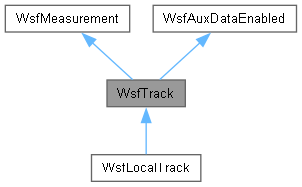
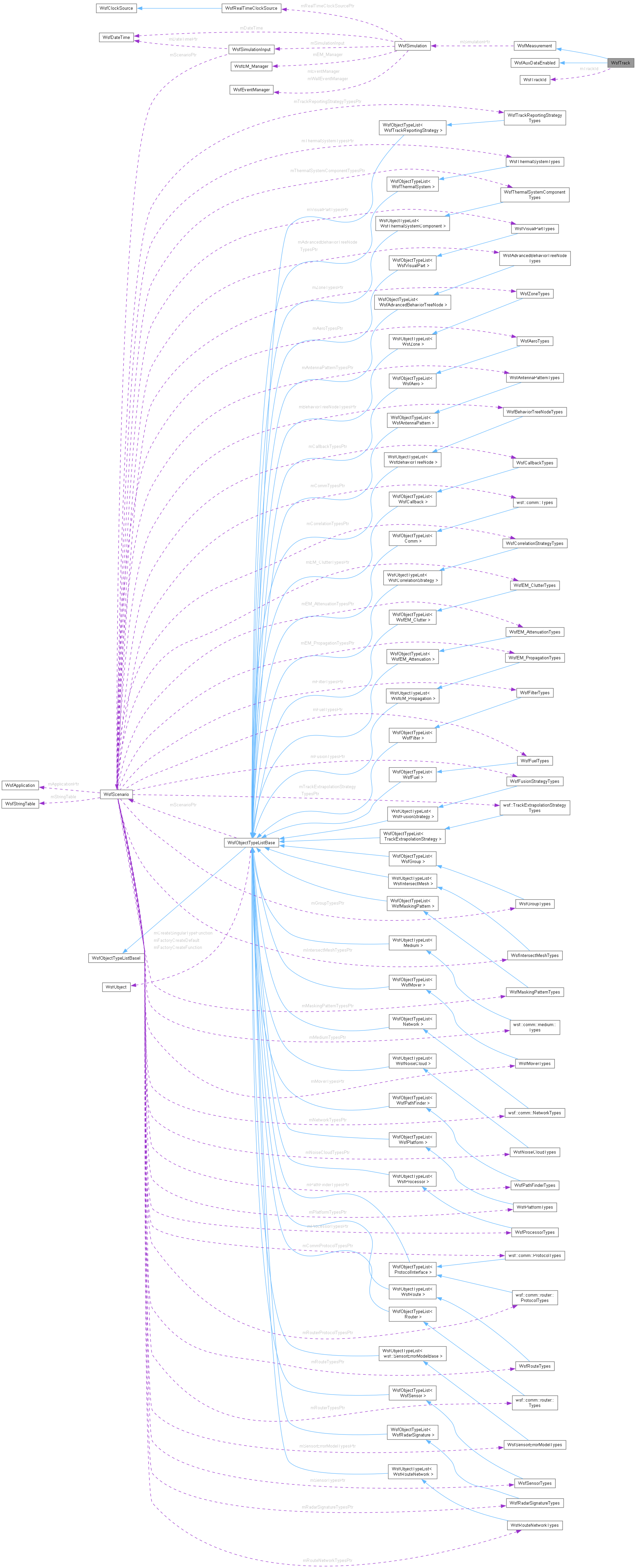
Classes | |
| class | EmitterTypeData |
| A representation of a detected emitter type. More... | |
| struct | EmitterTypeIdList |
| A nested class to maintain a list of emitter type IDs. More... | |
Public Types | |
| enum | TrackType { cUNFILTERED_SENSOR , cFILTERED_SENSOR , cPREDEFINED , cPROCESSED , cSTATIC_IMAGE , cPSEUDO_SENSOR } |
| The source type of the track data. More... | |
| enum | IFF_Status { cIFF_UNKNOWN , cIFF_AMBIGUOUS , cIFF_FOE , cIFF_FRIEND , cIFF_NEUTRAL } |
| An enumeration for IFF. More... | |
| enum | CopyCaller { cCC_COPY_CONSTRUCTOR , cCC_ASSIGNMENT , cCC_REPLACEMENT_UPDATE } |
| An enumeration that is used to determine how 'CopyMemberData' operates. More... | |
| using | Signal = WsfTrack_Signal |
Public Member Functions | |
| WsfTrack () | |
| Use this constructor if the track is a 'predefined track'. | |
| WsfTrack (WsfStringId aOriginatorNameId, WsfStringId aOriginatorTypeId) | |
| Use this constructor if the track is a 'predefined track'. | |
| WsfTrack (TrackType aTrackType, WsfObject *aOriginatingProcessorOrSensor, WsfPlatform *aOriginatingPlatform) | |
| Use this constructor for tracks generated by a platform part. | |
| WsfTrack (const WsfTrack &aSrc) | |
| ~WsfTrack () override | |
| WsfTrack * | Clone () const override |
| virtual void | Initialize (double aSimTime, const WsfTrackId &aTrackId, WsfSimulation &aSimulation) |
| void | SetSimulation (WsfSimulation *aSimulationPtr) |
| void | Update (double aSimTime) override |
| void | KinematicUpdate (double aSimTime) override |
| virtual void | ReplacementUpdate (const WsfTrack &aSource) |
| virtual void | UpdateFromMeasurement (double aSimTime, const WsfTrack &aMeasurement) |
| const char * | GetScriptClassName () const override |
| bool | IsTrack () const override |
| Return that this is a track. | |
| void | SetPlatformOriginator (WsfPlatform *aPlatformPtr) |
| Identify the specified platform as the originator. | |
| void | SetProcessorOriginator (WsfObject *aProcessorPtr, WsfPlatform *aPlatformPtr) |
| Identify the specified processor as the originator. | |
| void | SetSensorOriginator (WsfObject *aSensorPtr, WsfPlatform *aPlatformPtr) |
| Identify the specified sensor as the originator. | |
| void | SetSensorOriginator (WsfStringId aSensorNameId, WsfStringId aSensorTypeId) |
| const WsfTrackId & | GetTrackId () const |
| Get the track ID. | |
| void | SetTrackId (const WsfTrackId &aTrackId) |
| Set the track ID. | |
| TrackType | GetTrackType () const |
| Get the 'track type'. | |
| void | SetTrackType (TrackType aTrackType) |
| bool | IsPredefinedTrack () const |
| double | GetStartTime () const |
| void | SetStartTime (double aStartTime) |
| Set the time when this track was started. | |
| double | GetUpdateTime () const |
| Get the time when this track was last updated. | |
| double | GetLastUpdateInterval () const |
| Get the last time interval between updates. | |
| int | GetUpdateCount () const |
| Define the time when this track was last updated. | |
| void | SetUpdateCount (int aUpdateCount) |
| Set the number of updates to this track. | |
| double | GetMessageDataTag () const |
| The 'data Id' to be used when the track is attached to a message. | |
| void | SetMessageDataTag (double aMessageDataTag) |
| Set the 'data Id' to be used when the track is attached to a message. | |
| WsfStringId | GetOriginatorNameId () const |
| Get the platform name ID of the originator. | |
| size_t | GetOriginatorIndex () const |
| Get the platform index of the originator. | |
| WsfStringId | GetOriginatorTypeId () const |
| The platform type ID of the originator. | |
| WsfStringId | GetProcessorNameId () const |
| WsfStringId | GetProcessorTypeId () const |
| WsfStringId | GetSensorNameId () const |
| WsfStringId | GetSensorTypeId () const |
| WsfStringId | GetSensorModeId () const |
| void | SetSensorModeId (WsfStringId aSensorModeId) |
| bool | IsFusible () const |
| Is the track a fusible track. | |
| void | SetFusible (bool aIsFusible) |
| Define whether the track is a fusible track. | |
| virtual void | SetPurgeable (bool aIsPurgeable) |
| Set whether this track can be purged. | |
| bool | IsPurgeable () const |
| bool | IsStale () const |
| void | SetStale (bool aIsStale) |
| Define whether the track data are to be considered 'stale.'. | |
| Public Member Functions inherited from WsfMeasurement | |
| WsfMeasurement () | |
| WsfMeasurement (const WsfMeasurement &aSrc)=default | |
| WsfSpatialDomain | GetSpatialDomain () const |
| Get the spatial domain of the platform. | |
| void | SetSpatialDomain (const WsfSpatialDomain &aSpatialDomain) |
| Set the spatial domain of the platform. | |
| double | GetDefaultAltitude () const |
| Return a default altitude based on the platform's spatial domain. | |
| virtual WsfFilter * | GetFilter () |
| Return a pointer to the filter. If no filter is present, the pointer will be zero. | |
| virtual const WsfFilter * | GetFilter () const |
| Return a pointer to the filter (const version). If no filter is present, the pointer will be zero. | |
| virtual bool | GetExtrapolatedLocationWCS (double aSimTime, double aLocationWCS[3]) const |
| template<typename T> | |
| bool | GetExtrapolatedData (double aSimTime, const std::string &aExtrapolationType, T &aData) const |
| WsfSimulation * | GetSimulation () const |
| Return the simulation object this measurement is associated with, or nullptr if WsfMeasurement::Initialize was not called. | |
| void | SetSimulation (WsfSimulation &aSimulation) |
| void | SetSphericalMeasurement (double aSimTime, double aAzimuth, double aElevation, double aRange, double aRangeRate) |
| Convenience method to set a 3D spherical measurement result. | |
| Public Member Functions inherited from WsfAuxDataEnabled | |
| WsfAuxDataEnabled ()=default | |
| WsfAuxDataEnabled (const WsfAuxDataEnabled &aSrc)=default | |
| WsfAuxDataEnabled & | operator= (const WsfAuxDataEnabled &aRhs) |
| WsfAuxDataEnabled (WsfAuxDataEnabled &&)=default | |
| WsfAuxDataEnabled & | operator= (WsfAuxDataEnabled &&)=default |
| virtual | ~WsfAuxDataEnabled () noexcept |
| void | SetAuxData (const WsfAttributeContainer &aAuxData) |
| void | DeleteAuxData () |
| Delete the aux data container from the object. | |
| void | MergeAuxData (const WsfAuxDataEnabled &aSrc) |
| Merge the object's aux data with aux data from an existing object. | |
| void | UpdateAuxData (const WsfAuxDataEnabled &aSrc) |
| Update the object's aux data with aux data from an existing object. | |
| bool | HasAuxData () const |
| Returns true if this object has aux data. | |
| bool | ProcessInput (UtInput &aInput) |
| template<typename T> | |
| void | Serialize (T &aBuff) |
| (De)serialization for XIO | |
| WsfAttributeContainer & | GetAuxData () |
| const WsfAttributeContainer & | GetAuxData () const noexcept |
| const WsfAttributeContainer & | GetAuxDataConst () const noexcept |
Reporting responsibility methods. | |
This is used to declare if the local track manager has reporting responsibility for this track. | |
| using | History = std::vector<std::unique_ptr<WsfMeasurement>> |
| bool | IsReportable () const |
| void | IsReportable (bool aIsReportable) |
| Set the track reportable flag used by the local track manager to support reporting decision. | |
| bool | Is3D () const |
| void | Set3D (bool aIs3D) |
| Set whether to consider this track as having a full 3D solution (see WsfTrack::Is3D). | |
| void | SetReportable (bool aIsReportable) |
| bool | HasHistory () const |
| virtual History & | GetHistory () const |
Detected signal data | |
Get/Set the detected signal and validity flags | |
| using | SignalList = WsfTrack_SignalList |
| const SignalList * | GetSignalList () const |
| void | AddSignal (const Signal &aSignal) |
| unsigned int | GetSignalCount () const |
| void | GetSignalEntry (unsigned int aIndex, Signal &aSignal) const |
| void | MergeSignalLists (const WsfTrack &aOtherTrack) |
| void | SetSignalList (const std::vector< Signal > &aSignalList) |
| double | GetFrequency () const |
| void | SetFrequency (double aFrequency) |
| bool | FrequencyValid () const |
| Is detected frequency attribute valid? | |
| void | SetFrequencyValid (bool aFrequencyValid) |
Identify Friend or Foe (IFF). | |
Get/Set the IFF status. A value of cIFF_UNKNOWN indicates there is no report of IFF status; This is the same as IFF_StatusValid() == false. | |
| bool | IFF_StatusValid () const |
| IFF_Status | GetIFF_Status () const |
| void | SetIFF_Status (IFF_Status aIFF_Status) |
| Set the IFF status of the target. | |
Track quality. | |
Get/Set the track quality. Track quality is expressed as a real value in the range [0..1] with 0 being the least quality and 1 being the highest quality. A quality of 1 should be reserved for high quality tracks that actions can be taken on. There is no validity flag for this field. All tracks have 'quality'. It is the responsibility of the producer to assign track quality. | |
| double | GetTrackQuality () const |
| Get the track quality. | |
| double | GetTrackQuality (double aSimTime) const |
| Get the track quality at a future time. | |
| void | SetTrackQuality (double aTrackQuality) |
| Set the track quality. | |
Quality and Expected Error | |
Get the track quality and associated expected error. Track quality is expressed as a real value in the range [0..1] with 0 being the least quality and 1 being the highest quality. A quality of 1 should be reserved for highest quality tracks. There is no validity flag for this field. All tracks have 'quality'. This field always returns quantitative track quality when available from covariances. Otherwise, it returns the default (0.5) or value provided using the "quality" keyword. The expected error calculation returns the expected RMS error in meters based on the track quality. See UtMeasurementUtil for a description of the track quality / error algorithms. The expected error | |
| double | GetQuality () const |
| Get the track quality. | |
| double | GetQuality (double aSimTime) const |
| Get the track quality at a future time. | |
| double | GetExpectedLocationError () const |
| Get the expected RMS location error associated with the track. | |
| double | GetExpectedLocationError (double aSimTime) const |
| Get the expected RMS error associated with the track at a given time. | |
Emitter Type ID data | |
Get/Set the emitter type and validity flags | |
| void | AddEmitterTypeId (const EmitterTypeData &aEmitterTypeData) |
| void | AddEmitterTypeId (WsfStringId aTruthEmitterTypeId, WsfStringId aEmitterTypeId) |
| unsigned int | GetEmitterTypeIdCount () const |
| void | GetEmitterTypeIdEntry (unsigned int aIndex, EmitterTypeData &aEmitterTypeData) const |
| void | MergeEmitterTypeIdLists (const WsfTrack &aOtherTrack) |
| void | SetEmitterTypeIdList (const std::vector< EmitterTypeData > &aEmitterTypeIdList) |
| bool | EmitterTypeIdValid () const |
| Is the emitter type ID attribute valid? | |
| void | SetEmitterTypeIdValid (bool aEmitterTypeIdValid) |
| Define whether or not the emitter type ID attribute is valid. | |
Signal to noise. | |
Get/Set the signal-to-noise ratio (in dB) and validity flags | |
| double | GetSignalToNoise () const |
| Get the signal to noise from the sensor. | |
| void | SetSignalToNoise (double aSignalToNoise) |
| Set the signal to noise from the sensor. | |
| bool | SignalToNoiseValid () const |
| Is the signal-to-noise attribute valid? | |
| void | SetSignalToNoiseValid (bool aSignalToNoiseValid) |
| Define whether or not the signal-to-noise attribute is valid. | |
| double | GetPixelCount () const |
| Pixel count methods (for tracks produced from images). | |
| void | SetPixelCount (double aPixelCount) |
| Set the number of pixels occupied by the object. | |
Residual Covariance matrix. | |
Get/Set the track residual covariance | |
| const UtMatrixd * | GetResidualCovarianceMatrix () const |
| Get the residual covariance matrix. | |
| const UtCovariance * | GetResidualCovariance () const |
| void | SetResidualCovariance (const UtCovariance &aResidualCovarianceMatrix) |
| Set the residual state covariance matrix. | |
| void | SetResidualCovariance (UtCovariance *aResidualCovarianceMatrixPtr) |
| bool | ResidualCovarianceValid () const |
| Is the residual covariance matrix attribute valid? | |
| void | SetResidualCovarianceValid (bool aStateCovarianceValid) |
| Define whether the state covariance matrix attribute is valid. | |
| bool | ProcessNoiseVariancesValid () const |
| void | GetProcessNoiseVariancesECS (double aProcessNoiseVariancesECS[3]) const |
| void | SetProcessNoiseVariancesECS (double aProcessNoiseVariancesECS[3]) |
| int | GetProcessNoiseModel () const |
Candidate methods | |
Get/Set the "candidate" status of the track. | |
| void | SetIsCandidate (bool aIsCandidate) |
| Set the "candidate" status of a track. | |
| bool | IsCandidate () const |
False target methods. | |
A track may represent a false target. | |
| void | SetIsFalseTarget (bool aIsFalseTarget) |
| bool | IsFalseTarget () const |
Strobe methods. | |
A track may represent a strobe track, possibly from interference. | |
| void | SetIsStrobe (bool aIsStrobe) |
| bool | IsStrobe () const |
Truth methods. | |
The 'Target Platform' is not really part of the 'track' in that it represents truth data. In general this should not be used for simulation decisions, unless it is absolutely necessary to 'cheat'. | |
| void | SetTarget (const WsfPlatform &aTarget) |
| void | SetTargetIndex (size_t aTargetIndex) |
| size_t | GetTargetIndex () const |
| Return the platform index of the target. | |
| void | SetTargetName (WsfStringId aTargetName) |
| WsfStringId | GetTargetName () const |
| Return the string id that corresponds to the target platform or false-target blip name. | |
| void | SetTargetType (WsfStringId aTargetType) |
| WsfStringId | GetTargetType () const |
| Return the string id corresponding with the target platform's type. | |
Methods to support WsfTrackProcessor circular report detection. | |
| void | SetLastSourceName (WsfStringId aSourceName) const |
| WsfStringId | GetLastSourceName () const |
Input methods. | |
| bool | ProcessInput (UtInput &aInput) override |
| void | ProcessInputBlock (const WsfScenario &aScenario, UtInputBlock &aInputBlock) |
| WsfTrack & | operator= (const WsfTrack &aRhs) |
| Assignment operator. | |
| static bool | LoadTrackInstance (const WsfScenario &aScenario, UtInput &aInput, WsfPlatform *aPlatformPtr, WsfTrack *&aTrackPtr) |
Additional Inherited Members | |
| Static Public Attributes inherited from WsfAuxDataEnabled | |
| static UtCallbackListN< void(const WsfAuxDataEnabled *)> | AuxDataAccessed |
| static UtCallbackListN< void(const WsfAuxDataEnabled *)> | AuxDataDestroyed |
| using | WsfSpatialDomainInformation = UtInformation<int> |
| const wsf::TrackExtrapolators * | GetTrackExtrapolators () const |
| static double | GetDefaultAltitude (WsfSpatialDomain aDomain) |
| Given a spatial domain, return the default altitude of that domain. | |
| WsfSpatialDomainInformation | mSpatialDomain |
| WsfSimulation * | mSimulationPtr {nullptr} |
Detailed Description
An object that represents an 'track' (perception) of something.
A track can be:
- the product of a sensor
- the product of a processor.
- 'pre-briefed' (an 'initial' track)
Tracks are passed from sensors to processors internally within a platform and are passed between platforms via communications links. A processor can pass a sensor track through unmodified or it can perform fusion, etc. and create new tracks that then become a product of the processor.
The creator/maintainer of a track should create an instance of the track using the proper constructor to identify its source (sensor or processor) The instance is then associated ONLY with that sensor or processor.
When a track is started Initialize() should be called to set the start time and track ID and then proceed with the normal track update process described below (including calling Update()!).
When a track is updated, Update() should be called and then the necessary fields should be updated.
A reporter must declare which fields in the track are 'valid'. The validity of a field is set with the 'Set<field>Valid()' methods and queried with the '<field>Valid()'. The validity of all fields is initially set to 'false' (invalid) by the constructor. The field validity and value are modified ONLY by the 'Set' methods and are NOT modified by Initialize() or Update().
An "auxiliary data" service is available with WsfTrack for storing arbitrary data of interest (see WsfAttributeContainer for more information). The auxiliary data are accessed through the WsfTrack::GetAuxData method. The aux data can be added through user input (see the "aux_data" keyword in the WSF User Input Guide). (see WsfAttributeContainer and UtAttributeContainer).
Member Typedef Documentation
◆ EmitterTypeIdPtrInformation
|
protected |
◆ History
| using WsfTrack::History = std::vector<std::unique_ptr<WsfMeasurement>> |
◆ IFF_StatusInformation
|
protected |
◆ Signal
| using WsfTrack::Signal = WsfTrack_Signal |
◆ SignalList
◆ SignalListPtrInformation
|
protected |
Member Enumeration Documentation
◆ CopyCaller
| enum WsfTrack::CopyCaller |
◆ IFF_Status
| enum WsfTrack::IFF_Status |
An enumeration for IFF.
◆ TrackType
| enum WsfTrack::TrackType |
The source type of the track data.
| Enumerator | |
|---|---|
| cUNFILTERED_SENSOR | The track is the result of a direct sensor measurement. |
| cFILTERED_SENSOR | The track is the result of filtered or processed sensor measurements. |
| cPREDEFINED | The track is 'pre-defined' or 'pre-briefed' (typically read from an input file). |
| cPROCESSED | The track is the product of some 'process' (filtering, fusion, intel reports, etc.). |
| cSTATIC_IMAGE | The track is an extract from a static image (e.g.: spot SAR or photograph). This is similar to a 'FILTERED_SENSOR' track, but a different type must be used because the mechanisms for using it in fusion processes may be different. |
| cPSEUDO_SENSOR | The track is a 'pseudo-sensor' track. These exist only for visualization purposes and are produced by WsfEOIR_Sensor and WsfSAR_Sensor during the formation of an image. These tracks are only presented via the observer interface (never sent over internal/external links). In general, an observer will typically ignore these tracks. |
Constructor & Destructor Documentation
◆ WsfTrack() [1/4]
| WsfTrack::WsfTrack | ( | ) |
Use this constructor if the track is a 'predefined track'.
References cPREDEFINED, mGlobalTrackNumber, mIsFusible, mIsPurgeable, and mTrackType.
Referenced by Clone(), WsfLocalTrack::GetRawTrack(), WsfLocalTrack::IsMirrorTrack(), LoadTrackInstance(), MergeEmitterTypeIdLists(), MergeSignalLists(), operator=(), WsfLocalTrack::ReplacementUpdate(), ReplacementUpdate(), WsfLocalTrack::SerializeP(), WsfLocalTrack::SetMirrorTrack(), WsfLocalTrack::UpdateFilter(), WsfLocalTrack::UpdateFromMeasurement(), UpdateFromMeasurement(), WsfLocalTrack::UpdateSignalList(), WsfLocalTrack::WsfLocalTrack(), WsfLocalTrack::WsfLocalTrack(), WsfLocalTrack::WsfLocalTrack(), and WsfTrack().
◆ WsfTrack() [2/4]
| WsfTrack::WsfTrack | ( | WsfStringId | aOriginatorNameId, |
| WsfStringId | aOriginatorTypeId ) |
Use this constructor if the track is a 'predefined track'.
References cPREDEFINED, mGlobalTrackNumber, mIsFusible, mIsPurgeable, mOriginatorNameId, mOriginatorPlatformIndex, mOriginatorTypeId, and mTrackType.
◆ WsfTrack() [3/4]
| WsfTrack::WsfTrack | ( | TrackType | aTrackType, |
| WsfObject * | aOriginatingProcessorOrSensor, | ||
| WsfPlatform * | aOriginatingPlatform ) |
Use this constructor for tracks generated by a platform part.
References cUNFILTERED_SENSOR, WsfPlatform::GetIndex(), WsfObject::GetNameId(), WsfObject::GetTypeId(), mGlobalTrackNumber, mIsFusible, mIsPurgeable, mOriginatorNameId, mOriginatorPlatformIndex, mOriginatorTypeId, mProcessorNameId, mProcessorTypeId, mSensorNameId, mSensorTypeId, mTrackId, and mTrackType.
◆ WsfTrack() [4/4]
| WsfTrack::WsfTrack | ( | const WsfTrack & | aSrc | ) |
◆ ~WsfTrack()
|
override |
Member Function Documentation
◆ AddEmitterTypeId() [1/2]
| void WsfTrack::AddEmitterTypeId | ( | const EmitterTypeData & | aEmitterTypeData | ) |
Adds a emitter type data to the list of emitter type data. The emitter data will not be added if it is already in the list.
- Parameters
-
aEmitterTypeData The emitter type data to be added
References WsfTrack::EmitterTypeData::mEmitterTruthId, mEmitterTypeIdListPtr, and mSignalListPtr.
Referenced by AddEmitterTypeId(), MergeEmitterTypeIdLists(), and SetEmitterTypeIdList().
◆ AddEmitterTypeId() [2/2]
| void WsfTrack::AddEmitterTypeId | ( | WsfStringId | aTruthEmitterTypeId, |
| WsfStringId | aEmitterTypeId ) |
Adds a emitter type to the list of emitter types. The emitter will not be added if it is already in the list.
- Parameters
-
aTruthEmitterTypeId The truth emitter type to be added aEmitterTypeId The derived emitter type to be added
References AddEmitterTypeId().
◆ AddSignal()
| void WsfTrack::AddSignal | ( | const Signal & | aSignal | ) |
Adds a signal to the list of detected signals. The signal will not be added if it is already in the list.
- Parameters
-
aSignal The signal to be added
References WsfTrack_Signal::mLowerFrequency, mSignalListPtr, and WsfTrack_Signal::mUpperFrequency.
Referenced by MergeSignalLists(), SetSignalList(), and WsfBayesClassifier::Test().
◆ Clone()
|
overridevirtual |
Make a copy (clone) of the track.
- Returns
- A pointer to the newly created track.
Reimplemented from WsfMeasurement.
References WsfTrack().
Referenced by WsfTrackManager::AddInitialTrack(), WsfTrackManager::AddRawTrackReport(), WsfTrackManager::AddTrackReport(), WsfWeapon::CreateTargetTrack(), WsfImplicitWeapon::Fire(), WsfWeapon::SalvoRequest::SalvoRequest(), WsfTrackMessage::SetTrack(), WsfUplinkProcessor::StopUplinking(), and WsfCompositeSensor::UpdateCompositeTrack().
◆ EmitterTypeIdValid()
|
inline |
Is the emitter type ID attribute valid?
References mEmitterTypeIdListPtr.
◆ FrequencyValid()
| bool WsfTrack::FrequencyValid | ( | ) | const |
Is detected frequency attribute valid?
References mSignalListPtr.
Referenced by wsf::event::utils::PrintTrackData(), and wsf::event::utilsCSV::PrintTrackData().
◆ GetEmitterTypeIdCount()
| unsigned int WsfTrack::GetEmitterTypeIdCount | ( | ) | const |
Get the number of entries in the detected signal list.
- Returns
- The number of entries in the detected signal list.
References mEmitterTypeIdListPtr.
Referenced by WsfTargetTypeReporting::UpdateReportedTargetType().
◆ GetEmitterTypeIdEntry()
| void WsfTrack::GetEmitterTypeIdEntry | ( | unsigned int | aIndex, |
| EmitterTypeData & | aEmitterTypeData ) const |
Get the i'th emitter type from the list of emitter types.
- Parameters
-
aIndex [input] The index of the desired entry. This must be in the range [0..GetEmitterTypeCount()-1]. aEmitterTypeData [output] The desired entry. This is not modified if the aIndex is not in range.
References mEmitterTypeIdListPtr.
Referenced by WsfTargetTypeReporting::UpdateReportedTargetType().
◆ GetExpectedLocationError() [1/2]
| double WsfTrack::GetExpectedLocationError | ( | ) | const |
Get the expected RMS location error associated with the track.
References GetQuality().
◆ GetExpectedLocationError() [2/2]
| double WsfTrack::GetExpectedLocationError | ( | double | aSimTime | ) | const |
Get the expected RMS error associated with the track at a given time.
References GetQuality().
◆ GetFrequency()
| double WsfTrack::GetFrequency | ( | ) | const |
Get the frequency of the detected emitter.
- Returns
- The detected frequency (Hertz).
- Note
- This is for compatibility with code that existed prior to the implementation of frequency lists. lists. It will return the first frequency from the frequency list.
References GetSignalEntry(), WsfTrack_Signal::mLowerFrequency, and WsfTrack_Signal::mUpperFrequency.
◆ GetGlobalTrackNumber()
|
inline |
References mGlobalTrackNumber.
◆ GetHistory()
|
virtual |
References mHistory.
Referenced by WsfTrackManager::AddTrackReport(), WsfTrackManager::PurgeLocalTrackHistory(), and WsfEW_SensorComponent::TrackerUpdateTrack().
◆ GetIFF_Status()
|
inline |
References mIFF_Status.
Referenced by WsfBMUtils::ConvertTrack(), WsfSA_Perceive::CreateBanditsList(), WsfAccessorIFF::GetAttribute(), UCI_Util::GetStandardIdentity(), WsfAccessorIFF::HasAttribute(), WsfThreatProcessor::IsThreatening(), WsfEventPipeInterface::PackTrack(), WsfSA_Perceive::PossibleEnemy(), WsfDefaultFusion::ReviewIFF(), WsfL16::SurveillancePart::SendSpaceTrack(), WsfSA_Assess::UpdateEngagementsData(), WsfDefaultFusion::UpdateIFF_Status(), WsfSA_Processor::UpdateTrackData(), and WsfSA_EntityPerception::WsfSA_EntityPerception().
◆ GetLastSourceName()
|
inline |
Set the platform name (ID) of the platform that last provided data to update this track. This should be the value from WsfTrackMessage::GetSenderId.
References mLastSourceName.
Referenced by WsfTrackProcessor::SendTrackP().
◆ GetLastUpdateInterval()
|
inline |
Get the last time interval between updates.
References mLastUpdateTime.
◆ GetMessageDataTag()
|
inline |
The 'data Id' to be used when the track is attached to a message.
References mMessageDataTag.
◆ GetOriginatorIndex()
|
inline |
Get the platform index of the originator.
References mOriginatorPlatformIndex.
Referenced by WsfBMUtils::GetOriginalTracks(), WsfBMUtils::GetTrackSensorType(), WsfBMUtils::IsTrackGeneratedByLocalSensor(), and WsfEventPipeInterface::PackTrack().
◆ GetOriginatorNameId()
|
inline |
Get the platform name ID of the originator.
References mOriginatorNameId.
Referenced by WsfTrackManager::AddMeasurement(), MTT_PerceivedCluster::CopyFrom(), WsfDirectionFinderProcessor::CreateLocalTrack(), WsfDefaultFusion::PerformMirrorTrackUpdate(), WsfDefaultFusion::PerformStandardTrackUpdate(), WsfWeaponTrackProcessor::ProcessTrackUpdate(), WsfWeaponTrackProcessor::SetCurrentTarget(), and WsfXIO_AutoDisMapping::TranslateTrack().
◆ GetOriginatorTypeId()
|
inline |
The platform type ID of the originator.
References mOriginatorTypeId.
Referenced by MTT_PerceivedCluster::CopyFrom().
◆ GetPixelCount()
|
inline |
Pixel count methods (for tracks produced from images).
Get the number of pixels occupied by the object. This value will be zero if not from an image.
References mPixelCount.
Referenced by WsfEventPipeInterface::PackTrack(), wsf::event::utils::PrintTrackData(), and wsf::event::utilsCSV::PrintTrackData().
◆ GetProcessNoiseModel()
| int WsfTrack::GetProcessNoiseModel | ( | ) | const |
◆ GetProcessNoiseVariancesECS()
| void WsfTrack::GetProcessNoiseVariancesECS | ( | double | aProcessNoiseVariancesECS[3] | ) | const |
◆ GetProcessorNameId()
|
inline |
Get the processor name Id of the reporting processor.
- Note
- this will be 0 if the track type is either a 'cFILTERED_SENSOR' or 'cUNFILTER_SENSOR'.
References mProcessorNameId.
◆ GetProcessorTypeId()
|
inline |
Get the processor Type Id of the reporting processor.
- Note
- this will be 0 if the track type is either a 'cFILTERED_SENSOR' or 'cUNFILTER_SENSOR'.
References mProcessorTypeId.
◆ GetQuality() [1/2]
| double WsfTrack::GetQuality | ( | ) | const |
Get the track quality.
References mTrackQuality.
Referenced by WsfTrackManager::AssessTrackQuality(), GetExpectedLocationError(), GetExpectedLocationError(), GetTrackQuality(), and GetTrackQuality().
◆ GetQuality() [2/2]
| double WsfTrack::GetQuality | ( | double | aSimTime | ) | const |
Get the track quality at a future time.
References mTrackQuality.
◆ GetResidualCovariance()
|
inline |
References mResidualCovariancePtr.
Referenced by WsfDefaultFusion::PerformStandardTrackUpdate(), and wsf::event::utils::PrintTrackData().
◆ GetResidualCovarianceMatrix()
| const UtMatrixd * WsfTrack::GetResidualCovarianceMatrix | ( | ) | const |
Get the residual covariance matrix.
References mResidualCovariancePtr.
◆ GetScriptClassName()
|
override |
◆ GetSensorModeId()
|
inline |
Get the sensor mode ID in use at the time of the sensor report.
- Note
- this will be 0 if the track type is not either a 'cFILTERED_SENSOR' or 'cUNFILTER_SENSOR'.
References mSensorModeId.
Referenced by WsfEventPipeInterface::PackTrack(), WsfWeaponTrackProcessor::ProcessTrackUpdate(), WsfSensor::SendTrackUpdateMessage(), WsfEW_TrackEffect::SensorTrackDropped(), and WsfWeaponTrackProcessor::SetCurrentTarget().
◆ GetSensorNameId()
|
inline |
Get the sensor name Id of the reporting sensor.
- Note
- this will be 0 if the track type is not either a 'cFILTERED_SENSOR' or 'cUNFILTER_SENSOR'.
References mSensorNameId.
Referenced by MTT_PerceivedCluster::CopyFrom(), WsfClusterCorrelation::GetMaxMeasurementError(), WsfBMUtils::GetOriginalTracks(), WsfBMUtils::GetRawTrackSensorType(), WsfWMAIEngagementMod::Drag::isFinished(), WsfL16::SurveillancePart::IsSensorTrackSuppressed(), WsfUplinkProcessor::LocalTrackCorrelation(), WsfEventPipeInterface::PackTrack(), WsfWeaponTrackProcessor::ProcessTrackUpdate(), WsfRF_Repeater::RegisterTrack(), WsfCompositeSensor::SensorDetectionChanged(), WsfCompositeSensor::SensorTurnedOff(), WsfWeaponTrackProcessor::SetCurrentTarget(), WsfP6DOF_Mover::Update(), UT_DEFINE_SCRIPT_METHOD(), and UT_DEFINE_SCRIPT_METHOD().
◆ GetSensorTypeId()
|
inline |
Get the sensor Type Id of the reporting sensor.
- Note
- this will be 0 if the track type is not either a 'cFILTERED_SENSOR' or 'cUNFILTER_SENSOR'.
References mSensorTypeId.
Referenced by UT_DEFINE_SCRIPT_METHOD(), and UT_DEFINE_SCRIPT_METHOD().
◆ GetSignalCount()
| unsigned int WsfTrack::GetSignalCount | ( | ) | const |
Get the number of entries in the detected signal list.
- Returns
- The number of entries in the detected signal list.
References mSignalListPtr.
Referenced by wsf::event::utils::PrintTrackData(), wsf::event::utilsCSV::PrintTrackData(), WsfRF_Repeater::SensorTrackUpdated(), WsfSignalAccessor::SetTrack(), and WsfRF_Jammer::StartJammingTrack().
◆ GetSignalEntry()
| void WsfTrack::GetSignalEntry | ( | unsigned int | aIndex, |
| Signal & | aSignal ) const |
Get the i'th signal from the list of detected signal.
- Parameters
-
aIndex [input] The index of the desired entry. This must be in the range [0..GetSignalCount()-1]. aSignal [output] The desired entry. This is not modified if the aIndex is not in range.
References mSignalListPtr.
Referenced by GetFrequency(), wsf::event::utils::PrintTrackData(), wsf::event::utilsCSV::PrintTrackData(), WsfRF_Repeater::SensorTrackUpdated(), WsfSignalAccessor::SetTrack(), and WsfRF_Jammer::StartJammingTrack().
◆ GetSignalList()
|
inline |
References mSignalListPtr.
Referenced by wsf::UCI_SensorComponent::SendEntityMessage(), and WsfDefaultFusion::UpdateSignalList().
◆ GetSignalToNoise()
|
inline |
Get the signal to noise from the sensor.
References mSignalToNoise.
Referenced by WsfEventPipeInterface::PackTrack(), wsf::event::utils::PrintTrackData(), wsf::event::utilsCSV::PrintTrackData(), WsfDefaultFusion::UpdateSignalToNoise(), and WsfFalseTargetScreener::UpdateTargetTrack().
◆ GetSimulation()
|
inline |
References WsfMeasurement::mSimulationPtr.
Referenced by WsfDirectionFinderProcessor::AddFilterToFusedTrack(), GetTargetIndex(), and WsfEventPipeInterface::PackTrack().
◆ GetStartTime()
|
inline |
Get the time when this track was started. If this is the first update then StartTime = UpdateTime.
References mStartTime.
Referenced by WsfEventPipeInterface::PackTrack(), wsf::event::utils::PrintTrackData(), wsf::event::utilsCSV::PrintTrackData(), WsfXIO_AutoDisMapping::TranslateTrack(), WsfPassiveSensor::PassiveMode::UpdateTrackReportingFlags(), and WsfSOSM_Sensor::SOSM_Mode::UpdateTrackReportingFlags().
◆ GetTargetIndex()
| size_t WsfTrack::GetTargetIndex | ( | ) | const |
Return the platform index of the target.
Get the platform index of the target. This index can be 0 if the track is not associated with a target.
References WsfSimulation::GetPlatformByName(), GetSimulation(), and platformPtr.
Referenced by WsfWeaponTaskManager::AcquireResource(), WsfBMUtils::BelievedAlive(), WsfSA_Assess::CalculatePrioritizedThreats(), WsfBallisticMissileLaunchComputer::ComputeAirIntercept(), WsfBallisticMissileLaunchComputer::ComputeLateralTargetOffset(), Contains(), MTT_PerceivedCluster::CopyFrom(), WsfTruthCorrelation::CorrelateImpl(), WsfSA_Perceive::CreateBanditsList(), WsfBallisticMissileLaunchComputer::EstimatedTimeToIntercept(), WsfTabularLaunchComputer::EstimatedTimeToIntercept(), WsfSA_Assess::GetPerceivedTrackedPlatformWithTarget(), WsfBMUtils::GetTarget(), WsfOrbitalManeuver::GetTargetPropagatorPerception(), GetTargetType(), WsfPerceptionProcessor::Important(), WsfSA_Perceive::Important(), WsfL16::Interface_J11::InFlightTargetUpdate(), Initialize(), WsfThreatProcessor::IsThreatening(), WsfPerceptionProcessor::MarkThreatAsImportant(), WsfSA_Perceive::MarkThreatAsImportant(), WsfPerceptionProcessor::MarkThreatAsUnimportant(), WsfSA_Perceive::MarkThreatAsUnimportant(), WsfEventPipeInterface::PackTrack(), WsfSA_Processor::PlatformInTrackListMWS(), wsf::event::utils::PrintTrackData(), wsf::event::utilsCSV::PrintTrackData(), wsf::event::utils::PrintTrackTargetName(), wsf::event::utilsCSV::PrintTrackTargetName(), WsfCuedLaserWeapon::ProcessMessage(), WsfWeaponTrackProcessor::ProcessTrackUpdate(), WsfRF_Repeater::RegisterTrack(), WsfDefaultSensorScheduler::SelectTargetForRequest(), WsfL16::SurveillancePart::SendSpaceTrack(), WsfSensor::SendTrackDropMessage(), WsfCompositeSensor::SensorDetectionChanged(), WsfDisPlatform::SensorTrackDropped(), WsfDisPlatform::SensorTrackInitiated(), WsfRF_Repeater::SensorTrackUpdated(), WsfRIPRProcessor::SetTargetByTrack(), WsfRF_Jammer::StartJammingTrack(), WsfRIPRProcessor::StartUplinking(), WsfUplinkProcessor::StartUplinking(), WsfRIPRProcessor::Targeting(), WsfRIPRProcessor::TargetTrack(), WsfMilEventPipe::TaskAssigned(), WsfImageProcessor::TrackDropped(), WsfXIO_AutoDisMapping::TranslateTrack(), WsfPerceptionProcessor::Unimportant(), WsfSA_Perceive::Unimportant(), Fires::BallisticPath::Update(), WsfSA_Assess::UpdateEngagementsData(), WsfWeaponEngagement::UpdateIntendedTarget(), WsfOrbitDeterminationFusion::UpdateLocalTrackFromNonLocalTrack(), WsfSA_Perceive::UpdatePerceivedItemsCalculation(), WsfLocalTrackStatus::UpdateTargetName(), WsfEW_SensorComponent::UpdateTrack(), WsfImageProcessor::UpdateTrack(), WsfSA_Processor::UpdateTrackData(), WsfBallisticMissileLaunchComputer::WeaponFireAborted(), WsfRIPRProcessor::WeaponsActive(), WsfRIPRProcessor::WeaponsIncoming(), and WsfSA_EntityPerception::WsfSA_EntityPerception().
◆ GetTargetName()
|
inline |
Return the string id that corresponds to the target platform or false-target blip name.
Referenced by WsfTrackManager::AddMeasurement(), WsfTrackManager::AddRawTrackReport(), WsfTrackManager::AddTrackReport(), WsfFusionCenter::AdjustTrackQuantities(), WsfTaskManager::AssignTask(), WsfSA_Assess::CalculatePrioritizedThreats(), WsfPerfectCorrelation::CorrelateImpl(), WsfTruthCorrelation::CorrelateImpl(), WsfDirectionFinderProcessor::CreateLocalTrack(), WsfTrackStateController::DiscoverTrack(), WsfImplicitWeapon::Fire(), WsfLaserWeapon::Fire(), WsfRoadMover::GoToTrack(), WsfXIO_TaskService::HandleCommand(), WsfL16::Interface_J11::InFlightTargetUpdate(), WsfThreatProcessor::IsThreatening(), WsfTrackStateController::LocalTrackDropped(), wsf::event::utils::PrintTrackTargetName(), wsf::event::utilsCSV::PrintTrackTargetName(), WsfBeamDirector::WsfBeamDirectorMode::Select(), WsfTrackProcessor::SendTrackP(), WsfRF_Repeater::SensorTrackInitiated(), WsfRF_Repeater::SensorTrackUpdated(), WsfCTD_SensorComponent::TrackerDropTrack(), WsfP6DOF_Mover::Update(), WsfCompositeSensor::UpdateCompositeTrack(), WsfWeaponEngagement::UpdateIntendedTarget(), WsfOrbitDeterminationFusion::UpdateLocalTrackFromNonLocalTrack(), WsfLocalTrackStatus::UpdateTargetName(), WsfCoherentSensorProcessor::UpdateTrack(), WsfImageProcessor::UpdateTrack(), WsfSA_Processor::UpdateTrackData(), WsfQuantumTask::WsfQuantumTask(), and WsfSA_EntityPerception::WsfSA_EntityPerception().
◆ GetTargetType()
| WsfStringId WsfTrack::GetTargetType | ( | ) | const |
Return the string id corresponding with the target platform's type.
References GetTargetIndex().
Referenced by WsfPerceptionProcessor::Important(), WsfSA_Perceive::Important(), WsfL16::Interface_J11::InFlightTargetUpdate(), WsfPerceptionProcessor::Unimportant(), WsfSA_Perceive::Unimportant(), WsfCoherentSensorProcessor::UpdateTrack(), WsfImageProcessor::UpdateTrack(), WsfSA_Processor::UpdateTrackData(), and WsfSA_EntityPerception::WsfSA_EntityPerception().
◆ GetTrackId()
|
inline |
Get the track ID.
References mTrackId.
Referenced by WsfExplicitWeapon::AbortSalvo(), WsfTaskManager::AcquireResource(), WsfWeaponTaskManager::AcquireResource(), WsfTrackManager::AddMeasurement(), WsfTrackManager::AddRawTrackReport(), WsfThreatProcessor::AddThreat(), WsfTrackManager::AddTrackReport(), WsfExplicitWeapon::AddWeaponToSimulation(), WsfFusionCenter::AdjustTrackQuantities(), WsfFalseTargetScreener::AllowTrackReporting(), WsfQuantumTaskerProcessor::AssignTask(), WsfTaskManager::AssignTask(), WsfWeaponTaskManager::AssignTask(), WsfTrackMessage::CanBeReplacedBy(), WsfL16::ComputerProcessor::ClearTrackNumber(), Contains(), WsfBMUtils::ConvertTrack(), MTT_PerceivedCluster::CopyFrom(), WsfLaunchComputer::CopyResultsToTrack(), WsfCorrelationStrategy::Correlate(), WsfClusterCorrelation::CorrelateImpl(), WsfMTT_Correlation::CorrelateImpl(), WsfNearestNeighborCorrelation::CorrelateImpl(), WsfPerfectCorrelation::CorrelateImpl(), WsfTruthCorrelation::CorrelateImpl(), WsfTrackManager::CorrelateTrack(), WsfBayesClassification::CreateClassifier(), WsfTaskManager::CreateDelayTask(), WsfDirectionFinderProcessor::CreateLocalTrack(), WsfMTT_Correlation::DecorrelateNonlocalTrack(), WsfTrackStateController::DiscoverTrack(), WsfCompositeSensor::DropContributorTrack(), WsfCuedLaserWeapon::Fire(), WsfTrackManager::FuseTrack(), WsfWeaponServer::GenerateCommand(), WsfBMUtils::GetOriginalTracks(), WsfDefaultSensorTracker::GetRequestDataForTarget(), WsfL16::ComputerProcessor::GetTrackNumber(), WsfBMUtils::GetTrackSensorType(), WsfRoadMover::GoToTrack(), WsfXIO_WeaponComponent::HandleTaskCommand(), WsfTrackManager::Initialize2(), WsfLaunchComputer::InitializeResults(), WsfTrackManager::InitiateTrack(), WsfTrackManager::InitiateTrackP(), WsfTrackManager::InitiateTrackSilent(), WsfLocalTrack::IsMirrorTrack(), WsfUplinkProcessor::LocalTrackCorrelation(), WsfPerceptionProcessor::LocalTrackDropped(), WsfSA_Perceive::LocalTrackDropped(), WsfTrackStateController::LocalTrackDropped(), WsfClusterCorrelation::MakeCorrelated(), WsfCorrelationStrategy::NewTrackCorrelation(), WsfTrackManager::NotifyOfLocalTrackCorrelation(), WsfTrackManager::NotifyOfLocalTrackDecorrelation(), WsfTrackProcessor::NotifyPlatform(), WsfL16::SurveillancePart::OwningPlatformWantsTrackRefNumber(), WsfEventPipeInterface::PackTrack(), WsfBeamDirector::PointAtTarget(), wsf::event::utils::PrintTrackTargetName(), wsf::event::utilsCSV::PrintTrackTargetName(), WsfTaskManager::ProcessTaskAssignMessage(), WsfWeaponTrackProcessor::ProcessTrackUpdate(), WsfL16::SurveillancePart::RawTrackReceived(), WsfRF_Repeater::RegisterTrack(), WsfThreatProcessor::RemoveThreat(), WsfLocalTrack::ReplacementUpdate(), WsfXIO_SensorService::RequestCanceled(), WsfXIO_SensorService::RequestUpdated(), WsfDefaultFusion::ReviewTrackQuality(), wsf::UCI_SensorComponent::SendEntityMessage(), WsfSensor::SendTrackDropMessage(), WsfTrackProcessor::SendTrackP(), WsfRF_Repeater::SensorTrackInitiated(), WsfRF_Repeater::SensorTrackUpdated(), WsfCompositeSensor::SensorTurnedOff(), WsfTrackManager::SetCurrentTarget(), WsfWeaponTrackProcessor::SetCurrentTarget(), WsfLocalTrack::SetMirrorTrack(), WsfL16::ComputerProcessor::SetTrackNumber(), WsfRF_Jammer::StartJammingTrack(), WsfDefaultSensorScheduler::StartTracking(), WsfRIPRProcessor::StartUplinking(), WsfUplinkProcessor::StartUplinking(), WsfDefaultSensorTracker::TargetDetected(), WsfAssetManager::TimeLastReceivedTrackUpdate(), WsfL16::SurveillancePart::TrackCreated(), WsfL16::SurveillancePart::TrackDropped(), WsfEW_SensorComponent::TrackerInitializeTrack(), WsfL16::SurveillancePart::TrackUpdated(), WsfTrackManager::UnlockTrack(), WsfCompositeSensor::UpdateCompositeTrack(), WsfFusionCenter::UpdateFalseTargetTracks(), WsfMTT_Fusion::UpdateLocalTrackFromNonLocalTrack(), WsfOrbitDeterminationFusion::UpdateLocalTrackFromNonLocalTrack(), WsfSA_Perceive::UpdatePerceivedItemsCalculation(), WsfFusionCenter::UpdateRealTargetTracks(), WsfFalseTargetScreener::UpdateTargetTrack(), WsfDefaultFusion::UpdateTrackQuality(), WsfUplinkProcessor::UplinkTrack(), UT_DEFINE_SCRIPT_METHOD(), UT_DEFINE_SCRIPT_METHOD(), UT_DEFINE_SCRIPT_METHOD(), UT_DEFINE_SCRIPT_METHOD(), UT_DEFINE_SCRIPT_METHOD(), UT_DEFINE_SCRIPT_METHOD(), UT_DEFINE_SCRIPT_METHOD(), WsfWeapon::WeaponFireAborted(), WsfWeaponTaskManager::WeaponFireAborted(), WsfMilEventPipe::WeaponFired(), WsfWeaponTaskManager::WeaponFired(), and WsfQuantumTask::WsfQuantumTask().
◆ GetTrackQuality() [1/2]
| double WsfTrack::GetTrackQuality | ( | ) | const |
Get the track quality.
References GetQuality(), mTrackQuality, and UseQuantitativeTrackQuality().
Referenced by WsfTrackManager::AssessTrackQuality(), MTT_PerceivedCluster::CopyFrom(), WsfNonExportableUtil::GetLink16_TrackQuality(), WsfEventPipeInterface::PackTrack(), wsf::event::utils::PrintTrackData(), wsf::event::utilsCSV::PrintTrackData(), wsf::event::utils::PrintTrackDataBrief(), WsfDefaultFusion::ReviewTrackQuality(), WsfL16::SurveillancePart::SendAirTrack(), WsfL16::SurveillancePart::SendLandTrack(), WsfL16::SurveillancePart::SendSurfaceTrack(), WsfCompositeSensor::UpdateCompositeTrack(), WsfSA_Assess::UpdateEngagementsData(), WsfMTT_Fusion::UpdateLocalTrackFromNonLocalTrack(), and WsfDefaultFusion::UpdateTrackQuality().
◆ GetTrackQuality() [2/2]
| double WsfTrack::GetTrackQuality | ( | double | aSimTime | ) | const |
Get the track quality at a future time.
References GetQuality(), mTrackQuality, and UseQuantitativeTrackQuality().
◆ GetTrackType()
|
inline |
Get the 'track type'.
References mTrackType.
Referenced by WsfTrackManager::AddTrackReport(), WsfTrackManager::AssessTrackQuality(), MTT_PerceivedCluster::CopyFrom(), WsfL16::SurveillancePart::HaveReportingResponsibility(), wsf::event::utils::PrintTrackData(), wsf::event::utilsCSV::PrintTrackData(), wsf::event::utils::PrintTrackDataBrief(), and WsfTrackProcessor::ShouldProcessInboundReport().
◆ GetUpdateCount()
|
inline |
Define the time when this track was last updated.
Get the number of updates to this track.
References mUpdateCount.
Referenced by WsfTrackManager::AddRawTrackReport(), WsfEventPipeInterface::PackTrack(), WsfDefaultFusion::PerformStandardTrackUpdate(), wsf::event::utils::PrintTrackData(), wsf::event::utilsCSV::PrintTrackData(), wsf::event::utils::PrintTrackDataBrief(), WsfRF_Jammer::ProcessMessage(), WsfSensor::SendTrackUpdateMessage(), and WsfSensorProcessor::TrackUpdated().
◆ GetUpdateTime()
|
inline |
Get the time when this track was last updated.
Referenced by WsfDirectionFinderProcessor::AddFilterToFusedTrack(), WsfTrackManager::AddMeasurement(), WsfTrackManager::AddRawTrackReport(), WsfClusterCorrelation::ClusterRawTracksIntoLocalTracks(), WsfBMUtils::ConvertTrack(), MTT_PerceivedCluster::CopyFrom(), WsfDirectionFinderProcessor::CreateLocalTrack(), WsfNonExportableUtil::GetLink16_TrackQuality(), WsfOrbitalManeuver::GetTargetPropagatorPerception(), WsfL16::SurveillancePart::HaveReportingResponsibility(), WsfTrackManager::InitiateTrackP(), KinematicUpdate(), WsfHeatMap::LocalTrackDropped(), WsfEventPipeInterface::PackTrack(), WsfDefaultFusion::PerformStandardTrackUpdate(), wsf::event::utils::PrintTrackData(), wsf::event::utilsCSV::PrintTrackData(), wsf::event::utils::PrintTrackDataBrief(), WsfWeaponTrackProcessor::ProcessTrackUpdate(), ReplacementUpdate(), wsf::UCI_SensorComponent::SendEntityMessage(), WsfTrackProcessor::SendTrackP(), WsfWeaponTrackProcessor::SetCurrentTarget(), WsfDefaultSensorScheduler::StartTracking(), WsfCorrelationStrategy::TestCorrelation(), WsfXIO_AutoDisMapping::TranslateTrack(), Fires::BallisticPath::Update(), WsfCompositeSensor::UpdateCompositeTrack(), WsfOrbitDeterminationFusion::UpdateLocalTrackFromNonLocalTrack(), WsfSensorMode::UpdateTrackPosition(), and UT_DEFINE_SCRIPT_METHOD().
◆ HasHistory()
| bool WsfTrack::HasHistory | ( | ) | const |
References mHistory.
Referenced by WsfTrackManager::PurgeLocalTrackHistory().
◆ IFF_StatusValid()
|
inline |
◆ Initialize()
|
virtual |
Initialize a new track.
This ONLY sets the track ID, track start and update times and update count. All other fields remain at their previous values.
- Parameters
-
aSimTime The current simulation time. The start time and last update time of the track will be set to this value. aTrackId The track ID to be associated with the new track. aSimulation The Simulation
References WsfMeasurement::GetExtrapolatedLocationWCS(), WsfPlatform::GetIndex(), WsfSimulation::GetPlatformByName(), GetTargetIndex(), IsPredefinedTrack(), mOriginatorNameId, mOriginatorPlatformIndex, WsfMeasurement::mSimulationPtr, mStartTime, mTrackId, mUpdateCount, platformPtr, SetLocationWCS(), WsfMeasurement::SetSimulation(), and targetIndex().
Referenced by WsfWeaponServer::CreateATargetPoint(), WsfWeaponServer::CreateATargetPoint(), WsfJamStrobeDetector::InitializeTrack(), WsfSensorMode::InitializeTrack(), WsfUtil::MakeTrack(), SAM_LaunchComputerGenerator::PlaceNewTarget(), WsfWeaponServer::ProcessCommand(), and WsfCompositeSensor::UpdateCompositeTrack().
◆ Is3D()
| bool WsfTrack::Is3D | ( | ) | const |
Does the track have sufficient data to be considered a "3D" track. For a fused track this flag is set if there were sufficient data to create a 3D location estimate (for example, if range, bearing, and elevation are all available from the same sensor). This flag should be set false if some part of the solution is guessed (for example, altitude guessed in conjunction with a range-bearing report). This method may return a different result from WsfTrack::LocationValid, as the location may be valid without a true "3D" solution available.
References mIs3D.
Referenced by WsfBMUtils::ConvertTrack(), MTT_PerceivedCluster::CopyFrom(), WsfEventPipeInterface::PackTrack(), WsfDefaultFusion::PerformStandardTrackUpdate(), wsf::event::utils::PrintTrackData(), wsf::event::utilsCSV::PrintTrackData(), WsfL16::SurveillancePart::SendSpaceTrack(), and WsfSensorMode::UpdateTrackPosition().
◆ IsCandidate()
|
inline |
Return whether the track is marked as a "candidate" (i.e., perhaps, not to be used for decision making due to its immaturity).
References mIsCandidate.
Referenced by WsfTrackManager::AddMeasurement(), WsfTrackManager::FuseTrack(), WsfTrackStateController::LocalTrackInitiated(), wsf::event::utils::PrintTrackData(), wsf::event::utilsCSV::PrintTrackData(), wsf::event::utils::PrintTrackDataBrief(), WsfTrackProcessor::SendTrack(), and WsfTrackProcessor::SendTrack().
◆ IsFalseTarget()
|
inline |
Get the flag indicating this is a spurious target not corresponding to a real platform.
- Returns
- 'True' = Is a false target.
References mIsFalseTarget.
Referenced by wsf::event::utils::PrintTrackData(), wsf::event::utilsCSV::PrintTrackData(), wsf::event::utils::PrintTrackDataBrief(), WsfSA_Assess::UpdateEngagementsData(), WsfSA_Perceive::UpdatePerceivedItemsCalculation(), WsfFalseTargetScreener::UpdateTargetTrack(), and WsfSA_Processor::UpdateTrackData().
◆ IsFusible()
|
inline |
Is the track a fusible track.
References mIsFusible.
Referenced by WsfTrackManager::AddTrackReport(), WsfLink16Correlation::CorrelateImpl(), WsfPerfectCorrelation::CorrelateImpl(), WsfTruthCorrelation::CorrelateImpl(), and WsfTrackManager::UnlockTrack().
◆ IsPredefinedTrack()
|
inline |
Is the track a predefined (pre-briefed) track? This method is retained for compatibility.
References cPREDEFINED, and mTrackType.
Referenced by Initialize(), and IsReportable().
◆ IsPurgeable()
|
inline |
Return the current state of whether this track is purgeable.
- Note
- A result of true indicates that the track can be purged eventually. In the case of a WsfLocalTrack, it may have a nonzero use count and will not be purged until the use count goes to zero.
References mIsPurgeable.
Referenced by WsfLocalTrack::SetPurgeable().
◆ IsReportable() [1/2]
|
inline |
Is the track reportable by the local track manager?
- Returns
- 'true' if the local track manager has reporting responsibility for the track or 'false' if not.
References mIsReportable.
Referenced by WsfTrackProcessor::SendTrackP(), and WsfEW_SensorComponent::UpdateTrack().
◆ IsReportable() [2/2]
| void WsfTrack::IsReportable | ( | bool | aIsReportable | ) |
Set the track reportable flag used by the local track manager to support reporting decision.
References IsPredefinedTrack(), and mIsReportable.
◆ IsStale()
|
inline |
Are the data in the track 'stale.'
- Note
- Track data are considered stale if it should have been purged, but was retained instead due to an existing lock on it.
References mIsStale.
Referenced by WsfTrackManager::FuseTrack(), and WsfTrackProcessor::SendTrackP().
◆ IsStrobe()
|
inline |
Get the flag indicating this is a strobe detection track.
- Returns
- 'True' = Is a strobe track.
References mIsStrobe.
◆ IsTrack()
|
inlineoverridevirtual |
Return that this is a track.
Reimplemented from WsfMeasurement.
◆ KinematicUpdate()
|
overridevirtual |
Update the track to the given time based on the current kinematic state estimate. This state estimate will be based on the associated filter, if present, or a simple velocity-based approximation, if no filter is present. The track's location, velocity, and covariance matrix may all be updated.
Reimplemented from WsfMeasurement.
References WsfMeasurement::GetFilter(), GetUpdateTime(), WsfMeasurement::KinematicUpdate(), mTrackQuality, SetLocationWCS(), Update(), UseQuantitativeTrackQuality(), and WsfMeasurement::WsfMeasurement().
Referenced by WsfClusterCorrelation::ClusterRawTracksIntoLocalTracks(), WsfDefaultFusion::PerformStandardTrackUpdate(), WsfTrackProcessor::SendTrackP(), and WsfOrbitDeterminationFusion::UpdateLocalTrackFromNonLocalTrack().
◆ LineOfSightRatesFrom()
| bool WsfTrack::LineOfSightRatesFrom | ( | double | aSimTime, |
| WsfPlatform * | aObserver, | ||
| double & | aLOSR_Az, | ||
| double & | aLOSR_El ) |
Fetch relative line of sight rates, from the Observer's perspective, (the Observer does not have to be the originator of the track) for Intercept guidance. Will return true if the results are valid.
References WsfMeasurement::GetExtrapolatedLocationWCS(), GetVelocityWCS(), and WsfPlatform::Update().
◆ LoadTrackInstance()
|
static |
Load an initial track from an input stream.
- Parameters
-
aScenario The Scenario aInput [input] The input stream. aPlatformPtr [input] The platform that is the 'owner' of the track (needed for relative geometry calculations and such). aTrackPtr [output] Pointer to the track if the current command was a a track definition.
- Returns
- true if the current command was a track definition or false if not.
References WsfObject::GetNameId(), WsfObject::GetTypeId(), trackPtr, and WsfTrack().
Referenced by WsfPlatform::ProcessInput(), and WsfTrackManager::ProcessInput().
◆ MergeEmitterTypeIdLists()
| void WsfTrack::MergeEmitterTypeIdLists | ( | const WsfTrack & | aOtherTrack | ) |
Merge a emitter type list from another track into this track. Duplicates will be omitted.
- Parameters
-
aOtherTrack A reference to the other track.
References AddEmitterTypeId(), mEmitterTypeIdListPtr, and WsfTrack().
Referenced by WsfLocalTrack::UpdateSignalList().
◆ MergeSignalLists()
| void WsfTrack::MergeSignalLists | ( | const WsfTrack & | aOtherTrack | ) |
Merge a signal list from another track into this track. Duplicates will be omitted.
- Parameters
-
aOtherTrack A reference to the other track.
References AddSignal(), mSignalListPtr, and WsfTrack().
Referenced by WsfDefaultFusion::UpdateSignalList(), and WsfLocalTrack::UpdateSignalList().
◆ operator=()
Assignment operator.
References cCC_ASSIGNMENT, WsfAuxDataEnabled::operator=(), and WsfTrack().
Referenced by WsfLocalTrack::operator=().
◆ ProcessInput()
|
overridevirtual |
Check for and process a track-related command.
- Parameters
-
aInput The input stream object.
- Returns
- true if the command was understood and processed or false if the command was not recognized.
- Note
- The base class method does not check for the 'position', 'altitude', 'speed' or 'heading' commands because they require additional processing after the entire track has been read. These command are processed directly by ProcessInputBlock() and the required additional processing is done after the block terminator is processed.
Reimplemented from WsfMeasurement.
References mIsReportable, mTrackQuality, WsfAuxDataEnabled::ProcessInput(), WsfMeasurement::ProcessInput(), and SetFrequency().
Referenced by ProcessInputBlock().
◆ ProcessInputBlock()
| void WsfTrack::ProcessInputBlock | ( | const WsfScenario & | aScenario, |
| UtInputBlock & | aInputBlock ) |
Read a block of track commands up to 'end_' token defined for the input block. This is the preferred mechanism for reading a block that defines a track. The caller should have read the command that introduced the track block (e.g.: 'track') and then created a UtInputBlock that defines the terminator (e.g.: 'end_track'). This method will then repeatedly invoke ProcessInput() to read and process commands. A derived class can provide additional commands via their implementation of ProcessInput().
- Parameters
-
aScenario The scenario aInputBlock The input block stream object.
- Note
- In general this method should not be overridden unless a derived class intends on completely reimplementing whatever functionality is desired.
References cPREDEFINED, wsf::TerrainInterface::Get(), wsf::Terrain::GetElevInterp(), WsfScenario::GetInputPlatformByName(), mIs3D, mTrackType, and ProcessInput().
◆ ProcessNoiseVariancesValid()
| bool WsfTrack::ProcessNoiseVariancesValid | ( | ) | const |
◆ ReplacementUpdate()
|
virtual |
Reimplemented in WsfLocalTrack.
References cCC_REPLACEMENT_UPDATE, GetUpdateTime(), Update(), and WsfTrack().
Referenced by WsfLocalTrack::ReplacementUpdate().
◆ ResidualCovarianceValid()
| bool WsfTrack::ResidualCovarianceValid | ( | ) | const |
Is the residual covariance matrix attribute valid?
Referenced by wsf::event::utils::PrintTrackData().
◆ SerializeP()
| void WsfTrack::SerializeP | ( | T & | aBuff | ) |
For XIO (de)serialization.
References UseQuantitativeTrackQuality().
◆ Set3D()
|
inline |
Set whether to consider this track as having a full 3D solution (see WsfTrack::Is3D).
References mIs3D.
Referenced by MTT_ActiveTrack::CopyTo(), WsfWeaponServer::CreateATargetPoint(), WsfWeaponServer::CreateATargetPoint(), WsfUtil::MakeTrack(), WsfDefaultFusion::PerformStandardTrackUpdate(), WsfWeaponServer::ProcessCommand(), WsfJamStrobeDetector::UpdateTrack(), and WsfSensorMode::UpdateTrackPosition().
◆ SetEmitterTypeIdList()
| void WsfTrack::SetEmitterTypeIdList | ( | const std::vector< EmitterTypeData > & | aEmitterTypeIdList | ) |
Set the list of detected emitter types associated with the track.
- Parameters
-
aEmitterTypeIdList The list of detected emitter IDs.
References AddEmitterTypeId(), and mEmitterTypeIdListPtr.
Referenced by WsfEmitterTypeReporting::UpdateReportedEmitterType().
◆ SetEmitterTypeIdValid()
|
inline |
Define whether or not the emitter type ID attribute is valid.
References mEmitterTypeIdListPtr.
Referenced by WsfEmitterTypeReporting::UpdateReportedEmitterType().
◆ SetFrequency()
| void WsfTrack::SetFrequency | ( | double | aFrequency | ) |
Set the frequency of the detected emitter.
- Parameters
-
aFrequency The detected frequency (Hertz).
- Note
- This is for compatibility with code that existed prior to the implementation of frequency lists. lists. It will create a frequency list with a single frequency.
References SetSignalList().
Referenced by ProcessInput().
◆ SetFrequencyValid()
| void WsfTrack::SetFrequencyValid | ( | bool | aFrequencyValid | ) |
Define whether or not the detected frequency attribute is valid. Note: This function is deprecated. Frequency is not valid unless there is at least one item in the signal list. Previously, the sensor input "reports_fequency" could be specified, but if the sensor couldn't actually report it, there was a mismatch ("valid" == true when it really is not), leading to undefined behavior in the copy constructor (now fixed).
◆ SetFusible()
|
inline |
Define whether the track is a fusible track.
References mIsFusible.
◆ SetGlobalTrackNumber()
|
inline |
References mGlobalTrackNumber.
◆ SetIFF_Status()
|
inline |
Set the IFF status of the target.
References mIFF_Status.
Referenced by WsfDefaultFusion::ReviewIFF(), WsfL16::Interface::SetIFF_FromJ3xIdentity(), WsfDefaultFusion::UpdateIFF_Status(), and WsfSensorMode::UpdateTrack().
◆ SetIsCandidate()
|
inline |
Set the "candidate" status of a track.
References mIsCandidate.
Referenced by WsfTrackManager::AddMeasurement(), and WsfTrackManager::FuseTrack().
◆ SetIsFalseTarget()
|
inline |
Set the flag indicating this is a spurious target not corresponding to a real platform.
- Parameters
-
aIsFalseTarget 'True' = Is a false target (default = not a false target).
References mIsFalseTarget.
◆ SetIsStrobe()
|
inline |
Set the flag indicating this is a strobe detection track.
- Parameters
-
aIsStrobe 'True' = Is a strobe track ('false' (default) = not a strobe track).
References mIsStrobe.
Referenced by WsfJamStrobeDetector::InitializeTrack().
◆ SetLastSourceName()
|
inline |
Set the platform name (ID) of the platform that last provided data to update this track. This should be the value from WsfTrackMessage::GetSenderId.
- Note
- This is 'const' even though it modifies the track. This attribute is 'mutable'.
References mLastSourceName.
◆ SetMessageDataTag()
|
inline |
Set the 'data Id' to be used when the track is attached to a message.
References mMessageDataTag.
Referenced by WsfJamStrobeDetector::InitializeTrack(), WsfSensorMode::InitializeTrack(), WsfJamStrobeDetector::UpdateTrack(), and WsfSensorMode::UpdateTrack().
◆ SetPixelCount()
|
inline |
Set the number of pixels occupied by the object.
References mPixelCount.
◆ SetPlatformOriginator()
| void WsfTrack::SetPlatformOriginator | ( | WsfPlatform * | aPlatformPtr | ) |
Identify the specified platform as the originator.
References WsfPlatform::GetIndex(), WsfObject::GetNameId(), WsfObject::GetTypeId(), mOriginatorNameId, mOriginatorPlatformIndex, mOriginatorTypeId, and mTrackId.
Referenced by WsfWeaponServer::CreateATargetPoint(), WsfWeaponServer::CreateATargetPoint(), WsfUtil::MakeTrack(), WsfWeaponServer::ProcessCommand(), SetProcessorOriginator(), SetSensorOriginator(), and WsfXIO_AutoDisMapping::TranslateTrack().
◆ SetProcessNoiseVariancesECS()
| void WsfTrack::SetProcessNoiseVariancesECS | ( | double | aProcessNoiseVariancesECS[3] | ) |
◆ SetProcessorOriginator()
| void WsfTrack::SetProcessorOriginator | ( | WsfObject * | aProcessorPtr, |
| WsfPlatform * | aPlatformPtr ) |
Identify the specified processor as the originator.
References cPROCESSED, WsfObject::GetNameId(), WsfObject::GetTypeId(), mIsFusible, mIsPurgeable, mProcessorNameId, mProcessorTypeId, mTrackType, and SetPlatformOriginator().
◆ SetPurgeable()
|
inlinevirtual |
Set whether this track can be purged.
Reimplemented in WsfLocalTrack.
References mIsPurgeable.
Referenced by WsfLocalTrack::SetPurgeable().
◆ SetReportable()
|
inline |
Declare the local reporting responsibility of the track.
- Parameters
-
aIsReportable 'true' if the local track manager is to have reporting responsibility for the track or 'false' if it should not report the track.
References mIsReportable.
◆ SetResidualCovariance() [1/2]
| void WsfTrack::SetResidualCovariance | ( | const UtCovariance & | aResidualCovarianceMatrix | ) |
Set the residual state covariance matrix.
References mResidualCovariancePtr.
Referenced by WsfDefaultFusion::PerformStandardTrackUpdate(), WsfDefaultSensorTracker::TargetDetected(), WsfDefaultSensorTracker::TargetUndetected(), and WsfLocalTrack::UpdateFromMeasurement().
◆ SetResidualCovariance() [2/2]
| void WsfTrack::SetResidualCovariance | ( | UtCovariance * | aResidualCovariancePtr | ) |
Set the residual state covariance matrix. The track instance owns the parameter.
References mResidualCovariancePtr.
◆ SetResidualCovarianceValid()
| void WsfTrack::SetResidualCovarianceValid | ( | bool | aStateCovarianceValid | ) |
Define whether the state covariance matrix attribute is valid.
References mResidualCovariancePtr.
◆ SetSensorModeId()
|
inline |
Set the sensor mode ID in use at the time of the sensor report. This should not be called for non-sensor tracks.
References mSensorModeId.
Referenced by WsfJamStrobeDetector::InitializeTrack(), WsfSensorMode::InitializeTrack(), WsfCompositeSensor::UpdateCompositeTrack(), WsfJamStrobeDetector::UpdateTrack(), and WsfSensorMode::UpdateTrack().
◆ SetSensorOriginator() [1/2]
| void WsfTrack::SetSensorOriginator | ( | WsfObject * | aSensorPtr, |
| WsfPlatform * | aPlatformPtr ) |
Identify the specified sensor as the originator.
References WsfObject::GetNameId(), WsfObject::GetTypeId(), SetPlatformOriginator(), and SetSensorOriginator().
Referenced by WsfCompositeSensor::CompositeMode::InitializeTrack(), SetSensorOriginator(), and WsfCompositeSensor::UpdateCompositeTrack().
◆ SetSensorOriginator() [2/2]
| void WsfTrack::SetSensorOriginator | ( | WsfStringId | aSensorNameId, |
| WsfStringId | aSensorTypeId ) |
Identify the specified sensor as the originator.
This is a special form typically used by image processors which create tracks from the image. It sets the producing sensor name and type, even though this isn't a direct sensor measurement. (This is a sort of 'hybrid' track in which the characteristics of the sensor are maintained).
References cUNFILTERED_SENSOR, mIsFusible, mIsPurgeable, mSensorNameId, mSensorTypeId, and mTrackType.
◆ SetSignalList()
| void WsfTrack::SetSignalList | ( | const std::vector< Signal > & | aSignalList | ) |
Set the list of detected signals associated with the track.
- Parameters
-
aSignalList The list of detected frequencies.
References AddSignal(), and mSignalListPtr.
Referenced by SetFrequency(), and WsfPassiveSensor::PassiveMode::UpdateTrack().
◆ SetSignalToNoise()
|
inline |
Set the signal to noise from the sensor.
References mSignalToNoise.
Referenced by WsfDefaultFusion::UpdateSignalToNoise(), and WsfSensorMode::UpdateTrack().
◆ SetSignalToNoiseValid()
|
inline |
Define whether or not the signal-to-noise attribute is valid.
References mSignalToNoise.
Referenced by WsfSensorMode::InitializeTrack(), and WsfSensorMode::UpdateTrackReportingFlags().
◆ SetSimulation()
| void WsfTrack::SetSimulation | ( | WsfSimulation * | aSimulationPtr | ) |
References WsfMeasurement::mSimulationPtr.
◆ SetStale()
|
inline |
Define whether the track data are to be considered 'stale.'.
References mIsStale.
Referenced by WsfTrackManager::FuseTrack().
◆ SetStartTime()
|
inline |
Set the time when this track was started.
References mStartTime.
Referenced by WsfXIO_AutoDisMapping::TranslateTrack().
◆ SetTarget()
| void WsfTrack::SetTarget | ( | const WsfPlatform & | aTarget | ) |
NOTE: GetTargetIndex() can return zero which means the track is probably not explicitly tied to a specific platform.
Set the platform index, name, and type of the target.
- Parameters
-
aTarget The target to be associated with this track.
References WsfPlatform::GetIndex(), WsfObject::GetNameId(), and WsfObject::GetTypeId().
◆ SetTargetIndex()
|
inline |
Set the platform index of the target.
- Parameters
-
aTargetIndex The platform index of the target.
Referenced by WsfTruthCorrelation::CorrelateImpl(), WsfUtil::MakeTrack(), SAM_LaunchComputerGenerator::PlaceNewTarget(), WsfRIPRProcessor::StartUplinking(), WsfUplinkProcessor::StartUplinking(), WsfXIO_AutoDisMapping::TranslateTrack(), WsfJamStrobeDetector::UpdateTrack(), and WsfSensorMode::UpdateTrack().
◆ SetTargetName()
|
inline |
Set the string id of that corresponds to the target platform or false-target blip name.
- Parameters
-
aTargetName The string id corresponds to the target platform name.
Referenced by WsfTruthCorrelation::CorrelateImpl(), WsfTrackStateController::DeleteTrack(), WsfUtil::MakeTrack(), WsfRIPRProcessor::StartUplinking(), WsfUplinkProcessor::StartUplinking(), WsfJamStrobeDetector::UpdateTrack(), and WsfSensorMode::UpdateTrack().
◆ SetTargetType()
|
inline |
Set the id corresponding with the target platform's type
- Parameters
-
aTargetType The string id corresponding with the target platform's type.
Referenced by WsfTruthCorrelation::CorrelateImpl(), WsfUtil::MakeTrack(), WsfBayesClassifier::Test(), WsfClassifierTabulated::Test(), WsfJamStrobeDetector::UpdateTrack(), WsfPassiveSensor::PassiveMode::UpdateTrack(), and WsfSensorMode::UpdateTrack().
◆ SetTrackId()
|
inline |
◆ SetTrackQuality()
| void WsfTrack::SetTrackQuality | ( | double | aTrackQuality | ) |
Set the track quality.
References mTrackQuality.
Referenced by WsfTrackManager::AssessTrackQuality(), WsfJamStrobeDetector::InitializeTrack(), WsfSensorMode::InitializeTrack(), WsfDefaultFusion::ReviewTrackQuality(), WsfCompositeSensor::SensorDetectionChanged(), WsfDefaultSensorTracker::TargetDetected(), WsfCompositeSensor::UpdateCompositeTrack(), WsfMTT_Fusion::UpdateLocalTrackFromNonLocalTrack(), WsfJamStrobeDetector::UpdateTrack(), WsfDefaultFusion::UpdateTrackQuality(), WsfPassiveSensor::PassiveMode::UpdateTrackReportingFlags(), and WsfSOSM_Sensor::SOSM_Mode::UpdateTrackReportingFlags().
◆ SetTrackType()
| void WsfTrack::SetTrackType | ( | TrackType | aTrackType | ) |
Set the 'track type'.
- Note
- This only allows switching between filtered and unfiltered sensor types.
References cFILTERED_SENSOR, cPSEUDO_SENSOR, cSTATIC_IMAGE, cUNFILTERED_SENSOR, mSensorModeId, mSensorNameId, mSensorTypeId, and mTrackType.
Referenced by WsfEOIR_Sensor::NotifyObservers(), WsfDefaultSensorTracker::TargetDetected(), WsfCompositeSensor::UpdateCompositeTrack(), and WsfTRIMSIM_SensorComponent::UpdateTrack().
◆ SetUpdateCount()
|
inline |
Set the number of updates to this track.
References mUpdateCount.
Referenced by WsfDefaultFusion::PerformStandardTrackUpdate().
◆ SignalToNoiseValid()
|
inline |
Is the signal-to-noise attribute valid?
References mSignalToNoise.
Referenced by WsfEventPipeInterface::PackTrack(), wsf::event::utils::PrintTrackData(), wsf::event::utilsCSV::PrintTrackData(), WsfDefaultFusion::UpdateSignalToNoise(), and WsfSensorMode::UpdateTrack().
◆ Update()
|
overridevirtual |
Indicate the track is being updated.
This ONLY updates the update time and update count. All other fields remain at their previous values.
- Parameters
-
aSimTime The current simulation time. This last update time of the track will be set to this value.
Reimplemented from WsfMeasurement.
References mLastUpdateTime, and mUpdateCount.
Referenced by KinematicUpdate(), WsfDefaultFusion::PerformStandardTrackUpdate(), SAM_LaunchComputerGenerator::PlaceNewTarget(), ReplacementUpdate(), UpdateFromMeasurement(), WsfMTT_Fusion::UpdateLocalTrackFromNonLocalTrack(), WsfOrbitDeterminationFusion::UpdateLocalTrackFromNonLocalTrack(), WsfJamStrobeDetector::UpdateTrack(), WsfSensorMode::UpdateTrack(), Fires::UT_DEFINE_SCRIPT_METHOD(), UT_DEFINE_SCRIPT_METHOD(), UT_DEFINE_SCRIPT_METHOD(), UT_DEFINE_SCRIPT_METHOD(), UT_DEFINE_SCRIPT_METHOD(), UT_DEFINE_SCRIPT_METHOD(), and UT_DEFINE_SCRIPT_METHOD().
◆ UpdateFromMeasurement()
|
virtual |
Update a track from an existing measurement. Only measurement information are copied (no track fusion occurs). "Invariant" data such as track type and track id are not copied.
Reimplemented in WsfLocalTrack.
References WsfAuxDataEnabled::GetAuxDataConst(), WsfAuxDataEnabled::HasAuxData(), mEmitterTypeIdListPtr, mFalseTargetId, mIFF_Status, mIsFalseTarget, mIsStale, mPixelCount, mResidualCovariancePtr, mSignalListPtr, mSignalToNoise, WsfMeasurement::mSpatialDomain, mTrackQuality, WsfAuxDataEnabled::SetAuxData(), Update(), and WsfTrack().
Referenced by WsfLocalTrack::UpdateFromMeasurement().
◆ UseQuantitativeTrackQuality()
|
protected |
References WsfMeasurement::mSimulationPtr.
Referenced by GetTrackQuality(), GetTrackQuality(), KinematicUpdate(), and SerializeP().
Member Data Documentation
◆ [union]
| union { ... } WsfTrack |
◆ mEmitterTypeIdListPtr
|
protected |
◆ mFalseTargetId
|
protected |
Referenced by UpdateFromMeasurement().
◆ mFlags
| unsigned int WsfTrack::mFlags |
◆ mGlobalTrackNumber
|
protected |
Referenced by GetGlobalTrackNumber(), SetGlobalTrackNumber(), WsfTrack(), WsfTrack(), and WsfTrack().
◆ mHistory
|
mutableprotected |
Referenced by GetHistory(), and HasHistory().
◆ mIFF_Status
|
protected |
Referenced by GetIFF_Status(), IFF_StatusValid(), SetIFF_Status(), and UpdateFromMeasurement().
◆ mIs3D
| bool WsfTrack::mIs3D |
Referenced by Is3D(), ProcessInputBlock(), and Set3D().
◆ mIsCandidate
| bool WsfTrack::mIsCandidate |
Referenced by IsCandidate(), and SetIsCandidate().
◆ mIsFalseTarget
| bool WsfTrack::mIsFalseTarget |
Referenced by IsFalseTarget(), SetIsFalseTarget(), and UpdateFromMeasurement().
◆ mIsFusible
| bool WsfTrack::mIsFusible |
Referenced by IsFusible(), SetFusible(), SetProcessorOriginator(), SetSensorOriginator(), WsfTrack(), WsfTrack(), and WsfTrack().
◆ mIsPurgeable
| bool WsfTrack::mIsPurgeable |
Referenced by IsPurgeable(), SetProcessorOriginator(), SetPurgeable(), SetSensorOriginator(), WsfTrack(), WsfTrack(), and WsfTrack().
◆ mIsReportable
| bool WsfTrack::mIsReportable |
Referenced by IsReportable(), IsReportable(), ProcessInput(), and SetReportable().
◆ mIsStale
| bool WsfTrack::mIsStale |
Referenced by IsStale(), SetStale(), and UpdateFromMeasurement().
◆ mIsStrobe
| bool WsfTrack::mIsStrobe |
Referenced by IsStrobe(), and SetIsStrobe().
◆ mLastSourceName
|
mutableprotected |
The name of the platform that last provided data that updated this track.
Referenced by GetLastSourceName(), and SetLastSourceName().
◆ mLastUpdateTime
|
protected |
Referenced by GetLastUpdateInterval(), and Update().
◆ mMessageDataTag
|
protected |
Referenced by GetMessageDataTag(), and SetMessageDataTag().
◆ mOriginatorNameId
|
protected |
Referenced by GetOriginatorNameId(), Initialize(), SetPlatformOriginator(), WsfTrack(), and WsfTrack().
◆ mOriginatorPlatformIndex
|
protected |
Referenced by GetOriginatorIndex(), Initialize(), SetPlatformOriginator(), WsfTrack(), and WsfTrack().
◆ mOriginatorTypeId
|
protected |
Referenced by GetOriginatorTypeId(), SetPlatformOriginator(), WsfTrack(), and WsfTrack().
◆ mPixelCount
|
protected |
Referenced by GetPixelCount(), SetPixelCount(), and UpdateFromMeasurement().
◆ mProcessorNameId
|
protected |
Referenced by GetProcessorNameId(), SetProcessorOriginator(), and WsfTrack().
◆ mProcessorTypeId
|
protected |
Referenced by GetProcessorTypeId(), SetProcessorOriginator(), and WsfTrack().
◆ mResidualCovariancePtr
|
protected |
◆ mSensorModeId
|
protected |
Referenced by GetSensorModeId(), SetSensorModeId(), and SetTrackType().
◆ mSensorNameId
|
protected |
Referenced by GetSensorNameId(), SetSensorOriginator(), SetTrackType(), and WsfTrack().
◆ mSensorTypeId
|
protected |
Referenced by GetSensorTypeId(), SetSensorOriginator(), SetTrackType(), and WsfTrack().
◆ mSignalListPtr
|
protected |
◆ mSignalToNoise
|
protected |
Referenced by GetSignalToNoise(), SetSignalToNoise(), SetSignalToNoiseValid(), SignalToNoiseValid(), and UpdateFromMeasurement().
◆ mStartTime
|
protected |
Referenced by GetStartTime(), Initialize(), and SetStartTime().
◆ mTrackId
|
protected |
Referenced by GetTrackId(), Initialize(), SetPlatformOriginator(), SetTrackId(), and WsfTrack().
◆ mTrackQuality
|
protected |
Referenced by GetQuality(), GetQuality(), GetTrackQuality(), GetTrackQuality(), KinematicUpdate(), ProcessInput(), SetTrackQuality(), and UpdateFromMeasurement().
◆ mTrackType
|
protected |
◆ mUpdateCount
|
protected |
Referenced by GetUpdateCount(), Initialize(), SetUpdateCount(), and Update().
The documentation for this class was generated from the following files: