#include <WsfOrbitalMissionSequence.hpp>
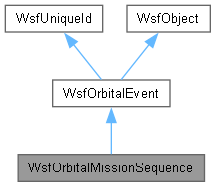
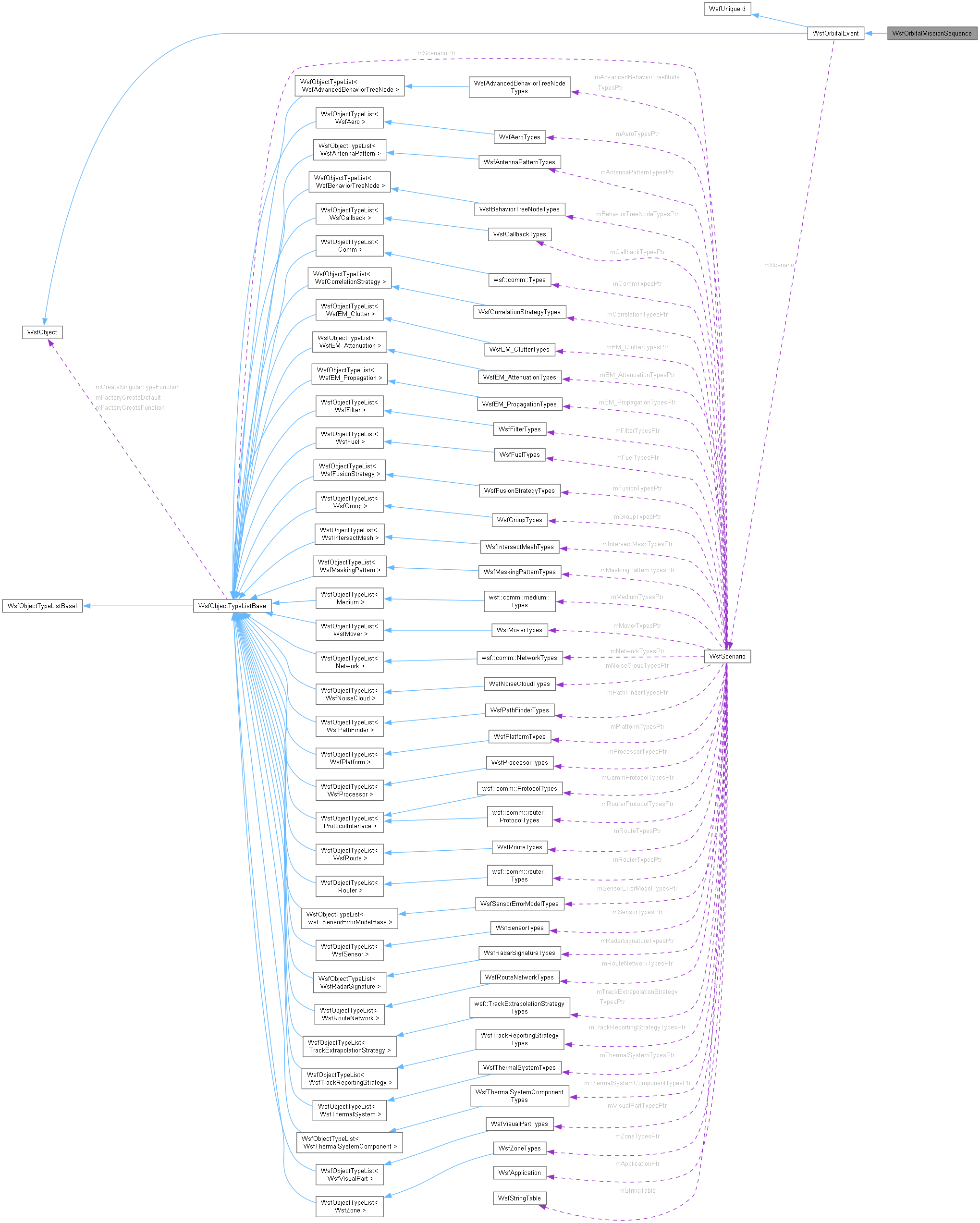
Public Types | |
| using | MissionEvents = std::list<ut::CloneablePtr<WsfOrbitalEvent>> |
| Public Types inherited from WsfObject | |
| typedef std::vector< WsfStringId > | TypeList |
| The list of types returned by GetTypeList. | |
Public Member Functions | |
| WsfOrbitalMissionSequence (const WsfScenario &aScenario) | |
| WsfOrbitalMissionSequence (const WsfOrbitalMissionSequence &aSrc) | |
| WsfOrbitalMissionSequence & | operator= (const WsfOrbitalMissionSequence &)=delete |
| ~WsfOrbitalMissionSequence () override=default | |
| WsfOrbitalMissionSequence * | Clone () const override |
| Make a copy of this object. | |
| bool | ProcessInput (UtInput &aInput) override |
| bool | Initialize (const UtCalendar &aEpoch, const wsf::space::OrbitalMissionContext &aContext) override |
| const WsfOrbitalEvent * | GetCurrentMissionEvent () const override |
| WsfOrbitalEvent * | GetCurrentMissionEvent () override |
| WsfOrbitalEvent * | AdvanceMissionEvent (const UtCalendar &aEpoch, const wsf::space::OrbitalMissionContext &aContext) override |
| UtCalendar | ComputeContraintEpoch (const UtCalendar &aEpoch, const UtOrbitalPropagatorBase &aPropagator, bool &aSuccess) const |
| const MissionEvents & | GetSequence () const |
| Return the actual sequence (std::list) of maneuvers (WsfOrbitalEvent). | |
| void | AddMissionEvent (std::unique_ptr< WsfOrbitalEvent > &&aMissionEventPtr) |
| double | GetRequiredDeltaV (const UtOrbitalPropagatorBase &aPropagator) const override |
| double | GetDeltaV () const override |
| bool | IsSequence () const override |
| Is this MissionEvent a MissionEvent sequence (WsfMissionEventSequence)? | |
| const char * | GetScriptClassName () const override |
| MissionEvents & | GetSequence () |
| Return the actual sequence (std::list) of maneuvers (WsfOrbitalEvent). | |
| void | Accept (WsfOrbitalEventVisitor *aVisitorPtr) override |
| bool | ProcessInputWithIgnore (UtInput &aInput, bool aIgnoreSomeExceptions) |
| template<typename Callable> | |
| bool | PreOrderTraversal (Callable aOperation) |
| bool | IsEmpty () const |
| Public Member Functions inherited from WsfOrbitalEvent | |
| WsfOrbitalEvent (const WsfOrbitalEvent &aSrc) | |
| WsfOrbitalEvent & | operator= (const WsfOrbitalEvent &)=delete |
| ~WsfOrbitalEvent () override=default | |
| bool | CanVerify () const |
| Return whether this event can be verified. | |
| virtual bool | VerifyCondition () const |
| virtual bool | EvaluatePreconditions (const wsf::space::OrbitalMissionContext &aContext) const |
| virtual bool | EvaluatePostconditions (const wsf::space::OrbitalMissionContext &aContext) const |
| virtual bool | ValidateParameterRanges (const std::string &aExecutingPlatformName) const |
| bool | IsComplete () const |
| Return whether the event is complete. | |
| bool | IsCanceled () const |
| Return whether the event is canceled. | |
| void | SetCanceled () |
| Mark the event as canceled. | |
| bool | Execute (const UtCalendar &aEpoch, wsf::space::OrbitalMissionContext &aContext) |
| const char * | GetScriptClassName () const override |
| bool | IsFinite () const |
| void | SetFinite (bool aIsFinite) |
| Set whether the event is finite. | |
| bool | HasExecuted () const |
| Return whether the event has executed at least once (i.e., Execute() has been called). | |
| const wsf::space::OrbitalPropagatorCondition & | GetCondition () const |
| Return the condition for event execution (const). | |
| wsf::space::OrbitalPropagatorCondition & | GetCondition () |
| Return the condition for event execution (non-const). | |
| WsfStringId | GetConditionString () const |
| Return the condition string for event execution. | |
| void | SetCondition (std::unique_ptr< wsf::space::OrbitalPropagatorCondition > aConditionPtr) |
| Set the condition for execution. | |
| const UtCalendar & | GetStartTime () const |
| Return the time at which the event will begin executing. | |
| void | SetStartTime (const UtCalendar &aStartTime) |
| Set the start time to begin event execution. | |
| const UtCalendar & | GetEvaluationTime () const |
| Return the nominal time to execute the event impulsively. | |
| UtTimeValue | GetDuration () const |
| Return the full duration of the event. If the event is impulsive, this method returns 0. | |
| void | SetDuration (const UtTimeValue &aDuration) |
| Set the full duration of the event. A value of 0 implies and impulsive event; otherwise it is finite. | |
| void | SetOnlyDuration (const UtTimeValue &aDuration) |
| UtTimeValue | GetUpdateInterval () const |
| For finite events, return the interval at which the event is to be re-evaluated. | |
| void | SetUpdateInterval (const UtTimeValue &aUpdateInterval) |
| Set the update interval for which the event is to be re-evaluated. | |
| virtual bool | GetNextExecutionTime (const UtCalendar &aCurrentTime, const UtOrbitalPropagatorBase &aPropagator, UtCalendar &aNextExecutionTime) |
| For finite events, return the next time the event should be executed. | |
| Public Member Functions inherited from WsfUniqueId | |
| WsfUniqueId () | |
| Construtor initializes the unique identifier to 0. | |
| WsfUniqueId (const WsfUniqueId &) | |
| Copy constructor initializes the unique identifier to 0. | |
| WsfUniqueId & | operator= (const WsfUniqueId &) |
| unsigned int | GetUniqueId () const |
| Get the unique identifier assigned to this object. | |
| template<typename T> | |
| void | Serialize (T &aBuff) |
| For XIO (de)serialization. | |
| Public Member Functions inherited from WsfObject | |
| WsfObject () | |
| This is the constructor for the WsfObject class. | |
| ~WsfObject () override | |
| This is the destructor for the WsfObject class. | |
| const char * | GetScriptClassName () const override |
| const std::string & | GetType () const |
| WsfStringId | GetTypeId () const |
| Get the string ID of the 'type' of the object. | |
| void | SetType (WsfStringId aType) |
| const std::string & | GetBaseType () const |
| WsfStringId | GetBaseTypeId () const |
| const TypeList & | GetTypeList () const |
| bool | IsA_TypeOf (WsfStringId aType) const |
| WsfObject & | operator= (const WsfObject &aRhs) |
| Assignment operator. | |
| template<typename T> | |
| void | Serialize (T &aBuff) |
| For XIO (de)serialization. | |
| const std::string & | GetName () const |
| WsfStringId | GetNameId () const |
| void | SetName (WsfStringId aName) |
Static Public Member Functions | |
| static WsfStringId | GetTypeId () |
| Static Public Member Functions inherited from WsfOrbitalEvent | |
| static WsfOrbitalEvent * | Create (const WsfScenario &aScenario, UtInput &aInput, bool aIgnoreSomeExceptions=false) |
Protected Member Functions | |
| WsfOrbitalEvent * | GetNextMissionEvent () const |
| const WsfScenario & | GetScenario () const |
| Protected Member Functions inherited from WsfOrbitalEvent | |
| WsfOrbitalEvent (const WsfScenario &aScenario) | |
| virtual bool | InitializeVariables (const UtCalendar &aCurrentTime, const UtCalendar &aEvaluationTime, const wsf::space::OrbitalMissionContext &aContext) |
| virtual bool | InitializeTimes (const UtCalendar &aEpoch, const wsf::space::OrbitalMissionContext &aContext) |
| Protected Member Functions inherited from WsfUniqueId | |
| void | AssignUniqueId (WsfSimulation *aSimulationPtr) |
| WsfObject (const WsfObject &aSrc) | |
| Copy constructor (for Clone()). | |
Additional Inherited Members | |
| Static Protected Member Functions inherited from WsfOrbitalEvent | |
| static WsfOrbitalEvent * | Create (const WsfScenario &aScenario, WsfStringId aType) |
| Protected Attributes inherited from WsfOrbitalEvent | |
| ut::CloneablePtr< wsf::space::OrbitalPropagatorCondition > | mCondition {} |
| bool | mIsFinite |
| bool | mHasExecuted |
| bool | mIsComplete |
| bool | mIsCanceled |
| bool | mDebug |
| bool | mCanVerify |
| UtCalendar | mStartTime |
| Can this event be verified without running in a simulation? | |
| UtCalendar | mEvaluationTime |
| UtTimeValue | mDuration |
| UtTimeValue | mUpdateInterval |
| const WsfScenario & | mScenario |
Detailed Description
A sequence of maneuvers. A maneuver sequence is aggregated by a WsfManeuvering object, which can execute maneuver sequences for capable derived propagator types, or for space mover types that aggregates a capable derived propagator. Currently the sole capable propagator is the UtOrbitalPropagator, and the only mover capable of executing maneuvers is the WsfSpaceMover.
Member Typedef Documentation
◆ MissionEvents
| using WsfOrbitalMissionSequence::MissionEvents = std::list<ut::CloneablePtr<WsfOrbitalEvent>> |
Constructor & Destructor Documentation
◆ WsfOrbitalMissionSequence() [1/2]
|
explicit |
References GetTypeId(), WsfObject::SetType(), and WsfOrbitalEvent::WsfOrbitalEvent().
Referenced by Clone(), operator=(), PreOrderTraversal(), and WsfOrbitalMissionSequence().
◆ WsfOrbitalMissionSequence() [2/2]
| WsfOrbitalMissionSequence::WsfOrbitalMissionSequence | ( | const WsfOrbitalMissionSequence & | aSrc | ) |
References WsfOrbitalEvent::WsfOrbitalEvent(), and WsfOrbitalMissionSequence().
◆ ~WsfOrbitalMissionSequence()
|
overridedefault |
Member Function Documentation
◆ Accept()
|
overridevirtual |
Implements WsfOrbitalEvent.
References WsfOrbitalEventVisitor::VisitMissionSequence().
◆ AddMissionEvent()
| void WsfOrbitalMissionSequence::AddMissionEvent | ( | std::unique_ptr< WsfOrbitalEvent > && | aMissionEventPtr | ) |
Add a maneuver to this maneuver sequence.
- Parameters
-
aMissionEventPtr The maneuver to be added. This instance will take control of the passed object.
◆ AdvanceMissionEvent()
|
overridevirtual |
Advance to the "next" MissionEvent in the MissionEvent sequence, after the current MissionEvent. (see WsfOrbitalMissionSequence::GetCurrentMissionEvent, above). The next MissionEvent may also be a MissionEvent sequence (e.g. a Hohmann transfer). The progression of calls to AdvanceMissionEvent is to return a MissionEvent sequence once, followed by aggregated MissionEvents: in the example of the Hohmann transfer, the aggregate Hohmann transfer is first returned, followed by the two "atomic" MissionEvents that first change to the transfer orbit, and second change to the final orbit. It is the responsibility of the caller to call Execute() on the returned MissionEvent before calling this method again. This is to allow propagation to occur up to the execution time of the MissionEvent. For instance, a Hohmann transfer may have a constraint upon it to execute at a relative time. In that case, calling Execute() will advance the MissionEvent to the proper time to begin execution of the two actual transfer burns associated with the MissionEvent.
- Parameters
-
aEpoch The current epoch, to be used as the basis for evaluating the next MissionEvent in the sequence. aContext The orbital mission context in which this event is being executed.
- Returns
- A pointer to the next (non-sequence) MissionEvent object, or zero if there is no next MissionEvent.
- Note
- Do not call Initialize on the returned MissionEvent object, as it will have already been initialized.
- Call this method in a try ... catch block. If the next MissionEvent cannot be initialized, an AdvanceMissionEventExeption will be thrown. Throwing the exception, as opposed to returning a bool or some other mechanism, is done to properly unwind the stack.
Reimplemented from WsfOrbitalEvent.
References WsfOrbitalEvent::AdvanceMissionEvent(), wsf::space::OrbitalMissionContext::CompleteMissionEvent(), WsfObject::GetType(), WsfOrbitalEvent::mDebug, WsfOrbitalEvent::mIsComplete, and WsfOrbitalEvent::WsfOrbitalEvent().
◆ Clone()
|
inlineoverridevirtual |
◆ ComputeContraintEpoch()
| UtCalendar WsfOrbitalMissionSequence::ComputeContraintEpoch | ( | const UtCalendar & | aEpoch, |
| const UtOrbitalPropagatorBase & | aPropagator, | ||
| bool & | aSuccess ) const |
References WsfOrbitalEvent::mCondition.
Referenced by Initialize().
◆ GetCurrentMissionEvent() [1/2]
|
overridevirtual |
Return the "current" MissionEvent in the MissionEvent sequence, defined to be either a MissionEvent that is currently executing, or if no MissionEvent is currently executing, the next MissionEvent to execute in a sequence. If the current MissionEvent is also a sequence (e.g. a Hohmann transfer), this method will continue to recurse to return the current MissionEvent that is not a sequence (const version).
- Returns
- A const pointer to the current (non-sequence) MissionEvent object, or zero if there is no current MissionEvent.
Reimplemented from WsfOrbitalEvent.
References WsfOrbitalEvent::GetCurrentMissionEvent(), WsfOrbitalEvent::IsComplete(), WsfOrbitalEvent::mHasExecuted, and WsfOrbitalEvent::WsfOrbitalEvent().
◆ GetCurrentMissionEvent() [2/2]
|
overridevirtual |
Return the "current" MissionEvent in the MissionEvent sequence, defined to be either a MissionEvent that is currently executing, or if no MissionEvent is currently executing, the next MissionEvent to execute in a sequence. If the current MissionEvent is also a sequence (e.g. a Hohmann transfer), this method will continue to recurse to return the current MissionEvent that is not a sequence.
- Returns
- A pointer to the current (non-sequence) MissionEvent object, or zero if there is no current MissionEvent.
Reimplemented from WsfOrbitalEvent.
References WsfOrbitalEvent::GetCurrentMissionEvent(), WsfOrbitalEvent::IsComplete(), WsfOrbitalEvent::mHasExecuted, and WsfOrbitalEvent::WsfOrbitalEvent().
◆ GetDeltaV()
|
overridevirtual |
Return the sum of the delta-v results for all mission events in the sequence. Only completed events will have nonzero values, so it is suggested that this method is only called when IsComplete() is valid.
Reimplemented from WsfOrbitalEvent.
◆ GetNextMissionEvent()
|
protected |
References WsfOrbitalEvent::WsfOrbitalEvent().
◆ GetRequiredDeltaV()
|
overridevirtual |
Return the sum of the required delta-v results for all mission events in the sequence. so it is suggested that this method is only called when IsComplete() is valid.
Reimplemented from WsfOrbitalEvent.
◆ GetScenario()
|
inlineprotected |
◆ GetScriptClassName()
|
inlineoverride |
◆ GetSequence() [1/2]
|
inline |
Return the actual sequence (std::list) of maneuvers (WsfOrbitalEvent).
◆ GetSequence() [2/2]
|
inline |
Return the actual sequence (std::list) of maneuvers (WsfOrbitalEvent).
Referenced by WsfSpaceMoverBase::VerifyMission().
◆ GetTypeId()
|
static |
static Return the maneuver type as a WsfStringId.
Referenced by WsfOrbitalMissionSequence().
◆ Initialize()
|
overridevirtual |
Initialize this MissionEvent in preparation to execute it.
- Parameters
-
aEpoch The current epoch, to be used as the basis for evaluating the next mission event in the sequence. aContext The orbital mission context in which this event is executing.
Reimplemented from WsfOrbitalEvent.
References WsfUniqueId::AssignUniqueId(), ComputeContraintEpoch(), wsf::space::OrbitalMissionContext::GetPropagator(), wsf::space::OrbitalMissionContext::GetSimulation(), WsfOrbitalEvent::mEvaluationTime, WsfOrbitalEvent::mStartTime, and ok.
◆ IsEmpty()
| bool WsfOrbitalMissionSequence::IsEmpty | ( | ) | const |
◆ IsSequence()
|
inlineoverridevirtual |
Is this MissionEvent a MissionEvent sequence (WsfMissionEventSequence)?
Reimplemented from WsfOrbitalEvent.
◆ operator=()
|
delete |
References WsfOrbitalMissionSequence().
◆ PreOrderTraversal()
|
inline |
Perform a pre-order traversal on the mission sequence.
This will perform a pre-order traversal of the mission sequence, invoking the given aOperation on each mission event. The provided operation must have the signature bool(WsfOrbitalEvent*), and will return true if the traversal should proceed beyond the given orbital event, and false if the traversal should halt.
- Parameters
-
aOperation - A callable entity containing the operation to perform at each event of the sequence.
- Returns
- - true if every invocation of the operation returns true; false otherwise.
References WsfOrbitalMissionSequence().
◆ ProcessInput()
|
overridevirtual |
Process input from a generic source.
Examine the current input command. If it is NOT one of the commands recognized by this class then it simply returns 'false'. If it is one of the commands recognized by this class then it processes the command and returns 'true'.
- Parameters
-
aInput a reference to a UtInput object.
- Returns
- 'true' if the command was one recognized by the class or 'false' if not.
- Exceptions
-
UtInput::ExceptionBase (or an object derived from it) if the command was recognized but contains some sort of error.
- Note
- If a derived class does not recognize the command (i.e.: the return value is false) then it should call the base class ProcessInput method. This chain should continue until either the command is recognized or the top-level base class is encountered.
Reimplemented from WsfOrbitalEvent.
References ProcessInputWithIgnore().
◆ ProcessInputWithIgnore()
| bool WsfOrbitalMissionSequence::ProcessInputWithIgnore | ( | UtInput & | aInput, |
| bool | aIgnoreSomeExceptions ) |
References WsfOrbitalEvent::Create(), WsfOrbitalEvent::ProcessInput(), and WsfOrbitalEvent::WsfOrbitalEvent().
Referenced by ProcessInput().
The documentation for this class was generated from the following files: