#include <WsfSpaceMoverBase.hpp>
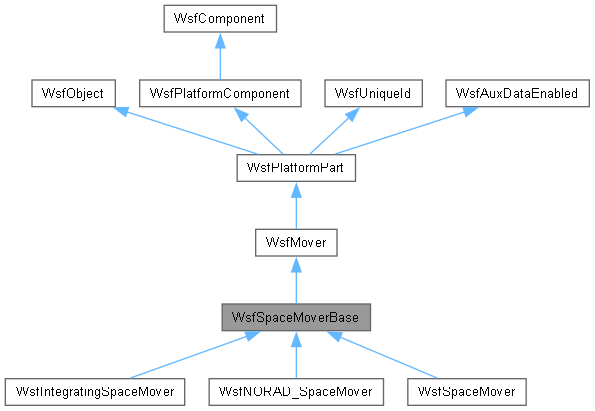
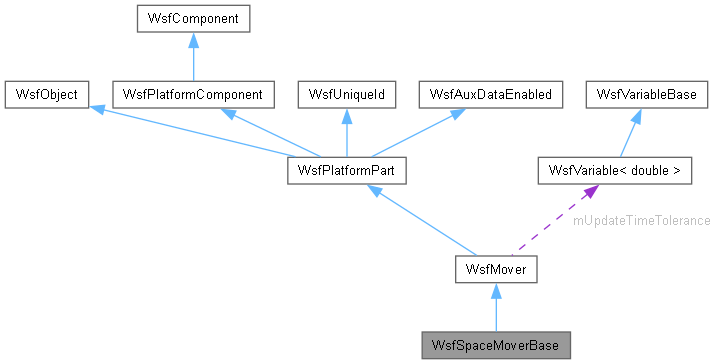
Classes | |
| class | SpaceModel |
Public Member Functions | |
| WsfSpaceMoverBase ()=delete | |
| WsfSpaceMoverBase (const WsfScenario &aScenario, std::unique_ptr< UtOrbitalPropagatorBase > aPropagatorPtr, const std::string &aScriptClassName="WsfSpaceMover") | |
| WsfSpaceMoverBase (const WsfSpaceMoverBase &aSrc) | |
| WsfSpaceMoverBase & | operator= (const WsfSpaceMoverBase &)=delete |
| ~WsfSpaceMoverBase () override | |
| Public Member Functions inherited from WsfMover | |
| WsfMover ()=delete | |
| WsfMover (const WsfScenario &aScenario) | |
| WsfMover (const WsfMover &aSrc) | |
| WsfMover & | operator= (const WsfMover &)=delete |
| ~WsfMover () override | |
| virtual double | TurnRadius (double atSpeed) |
| WsfModeList * | GetModeList () const |
| virtual void | TriggerExtrapolation () |
| WsfComponent * | CloneComponent () const override |
| int | GetComponentInitializationOrder () const override |
| const char * | GetScriptClassName () const override |
| virtual void | SwapMoverInitiated (double aSimTime, WsfMover *aOldMoverPtr) |
| void | TurnOff (double aSimTime) override |
| void | TurnOn (double aSimTime) override |
| void | SetNonOperational (double aSimTime) override |
| void | SetOperational (double aSimTime) override |
| void | PartBroken (double aSimTime) override |
| void | Restore (double aSimTime) override |
| virtual bool | IsStopped () const |
| Return whether the mover (and its attached platform) is stopped. | |
| virtual bool | IsPaused () const |
| virtual void | SetHeading (double aHeading) |
| virtual void | SetPitch (double aPitch) |
| virtual void | SetRoll (double aRoll) |
| virtual void | SetOrientationNED (double aHeading, double aPitch, double aRoll) |
| virtual void | ResetPosition (double aSimTime) |
| Informs the mover to use the current platform state. | |
| double | GetLastUpdateTime () const |
| double | GetUpdateInterval () const override |
| double | GetUpdateTimeTolerance () const |
| void | SetUpdateInterval (double aUpdateInterval) override |
| void | SetLastUpdateTime (double aLastUpdateTime) |
| virtual bool | UpdateAllowed () const |
| bool | UpdateWhenBroken () const |
| void | SetUpdateWhenBroken () |
| void | SetNoUpdateWhenBroken () |
| virtual const WsfRoute * | GetRoute () const |
| virtual const WsfRoute * | GetDefaultRoute () const |
| virtual int | RoutePointIndex () const |
| virtual bool | GoToAltitude (double aSimTime, double aAltitude, double aClimbDiveRate, bool aKeepRoute) |
| virtual bool | ReturnToRoute (double aSimTime) |
| virtual bool | GoToClosestPoint (double aSimTime) |
| virtual bool | GoToLabel (double aSimTime, WsfStringId aLabelId) |
| virtual bool | GoToLocation (double aSimTime, double aLatitude, double aLongitude, double aAltitude) |
| virtual bool | GoToSpeed (double aSimTime, double aSpeed, double aLinearAccel, bool aKeepRoute) |
| virtual bool | TurnToHeading (double aSimTime, double aHeading, double aRadialAccel, WsfPath::TurnDirection aTurnDirection) |
| virtual bool | TurnToRelativeHeading (double aSimTime, double aHeadingChange, double aRadialAccel, WsfPath::TurnDirection aTurnDirection) |
| virtual bool | SetRoute (double aSimTime, const WsfRoute &aRoute) |
| virtual bool | UpdateRoute (double aSimTime, const WsfRoute &aRoute) |
| virtual bool | UpdateDefaultRoute () |
| virtual bool | GoToWaypoint (double aSimTime, unsigned int aDestination) |
| virtual bool | FindAndSetPath (double aSimTime, WsfGeoPoint *aStartPtr, WsfGeoPoint *aEndPtr) |
| virtual bool | FlyRates (const UtVec3d &aAngularRates, const UtVec3d &aLongitudinalAccel) |
| virtual bool | FlyHeadingSpeedAltitude (double aHeading, double aSpeed, double aAltitude, double aMaxGees, double aMaxClimb) |
| virtual bool | TurnInPlaneWithSpeed (const UtVec3d &aPlane, double aGees, double aSpeed) |
| virtual bool | TurnInPlaneWithThrottle (const UtVec3d &aPlane, double aGees, double aThrottle) |
| virtual bool | FlyVectorWithSpeed (const UtVec3d &aVelocityVector, double aMaxGees, double aSpeed) |
| virtual bool | FlyVectorWithThrottle (const UtVec3d &aVelocityVector, double aMaxGees, double aThrottle) |
| virtual bool | ExecuteTriggers (double aSimTime, unsigned int aPointIndex) |
| WsfStringId | GetModeId () const |
| virtual void | SetMode (WsfStringId aModeName) |
| bool | ThreadSafe () const |
| Returns true if the mover update is thread safe. | |
| void | SetThreadSafe () |
| void | SetNotThreadSafe () |
| virtual void | InitializeProperties () |
| Add any input properties and its default value common properties list. | |
| virtual bool | PropertyExists (const std::string &aPropertyName) |
| Return true if the given property exists in the set of properties. | |
| virtual void | RegisterProperty (const std::string &aPropertyName, const int &aProperty) |
| Add an integer property to the common set of properties. | |
| virtual void | RegisterProperty (const std::string &aPropertyName, const double &aProperty) |
| Add an floating point property to the common set of properties. | |
| virtual void | RegisterProperty (const std::string &aPropertyName, const std::string &aProperty) |
| Add an string property to the set of common properties. | |
| virtual bool | GetPropertyInt (const std::string &aPropertyName, int &aProperty) |
| virtual bool | GetPropertyDouble (const std::string &aPropertyName, double &aProperty) |
| virtual bool | GetPropertyString (const std::string &aPropertyName, std::string &aProperty) |
| virtual double | GetThrottlePosition () |
| Public Member Functions inherited from WsfPlatformPart | |
| WsfPlatformPart (const WsfScenario &aScenario, int aPartType) | |
| WsfPlatformPart & | operator= (const WsfPlatformPart &aRhs)=delete |
| ~WsfPlatformPart () override | |
| bool | DebugEnabled () const |
| Returns 'true' if debugging is enabled for this instance. | |
| void | SetDebugEnabled (bool aDebugEnabled) |
| unsigned int | GetDebugMask () |
| bool | IsExternallyControlled () const |
| virtual void | SetExternallyControlled (double aSimTime, bool aIsExternallyControlled) |
| int | GetPartType () const |
| const char * | GetScriptClassName () const override |
| WsfSimulation * | GetSimulation () const |
| const WsfScenario & | GetScenario () const |
| WsfStringId | GetComponentName () const override |
| void | ComponentParentChanged (WsfPlatform *aPlatformPtr) override |
| WsfPlatform * | GetPlatform () const |
| virtual void | SetPlatform (WsfPlatform *aPlatformPtr) |
| virtual void | PlatformAdded (double aSimTime, WsfPlatform *aPlatformPtr) |
| virtual void | PlatformDeleted (WsfPlatform *aPlatformPtr) |
| double | GetLastStatusChangeTime () const |
| void | SetLastStatusChangeTime (double aSimTime) |
| Allows a system to set the time at which the device was initialized. | |
| bool | CanBeMadeOperational () const |
| Returns an indication that this system can be made operational. | |
| bool | CanBeMadeNonOperational () const |
| Returns an indication that this system can be made non-operational. | |
| bool | CanBeTurnedOn () const |
| Returns an indication that this system can be turned on. | |
| bool | CanBeTurnedOff () const |
| Returns an indication that this system can be turned off. | |
| bool | IsTurnedOn () const |
| bool | InitiallyTurnedOn () const |
| Is the system to be turned 'on' when added to the simulation? | |
| void | SetInitiallyTurnedOn (bool aInitiallyTurnedOn) |
| Sets if the system is turned on when added to the simulation. | |
| bool | IsOperational () const |
| bool | SetOperational (double aSimTime, bool aMakeOperational) |
| double | GetDamageFactor () const |
| bool | SetDamageFactor (double aSimTime, double aDamageFactor) |
| bool | IsCritical () const |
| void | SetCritical (bool aValue) |
| virtual void | OnPlatformBrokenEvent (double aSimTime) |
| Owning platform has issued a broken event. | |
| bool | IsBroken () const |
| WsfInternalLinks & | GetInternalLinks () |
| Return the internal links for this part. | |
| virtual bool | HasInternalLinks () const |
| Does this platform part have a communication link to other platform parts? | |
| virtual bool | ProcessMessage (double aSimTime, const WsfMessage &aMessage) |
| virtual bool | ReceiveMessage (double aSimTime, const WsfMessage &aMessage) |
| virtual void | SendMessage (double aSimTime, const WsfMessage &aMessage) |
| virtual void | SendMessageTo (double aSimTime, const WsfMessage &aMessage, WsfStringId aRecipientId) |
| void | SendMessageToProcessor (double aSimTime, const WsfMessage &aMessage, WsfStringId aRecipientId) |
| virtual void | SendQueuedMessages (double aSimTime) |
| const WsfCategoryList & | GetCategories () const |
| Get the categories to which this part belongs. | |
| void | AddCategory (WsfStringId aCategoryId) |
| Adds the provided category to the platform part's category list. | |
| bool | IsCategoryMember (WsfStringId aCategoryId) const |
| const WsfGroupList & | GetGroups () const |
| Get the groups to which this platform part belongs. | |
| void | JoinGroup (WsfGroup *aGroupPtr) |
| Join the given group. | |
| void | LeaveGroup (WsfGroup *aGroupPtr) |
| Leave the given group. | |
| bool | IsGroupMember (WsfStringId aGroupId) |
| unsigned int | GetUpdateEventEpoch () const |
| void | IncrementUpdateEventEpoch () |
| bool | UpdateEventActive () const |
| Is an 'Update' event active? | |
| void | SetUpdateEventActive (bool aUpdateEventActive) |
| Indicate if the 'Update' event is active. | |
| Public Member Functions inherited from WsfObject | |
| WsfObject () | |
| This is the constructor for the WsfObject class. | |
| ~WsfObject () override | |
| This is the destructor for the WsfObject class. | |
| const char * | GetScriptClassName () const override |
| const std::string & | GetType () const |
| WsfStringId | GetTypeId () const |
| Get the string ID of the 'type' of the object. | |
| void | SetType (WsfStringId aType) |
| const std::string & | GetBaseType () const |
| WsfStringId | GetBaseTypeId () const |
| const TypeList & | GetTypeList () const |
| bool | IsA_TypeOf (WsfStringId aType) const |
| WsfObject & | operator= (const WsfObject &aRhs) |
| Assignment operator. | |
| template<typename T> | |
| void | Serialize (T &aBuff) |
| For XIO (de)serialization. | |
| const std::string & | GetName () const |
| WsfStringId | GetNameId () const |
| void | SetName (WsfStringId aName) |
| Public Member Functions inherited from WsfComponentT< WsfPlatform > | |
| WsfComponentT () | |
| WsfComponentT (const WsfComponentT &) noexcept | |
| WsfComponentT & | operator= (const WsfComponentT &) noexcept |
| ~WsfComponentT () override=default | |
| ParentType * | GetComponentParent () const |
| void | SetComponentParent (ParentType *aParentPtr) |
| Public Member Functions inherited from WsfComponent | |
| virtual | ~WsfComponent ()=default |
| template<typename T> | |
| bool | QueryInterfaceT (T *&aRolePtr) |
| bool | ComponentHasRole (int aRole) |
| Returns true if the component has the specified role. | |
| virtual void | PreInput () |
| Public Member Functions inherited from WsfUniqueId | |
| WsfUniqueId () | |
| Construtor initializes the unique identifier to 0. | |
| WsfUniqueId (const WsfUniqueId &) | |
| Copy constructor initializes the unique identifier to 0. | |
| WsfUniqueId & | operator= (const WsfUniqueId &) |
| unsigned int | GetUniqueId () const |
| Get the unique identifier assigned to this object. | |
| template<typename T> | |
| void | Serialize (T &aBuff) |
| For XIO (de)serialization. | |
| Public Member Functions inherited from WsfAuxDataEnabled | |
| WsfAuxDataEnabled ()=default | |
| WsfAuxDataEnabled (const WsfAuxDataEnabled &aSrc)=default | |
| WsfAuxDataEnabled & | operator= (const WsfAuxDataEnabled &aRhs) |
| WsfAuxDataEnabled (WsfAuxDataEnabled &&)=default | |
| WsfAuxDataEnabled & | operator= (WsfAuxDataEnabled &&)=default |
| virtual | ~WsfAuxDataEnabled () noexcept |
| void | SetAuxData (const WsfAttributeContainer &aAuxData) |
| void | DeleteAuxData () |
| Delete the aux data container from the object. | |
| void | MergeAuxData (const WsfAuxDataEnabled &aSrc) |
| Merge the object's aux data with aux data from an existing object. | |
| void | UpdateAuxData (const WsfAuxDataEnabled &aSrc) |
| Update the object's aux data with aux data from an existing object. | |
| bool | HasAuxData () const |
| Returns true if this object has aux data. | |
| bool | ProcessInput (UtInput &aInput) |
| template<typename T> | |
| void | Serialize (T &aBuff) |
| (De)serialization for XIO | |
| WsfAttributeContainer & | GetAuxData () |
| const WsfAttributeContainer & | GetAuxData () const noexcept |
| const WsfAttributeContainer & | GetAuxDataConst () const noexcept |
WsfSpaceMoverBase Initial State Accessors | |
| WSF_SPACE_DEPRECATED WsfGeoPoint | GetInitialPositionLLA () const |
| UtVec3d | GetInitialPositionECI () const |
| UtVec3d | GetInitialPositionWCS () const |
| UtVec3d | GetInitialVelocityECI () const |
| UtVec3d | GetInitialVelocityWCS () const |
| const char * | GetScriptClassName () const override |
| WsfSpatialDomain | GetSpatialDomain () const override |
| bool | IsExtrapolating () const override |
| const UtOrbitalPropagatorBase & | GetPropagator () const |
| Return a reference to the orbital propagator associated with this space mover. | |
| UtOrbitalPropagatorBase & | GetPropagator () |
| Return a reference to the orbital propagator associated with this space mover (non-const version). | |
| const WsfOrbitalManeuvering & | GetOrbitalManeuvering () const |
| Return the maneuvering model for this space mover. | |
| bool | InitializeOrbitalManeuvering (const UtCalendar &aEpoch) |
| Initialize just the orbital maneuvering model. | |
| const WsfOrbitalEvent * | GetCurrentMissionEvent () const |
| Return the current maneuver, if any, being performed by this mover. | |
| const WsfOrbitalMissionSequence & | GetMissionEvents () const |
| void | ScheduleMission (const UtCalendar &aEpoch, std::unique_ptr< WsfOrbitalMissionSequence > aMissionEventsPtr) |
| void | CancelMission () |
| bool | VerifyMission (const UtCalendar &aEpoch, const WsfOrbitalMissionSequence &aSequence, wsf::space::verify::PreOperation aPreVerifyOp=wsf::space::verify::PreOperation{}, wsf::space::verify::PostOperation aPostVerifyOp=wsf::space::verify::PostOperation{}) const |
| bool | VerifyMission (const UtCalendar &aEpoch) const |
| WsfAttitudeController & | GetAttitudeController () |
| Return a reference to the attitude controller associated with this space mover. | |
| double | GetSimTimeOfEpoch () const |
| WsfScriptContext & | GetScriptContext () |
| Return a reference to the script context. | |
| void | UpdatePropagation (const UtCalendar &aEpoch) |
| const UtCalendar & | GetCurrentTime () const |
| Get the current propagation time. | |
| double | GetElementOutputUpdateInterval () const |
| Get the interval between entries in an event pipe of this mover's elements. | |
| const std::string & | GetDescriptor () const |
| Return the descriptor associated with this mover. | |
| const std::string & | GetDesignator () const |
| Return the designator associated with this mover. | |
| const ut::OrbitalState & | GetInitialOrbitalState () const |
| Return the initial unpropagated orbital state. | |
| double | GetInitialHeading () const |
| void | SetInitialOrbitalState (const ut::OrbitalState &aState) |
| A pass-through method to set the initial orbital state. | |
| bool | GetFutureLocationWCS (double aSimTime, double aLocationWCS[3]) final |
| Return the WCS location at some time aSimTime in the future. | |
| WsfMover::KinematicModel * | CreateKinematicModel (double aSimTime, WsfStringId aModelTypeId, const double aLocationWCS[3], const double aVelocityWCS[3], WsfMover *aMoverPtr, WsfDraw *aDrawPtr) const override |
| void | SetTargetOrientationECI (double aPsi, double aTheta, double aPhi) |
| Set the mover's target ECI orientation. | |
| ut::optional< UtColor > | GetOrbitColor () const |
| UtColor | GetOrbitColorValue () const |
| bool | OrbitColorSet () const |
| void | UpdateColor (double aSimTime, const UtColor &aColor) |
| void | SetOrbitColor (const std::string &aOrbitColor) |
| void | SetOrbitColor (const UtColor &aOrbitColor) |
| bool | IsTLEInputAllowed () const noexcept |
| void | SetTLEInputAllowed (bool aTLE_InputAllowed) noexcept |
| double | GetLookAngleTo (const UtVec3d &aLocationWCS) const |
| double | GetIncidenceAngle (const UtVec3d &aLocationWCS) const |
| double | GetTargetElevationAngle (const UtVec3d &aLocationWCS) const |
| double | GetSquintAngleTo (const UtVec3d &aLocationWCS) const |
| double | GetDistanceToHorizon () const |
| double | GetLookAngleToHorizon () const |
Common framework methods. | |
| WsfMover * | Clone () const override |
| const int * | GetComponentRoles () const override |
| void * | QueryInterface (int aRole) override |
| bool | PreInitialize (double aSimTime) override |
| bool | Initialize (double aSimTime) override |
| bool | Initialize2 (double aSimTime) override |
| bool | ProcessInput (UtInput &aInput) override |
| void | Update (double aSimTime) override |
Mostly pass-through methods that are optionally supported by the maneuvering model. | |
| const ut::OrbitalState & | GetOrbitalState () const |
| Return the current propagated orbital state. | |
| double | GetAvailableDeltaV () const |
| double | GetRequiredDuration (double aDeltaV) const |
| double | GetRequiredDeltaV (double aDuration) const |
| double | GetManeuverDuration (const UtCalendar &aEpoch, const WsfOrbitalManeuver &aManeuver, double aDeltaV) const |
| bool | PerformStagingOperation () |
| const ut::CentralBody & | GetCentralBody () const |
| const ut::CentralPoint & | GetCentralPoint () const |
| bool | Maneuver (const UtCalendar &aEpoch, const UtVec3d &aCommandedDeltaV, UtVec3d &aActualDeltaV) |
| virtual bool | SetInitialPoint (double aLat, double aLon, double aAlt, double aSpeed, double aHeading) |
Additional Inherited Members | |
| Public Types inherited from WsfPlatformPart | |
| enum | { cLEVEL_ONE_DEBUG = 0x00000001 , cLEVEL_TWO_DEBUG = 0x00000002 } |
| using | InternalMessageQueue = std::queue<WsfMessage*> |
| using | RecipientMessageQueue = std::queue<std::pair<WsfPlatformPart*, WsfMessage*>> |
| Public Types inherited from WsfObject | |
| typedef std::vector< WsfStringId > | TypeList |
| The list of types returned by GetTypeList. | |
| Public Types inherited from WsfComponentT< WsfPlatform > | |
| typedef WsfPlatform | ParentType |
| This is needed to support the WsfComponentList template. | |
| Static Public Attributes inherited from WsfMover | |
| static const char * | cTYPE_KIND = "mover" |
| Static Public Attributes inherited from WsfAuxDataEnabled | |
| static UtCallbackListN< void(const WsfAuxDataEnabled *)> | AuxDataAccessed |
| static UtCallbackListN< void(const WsfAuxDataEnabled *)> | AuxDataDestroyed |
| void | SetModeList (WsfModeList *aModeListPtr) |
| void | SetUpdateTimeTolerance (double aDt) |
| Revise the internal time tolerance allowed for Update() sequencing logic. | |
| WsfPlatformPart (const WsfPlatformPart &aSrc) | |
| Copy constructor (for Clone()). | |
| WsfObject (const WsfObject &aSrc) | |
| Copy constructor (for Clone()). | |
| Protected Member Functions inherited from WsfUniqueId | |
| void | AssignUniqueId (WsfSimulation *aSimulationPtr) |
| double | mLastUpdateTime |
| The simulation time when Update was last called. | |
| WsfVariable< double > | mUpdateTimeTolerance |
| bool | mThreadSafe |
| std::vector< WsfMoverMode * > | mMoverModeList |
| The generic list of modes (not valid until Initialize is called). | |
| WsfStringId | mModeId |
Detailed Description
WsfSpaceMoverBase is a base class for Space-Based movers (in the WSF project these are WsfSpaceMover and WsfNORAD_SpaceMover). Notably, this class aggregates the orbital propagator object as a UtOrbtialPropagatorBase*. The way to implement a derived class with a derived mover is to instantiate the derived mover in the constructor, as follows:
Constructor & Destructor Documentation
◆ WsfSpaceMoverBase() [1/3]
|
delete |
◆ WsfSpaceMoverBase() [2/3]
| WsfSpaceMoverBase::WsfSpaceMoverBase | ( | const WsfScenario & | aScenario, |
| std::unique_ptr< UtOrbitalPropagatorBase > | aPropagatorPtr, | ||
| const std::string & | aScriptClassName = "WsfSpaceMover" ) |
References GetScriptContext(), and WsfMover::WsfMover().
◆ WsfSpaceMoverBase() [3/3]
| WsfSpaceMoverBase::WsfSpaceMoverBase | ( | const WsfSpaceMoverBase & | aSrc | ) |
References WsfMover::mUpdateTimeTolerance, WsfMover::WsfMover(), and WsfSpaceMoverBase().
◆ ~WsfSpaceMoverBase()
|
override |
Member Function Documentation
◆ CancelMission()
| void WsfSpaceMoverBase::CancelMission | ( | ) |
Cancel the current mission. The current mission event will cease to be executed, even though it may not have actually achieved its goal. Future events will be deleted, and the parent platform will propagate using its current state.
References WsfPlatformPart::GetScenario().
◆ Clone()
|
overridevirtual |
Clone this object.
- Returns
- a pointer to the new object.
Implements WsfMover.
References WsfMover::WsfMover(), and WsfSpaceMoverBase().
◆ CreateKinematicModel()
|
overridevirtual |
Get the kinematic model of this mover if available. If aMoverPtr is null, "this" has been initialized (i.e., GetPlatform(), etc. will work); however, if aMoverPtr is non-null, "this" has not been initialized, so that any data needed from the simulation or scenario should be retrieved using aMoverPtr instead. In either case, the kinematic model needs to be extracted without disturbing the state of the platform to which either of "this" or aMoverPtr is attached.
- Parameters
-
aSimTime The current simulation time. aPlatformTypeId The platform type id that is being propagated kinematically. aLocationWCS The location of the platform at aSimTime. aVelocityWCS The velocity of the platform at aSimTime. aMoverPtr If non-null, a valid mover from which "this" should be initialized. aDrawPtr A WsfDraw object that can be used for custom visualization.
- Returns
- The kinematic model pointer if available, otherwise nullptr.
Reimplemented from WsfMover.
References WsfSimulation::GetDateTime(), WsfPlatformPart::GetPlatform(), GetPropagator(), WsfPlatformPart::GetSimulation(), WsfDateTime::GetStartDateAndTime(), and WsfMover::WsfMover().
◆ GetAttitudeController()
|
inline |
Return a reference to the attitude controller associated with this space mover.
Referenced by WsfOrbitalAttitudeChangeEvent::ExecuteEvent(), and WsfOrbitalAttitudeChangeEvent::Initialize().
◆ GetAvailableDeltaV()
| double WsfSpaceMoverBase::GetAvailableDeltaV | ( | ) | const |
Referenced by operator=().
◆ GetCentralBody()
| const ut::CentralBody & WsfSpaceMoverBase::GetCentralBody | ( | ) | const |
Referenced by GetDistanceToHorizon(), GetInitialPositionLLA(), GetLookAngleToHorizon(), and operator=().
◆ GetCentralPoint()
| const ut::CentralPoint & WsfSpaceMoverBase::GetCentralPoint | ( | ) | const |
Referenced by GetDistanceToHorizon(), GetLookAngleToHorizon(), Initialize(), operator=(), and PreInitialize().
◆ GetComponentRoles()
|
overridevirtual |
Returns a zero-terminated array of component roles. Note that the array should be in decreasing order of specificity and should generally the inheritance hierarchy. The first entry should be the components 'primary' role. For example a sensor would do the following:
Reimplemented from WsfMover.
References cWSF_COMPONENT_MOVER, cWSF_COMPONENT_NULL, cWSF_COMPONENT_PLATFORM_PART, and cWSF_COMPONENT_SPACE_MOVER.
◆ GetCurrentMissionEvent()
| const WsfOrbitalEvent * WsfSpaceMoverBase::GetCurrentMissionEvent | ( | ) | const |
Return the current maneuver, if any, being performed by this mover.
References WsfOrbitalEvent::GetCurrentMissionEvent().
Referenced by GetFutureLocationWCS(), and Maneuver().
◆ GetCurrentTime()
|
inline |
Get the current propagation time.
Referenced by Initialize2(), and WsfSpaceMoverBase::SpaceModel::SpaceModel().
◆ GetDescriptor()
|
inline |
Return the descriptor associated with this mover.
◆ GetDesignator()
|
inline |
Return the designator associated with this mover.
◆ GetDistanceToHorizon()
| double WsfSpaceMoverBase::GetDistanceToHorizon | ( | ) | const |
Return distance in meters from the mover to the central body's horizon. If the mover's position is inside the mean radius of the central body, this will return -1.
- Returns
- Distance from the mover to the horizon in meters; or -1 if the mover is inside the central body.
References GetCentralBody(), GetCentralPoint(), and GetOrbitalState().
◆ GetElementOutputUpdateInterval()
|
inline |
Get the interval between entries in an event pipe of this mover's elements.
◆ GetFutureLocationWCS()
|
finalvirtual |
Return the WCS location at some time aSimTime in the future.
Reimplemented from WsfMover.
References GetCurrentMissionEvent(), WsfDateTime::GetCurrentTime(), WsfSimulation::GetDateTime(), WsfPlatformPart::GetPlatform(), GetPropagator(), WsfPlatformPart::GetSimulation(), and WsfMover::mLastUpdateTime.
◆ GetIncidenceAngle()
| double WsfSpaceMoverBase::GetIncidenceAngle | ( | const UtVec3d & | aLocationWCS | ) | const |
Return the incidence angle for the given WCS location. This returns the angle in radians between the local vertical direction at aLocationWCS and the line connecting this space mover and the given aLocationWCS.
- Parameters
-
aLocationWCS The WCS location of the target point.
- Returns
- The incidence angle in radians.
References GetOrbitalState().
Referenced by GetTargetElevationAngle().
◆ GetInitialHeading()
| double WsfSpaceMoverBase::GetInitialHeading | ( | ) | const |
References GetInitialOrbitalState(), and WsfPlatformPart::GetPlatform().
◆ GetInitialOrbitalState()
| const ut::OrbitalState & WsfSpaceMoverBase::GetInitialOrbitalState | ( | ) | const |
Return the initial unpropagated orbital state.
Referenced by GetInitialHeading(), GetInitialPositionECI(), GetInitialPositionLLA(), GetInitialPositionWCS(), GetInitialVelocityECI(), GetInitialVelocityWCS(), WsfSpaceMover::Initialize(), Initialize(), Initialize2(), PreInitialize(), and WsfSpaceMover::ProcessInput().
◆ GetInitialPositionECI()
| UtVec3d WsfSpaceMoverBase::GetInitialPositionECI | ( | ) | const |
A convenience accessor to determine a WsfSpaceMoverBase's initial position. Extended to WsfSpaceMoverScriptClass for exposure to the user.
- Returns
- Initial Position (Reference Frame: Earth Centered Inertial (ECI) / Geocentric Celestial Reference Frame (GCRF))
References GetInitialOrbitalState().
Referenced by operator=().
◆ GetInitialPositionLLA()
| WsfGeoPoint WsfSpaceMoverBase::GetInitialPositionLLA | ( | ) | const |
A convenience accessor which calculates a WsfSpaceMoverBase's initial position from its orbital elements. Extended to WsfSpaceMoverScriptClass for exposure to the user.
- Returns
- Initial Position (Reference Frame: Latitude, Longitude, Altitude))
References GetCentralBody(), and GetInitialOrbitalState().
Referenced by operator=().
◆ GetInitialPositionWCS()
| UtVec3d WsfSpaceMoverBase::GetInitialPositionWCS | ( | ) | const |
A convenience accessor to determine a WsfSpaceMoverBase's initial position. Extended to WsfSpaceMoverScriptClass for exposure to the user.
- Returns
- Initial Position (Reference Frame: World Coordinate System (WCS) / Earth-Centered, Earth-Fixed (ECEF))
References GetInitialOrbitalState().
Referenced by operator=().
◆ GetInitialVelocityECI()
| UtVec3d WsfSpaceMoverBase::GetInitialVelocityECI | ( | ) | const |
A convenience accessor to determine a WsfSpaceMoverBase's initial velocity. Extended to WsfSpaceMoverScriptClass for exposure to the user.
- Returns
- Initial Velocity (Reference Frame: Earth Centered Inertial (ECI) / Geocentric Celestial Reference Frame (GCRF))
References GetInitialOrbitalState().
Referenced by operator=().
◆ GetInitialVelocityWCS()
| UtVec3d WsfSpaceMoverBase::GetInitialVelocityWCS | ( | ) | const |
A convenience accessor to determine a WsfSpaceMoverBase's initial velocity. Extended to WsfSpaceMoverScriptClass for exposure to the user.
- Returns
- Initial Velocity (Reference Frame: World Coordinate System (WCS) / Earth-Centered, Earth-Fixed (ECEF))
References GetInitialOrbitalState().
Referenced by operator=().
◆ GetLookAngleTo()
| double WsfSpaceMoverBase::GetLookAngleTo | ( | const UtVec3d & | aLocationWCS | ) | const |
Return the look angle to the given WCS location. This returns the angle in radians between the nadir direction and the line connecting this space mover and the given aLocationWCS.
- Parameters
-
aLocationWCS The WCS location of the target point.
- Returns
- The look angle from this space mover to the target point, in radians.
References GetOrbitalState().
◆ GetLookAngleToHorizon()
| double WsfSpaceMoverBase::GetLookAngleToHorizon | ( | ) | const |
Return look angle in radians to the central body's horizon. If the mover's position is inside the mean radius of the central body, this will return -2 pi.
- Returns
- Look angle to the horizon in radians; or -2 pi if the mover is inside the central body.
References GetCentralBody(), GetCentralPoint(), and GetOrbitalState().
◆ GetManeuverDuration()
| double WsfSpaceMoverBase::GetManeuverDuration | ( | const UtCalendar & | aEpoch, |
| const WsfOrbitalManeuver & | aManeuver, | ||
| double | aDeltaV ) const |
Referenced by operator=().
◆ GetMissionEvents()
| const WsfOrbitalMissionSequence & WsfSpaceMoverBase::GetMissionEvents | ( | ) | const |
Return the current mission sequence.
In the case that no mission sequence is defined on this mover, this method will return an empty, but valid, object.
Referenced by VerifyMission().
◆ GetOrbitalManeuvering()
| const WsfOrbitalManeuvering & WsfSpaceMoverBase::GetOrbitalManeuvering | ( | ) | const |
Return the maneuvering model for this space mover.
Referenced by WsfIntegratingPropagator::SetSpaceMover(), and VerifyMission().
◆ GetOrbitalState()
| const ut::OrbitalState & WsfSpaceMoverBase::GetOrbitalState | ( | ) | const |
Return the current propagated orbital state.
Referenced by GetDistanceToHorizon(), GetIncidenceAngle(), GetLookAngleTo(), GetLookAngleToHorizon(), GetSquintAngleTo(), operator=(), wsf::event::utils::PrintOrbitalManeuverData(), and wsf::event::utilsCSV::PrintOrbitalManeuverData().
◆ GetOrbitColor()
|
inline |
◆ GetOrbitColorValue()
|
inline |
◆ GetPropagator() [1/2]
|
inline |
Return a reference to the orbital propagator associated with this space mover (non-const version).
◆ GetPropagator() [2/2]
|
inline |
Return a reference to the orbital propagator associated with this space mover.
Referenced by CreateKinematicModel(), GetFutureLocationWCS(), WsfIntegratingSpaceMover::GetOrbitalDynamicsClone(), WsfIntegratingSpaceMover::GetOrbitalIntegratorClone(), WsfOrbitalManeuver::GetTargetPropagatorPerception(), WsfOrbitalManeuver::GetTargetPropagatorTruth(), WsfNORAD_SpaceMover::Initialize(), WsfSpaceMover::Initialize(), Initialize(), Initialize2(), wsf::event::utils::PrintOrbitalManeuverData(), wsf::event::utilsCSV::PrintOrbitalManeuverData(), WsfSpaceMover::ProcessInput(), WsfSpaceMover::ShowStatus(), UT_DEFINE_SCRIPT_METHOD(), wsf::space::script::UT_DEFINE_SCRIPT_METHOD(), and VerifyMission().
◆ GetRequiredDeltaV()
| double WsfSpaceMoverBase::GetRequiredDeltaV | ( | double | aDuration | ) | const |
Referenced by operator=().
◆ GetRequiredDuration()
| double WsfSpaceMoverBase::GetRequiredDuration | ( | double | aDeltaV | ) | const |
Referenced by operator=().
◆ GetScriptClassName()
|
override |
◆ GetScriptContext()
|
inline |
Return a reference to the script context.
Referenced by WsfOrbitalScriptEvent::Initialize(), Initialize(), and WsfSpaceMoverBase().
◆ GetSimTimeOfEpoch()
|
inline |
Return the relative time since the propagator's epoch time.
- Note
- This is not necessarily the same as the current simulation time.
◆ GetSpatialDomain()
|
inlineoverridevirtual |
Return the spatial domain in which the mover is operating.
The spatial domain is the domain in which the mover is operating (land, sea, space, etc.).
- Returns
- The spatial domain in which the platform is operating. WSF_SPATIAL_DOMAIN_LAND is returned if this method is not overridden by a derived class.
Reimplemented from WsfMover.
References WSF_SPATIAL_DOMAIN_SPACE.
◆ GetSquintAngleTo()
| double WsfSpaceMoverBase::GetSquintAngleTo | ( | const UtVec3d & | aLocationWCS | ) | const |
Return the squint angle to the given WCS location. This returns the angle between this mover's WCS velocity vector projected into the local horizontal plane, and the WCS displacement vector from this mover to the given aLocationWCS projected into the local horizontal plane.
- Parameters
-
aLocationWCS The WCS location of the target point.
- Returns
- The squint angle to the target point, in radians.
References GetOrbitalState().
◆ GetTargetElevationAngle()
| double WsfSpaceMoverBase::GetTargetElevationAngle | ( | const UtVec3d & | aLocationWCS | ) | const |
Return the target elevation angle for the given WCS location. This returns the angle in radians between the local horizontal direction at aLocationWCS and the line connecthing this space mover and the given aLocationWCS.
- Parameters
-
aLocationWCS The WCS location of the target point.
- Returns
- The target elevation angle in radians.
References GetIncidenceAngle().
◆ Initialize()
|
overridevirtual |
Initialize the kinematic state of the associated platform. Fix the initial location, orientation, speed and acceleration of the attached platform to what it should be at the beginning of its existence.
- Parameters
-
aSimTime The current simulation time.
- Returns
- True if successful.
Reimplemented from WsfMover.
References GetCentralPoint(), WsfDateTime::GetCurrentTime(), WsfSimulation::GetDateTime(), GetInitialOrbitalState(), WsfObject::GetName(), WsfPlatformPart::GetPlatform(), GetPropagator(), GetScriptContext(), WsfPlatformPart::GetSimulation(), WsfDateTime::GetStartDateAndTime(), WsfMover::Initialize(), ok, wsf::space::OrbitalPropagator::SetSpaceMover(), and UpdatePropagation().
Referenced by WsfNORAD_SpaceMover::Initialize(), WsfSpaceMover::Initialize(), and Initialize2().
◆ Initialize2()
|
overridevirtual |
Perform phase 2 initialization of the part. This is invoked by WsfPlatform::Initialize() during phase 2 initialization of the platform. During phase 2, platform components may assume that the platform location has been defined, initial tracks have been loaded and that all components have completed phase 1 initialization.
- Parameters
-
aSimTime The current simulation time.
- Returns
- 'true' if successful or 'false' if some sort of error occurred.
Reimplemented from WsfMover.
References GetCurrentTime(), WsfSimulation::GetDateTime(), GetInitialOrbitalState(), WsfObject::GetName(), WsfPlatformPart::GetPlatform(), GetPropagator(), WsfPlatformPart::GetSimulation(), WsfDateTime::GetStartDateAndTime(), Initialize(), ok, Update(), and VerifyMission().
Referenced by WsfIntegratingSpaceMover::Initialize2().
◆ InitializeOrbitalManeuvering()
| bool WsfSpaceMoverBase::InitializeOrbitalManeuvering | ( | const UtCalendar & | aEpoch | ) |
Initialize just the orbital maneuvering model.
References WsfOrbitalManeuvering::Initialize().
◆ IsExtrapolating()
|
inlineoverridevirtual |
Return whether the mover is "extrapolating". 'Extrapolating' has a slightly different meaning depending on the mover, but it fundamentally means it is moving without any form of external guidance. In the case of a simple waypoint- following mover this means it has reached its final waypoint and has either stopped there or is continuing on at a specified direction, speed, and altitude. For movers that do not follow waypoints it is a little murkier, but it typically means that the motion is occuring without any propulsion. In this latter case it basically means that with a little knowledge an external observer could take the position at any time and use Newton's Laws to estimate future positions.
Reimplemented from WsfMover.
◆ IsTLEInputAllowed()
|
inlinenoexcept |
◆ Maneuver()
| bool WsfSpaceMoverBase::Maneuver | ( | const UtCalendar & | aEpoch, |
| const UtVec3d & | aCommandedDeltaV, | ||
| UtVec3d & | aActualDeltaV ) |
References GetCurrentMissionEvent().
Referenced by wsf::space::OrbitalMissionSimulationContext::Maneuver(), and operator=().
◆ operator=()
|
delete |
References GetAvailableDeltaV(), GetCentralBody(), GetCentralPoint(), GetInitialPositionECI(), GetInitialPositionLLA(), GetInitialPositionWCS(), GetInitialVelocityECI(), GetInitialVelocityWCS(), GetManeuverDuration(), GetOrbitalState(), GetRequiredDeltaV(), GetRequiredDuration(), Maneuver(), PerformStagingOperation(), SetInitialPoint(), WsfMover::WsfMover(), and WsfSpaceMoverBase().
◆ OrbitColorSet()
|
inline |
◆ PerformStagingOperation()
| bool WsfSpaceMoverBase::PerformStagingOperation | ( | ) |
References WsfSimulation::GetSimTime(), WsfPlatformPart::GetSimulation(), and WsfObserver::MoverStaged().
Referenced by operator=().
◆ PreInitialize()
|
overridevirtual |
Perform pre-initializion function. This is called by WsfPlatform::Initialize prior to actually initializing the components on a platform (i.e.: calling Initialize and Initialize2 for each component). The primary reason for this method is to allow components to add other components that will then be subsequently initialized. The component may examine the component list and add components, but it must not assume ANYTHING about the actual state of the component.
- Parameters
-
aSimTime The current simulation time.
- Returns
- true if successful or false if unsuccessful (bad input data, etc.)
Reimplemented from WsfComponent.
References GetCentralPoint(), WsfDateTime::GetCurrentTime(), WsfSimulation::GetDateTime(), GetInitialOrbitalState(), WsfPlatform::GetMover(), WsfObject::GetName(), WsfPlatformPart::GetPlatform(), and WsfPlatformPart::GetSimulation().
◆ ProcessInput()
|
overridevirtual |
Process input from a generic source.
Examine the current input command. If it is NOT one of the commands recognized by this class then it simply returns 'false'. If it is one of the commands recognized by this class then it processes the command and returns 'true'.
- Parameters
-
aInput a reference to a UtInput object.
- Returns
- 'true' if the command was one recognized by the class or 'false' if not.
- Exceptions
-
UtInput::ExceptionBase (or an object derived from it) if the command was recognized but contains some sort of error.
- Note
- If a derived class does not recognize the command (i.e.: the return value is false) then it should call the base class ProcessInput method. This chain should continue until either the command is recognized or the top-level base class is encountered.
Reimplemented from WsfMover.
References WsfObjectTypeList< T >::Find(), WsfAttitudeControllerTypes::Get(), WsfOrbitalManeuveringTypes::Get(), WsfPlatformPart::GetScenario(), and WsfMover::ProcessInput().
Referenced by WsfNORAD_SpaceMover::ProcessInput(), and WsfSpaceMover::ProcessInput().
◆ QueryInterface()
|
overridevirtual |
Requests a component's role interface. A component can support one or more roles.
- Parameters
-
aRole The role whose interface is to be returned.
- Returns
- A pointer to the object if it supports the indicated role, or 'null' if it does not. Usage: WsfProcessor* procPtrOrNull = (WsfProcessor*)componentPtr->QueryComponentInterface(cWSF_COMPONENT_PROCESSOR);
Reimplemented from WsfMover.
References cWSF_COMPONENT_SPACE_MOVER, and WsfMover::QueryInterface().
◆ ScheduleMission()
| void WsfSpaceMoverBase::ScheduleMission | ( | const UtCalendar & | aEpoch, |
| std::unique_ptr< WsfOrbitalMissionSequence > | aMissionEventsPtr ) |
Set the MissionEvent sequence using a simulation event that executes at the current simulation time (necessary because a scripted event can schedule a new sequence, thus potentially deleting itself). Then, initialize and schedule the first event in the new sequence.
- Parameters
-
aEpoch The current epoch, to be used as the basis for scheduling mission. aMissionEventsPtr The new mission events sequence to be executed.
◆ SetInitialOrbitalState()
|
inline |
A pass-through method to set the initial orbital state.
Referenced by wsf::space::script::UT_DEFINE_SCRIPT_METHOD().
◆ SetInitialPoint()
|
virtual |
Reimplemented in WsfNORAD_SpaceMover, and WsfSpaceMover.
Referenced by operator=().
◆ SetOrbitColor() [1/2]
|
inline |
References SetOrbitColor().
Referenced by SetOrbitColor(), and UpdateColor().
◆ SetOrbitColor() [2/2]
| void WsfSpaceMoverBase::SetOrbitColor | ( | const UtColor & | aOrbitColor | ) |
◆ SetTargetOrientationECI()
| void WsfSpaceMoverBase::SetTargetOrientationECI | ( | double | aPsi, |
| double | aTheta, | ||
| double | aPhi ) |
Set the mover's target ECI orientation.
References WsfSimulation::GetSimTime(), WsfPlatformPart::GetSimulation(), simTime, and Update().
◆ SetTLEInputAllowed()
|
inlinenoexcept |
Referenced by WsfNORAD_SpaceMover::WsfNORAD_SpaceMover(), and WsfNORAD_SpaceMover::WsfNORAD_SpaceMover().
◆ Update()
|
overridevirtual |
Update the kinematic state of the associated platform. Update the location, orientation, speed and acceleration of the attached platform to what it should be at the supplied time.
- Parameters
-
aSimTime The current simulation time.
- Note
- The derived class MUST update the protected variable mLastUpdateTime to be the current simulation time.
Reimplemented from WsfMover.
References WsfSimulation::GetDateTime(), WsfPlatformPart::GetPlatform(), WsfPlatformPart::GetSimulation(), WsfDateTime::GetStartDateAndTime(), WsfMover::mLastUpdateTime, WsfMover::mUpdateTimeTolerance, and UpdatePropagation().
Referenced by WsfSpaceMoverBase::SpaceModel::GetLocationXYZ(), WsfSpaceMoverBase::SpaceModel::GetVelocityXYZ(), Initialize2(), and SetTargetOrientationECI().
◆ UpdateColor()
| void WsfSpaceMoverBase::UpdateColor | ( | double | aSimTime, |
| const UtColor & | aColor ) |
References WsfPlatformPart::GetSimulation(), WsfObserver::OrbitColorChanged(), and SetOrbitColor().
◆ UpdatePropagation()
| void WsfSpaceMoverBase::UpdatePropagation | ( | const UtCalendar & | aEpoch | ) |
Update the propagation and the associated platform. This method is usually only called from the Update method; however, in some cases it is called to update the state of the platform instantaneously, especially during execution of an impulsive maneuver.
- Parameters
-
aEpoch The time to which the propagation and platform state will be updated.
References WsfPlatformPart::GetPlatform().
Referenced by Initialize(), WsfIntegratingSpaceMover::Initialize2(), and Update().
◆ VerifyMission() [1/2]
| bool WsfSpaceMoverBase::VerifyMission | ( | const UtCalendar & | aEpoch | ) | const |
Verify the initial sequence of MissionEvents in this object. The sequence of MissionEvents is verified outside of the simulation as a check to make sure that constraints are being met. If the sequence is not verified, error messages are printed and the simulation will not run until the errors are fixed. In the case of some orbital events that involve checks on other platforms (WsfIterceptManeuver, WsfRendezvousManeuver, WsfOrbitalScriptEvent, etc.) the verification will terminate with the check of the non-verifiable event, and the sequence may subsequently fail to completely execute during runtime.
- Parameters
-
aEpoch The start epoch at which the MissionEvent sequence is to be verified.
References GetMissionEvents(), and VerifyMission().
◆ VerifyMission() [2/2]
| bool WsfSpaceMoverBase::VerifyMission | ( | const UtCalendar & | aEpoch, |
| const WsfOrbitalMissionSequence & | aSequence, | ||
| wsf::space::verify::PreOperation | aPreVerifyOp = wsf::space::verify::PreOperation{}, | ||
| wsf::space::verify::PostOperation | aPostVerifyOp = wsf::space::verify::PostOperation{} ) const |
Verify a given sequence of MissionEvents. The sequence of MissionEvents outside of the simulation as a check to make sure that constraints are being met. If the sequence is not verified, error messages are printed and the simulation will not run until the errors are fixed. In the case of some orbital events that involve checks on other platforms (WsfIterceptManeuver, WsfRendezvousManeuver, WsfOrbitalScriptEvent, etc.) the verification will terminate with the check of the non-verifiable event, and the sequence may subsequently fail to completely execute during runtime.
- Parameters
-
aEpoch The start epoch at which the MissionEvent sequence is to be verified. aSequence The mission sequence to be verified. aPreVerifyOp The operation to perform before each event is verified. aPostVerifyOp The operation to perform after each event is verified.
References WsfObject::GetName(), GetOrbitalManeuvering(), WsfPlatformPart::GetPlatform(), GetPropagator(), WsfOrbitalMissionSequence::GetSequence(), wsf::space::OrbitalMissionVerificationContext::Initialize(), and wsf::space::OrbitalMissionVerificationContext::VerifyMission().
Referenced by Initialize2(), and VerifyMission().
The documentation for this class was generated from the following files: