#include <ATA_LaunchComputerGenerator.hpp>
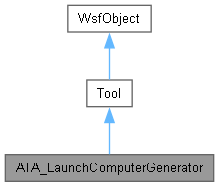
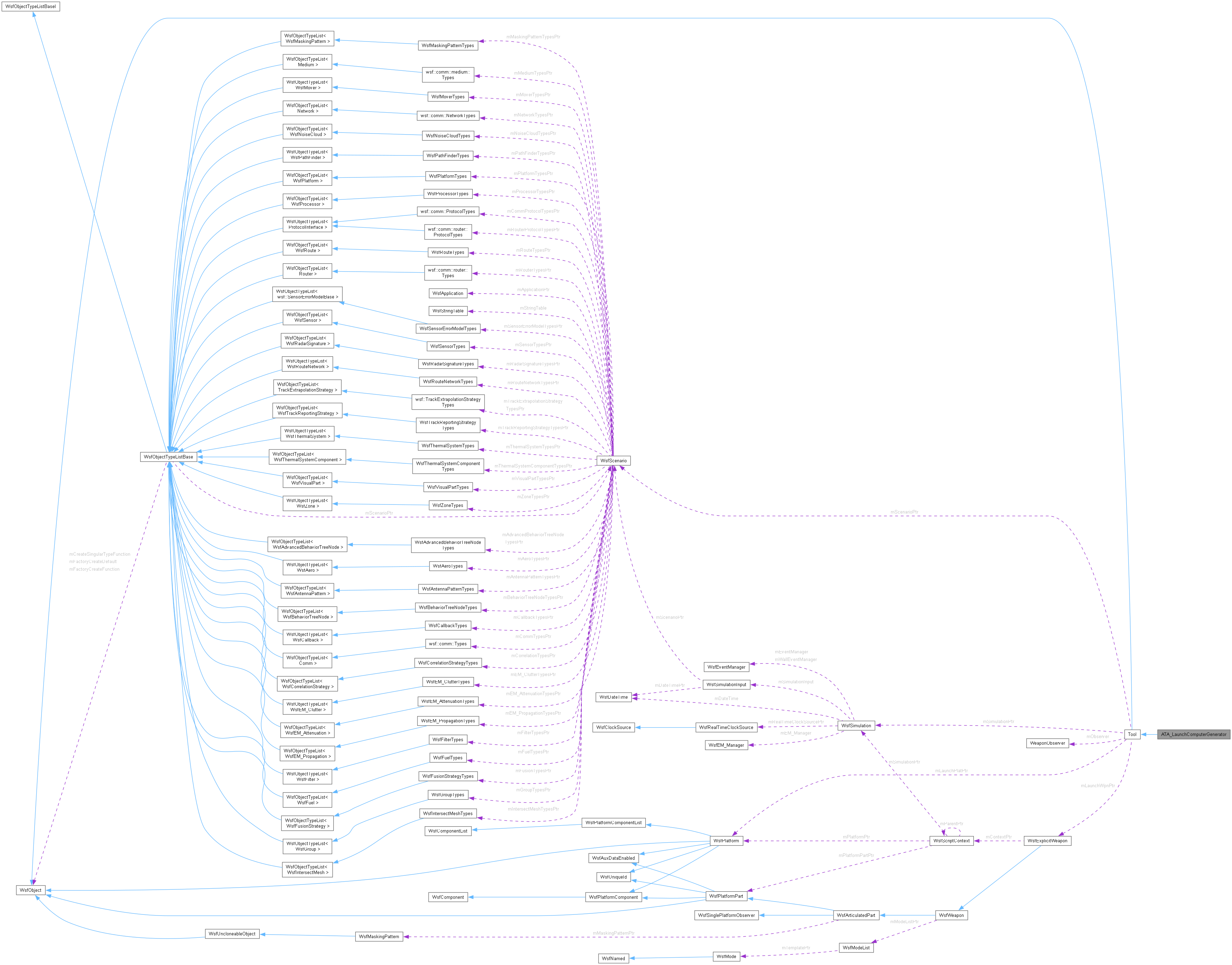
Public Member Functions | |
| ATA_LaunchComputerGenerator (WsfScenario &aScenario) | |
| ATA_LaunchComputerGenerator (const ATA_LaunchComputerGenerator &aSrc) | |
| ATA_LaunchComputerGenerator & | operator= (const ATA_LaunchComputerGenerator &)=delete |
| Tool * | Clone () const override |
| ~ATA_LaunchComputerGenerator () override | |
| bool | Initialize (WsfSimulation &aSimulation) override |
| bool | ProcessInput (UtInput &aInput) override |
| void | Update (double aSimTime) override |
| Public Member Functions inherited from Tool | |
| Tool (const Tool &aSrc) | |
| Tool & | operator= (const Tool &)=delete |
| ~Tool () override | |
| bool | ProcessInput (UtInput &aInput) override |
| virtual void | MoverBurnout (double aSimTime, WsfMover *aMoverPtr) |
| name Callbacks from WeaponObserver (lets the tool have access to simulation callbacks) | |
| virtual void | GuidanceComputerPhaseChanged (double aSimTime, WsfGuidanceComputer *aComputerPtr) |
| Optional tool method called by WeaponObserver to pass on the GuidanceComputerPhaseChanged simulation observer event. | |
| virtual void | PlatformAdded (double aSimTime, WsfPlatform *aPlatformPtr) |
| Optional tool method called by WeaponObserver to pass on the PlatformAdded simulation observer event. | |
| WsfStringId | WeaponPlatformTypeId () const |
| double | FrameStep () const |
| bool | IsInitialized () const |
| WsfPlatform * | GetLauncherPlatform () const |
| WsfExplicitWeapon * | GetLauncherWeapon () const |
| Public Member Functions inherited from WsfObject | |
| WsfObject () | |
| This is the constructor for the WsfObject class. | |
| ~WsfObject () override | |
| This is the destructor for the WsfObject class. | |
| const char * | GetScriptClassName () const override |
| const std::string & | GetType () const |
| WsfStringId | GetTypeId () const |
| Get the string ID of the 'type' of the object. | |
| void | SetType (WsfStringId aType) |
| const std::string & | GetBaseType () const |
| WsfStringId | GetBaseTypeId () const |
| const TypeList & | GetTypeList () const |
| bool | IsA_TypeOf (WsfStringId aType) const |
| WsfObject & | operator= (const WsfObject &aRhs) |
| Assignment operator. | |
| template<typename T> | |
| void | Serialize (T &aBuff) |
| For XIO (de)serialization. | |
| const std::string & | GetName () const |
| WsfStringId | GetNameId () const |
| void | SetName (WsfStringId aName) |
Protected Member Functions | |
| void | WriteOutputFile () |
| Output a data file defining the Launch Computer just generated. | |
| void | ResolveNames () override |
| Virtual method to resolve the output object name and output file names. | |
| Protected Member Functions inherited from Tool | |
| WsfSimulation * | GetSimulation () const |
| WsfScenario & | GetScenario () const |
| ToolManager * | GetManager () const |
| Tool (WsfScenario &aScenario) | |
| This constructor initializes the object. | |
| void | UnInitialize () |
| bool | IsDone () const |
| Return a flag to indicate that this Tool has completed its work. | |
| bool | DebugEnabled () const |
| Return a flag to indicate that debugging is enabled. | |
| WsfObject (const WsfObject &aSrc) | |
| Copy constructor (for Clone()). | |
Additional Inherited Members | |
| Public Types inherited from WsfObject | |
| typedef std::vector< WsfStringId > | TypeList |
| The list of types returned by GetTypeList. | |
| Protected Attributes inherited from Tool | |
| WsfScenario * | mScenarioPtr |
| WsfSimulation * | mSimulationPtr |
| WeaponObserver | mObserver |
| WsfPlatform * | mLaunchPlatPtr |
| WsfExplicitWeapon * | mLaunchWpnPtr |
| double | mFrameStep |
| double | mLastUpdate |
| double | mLatDeg |
| double | mLonDeg |
| double | mAlt |
| double | mHeadingRad |
| bool | mDone |
| bool | mNotifiedDone |
| bool | mInitialized |
| bool | mDebug |
| bool | mTerminateOnLaunchFailure |
| std::string | mToolProduces |
| std::string | mFileExtension |
| WsfStringId | mWeaponEffectTypeId |
| WsfStringId | mLaunchPlatformTypeId |
| WsfStringId | mTargetPlatformTypeId |
| WsfStringId | mWeaponNameId |
| std::string | mOutputFileName |
| std::string | mOutputObjectName |
Detailed Description
Air-To-Air (ATA) Launch Computer Generation Tool. A launch computer is valid only for a known launch aircraft altitude and speed. This Tool contains within it a pointer to a WsfATALaunchComputer object, which is configured with a sizeable matrix of target engagement conditions: aspect angle, azimuth, elevation, range rate, and range. The Tool then traverses this matrix of engagement conditions, placing an airborne target at the desired range, and giving it a velocity that results in the correct aspect angle, azimuth, range rate, etc. A weapon is fired at the target immediately after it is placed, and given a perfect track to the target. The missile flies out, and if possible kinematically, the target is intercepted and killed. (USER CAUTION: For this Tool, a valid kinematic intercept of the target should ALWAYS result in a target kill, therefore the missile's intercept Pk should temporarily be set to 1.0, provided that the point of closest approach is within the lethal radius of the warhead.) If the engagement results in a target kill, the time of flight is saved into an array of results. If the target is not killed, a zero is recorded. The process is repeated for each engagement condition. When all engagement results have been recorded, the results are written into an WSF-input format text file, defining the WsfATALaunchComputer appropriate to launch this weapon at the specified altitude and speed. (It will then often be the case that the launch computer instance just defined will be cut-and-pasted back into the original weapon definition file, so that it may be used as part of the weapon specification.)
Defining an accurate LAR for an air-to-air (ATA) missile, and therefore when to launch the missile (which is the job of the launch computer), is a tough job, because so many variables are involved. The maximum lethal range of an ATA missile may vary by an order of magnitude or more, from a head-on aspect, high altitude, high closing speed downhill shot against a non-maneuvering target which lies along the aircraft boresight (yielding a relatively long engagement range), versus a tail aspect, low altitude, high opening speed, uphill shot, off boresight, against a maneuvering target. Along with this must also be considered a minimum engagement range, below which the missile cannot react quickly enough to intercept. These constraints may even overlap, such that no successful firing solution is possible. It is the job of this Tool to estimate acceptable launch conditions during the engagement that yield an acceptable probability of kill for a specified weapon.
Constructor & Destructor Documentation
◆ ATA_LaunchComputerGenerator() [1/2]
| ATA_LaunchComputerGenerator::ATA_LaunchComputerGenerator | ( | WsfScenario & | aScenario | ) |
References Tool::mAlt, Tool::mToolProduces, and Tool::Tool().
Referenced by ATA_LaunchComputerGenerator(), Clone(), and operator=().
◆ ATA_LaunchComputerGenerator() [2/2]
| ATA_LaunchComputerGenerator::ATA_LaunchComputerGenerator | ( | const ATA_LaunchComputerGenerator & | aSrc | ) |
References ATA_LaunchComputerGenerator(), Clone(), and Tool::Tool().
◆ ~ATA_LaunchComputerGenerator()
|
override |
Member Function Documentation
◆ Clone()
|
overridevirtual |
Return a copy of this object. Must be implemented by all derived types. If cloning is impossible, a WsfUncloneableException should be thrown.
Implements Tool.
References ATA_LaunchComputerGenerator(), and Tool::Tool().
Referenced by ATA_LaunchComputerGenerator().
◆ Initialize()
|
overridevirtual |
In another typical WSF construct, this method initializes the object prior to run time. If the Initialization fails, the object will not be permitted to transition to the run mode. Derived classes must assure that they are initialized internally, as well as calling the base class Initialize method.
- Returns
- Boolean success value.
Reimplemented from Tool.
References Tool::DebugEnabled(), WsfSimulation::GetSimTime(), Tool::Initialize(), Tool::mInitialized, Tool::mOutputFileName, and Tool::UnInitialize().
◆ operator=()
|
delete |
References ATA_LaunchComputerGenerator(), Tool::Tool(), and WriteOutputFile().
◆ ProcessInput()
|
overridevirtual |
Process input from a generic source.
Examine the current input command. If it is NOT one of the commands recognized by this class then it simply returns 'false'. If it is one of the commands recognized by this class then it processes the command and returns 'true'.
- Parameters
-
aInput a reference to a UtInput object.
- Returns
- 'true' if the command was one recognized by the class or 'false' if not.
- Exceptions
-
UtInput::ExceptionBase (or an object derived from it) if the command was recognized but contains some sort of error.
- Note
- If a derived class does not recognize the command (i.e.: the return value is false) then it should call the base class ProcessInput method. This chain should continue until either the command is recognized or the top-level base class is encountered.
Reimplemented from WsfObject.
References WsfScenario::GetAtmosphere(), Tool::GetScenario(), Tool::mAlt, and Tool::ProcessInput().
◆ ResolveNames()
|
overrideprotectedvirtual |
Virtual method to resolve the output object name and output file names.
Reimplemented from Tool.
References WsfScenario::GetAtmosphere(), Tool::GetScenario(), Tool::mAlt, Tool::mFileExtension, Tool::mOutputFileName, Tool::mOutputObjectName, Tool::mToolProduces, and Tool::WeaponPlatformTypeId().
◆ Update()
|
overridevirtual |
Advance the Tool forward in time. This base method shall be overridden in derived classes, and at the end of the derived method, this parent method must be called, to properly maintain the internal state.
Reimplemented from Tool.
References WeaponObserver::cIDLE, WeaponObserver::cTERMINATED, Tool::DebugEnabled(), WsfSimulation::DeletePlatform(), WsfSimulation::GetPlatformByIndex(), Tool::GetSimulation(), Tool::mLastUpdate, Tool::mObserver, Tool::Update(), and WriteOutputFile().
◆ WriteOutputFile()
|
protected |
Output a data file defining the Launch Computer just generated.
References WsfLaunchComputerTypes::Get(), WsfScenario::GetAtmosphere(), Tool::GetScenario(), WsfObjectTypeList< T >::LoadType(), Tool::mAlt, Tool::mLaunchWpnPtr, Tool::mOutputFileName, and Tool::mOutputObjectName.
Referenced by operator=(), and Update().
The documentation for this class was generated from the following files: