#include <WsfBistaticErrorModel.hpp>
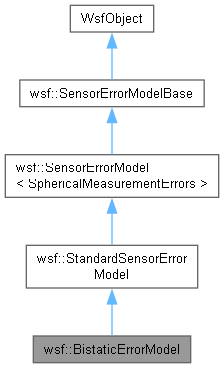
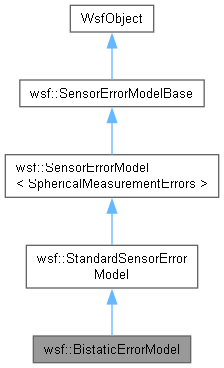
Classes | |
| struct | TransmitterKey |
| struct | BistaticMeasurement |
Public Member Functions | |
| BistaticErrorModel () | |
| ~BistaticErrorModel () override=default | |
| BistaticErrorModel * | Clone () const override |
| Create a clone of "this" object. | |
| bool | ProcessInput (UtInput &aInput) override |
| bool | Initialize (WsfSensorMode *aSensorModePtr) override |
| void | LoadPositionSigmaTable (UtInput &aInput) |
| Public Member Functions inherited from wsf::StandardSensorErrorModel | |
| StandardSensorErrorModel * | Clone () const override |
| Create a clone of "this" object. | |
| bool | ProcessInput (UtInput &aInput) override |
| bool | IsStandardModel () const final |
| void | SetSigmas (const Sigmas &aSigmas) |
| const Sigmas & | GetSigmas () const |
| void | SetAzErrorStdDev (double aAzErrorStdDev) |
| void | SetElErrorStdDev (double aElErrorStdDev) |
| void | SetRangeErrorStdDev (double aRangeErrorStdDev) |
| void | SetRangeRateErrorStdDev (double aRangeRateErrorStdDev) |
| std::unique_ptr< SphericalMeasurementErrors > | ComputeMeasurementErrors (WsfSensorResult &aResult) const override |
| void | ApplyMeasurementErrors (const SphericalMeasurementErrors &aErrors, WsfSensorResult &aResult) override |
| Public Member Functions inherited from wsf::SensorErrorModelBase | |
| virtual void | ApplyMeasurementErrors (WsfSensorResult &aResult)=0 |
| virtual bool | IsNullModel () const |
| Is this a null model (i.e., ApplyMeasurementErrors has no effect). | |
| bool | DebugEnabled () const |
| WsfSensorMode * | GetSensorMode () const |
| void | SetSensorMode (WsfSensorMode *aSensorModePtr) |
| Public Member Functions inherited from WsfObject | |
| WsfObject () | |
| This is the constructor for the WsfObject class. | |
| ~WsfObject () override | |
| This is the destructor for the WsfObject class. | |
| const char * | GetScriptClassName () const override |
| const std::string & | GetType () const |
| WsfStringId | GetTypeId () const |
| Get the string ID of the 'type' of the object. | |
| void | SetType (WsfStringId aType) |
| const std::string & | GetBaseType () const |
| WsfStringId | GetBaseTypeId () const |
| const TypeList & | GetTypeList () const |
| bool | IsA_TypeOf (WsfStringId aType) const |
| WsfObject & | operator= (const WsfObject &aRhs) |
| Assignment operator. | |
| template<typename T> | |
| void | Serialize (T &aBuff) |
| For XIO (de)serialization. | |
| const std::string & | GetName () const |
| WsfStringId | GetNameId () const |
| void | SetName (WsfStringId aName) |
Static Public Member Functions | |
| static std::unique_ptr< SensorErrorModelBase > | ObjectFactory (const std::string &aTypeName) |
| Static Public Member Functions inherited from wsf::StandardSensorErrorModel | |
| static std::unique_ptr< SensorErrorModelBase > | ObjectFactory (const std::string &aTypeName) |
Protected Member Functions | |
| BistaticErrorModel (const BistaticErrorModel &aSrc)=default | |
| SphericalMeasurementErrors | GetSphericalErrorStdDev (ut::Random &aRandom, WsfSensorResult &aResult, const Sigmas &aSigmas) const override |
| Sigmas | GetBistaticSphericalErrorStdDev (BistaticMeasurement &mMeasurement) const |
| WsfObject (const WsfObject &aSrc) | |
| Copy constructor (for Clone()). | |
Protected Attributes | |
| double | mTsErrorStdDev |
| double | mTxErrorStdDev |
| bool | mRealBlurring |
| Sigmas | mInitialSigmas |
| The initial spherical standard deviations provided by the sensor mode. | |
| std::map< TransmitterKey, UtVec3d > | mPositionDeltaMap |
Additional Inherited Members | |
| Public Types inherited from wsf::SensorErrorModelBase | |
| using | SensorModelTypes = WsfObjectTypeList<SensorErrorModelBase> |
| Public Types inherited from WsfObject | |
| typedef std::vector< WsfStringId > | TypeList |
| The list of types returned by GetTypeList. | |
Constructor & Destructor Documentation
◆ BistaticErrorModel() [1/2]
| wsf::BistaticErrorModel::BistaticErrorModel | ( | ) |
References mPositionDeltaMap, mRealBlurring, mTsErrorStdDev, and mTxErrorStdDev.
Referenced by BistaticErrorModel(), Clone(), and ~BistaticErrorModel().
◆ ~BistaticErrorModel()
|
overridedefault |
References BistaticErrorModel(), Clone(), Initialize(), LoadPositionSigmaTable(), ObjectFactory(), and ProcessInput().
◆ BistaticErrorModel() [2/2]
|
protecteddefault |
References BistaticErrorModel(), GetBistaticSphericalErrorStdDev(), and GetSphericalErrorStdDev().
Member Function Documentation
◆ Clone()
|
overridevirtual |
Create a clone of "this" object.
Implements wsf::SensorErrorModelBase.
References BistaticErrorModel().
Referenced by ~BistaticErrorModel().
◆ GetBistaticSphericalErrorStdDev()
|
protected |
References wsf::BistaticErrorModel::BistaticMeasurement::mAz, wsf::StandardSensorErrorModel::Sigmas::mAzErrorStdDev, wsf::BistaticErrorModel::BistaticMeasurement::mEl, wsf::StandardSensorErrorModel::Sigmas::mElErrorStdDev, mInitialSigmas, wsf::StandardSensorErrorModel::Sigmas::mRangeErrorStdDev, wsf::BistaticErrorModel::BistaticMeasurement::mRng, wsf::BistaticErrorModel::BistaticMeasurement::mTransmitterPositionPCS, wsf::BistaticErrorModel::BistaticMeasurement::mTransmitterPositionSigma, wsf::BistaticErrorModel::BistaticMeasurement::mTs, mTsErrorStdDev, wsf::BistaticErrorModel::BistaticMeasurement::mTx, and mTxErrorStdDev.
Referenced by BistaticErrorModel(), and GetSphericalErrorStdDev().
◆ GetSphericalErrorStdDev()
|
overrideprotectedvirtual |
Specifically compute normally distributed polar measurement errors based on the given sensor result and set of standard deviations.
- Parameters
-
aRandom The random number generator used to generate the errors. aResult The sensing chance result that may be used to help compute the sensor errors. aSigmas The set of standard deviations used to compute the sensor errors.
- Note
- The sensor result may be modified by this method.
- Once the deprecated WsfSensorMode::ComputeMeasurementErrors is removed, this method can be made protected.
Reimplemented from wsf::StandardSensorErrorModel.
References WsfEM_Antenna::ConvertNED_VectorToWCS(), WsfTypes::EnumToString(), WsfEM_XmtrRcvr::GetAntenna(), WsfEM_Antenna::GetArticulatedPart(), GetBistaticSphericalErrorStdDev(), WsfEM_Antenna::GetLocationWCS(), WsfEM_XmtrRcvr::GetPlatform(), WsfEM_Interaction::GetReceiver(), WsfEM_Antenna::GetRelativeLocationWCS(), WsfPlatform::GetSide(), WsfPlatform::GetSpatialDomain(), WsfEM_Interaction::GetTarget(), WsfEM_Interaction::GetTransmitter(), wsf::BistaticErrorModel::BistaticMeasurement::mAz, WsfEM_Interaction::RelativeData::mAz, wsf::SphericalMeasurementErrors::mAzError, wsf::StandardSensorErrorModel::Sigmas::mAzErrorStdDev, wsf::BistaticErrorModel::TransmitterKey::mDomain, wsf::BistaticErrorModel::BistaticMeasurement::mEl, WsfEM_Interaction::RelativeData::mEl, wsf::SphericalMeasurementErrors::mElError, wsf::StandardSensorErrorModel::Sigmas::mElErrorStdDev, WsfSensorResult::mMeasurement, mPositionDeltaMap, WsfEM_Interaction::RelativeData::mRange, wsf::SphericalMeasurementErrors::mRangeError, wsf::StandardSensorErrorModel::Sigmas::mRangeErrorStdDev, wsf::SphericalMeasurementErrors::mRangeRateError, wsf::StandardSensorErrorModel::Sigmas::mRangeRateErrorStdDev, WsfEM_Interaction::mRcvrToTgt, WsfEM_Interaction::mRcvrToXmtr, mRealBlurring, wsf::BistaticErrorModel::BistaticMeasurement::mRng, wsf::BistaticErrorModel::TransmitterKey::mSide, wsf::BistaticErrorModel::BistaticMeasurement::mTransmitterPositionPCS, wsf::BistaticErrorModel::BistaticMeasurement::mTransmitterPositionSigma, wsf::BistaticErrorModel::BistaticMeasurement::mTs, mTsErrorStdDev, wsf::BistaticErrorModel::BistaticMeasurement::mTx, mTxErrorStdDev, and WsfEM_Interaction::mXmtrToTgt.
Referenced by BistaticErrorModel().
◆ Initialize()
|
overridevirtual |
Perform any necessary initialization.
- Parameters
-
aSensorModePtr The sensor mode used by this error model.
Reimplemented from wsf::SensorErrorModelBase.
References wsf::StandardSensorErrorModel::GetSigmas(), wsf::SensorErrorModelBase::Initialize(), and mInitialSigmas.
Referenced by ~BistaticErrorModel().
◆ LoadPositionSigmaTable()
| void wsf::BistaticErrorModel::LoadPositionSigmaTable | ( | UtInput & | aInput | ) |
◆ ObjectFactory()
|
static |
Factory method for WsfSensorErrorModelTypes. This is called by WsfSensorErrorModelTypes::LoadType to determine if a pattern represented by this class is being requested.
Referenced by WsfMilExtension::AddedToScenario(), and ~BistaticErrorModel().
◆ ProcessInput()
|
overridevirtual |
Process input from a generic source.
Examine the current input command. If it is NOT one of the commands recognized by this class then it simply returns 'false'. If it is one of the commands recognized by this class then it processes the command and returns 'true'.
- Parameters
-
aInput a reference to a UtInput object.
- Returns
- 'true' if the command was one recognized by the class or 'false' if not.
- Exceptions
-
UtInput::ExceptionBase (or an object derived from it) if the command was recognized but contains some sort of error.
- Note
- If a derived class does not recognize the command (i.e.: the return value is false) then it should call the base class ProcessInput method. This chain should continue until either the command is recognized or the top-level base class is encountered.
Reimplemented from WsfObject.
References LoadPositionSigmaTable(), mRealBlurring, mTsErrorStdDev, mTxErrorStdDev, and wsf::StandardSensorErrorModel::ProcessInput().
Referenced by ~BistaticErrorModel().
Member Data Documentation
◆ mInitialSigmas
|
protected |
The initial spherical standard deviations provided by the sensor mode.
Referenced by GetBistaticSphericalErrorStdDev(), and Initialize().
◆ mPositionDeltaMap
|
protected |
A dual key map of transmitter platform to the sigmas associated with its location measurement sigmas. Note that the transmitter in a bistatic transaction can be on the red/opposite team. The comparable key is a paring of the side and domain.
Referenced by BistaticErrorModel(), GetSphericalErrorStdDev(), and LoadPositionSigmaTable().
◆ mRealBlurring
|
protected |
The range can be blurred in 2 ways. Realistically based on this model, but this causes multiplicative noise vs additive, and our current filters may not track the measurement outputs. Conversely, we can blur it in an additive way so the resulting track will simulate a system that can process this type of noise.
Referenced by BistaticErrorModel(), GetSphericalErrorStdDev(), and ProcessInput().
◆ mTsErrorStdDev
|
protected |
The reflected time measurement sigma. The reflected time, or scatter time (ts), is the time of reception of a signal that travels from transmitter to target and then to receiver.
Referenced by BistaticErrorModel(), GetBistaticSphericalErrorStdDev(), GetSphericalErrorStdDev(), and ProcessInput().
◆ mTxErrorStdDev
|
protected |
The direct time measurement sigma. The direct time is the time of reception of a signal that travels from transmitter directly to the receiver.
Referenced by BistaticErrorModel(), GetBistaticSphericalErrorStdDev(), GetSphericalErrorStdDev(), and ProcessInput().
The documentation for this class was generated from the following files: