#include <WsfCommRouter.hpp>
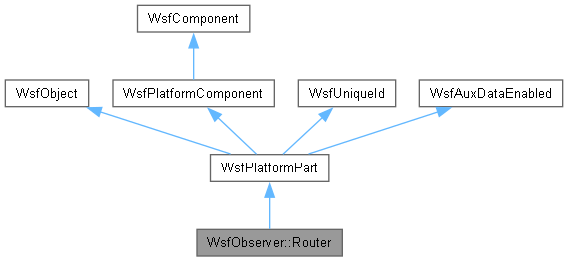
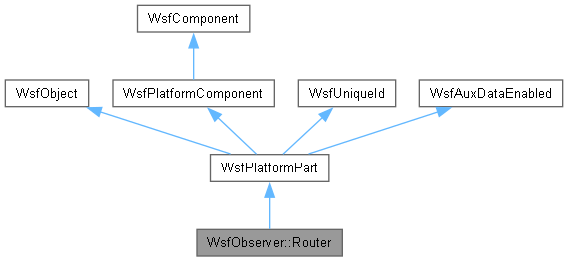
Classes | |
| class | SendData |
| struct | Gateway |
Public Types | |
| using | CommVector = std::vector<Comm*> |
| Public Types inherited from WsfPlatformPart | |
| enum | { cLEVEL_ONE_DEBUG = 0x00000001 , cLEVEL_TWO_DEBUG = 0x00000002 } |
| using | InternalMessageQueue = std::queue<WsfMessage*> |
| using | RecipientMessageQueue = std::queue<std::pair<WsfPlatformPart*, WsfMessage*>> |
| Public Types inherited from WsfObject | |
| typedef std::vector< WsfStringId > | TypeList |
| The list of types returned by GetTypeList. | |
| Public Types inherited from WsfComponentT< WsfPlatform > | |
| typedef WsfPlatform | ParentType |
| This is needed to support the WsfComponentList template. | |
Component List support | |
| using | ComponentList = WsfComponentListT<WsfComponentT<Router>> |
| ComponentList & | GetComponents () |
| const ComponentList & | GetComponents () const |
| bool | AddComponent (RouterComponent *aComponentPtr) |
| bool | RemoveComponent (RouterComponent *aComponentPtr) |
| virtual bool | Receive (double aSimTime, Comm *aXmtrPtr, Comm *aRcvrPtr, Message &aMessage, bool &aOverrideForward) |
| virtual bool | Send (double aSimTime, SendData &aData) |
| Router (const WsfScenario &aScenario) | |
| Router (Router &&aSrc)=delete | |
| Router * | Clone () const override |
| Router & | operator= (const Router &aRhs)=delete |
| Router & | operator= (Router &&aRhs)=delete |
| ~Router () override=default | |
Interface/Comm Member methods | |
| |
| virtual void | AddInterface (double aSimTime, Comm *aCommPtr) |
| void | AddInterface (double aSimTime, const Address &aAddress) |
| virtual void | RemoveInterface (double aSimTime, Comm *aCommPtr) |
| void | RemoveInterface (double aSimTime, const Address &aAddress) |
| bool | HasInterface (Comm *aCommPtr) const |
| bool | HasInterface (const Address &aAddress) const |
| void | ClearInterfaces () |
| const CommVector & | GetInterfaces () const |
| bool | IsActive () const |
| virtual void | InitializeCallbacks () |
| Setup the callbacks for this router. | |
| virtual bool | AddLink (double aSimTime, const Address &aSender, const Address &aDestination, ProtocolInterface &aProtocol, bool aNotifyObserver=true) |
| virtual bool | RemoveLink (double aSimTime, const Address &aSender, const Address &aDestination, ProtocolInterface &aProtocol, bool aNotifyObserver=true) |
| virtual bool | AddNode (double aSimTime, const Address &aNodeAddress, ProtocolInterface &aProtocol, bool aNotifyObserver=true) |
| virtual bool | RemoveNode (double aSimTime, const Address &aNodeAddress, ProtocolInterface &aProtocol, bool aNotifyObserver=true) |
| virtual bool | EnableLink (double aSimTime, const Address &aSender, const Address &aDestination, ProtocolInterface &aProtocol, bool aNotifyObserver=true) |
| virtual bool | DisableLink (double aSimTime, const Address &aSender, const Address &aDestination, ProtocolInterface &aProtocol, bool aNotifyObserver=true) |
| virtual bool | EnableNode (double aSimTime, const Address &aNodeAddress, ProtocolInterface &aProtocol) |
| virtual bool | DisableNode (double aSimTime, const Address &aNodeAddress, ProtocolInterface &aProtocol) |
| const Address & | GetGateway () const |
| void | SetGateway (const Address &aAddress) |
| size_t | GetHopLimit () const |
| NetworkManager * | GetNetworkManager () const |
| void | SetHopLimit (size_t aHopLimit) |
| virtual bool | Broadcast (double aSimTime, SendData &aData) |
| std::vector< ProtocolInterface * > | GetSortedProtocols () const |
| Router (const Router &aSrc) | |
| virtual bool | ValidateGateway () |
| virtual bool | AutomateAddedLinkage (double aSimTime, Comm *aCommPtr) |
| virtual void | PerfectCommAdded (double aSimTime, Comm *aCommPtr) |
| virtual void | PerfectCommRemoved (double aSimTime, Comm *aCommPtr) |
| virtual void | PerfectNetworkAdded (double aSimTime, Network *aNetworkPtr) |
| virtual void | PerfectNetworkRemoved (double aSimTime, Network *aNetworkPtr) |
| virtual void | PerfectCommEnabled (double aSimTime, Comm *aCommPtr) |
| virtual void | PerfectCommDisabled (double aSimTime, Comm *aCommPtr) |
| virtual void | PerfectConnectionAdded (double aSimTime, const Address &aSourceAddress, const Address &aDestinationAddress) |
| virtual void | PerfectConnectionRemoved (double aSimTime, const Address &aSourceAddress, const Address &aDestinationAddress) |
| virtual void | PerfectConnectionEnabled (double aSimTime, const Address &aSourceAddress, const Address &aDestinationAddress) |
| virtual void | PerfectConnectionDisabled (double aSimTime, const Address &aSourceAddress, const Address &aDestinationAddress) |
Component infrastructure methods | |
| WsfComponent * | CloneComponent () const override |
| void * | QueryInterface (int aRole) override |
| const int * | GetComponentRoles () const override |
| WsfStringId | GetComponentName () const override |
| int | GetComponentInitializationOrder () const override |
Common infrastructure methods | |
| bool | PreInitialize (double aSimTime) override |
| bool | Initialize (double aSimTime) override |
| bool | Initialize2 (double aSimTime) override |
| void | PreInput () override |
| virtual void | Setup () |
| virtual void | PendingStart () |
| bool | ProcessInput (UtInput &aInput) override |
| virtual bool | ProcessTypeAddEditDelete (UtInput &aInput) |
| const char * | GetScriptClassName () const override |
Status methods. | |
| void | PartBroken (double aSimTime) override |
| void | SetNonOperational (double aSimTime) override |
| void | SetOperational (double aSimTime) override |
| void | TurnOff (double aSimTime) override |
| void | TurnOn (double aSimTime) override |
| void | SetUpdateInterval (double aInterval) override |
| double | GetUpdateInterval () const override |
Additional Inherited Members | |
| Public Member Functions inherited from WsfPlatformPart | |
| WsfPlatformPart (const WsfScenario &aScenario, int aPartType) | |
| WsfPlatformPart & | operator= (const WsfPlatformPart &aRhs)=delete |
| ~WsfPlatformPart () override | |
| const int * | GetComponentRoles () const override |
| void * | QueryInterface (int aRole) override |
| bool | DebugEnabled () const |
| Returns 'true' if debugging is enabled for this instance. | |
| void | SetDebugEnabled (bool aDebugEnabled) |
| unsigned int | GetDebugMask () |
| bool | IsExternallyControlled () const |
| virtual void | SetExternallyControlled (double aSimTime, bool aIsExternallyControlled) |
| int | GetPartType () const |
| const char * | GetScriptClassName () const override |
| WsfSimulation * | GetSimulation () const |
| const WsfScenario & | GetScenario () const |
| WsfStringId | GetComponentName () const override |
| void | ComponentParentChanged (WsfPlatform *aPlatformPtr) override |
| bool | Initialize (double aSimTime) override |
| bool | Initialize2 (double aSimTime) override |
| bool | ProcessInput (UtInput &aInput) override |
| virtual void | Update (double aSimTime) |
| WsfPlatform * | GetPlatform () const |
| virtual void | SetPlatform (WsfPlatform *aPlatformPtr) |
| virtual void | PlatformAdded (double aSimTime, WsfPlatform *aPlatformPtr) |
| virtual void | PlatformDeleted (WsfPlatform *aPlatformPtr) |
| double | GetLastStatusChangeTime () const |
| void | SetLastStatusChangeTime (double aSimTime) |
| Allows a system to set the time at which the device was initialized. | |
| bool | CanBeMadeOperational () const |
| Returns an indication that this system can be made operational. | |
| bool | CanBeMadeNonOperational () const |
| Returns an indication that this system can be made non-operational. | |
| bool | CanBeTurnedOn () const |
| Returns an indication that this system can be turned on. | |
| bool | CanBeTurnedOff () const |
| Returns an indication that this system can be turned off. | |
| bool | IsTurnedOn () const |
| bool | InitiallyTurnedOn () const |
| Is the system to be turned 'on' when added to the simulation? | |
| void | SetInitiallyTurnedOn (bool aInitiallyTurnedOn) |
| Sets if the system is turned on when added to the simulation. | |
| virtual void | Restore (double aSimTime) |
| bool | IsOperational () const |
| bool | SetOperational (double aSimTime, bool aMakeOperational) |
| double | GetDamageFactor () const |
| bool | SetDamageFactor (double aSimTime, double aDamageFactor) |
| bool | IsCritical () const |
| void | SetCritical (bool aValue) |
| virtual void | OnPlatformBrokenEvent (double aSimTime) |
| Owning platform has issued a broken event. | |
| bool | IsBroken () const |
| WsfInternalLinks & | GetInternalLinks () |
| Return the internal links for this part. | |
| virtual bool | HasInternalLinks () const |
| Does this platform part have a communication link to other platform parts? | |
| virtual bool | ProcessMessage (double aSimTime, const WsfMessage &aMessage) |
| virtual bool | ReceiveMessage (double aSimTime, const WsfMessage &aMessage) |
| virtual void | SendMessage (double aSimTime, const WsfMessage &aMessage) |
| virtual void | SendMessageTo (double aSimTime, const WsfMessage &aMessage, WsfStringId aRecipientId) |
| void | SendMessageToProcessor (double aSimTime, const WsfMessage &aMessage, WsfStringId aRecipientId) |
| virtual void | SendQueuedMessages (double aSimTime) |
| const WsfCategoryList & | GetCategories () const |
| Get the categories to which this part belongs. | |
| void | AddCategory (WsfStringId aCategoryId) |
| Adds the provided category to the platform part's category list. | |
| bool | IsCategoryMember (WsfStringId aCategoryId) const |
| const WsfGroupList & | GetGroups () const |
| Get the groups to which this platform part belongs. | |
| void | JoinGroup (WsfGroup *aGroupPtr) |
| Join the given group. | |
| void | LeaveGroup (WsfGroup *aGroupPtr) |
| Leave the given group. | |
| bool | IsGroupMember (WsfStringId aGroupId) |
| unsigned int | GetUpdateEventEpoch () const |
| void | IncrementUpdateEventEpoch () |
| bool | UpdateEventActive () const |
| Is an 'Update' event active? | |
| void | SetUpdateEventActive (bool aUpdateEventActive) |
| Indicate if the 'Update' event is active. | |
| Public Member Functions inherited from WsfObject | |
| WsfObject () | |
| This is the constructor for the WsfObject class. | |
| ~WsfObject () override | |
| This is the destructor for the WsfObject class. | |
| const char * | GetScriptClassName () const override |
| const std::string & | GetType () const |
| WsfStringId | GetTypeId () const |
| Get the string ID of the 'type' of the object. | |
| void | SetType (WsfStringId aType) |
| const std::string & | GetBaseType () const |
| WsfStringId | GetBaseTypeId () const |
| const TypeList & | GetTypeList () const |
| bool | IsA_TypeOf (WsfStringId aType) const |
| WsfObject & | operator= (const WsfObject &aRhs) |
| Assignment operator. | |
| template<typename T> | |
| void | Serialize (T &aBuff) |
| For XIO (de)serialization. | |
| const std::string & | GetName () const |
| WsfStringId | GetNameId () const |
| void | SetName (WsfStringId aName) |
| Public Member Functions inherited from WsfComponentT< WsfPlatform > | |
| WsfComponentT () | |
| WsfComponentT (const WsfComponentT &) noexcept | |
| WsfComponentT & | operator= (const WsfComponentT &) noexcept |
| ~WsfComponentT () override=default | |
| ParentType * | GetComponentParent () const |
| void | SetComponentParent (ParentType *aParentPtr) |
| Public Member Functions inherited from WsfComponent | |
| virtual | ~WsfComponent ()=default |
| template<typename T> | |
| bool | QueryInterfaceT (T *&aRolePtr) |
| bool | ComponentHasRole (int aRole) |
| Returns true if the component has the specified role. | |
| Public Member Functions inherited from WsfUniqueId | |
| WsfUniqueId () | |
| Construtor initializes the unique identifier to 0. | |
| WsfUniqueId (const WsfUniqueId &) | |
| Copy constructor initializes the unique identifier to 0. | |
| WsfUniqueId & | operator= (const WsfUniqueId &) |
| unsigned int | GetUniqueId () const |
| Get the unique identifier assigned to this object. | |
| template<typename T> | |
| void | Serialize (T &aBuff) |
| For XIO (de)serialization. | |
| Public Member Functions inherited from WsfAuxDataEnabled | |
| WsfAuxDataEnabled ()=default | |
| WsfAuxDataEnabled (const WsfAuxDataEnabled &aSrc)=default | |
| WsfAuxDataEnabled & | operator= (const WsfAuxDataEnabled &aRhs) |
| WsfAuxDataEnabled (WsfAuxDataEnabled &&)=default | |
| WsfAuxDataEnabled & | operator= (WsfAuxDataEnabled &&)=default |
| virtual | ~WsfAuxDataEnabled () noexcept |
| void | SetAuxData (const WsfAttributeContainer &aAuxData) |
| void | DeleteAuxData () |
| Delete the aux data container from the object. | |
| void | MergeAuxData (const WsfAuxDataEnabled &aSrc) |
| Merge the object's aux data with aux data from an existing object. | |
| void | UpdateAuxData (const WsfAuxDataEnabled &aSrc) |
| Update the object's aux data with aux data from an existing object. | |
| bool | HasAuxData () const |
| Returns true if this object has aux data. | |
| bool | ProcessInput (UtInput &aInput) |
| template<typename T> | |
| void | Serialize (T &aBuff) |
| (De)serialization for XIO | |
| WsfAttributeContainer & | GetAuxData () |
| const WsfAttributeContainer & | GetAuxData () const noexcept |
| const WsfAttributeContainer & | GetAuxDataConst () const noexcept |
| Static Public Attributes inherited from WsfAuxDataEnabled | |
| static UtCallbackListN< void(const WsfAuxDataEnabled *)> | AuxDataAccessed |
| static UtCallbackListN< void(const WsfAuxDataEnabled *)> | AuxDataDestroyed |
| WsfPlatformPart (const WsfPlatformPart &aSrc) | |
| Copy constructor (for Clone()). | |
| WsfObject (const WsfObject &aSrc) | |
| Copy constructor (for Clone()). | |
| Protected Member Functions inherited from WsfUniqueId | |
| void | AssignUniqueId (WsfSimulation *aSimulationPtr) |
Detailed Description
The router class object for AFSIM communications. This object is held on every comm object in AFSIM to aid in determination of the path a message is transmitted. It is applicable to both traditional wired networks as well as EM based systems, such as radio. Knowledge of the communications network depends on the protocols used with this router. The default "legacy" protocol simply uses the simulation truth for routing decisions. Other protocols that are based on potentially incomplete, stale, or incorrect network states maintain their own graph that is used for routing.
Member Typedef Documentation
◆ CommVector
| using wsf::comm::router::Router::CommVector = std::vector<Comm*> |
◆ ComponentList
Constructor & Destructor Documentation
◆ Router() [1/3]
| wsf::comm::router::Router::Router | ( | const WsfScenario & | aScenario | ) |
◆ Router() [2/3]
|
delete |
◆ Router() [3/3]
|
protected |
◆ ~Router()
|
overridedefault |
Member Function Documentation
◆ AddComponent()
| bool wsf::comm::router::Router::AddComponent | ( | RouterComponent * | aComponentPtr | ) |
Wrapper for adding components directly to the router. Used by the various component typelist factories to pass created objects to the router.
◆ AddInterface() [1/2]
|
virtual |
◆ AddInterface() [2/2]
| void wsf::comm::router::Router::AddInterface | ( | double | aSimTime, |
| const Address & | aAddress ) |
◆ AddLink()
|
virtual |
Router graph manipulation methods. These methods add/remove nodes/links on the graph, and/or enables/disables connections. These methods alter what information is available to the router to make decisions. If the router is set to perfect routing, these calls will be initiated by the router "listening" to the callbacks from the network manager. If the router is using dynamic routing capabilities provided by an associated protocol, then these calls are made when appropriate and may result in a network representation locally that differs from "truth" (a.k.a. the network manager).
First, add (or find) the node(s) required.
Now add (or find) the edge.
◆ AddNode()
|
virtual |
Check for existence of node in graph.
Node doesn't exist. Add it to the graph.
Notify observer, if set to do so.
◆ AutomateAddedLinkage()
|
protectedvirtual |
Helper method for creating linkage between comm interfaces. This also queries the network type for correct add/removal of linkage, to prevent the addition of links that violate the specified network rules of topology, if applicable.
◆ Broadcast()
|
virtual |
This method enables basic broadcasting functionality. Be warned that this message isn't true broadcasting, as it simply sends multiple messages to each member of the network. This functionality requires a more robust modeling of interface connections, which is currently lacking. When and if that capability is developed, this method can be deprecated. Returns true if successful, prompting appropriate usage in the RouterSend usage of this method.
Note: This method uses only truth data from the network manager. Protocols can handle broadcasts as they see fit, since they get first crack at handling a send. This is only provided for basic functionality as a commonly available router mechanic.
This is safe, since we already validated this in Router::Send()
We only support this call from an originator
◆ ClearInterfaces()
|
inline |
◆ Clone()
|
overridevirtual |
Return a copy of this object. Must be implemented by all derived types. If cloning is impossible, a WsfUncloneableException should be thrown.
Implements WsfObject.
◆ CloneComponent()
|
inlineoverridevirtual |
Clones a component. May return null if component does not support clone.
Implements WsfComponent.
◆ DisableLink()
|
virtual |
One or both nodes are not in the local graph. Can't disable a missing link.
◆ DisableNode()
|
virtual |
◆ EnableLink()
|
virtual |
One or both nodes are not in the local graph. Can't enable a missing link.
◆ EnableNode()
|
virtual |
◆ GetComponentInitializationOrder()
|
inlineoverridevirtual |
Forces a specific initialization order. Components are initialized in increasing initialization order value.
Reimplemented from WsfComponent.
◆ GetComponentName()
|
inlineoverridevirtual |
Returns the component's name. Each component in a component list has a unique name. Names are usually defined by the user, but they may also be generated by code and prefixed with a '#' to guarantee no collisions with user-defined names.
Implements WsfComponent.
◆ GetComponentRoles()
|
overridevirtual |
Returns a zero-terminated array of component roles. Note that the array should be in decreasing order of specificity and should generally the inheritance hierarchy. The first entry should be the components 'primary' role. For example a sensor would do the following:
Implements WsfComponent.
◆ GetComponents() [1/2]
|
inline |
◆ GetComponents() [2/2]
|
inline |
◆ GetGateway()
|
inline |
GetGateway returns the gateway address. It must only be called during runtime, as gateways specified by platform and comm name can only be reconciled after simulation initialization. If the platform/comm name was used to specify the gateway, the gateway validation method fills the missing address.
◆ GetHopLimit()
|
inline |
◆ GetInterfaces()
|
inline |
◆ GetNetworkManager()
|
inline |
◆ GetScriptClassName()
|
override |
◆ GetSortedProtocols()
| std::vector< ProtocolInterface * > wsf::comm::router::Router::GetSortedProtocols | ( | ) | const |
This method call handles the query of protocols associated with this router object (via the component list) and provides a list of these protocols in their order of precedence of operation.
◆ GetUpdateInterval()
|
inlineoverridevirtual |
Get interval at which Update() is called. This value is set by calling WsfSimulation::GetInstance().SetProcessorUpdateInterval();
Implements WsfPlatformPart.
◆ HasInterface() [1/2]
| bool wsf::comm::router::Router::HasInterface | ( | Comm * | aCommPtr | ) | const |
◆ HasInterface() [2/2]
| bool wsf::comm::router::Router::HasInterface | ( | const Address & | aAddress | ) | const |
◆ Initialize()
|
overridevirtual |
Perform phase 1 initialization. This is called by WsfPlatform::Initialize() during phase 1 initialization of the platform. The component should complete validation of input data that could not be done by ProcessInput, as well as any other functions to prepare for simulation use (subject to the next paragraph).
The order in which components are initialized is defined by GetComponentInitializationOrder. In general a component implementation of this method should not be dependent on the state of another component, i.e.: it should not assume that the other components Initialize() method has been called. If such a dependency exists one should use Initialize2() if possible, or specify a value GetComponentInitializationOrder to force things to initialize in a particular order.
- Parameters
-
aSimTime The current simulation time.
- Returns
- true if successful or false if unsuccessful (bad input data, etc.)
- Note
- This method should NOT add any other components to the platform. This MUST be done in PreInitialize().
Reimplemented from WsfComponent.
◆ Initialize2()
|
overridevirtual |
Perform phase 2 initialization. This is called by WsfPlatform::Initialize() during phase 2 of platform initialization. This method is typically used when a component may have some dependency on another component having completed its phase 1 initialization. The component should be ready for use in the simulation upon completion of this method.
The order in which components are initialized is defined by GetComponentInitializationOrder.
- Parameters
-
aSimTime The current simulation time.
- Returns
- true if successful or false if unsuccessful.
- Note
- This method MUST NOT add any other components to the platform. This MUST be done in PreInitialize().
Reimplemented from WsfComponent.
◆ InitializeCallbacks()
|
virtual |
Setup the callbacks for this router.
◆ IsActive()
| bool wsf::comm::router::Router::IsActive | ( | ) | const |
The really just returns if the router is turned on, but we need to wrap it since WsfPlatformPart::IsTurnedOn() returns false before the simulation starts.
◆ operator=() [1/2]
◆ operator=() [2/2]
◆ PartBroken()
|
overridevirtual |
Inform the internal systems that this part is broken.
- Parameters
-
aSimTime The current simulation time.
Reimplemented from WsfPlatformPart.
◆ PendingStart()
|
virtual |
◆ PerfectCommAdded()
|
protectedvirtual |
Network Manager Callbacks Handles the local graph actions on notification from the network manager when this router is using perfect routing.
◆ PerfectCommDisabled()
|
protectedvirtual |
◆ PerfectCommEnabled()
|
protectedvirtual |
◆ PerfectCommRemoved()
|
protectedvirtual |
◆ PerfectConnectionAdded()
|
protectedvirtual |
◆ PerfectConnectionDisabled()
|
protectedvirtual |
◆ PerfectConnectionEnabled()
|
protectedvirtual |
◆ PerfectConnectionRemoved()
|
protectedvirtual |
◆ PerfectNetworkAdded()
|
protectedvirtual |
◆ PerfectNetworkRemoved()
|
protectedvirtual |
◆ PreInitialize()
|
overridevirtual |
Perform pre-initializion function. This is called by WsfPlatform::Initialize prior to actually initializing the components on a platform (i.e.: calling Initialize and Initialize2 for each component). The primary reason for this method is to allow components to add other components that will then be subsequently initialized. The component may examine the component list and add components, but it must not assume ANYTHING about the actual state of the component.
- Parameters
-
aSimTime The current simulation time.
- Returns
- true if successful or false if unsuccessful (bad input data, etc.)
Reimplemented from WsfComponent.
◆ PreInput()
|
overridevirtual |
Perform pre-input processing. This is called in certain contexts just before input processing is FIRST done for a component (See WsfObjectTypeListBase::LoadComponentP.) The primary motivation is to allow the newly created component to invoke the type/role-specific PreInput method in the component factories, which may in turn add any sub-components that MAY be required for input processing or for run-time.
This is currently implemented only for platform level components such as WsfComm, WsfProcessor, WsfSensor and some components implemented in optional projects. You can look at the PreInput methods in each of these and see they are very simple.
The reason for this is that WsfObjectTypeListBase::LoadComponentP cannot simply invoke the PreInput methods in the component factories. PreInput is only defined in the template WsfComponentFactoryT<>, and the PreInput method in the template defines a method whose argument is a reference to the object being created. There is no way for LoadComponentP to do this in general. Delegating it to to component solves the problem.
- Note
- This method may get called more than once as input objects derive from other input type-objects.
Reimplemented from WsfComponent.
◆ ProcessInput()
|
overridevirtual |
Process input from a generic source.
Examine the current input command. If it is NOT one of the commands recognized by this class then it simply returns 'false'. If it is one of the commands recognized by this class then it processes the command and returns 'true'.
- Parameters
-
aInput a reference to a UtInput object.
- Returns
- 'true' if the command was one recognized by the class or 'false' if not.
- Exceptions
-
UtInput::ExceptionBase (or an object derived from it) if the command was recognized but contains some sort of error.
- Note
- If a derived class does not recognize the command (i.e.: the return value is false) then it should call the base class ProcessInput method. This chain should continue until either the command is recognized or the top-level base class is encountered.
Usage: gateway_address "xxx.xxx.xxx.xxx"
This router's gateway, specified by address.
Usage: gateway "comm_name"
Use int to check for invalid user input < 0 to avoid unsigned rollover and excessive values without error
Component based input.
Reimplemented from WsfObject.
◆ ProcessTypeAddEditDelete()
|
virtual |
◆ QueryInterface()
|
overridevirtual |
Requests a component's role interface. A component can support one or more roles.
- Parameters
-
aRole The role whose interface is to be returned.
- Returns
- A pointer to the object if it supports the indicated role, or 'null' if it does not. Usage: WsfProcessor* procPtrOrNull = (WsfProcessor*)componentPtr->QueryComponentInterface(cWSF_COMPONENT_PROCESSOR);
Implements WsfComponent.
◆ Receive()
|
virtual |
The router virtual send/receive methods. The router handles layer processing (typically the network layer) of send/receive methods to determine where a message should be sent (the next hop) to reach its destination.
The send method also contains an optional vector of messages. The functionality of some protocols require sending multiple messages to satisfy a send request. In such a case, any additional messages will be fully populated with necessary data members and returned with the send method for handling by the calling comm interface layer.
The return of the receive method indicates whether or not forwarding of the message is required, while allowing message inspection by the protocols. This return is typically overridden by a check in addressing against the receiving interface, such that an address that doesn't map to the interface will attempt forwarding regardless of the receive return call. The reference passed boolean value in the receive call indicates to override this behavior, as some protocols utilize unique addressing that circumvents typical processing (such as multicast).
◆ RemoveComponent()
| bool wsf::comm::router::Router::RemoveComponent | ( | RouterComponent * | aComponentPtr | ) |
◆ RemoveInterface() [1/2]
|
virtual |
◆ RemoveInterface() [2/2]
| void wsf::comm::router::Router::RemoveInterface | ( | double | aSimTime, |
| const Address & | aAddress ) |
◆ RemoveLink()
|
virtual |
Finally, we must check any removed link to ensure it isn't the gateway. If it is the gateway, then we will provide a warning and clear the gateway, as it is no longer viable.
◆ RemoveNode()
|
virtual |
Check for existence of node in graph.
Node exists. Remove all incoming and outgoing edges. Track the existing edges first, so we can notify the observer after the fact and track applicable local event logging.
Remove the node itself.
◆ Send()
|
virtual |
Ensure the gateway specified isn't the potential sender when this message is not originated from that sender.
◆ SetGateway()
| void wsf::comm::router::Router::SetGateway | ( | const Address & | aAddress | ) |
◆ SetHopLimit()
|
inline |
◆ SetNonOperational()
|
overridevirtual |
Set the system status as Non-Operational.
- Parameters
-
aSimTime The current simulation time.
Reimplemented from WsfPlatformPart.
◆ SetOperational()
|
overridevirtual |
Set the system status as Operational.
- Parameters
-
aSimTime The current simulation time.
Reimplemented from WsfPlatformPart.
◆ Setup()
|
virtual |
◆ SetUpdateInterval()
|
inlineoverridevirtual |
Set the time interval between the periodic calls to Update(). A value of less than or equal to zero indicates periodic updates are not to be performed.
- Parameters
-
aUpdateInterval The new update interval.
- Note
- Users should call WsfSimulation::GetInstance().SetProcessorUpdateInterval() to set the interval.
Implements WsfPlatformPart.
◆ TurnOff()
|
overridevirtual |
Turn off the platform part (system).
- Parameters
-
aSimTime The current simulation time.
Reimplemented from WsfPlatformPart.
◆ TurnOn()
|
overridevirtual |
Turn on the platform part (system).
- Parameters
-
aSimTime The current simulation time.
Reimplemented from WsfPlatformPart.
◆ ValidateGateway()
|
protectedvirtual |
Helper method for determining if user set values indicate a valid gateway. Returns true if valid, or if the gateway was not set.
The documentation for this class was generated from the following files: