#include <WsfProcessor.hpp>
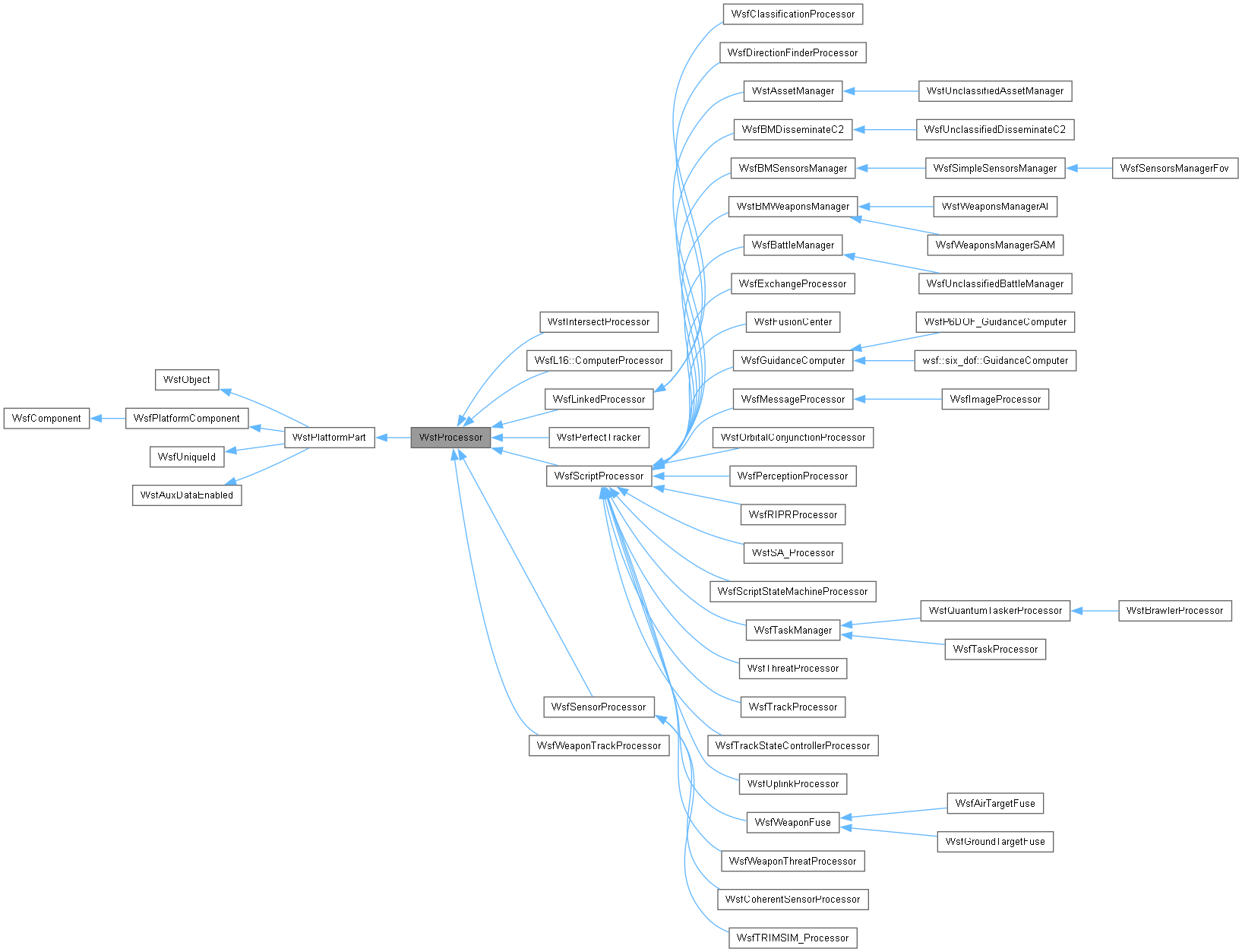
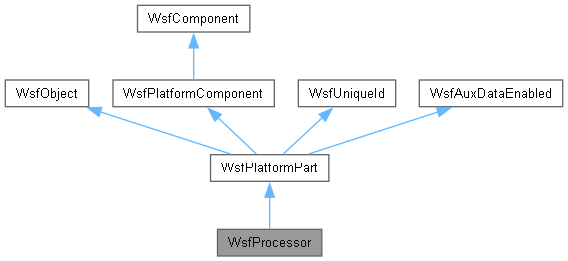
Public Member Functions | |
| WsfProcessor (const WsfScenario &aScenario) | |
| ~WsfProcessor () override=default | |
| Public Member Functions inherited from WsfPlatformPart | |
| WsfPlatformPart (const WsfScenario &aScenario, int aPartType) | |
| WsfPlatformPart & | operator= (const WsfPlatformPart &aRhs)=delete |
| ~WsfPlatformPart () override | |
| bool | DebugEnabled () const |
| Returns 'true' if debugging is enabled for this instance. | |
| void | SetDebugEnabled (bool aDebugEnabled) |
| unsigned int | GetDebugMask () |
| bool | IsExternallyControlled () const |
| virtual void | SetExternallyControlled (double aSimTime, bool aIsExternallyControlled) |
| int | GetPartType () const |
| const char * | GetScriptClassName () const override |
| WsfSimulation * | GetSimulation () const |
| const WsfScenario & | GetScenario () const |
| WsfStringId | GetComponentName () const override |
| void | ComponentParentChanged (WsfPlatform *aPlatformPtr) override |
| WsfPlatform * | GetPlatform () const |
| virtual void | SetPlatform (WsfPlatform *aPlatformPtr) |
| virtual void | PlatformAdded (double aSimTime, WsfPlatform *aPlatformPtr) |
| virtual void | PlatformDeleted (WsfPlatform *aPlatformPtr) |
| double | GetLastStatusChangeTime () const |
| void | SetLastStatusChangeTime (double aSimTime) |
| Allows a system to set the time at which the device was initialized. | |
| bool | CanBeMadeOperational () const |
| Returns an indication that this system can be made operational. | |
| bool | CanBeMadeNonOperational () const |
| Returns an indication that this system can be made non-operational. | |
| bool | CanBeTurnedOn () const |
| Returns an indication that this system can be turned on. | |
| bool | CanBeTurnedOff () const |
| Returns an indication that this system can be turned off. | |
| bool | IsTurnedOn () const |
| bool | InitiallyTurnedOn () const |
| Is the system to be turned 'on' when added to the simulation? | |
| void | SetInitiallyTurnedOn (bool aInitiallyTurnedOn) |
| Sets if the system is turned on when added to the simulation. | |
| virtual void | Restore (double aSimTime) |
| bool | IsOperational () const |
| bool | SetOperational (double aSimTime, bool aMakeOperational) |
| double | GetDamageFactor () const |
| bool | SetDamageFactor (double aSimTime, double aDamageFactor) |
| bool | IsCritical () const |
| void | SetCritical (bool aValue) |
| virtual void | OnPlatformBrokenEvent (double aSimTime) |
| Owning platform has issued a broken event. | |
| bool | IsBroken () const |
| WsfInternalLinks & | GetInternalLinks () |
| Return the internal links for this part. | |
| virtual bool | HasInternalLinks () const |
| Does this platform part have a communication link to other platform parts? | |
| virtual bool | ProcessMessage (double aSimTime, const WsfMessage &aMessage) |
| virtual bool | ReceiveMessage (double aSimTime, const WsfMessage &aMessage) |
| virtual void | SendMessage (double aSimTime, const WsfMessage &aMessage) |
| virtual void | SendMessageTo (double aSimTime, const WsfMessage &aMessage, WsfStringId aRecipientId) |
| void | SendMessageToProcessor (double aSimTime, const WsfMessage &aMessage, WsfStringId aRecipientId) |
| virtual void | SendQueuedMessages (double aSimTime) |
| const WsfCategoryList & | GetCategories () const |
| Get the categories to which this part belongs. | |
| void | AddCategory (WsfStringId aCategoryId) |
| Adds the provided category to the platform part's category list. | |
| bool | IsCategoryMember (WsfStringId aCategoryId) const |
| const WsfGroupList & | GetGroups () const |
| Get the groups to which this platform part belongs. | |
| void | JoinGroup (WsfGroup *aGroupPtr) |
| Join the given group. | |
| void | LeaveGroup (WsfGroup *aGroupPtr) |
| Leave the given group. | |
| bool | IsGroupMember (WsfStringId aGroupId) |
| unsigned int | GetUpdateEventEpoch () const |
| void | IncrementUpdateEventEpoch () |
| bool | UpdateEventActive () const |
| Is an 'Update' event active? | |
| void | SetUpdateEventActive (bool aUpdateEventActive) |
| Indicate if the 'Update' event is active. | |
| Public Member Functions inherited from WsfObject | |
| WsfObject () | |
| This is the constructor for the WsfObject class. | |
| ~WsfObject () override | |
| This is the destructor for the WsfObject class. | |
| const char * | GetScriptClassName () const override |
| const std::string & | GetType () const |
| WsfStringId | GetTypeId () const |
| Get the string ID of the 'type' of the object. | |
| void | SetType (WsfStringId aType) |
| const std::string & | GetBaseType () const |
| WsfStringId | GetBaseTypeId () const |
| const TypeList & | GetTypeList () const |
| bool | IsA_TypeOf (WsfStringId aType) const |
| WsfObject & | operator= (const WsfObject &aRhs) |
| Assignment operator. | |
| template<typename T> | |
| void | Serialize (T &aBuff) |
| For XIO (de)serialization. | |
| const std::string & | GetName () const |
| WsfStringId | GetNameId () const |
| void | SetName (WsfStringId aName) |
| Public Member Functions inherited from WsfComponentT< WsfPlatform > | |
| WsfComponentT () | |
| WsfComponentT (const WsfComponentT &) noexcept | |
| WsfComponentT & | operator= (const WsfComponentT &) noexcept |
| ~WsfComponentT () override=default | |
| ParentType * | GetComponentParent () const |
| void | SetComponentParent (ParentType *aParentPtr) |
| Public Member Functions inherited from WsfComponent | |
| virtual | ~WsfComponent ()=default |
| template<typename T> | |
| bool | QueryInterfaceT (T *&aRolePtr) |
| bool | ComponentHasRole (int aRole) |
| Returns true if the component has the specified role. | |
| Public Member Functions inherited from WsfUniqueId | |
| WsfUniqueId () | |
| Construtor initializes the unique identifier to 0. | |
| WsfUniqueId (const WsfUniqueId &) | |
| Copy constructor initializes the unique identifier to 0. | |
| WsfUniqueId & | operator= (const WsfUniqueId &) |
| unsigned int | GetUniqueId () const |
| Get the unique identifier assigned to this object. | |
| template<typename T> | |
| void | Serialize (T &aBuff) |
| For XIO (de)serialization. | |
| Public Member Functions inherited from WsfAuxDataEnabled | |
| WsfAuxDataEnabled ()=default | |
| WsfAuxDataEnabled (const WsfAuxDataEnabled &aSrc)=default | |
| WsfAuxDataEnabled & | operator= (const WsfAuxDataEnabled &aRhs) |
| WsfAuxDataEnabled (WsfAuxDataEnabled &&)=default | |
| WsfAuxDataEnabled & | operator= (WsfAuxDataEnabled &&)=default |
| virtual | ~WsfAuxDataEnabled () noexcept |
| void | SetAuxData (const WsfAttributeContainer &aAuxData) |
| void | DeleteAuxData () |
| Delete the aux data container from the object. | |
| void | MergeAuxData (const WsfAuxDataEnabled &aSrc) |
| Merge the object's aux data with aux data from an existing object. | |
| void | UpdateAuxData (const WsfAuxDataEnabled &aSrc) |
| Update the object's aux data with aux data from an existing object. | |
| bool | HasAuxData () const |
| Returns true if this object has aux data. | |
| bool | ProcessInput (UtInput &aInput) |
| template<typename T> | |
| void | Serialize (T &aBuff) |
| (De)serialization for XIO | |
| WsfAttributeContainer & | GetAuxData () |
| const WsfAttributeContainer & | GetAuxData () const noexcept |
| const WsfAttributeContainer & | GetAuxDataConst () const noexcept |
Component list support. | |
A processor contains a list of components. | |
| using | ComponentList = WsfComponentListT<WsfProcessorComponent> |
| ComponentList & | GetComponents () |
| const ComponentList & | GetComponents () const |
Miscellaneous methods. | |
| virtual void | ProcessCallback (double aSimTime, const WsfCallback &aCallback) |
| WsfProcessor (const WsfProcessor &aSrc) | |
| Copy constructor (for Clone()). | |
| WsfProcessor & | operator= (const WsfProcessor &aRhs)=delete |
Component infrastructure methods not provided by WsfPlatformPart. | |
| WsfComponent * | CloneComponent () const override |
| const int * | GetComponentRoles () const override |
| void * | QueryInterface (int aRole) override |
| int | GetComponentInitializationOrder () const override |
Common infrastructure methods. | |
| const char * | GetScriptClassName () const override |
| WsfProcessor * | Clone () const override=0 |
| bool | PreInitialize (double aSimTime) override |
| bool | Initialize (double aSimTime) override |
| bool | Initialize2 (double aSimTime) override |
| void | PreInput () override |
| bool | ProcessInput (UtInput &aInput) override |
| void | Update (double aSimTime) override |
Status methods. | |
| void | TurnOff (double aSimTime) override |
| void | TurnOn (double aSimTime) override |
| void | SetNonOperational (double aSimTime) override |
| void | SetOperational (double aSimTime) override |
| void | PartBroken (double aSimTime) override |
Update interval | |
| double | GetUpdateInterval () const override |
| void | SetUpdateInterval (double aUpdateInterval) override |
Additional Inherited Members | |
| Public Types inherited from WsfPlatformPart | |
| enum | { cLEVEL_ONE_DEBUG = 0x00000001 , cLEVEL_TWO_DEBUG = 0x00000002 } |
| using | InternalMessageQueue = std::queue<WsfMessage*> |
| using | RecipientMessageQueue = std::queue<std::pair<WsfPlatformPart*, WsfMessage*>> |
| Public Types inherited from WsfObject | |
| typedef std::vector< WsfStringId > | TypeList |
| The list of types returned by GetTypeList. | |
| Public Types inherited from WsfComponentT< WsfPlatform > | |
| typedef WsfPlatform | ParentType |
| This is needed to support the WsfComponentList template. | |
| Static Public Attributes inherited from WsfAuxDataEnabled | |
| static UtCallbackListN< void(const WsfAuxDataEnabled *)> | AuxDataAccessed |
| static UtCallbackListN< void(const WsfAuxDataEnabled *)> | AuxDataDestroyed |
| WsfPlatformPart (const WsfPlatformPart &aSrc) | |
| Copy constructor (for Clone()). | |
| WsfObject (const WsfObject &aSrc) | |
| Copy constructor (for Clone()). | |
| Protected Member Functions inherited from WsfUniqueId | |
| void | AssignUniqueId (WsfSimulation *aSimulationPtr) |
Detailed Description
A base class for processing systems. A processor is an platform part implements the 'behavior' of a platform. It can represent either a human or a machine.
Processors are invoked by one of two methods:
- By receiving a message from communications sensor systems (ReceiveMessage).
- By periodic call (Update) (the interval is defined by SetUpdateInterval).
A process can do just about anything it wants, i.e.: invoke actions, update platform objects, send messages (to other processors or platforms).
Member Typedef Documentation
◆ ComponentList
Constructor & Destructor Documentation
◆ WsfProcessor() [1/2]
| WsfProcessor::WsfProcessor | ( | const WsfScenario & | aScenario | ) |
References WsfPlatformPart::SetInitiallyTurnedOn(), WsfPlatformPart::WsfPlatformPart(), and WsfProcessor().
Referenced by WsfTaskManager::AssignTask(), wsf::six_dof::GuidanceComputer::Clone(), WsfAirTargetFuse::Clone(), WsfAssetManager::Clone(), WsfBattleManager::Clone(), WsfBMDisseminateC2::Clone(), WsfBMSensorsManager::Clone(), WsfBMWeaponsManager::Clone(), WsfClassificationProcessor::Clone(), WsfCoherentSensorProcessor::Clone(), WsfDirectionFinderProcessor::Clone(), WsfExchangeProcessor::Clone(), WsfFusionCenter::Clone(), WsfGroundTargetFuse::Clone(), WsfGuidanceComputer::Clone(), WsfImageProcessor::Clone(), WsfIntersectProcessor::Clone(), WsfL16::ComputerProcessor::Clone(), WsfLinkedProcessor::Clone(), WsfMessageProcessor::Clone(), WsfOrbitalConjunctionProcessor::Clone(), WsfP6DOF_GuidanceComputer::Clone(), WsfPerfectTracker::Clone(), Clone(), WsfQuantumTaskerProcessor::Clone(), WsfRIPRProcessor::Clone(), WsfScriptProcessor::Clone(), WsfScriptStateMachineProcessor::Clone(), WsfSensorProcessor::Clone(), WsfSimpleSensorsManager::Clone(), WsfTaskManager::Clone(), WsfTaskProcessor::Clone(), WsfThreatProcessor::Clone(), WsfTrackProcessor::Clone(), WsfTrackStateControllerProcessor::Clone(), WsfTRIMSIM_Processor::Clone(), WsfUnclassifiedAssetManager::Clone(), WsfUnclassifiedBattleManager::Clone(), WsfUnclassifiedDisseminateC2::Clone(), WsfWeaponFuse::Clone(), WsfWeaponsManagerAI::Clone(), WsfWeaponsManagerSAM::Clone(), WsfWeaponThreatProcessor::Clone(), WsfWeaponTrackProcessor::Clone(), WsfRIPRProcessor::CommanderPlatform(), WsfRIPRProcessor::CommanderProcessor(), WsfL16::ComputerProcessor::ComputerProcessor(), WsfL16::ComputerProcessor::ComputerProcessor(), WsfAssetManager::Create(), WsfBattleManager::Create(), WsfBMDisseminateC2::Create(), WsfBMSensorsManager::Create(), WsfBMWeaponsManager::Create(), WsfSimpleSensorsManager::Create(), WsfUnclassifiedAssetManager::Create(), WsfUnclassifiedBattleManager::Create(), WsfUnclassifiedDisseminateC2::Create(), WsfWeaponsManagerAI::Create(), WsfWeaponsManagerSAM::Create(), WsfTaskManager::Initialize2(), wsf::six_dof::GuidanceComputer::operator=(), WsfExchangeProcessor::operator=(), WsfFusionCenter::operator=(), WsfGuidanceComputer::operator=(), WsfIntersectProcessor::operator=(), WsfMessageProcessor::operator=(), WsfP6DOF_GuidanceComputer::operator=(), WsfPerfectTracker::operator=(), operator=(), WsfQuantumTaskerProcessor::operator=(), WsfTrackProcessor::operator=(), WsfTrackStateControllerProcessor::operator=(), WsfTrackProcessor::ProcessMessage(), WsfTaskManager::SendTaskMessage(), WsfRIPRProcessor::SubordinatePlatforms(), WsfRIPRProcessor::SubordinateProcessors(), WsfRIPRProcessor::SubsTargeting(), WsfRIPRProcessor::SubsWeaponsActive(), WsfIntersectProcessor::WsfIntersectProcessor(), WsfIntersectProcessor::WsfIntersectProcessor(), WsfLinkedProcessor::WsfLinkedProcessor(), WsfLinkedProcessor::WsfLinkedProcessor(), WsfPerfectTracker::WsfPerfectTracker(), WsfPerfectTracker::WsfPerfectTracker(), WsfProcessor(), WsfProcessor(), WsfScriptProcessor::WsfScriptProcessor(), WsfScriptProcessor::WsfScriptProcessor(), WsfScriptProcessor::WsfScriptProcessor(), WsfSensorProcessor::WsfSensorProcessor(), WsfSensorProcessor::WsfSensorProcessor(), WsfWeaponTrackProcessor::WsfWeaponTrackProcessor(), WsfWeaponTrackProcessor::WsfWeaponTrackProcessor(), WsfTaskManager::~WsfTaskManager(), WsfThreatProcessor::~WsfThreatProcessor(), WsfTRIMSIM_Processor::~WsfTRIMSIM_Processor(), and WsfWeaponsManagerAI::~WsfWeaponsManagerAI().
◆ ~WsfProcessor()
|
overridedefault |
◆ WsfProcessor() [2/2]
|
protected |
Copy constructor (for Clone()).
References WsfPlatformPart::WsfPlatformPart(), and WsfProcessor().
Member Function Documentation
◆ Clone()
|
overridepure virtual |
Create a clone of this object.
- Returns
- A pointer to the new copy.
Implements WsfObject.
Implemented in wsf::six_dof::GuidanceComputer, WsfAirTargetFuse, WsfAssetManager, WsfBattleManager, WsfBMDisseminateC2, WsfBMSensorsManager, WsfBMWeaponsManager, WsfBrawlerProcessor, WsfClassificationProcessor, WsfCoherentSensorProcessor, WsfDirectionFinderProcessor, WsfExchangeProcessor, WsfFusionCenter, WsfGroundTargetFuse, WsfGuidanceComputer, WsfImageProcessor, WsfIntersectProcessor, WsfL16::ComputerProcessor, WsfLinkedProcessor, WsfMessageProcessor, WsfOrbitalConjunctionProcessor, WsfP6DOF_GuidanceComputer, WsfPerceptionProcessor, WsfPerfectTracker, WsfQuantumTaskerProcessor, WsfRIPRProcessor, WsfSA_Processor, WsfScriptProcessor, WsfScriptStateMachineProcessor, WsfSensorProcessor, WsfSensorsManagerFov, WsfSimpleSensorsManager, WsfTaskManager, WsfTaskProcessor, WsfThreatProcessor, WsfTrackProcessor, WsfTrackStateControllerProcessor, WsfTRIMSIM_Processor, WsfUnclassifiedAssetManager, WsfUnclassifiedBattleManager, WsfUnclassifiedDisseminateC2, WsfUplinkProcessor, WsfWeaponFuse, WsfWeaponsManagerAI, WsfWeaponsManagerSAM, WsfWeaponThreatProcessor, and WsfWeaponTrackProcessor.
References ProcessCallback(), and WsfProcessor().
◆ CloneComponent()
|
inlineoverridevirtual |
Clones a component. May return null if component does not support clone.
Implements WsfComponent.
References WsfObject::Clone().
◆ GetComponentInitializationOrder()
|
inlineoverridevirtual |
Forces a specific initialization order. Components are initialized in increasing initialization order value.
Reimplemented from WsfComponent.
References cWSF_INITIALIZE_ORDER_PROCESSOR.
◆ GetComponentRoles()
|
overridevirtual |
Returns a zero-terminated array of component roles. Note that the array should be in decreasing order of specificity and should generally the inheritance hierarchy. The first entry should be the components 'primary' role. For example a sensor would do the following:
Reimplemented from WsfPlatformPart.
Reimplemented in WsfTaskManager.
References cWSF_COMPONENT_NULL, cWSF_COMPONENT_PLATFORM_PART, and cWSF_COMPONENT_PROCESSOR.
◆ GetComponents() [1/2]
|
inline |
Referenced by WsfTaskManager::AcquireResource(), WsfTaskManager::AssignTask(), WsfWeaponTaskManager::Find(), WsfWeaponTaskManager::FindOrCreate(), WsfTaskManager::PlatformDeleted(), WsfTaskManager::ProcessAssociationMessage(), WsfTaskManager::ProcessTaskStatusMessage(), WsfTaskManager::ReleaseResource(), WsfTaskManager::TaskCanceled(), WsfTaskManager::TaskCompleted(), WsfTaskManager::TaskCorrelated(), WsfTaskManager::TrackDropped(), and WsfTaskManager::Update().
◆ GetComponents() [2/2]
|
inline |
◆ GetScriptClassName()
|
override |
◆ GetUpdateInterval()
|
overridevirtual |
Get interval at which Update() is called. This value is set by calling WsfSimulation::GetInstance().SetProcessorUpdateInterval();
Implements WsfPlatformPart.
Referenced by WsfSA_Processor::HandleSA_ProcessorUpdates(), WsfCoherentSensorProcessor::Initialize(), WsfPerceptionProcessor::Initialize(), WsfSA_Processor::Initialize(), WsfCoherentSensorProcessor::OnSensorTargetUpdated(), WsfSA_Processor::SetUpdateInterval(), WsfSA_Processor::TryUpdateBehaviorCalculation(), WsfSA_Processor::TryUpdateFlightControls(), WsfSA_Processor::TryUpdateFlightKinematics(), WsfSA_Processor::TryUpdateFuel(), WsfSA_Processor::TryUpdateNav(), WsfSA_Processor::TryUpdateTracks(), WsfSA_Processor::TryUpdateWeapons(), WsfPerceptionProcessor::Update(), and WsfWeaponTrackProcessor::UpdateTargetTrack().
◆ Initialize()
|
overridevirtual |
Perform phase 1 initialization of the part. This is invoked by WsfPlatform::Initialize() during phase 1 initialization of the platform. During phase 1 initialization, platform components must not assume the existence of ANY data that is the responsibility of another platform component. In particular, the platform location and initial tracks cannot be assumed to be valid.
- Parameters
-
aSimTime The current simulation time.
- Returns
- 'true' if successful or 'false' if some sort of error occurred.
Reimplemented from WsfPlatformPart.
Reimplemented in WsfQuantumTaskerProcessor, WsfRIPRProcessor, WsfSA_Processor, WsfScriptProcessor, WsfScriptStateMachineProcessor, WsfSensorProcessor, WsfSensorsManagerFov, WsfSimpleSensorsManager, WsfTaskManager, WsfTaskProcessor, WsfThreatProcessor, WsfTrackProcessor, WsfTrackStateControllerProcessor, WsfUplinkProcessor, WsfWeaponFuse, WsfWeaponsManagerAI, WsfWeaponsManagerSAM, WsfWeaponThreatProcessor, and WsfWeaponTrackProcessor.
References WsfPlatformPart::GetPlatform(), WsfPlatformPart::GetSimulation(), WsfPlatformPart::Initialize(), and ok.
Referenced by WsfIntersectProcessor::Initialize(), WsfL16::ComputerProcessor::Initialize(), WsfLinkedProcessor::Initialize(), WsfScriptProcessor::Initialize(), WsfSensorProcessor::Initialize(), and WsfWeaponTrackProcessor::Initialize().
◆ Initialize2()
|
overridevirtual |
Perform phase 2 initialization of the part. This is invoked by WsfPlatform::Initialize() during phase 2 initialization of the platform. During phase 2, platform components may assume that the platform location has been defined, initial tracks have been loaded and that all components have completed phase 1 initialization.
- Parameters
-
aSimTime The current simulation time.
- Returns
- 'true' if successful or 'false' if some sort of error occurred.
Reimplemented from WsfPlatformPart.
Reimplemented in WsfQuantumTaskerProcessor, WsfRIPRProcessor, WsfSA_Processor, WsfScriptProcessor, WsfSensorsManagerFov, WsfSimpleSensorsManager, WsfTaskManager, WsfTaskProcessor, WsfWeaponFuse, WsfWeaponsManagerAI, WsfWeaponsManagerSAM, and WsfWeaponTrackProcessor.
References WsfPlatformPart::Initialize2(), and ok.
Referenced by WsfCoherentSensorProcessor::Initialize2(), WsfPerfectTracker::Initialize2(), WsfScriptProcessor::Initialize2(), and WsfWeaponTrackProcessor::Initialize2().
◆ operator=()
|
protecteddelete |
References WsfProcessor().
◆ PartBroken()
|
overridevirtual |
Set the processor terminated.
- Parameters
-
aSimTime The current simulation time.
- Note
- This method should not be invoked directly by application code.
Reimplemented from WsfPlatformPart.
References WsfPlatformPart::GetSimulation(), WsfPlatformPart::PartBroken(), and WsfObserver::ProcessorBroken().
◆ PreInitialize()
|
overridevirtual |
Perform pre-initializion function. This is called by WsfPlatform::Initialize prior to actually initializing the components on a platform (i.e.: calling Initialize and Initialize2 for each component). The primary reason for this method is to allow components to add other components that will then be subsequently initialized. The component may examine the component list and add components, but it must not assume ANYTHING about the actual state of the component.
- Parameters
-
aSimTime The current simulation time.
- Returns
- true if successful or false if unsuccessful (bad input data, etc.)
Reimplemented from WsfComponent.
Reimplemented in WsfQuantumTaskerProcessor, and WsfTaskManager.
References WsfPlatformPart::GetScenario(), ok, WsfComponent::PreInitialize(), and WsfComponentFactoryList< PARENT_TYPE >::PreInitialize().
Referenced by WsfPerceptionProcessor::CreatePerceptionProcessor(), WsfSA_Processor::CreateSA_Processor(), and WsfTaskManager::PreInitialize().
◆ PreInput()
|
overridevirtual |
Perform pre-input processing. This is called in certain contexts just before input processing is FIRST done for a component (See WsfObjectTypeListBase::LoadComponentP.) The primary motivation is to allow the newly created component to invoke the type/role-specific PreInput method in the component factories, which may in turn add any sub-components that MAY be required for input processing or for run-time.
This is currently implemented only for platform level components such as WsfComm, WsfProcessor, WsfSensor and some components implemented in optional projects. You can look at the PreInput methods in each of these and see they are very simple.
The reason for this is that WsfObjectTypeListBase::LoadComponentP cannot simply invoke the PreInput methods in the component factories. PreInput is only defined in the template WsfComponentFactoryT<>, and the PreInput method in the template defines a method whose argument is a reference to the object being created. There is no way for LoadComponentP to do this in general. Delegating it to to component solves the problem.
- Note
- This method may get called more than once as input objects derive from other input type-objects.
Reimplemented from WsfComponent.
References WsfPlatformPart::GetScenario(), and WsfComponentFactoryList< PARENT_TYPE >::PreInput().
◆ ProcessCallback()
|
virtual |
Process a callback. Notification that the current platform just executed a callback.
- Parameters
-
aSimTime The current simulation time. aCallback The callback being executed.
Referenced by Clone().
◆ ProcessInput()
|
overridevirtual |
Process input from a generic source.
Examine the current input command. If it is NOT one of the commands recognized by this class then it simply returns 'false'. If it is one of the commands recognized by this class then it processes the command and returns 'true'.
- Parameters
-
aInput a reference to a UtInput object.
- Returns
- 'true' if the command was one recognized by the class or 'false' if not.
- Exceptions
-
UtInput::ExceptionBase (or an object derived from it) if the command was recognized but contains some sort of error.
- Note
- If a derived class does not recognize the command (i.e.: the return value is false) then it should call the base class ProcessInput method. This chain should continue until either the command is recognized or the top-level base class is encountered.
Reimplemented from WsfPlatformPart.
Reimplemented in WsfQuantumTaskerProcessor, WsfRIPRProcessor, WsfSA_Processor, WsfScriptProcessor, WsfScriptStateMachineProcessor, WsfSensorProcessor, WsfSensorsManagerFov, WsfSimpleSensorsManager, WsfTaskManager, WsfTaskProcessor, WsfThreatProcessor, WsfTrackProcessor, WsfTrackStateControllerProcessor, WsfTRIMSIM_Processor, WsfUnclassifiedAssetManager, WsfUnclassifiedBattleManager, WsfUnclassifiedDisseminateC2, WsfUplinkProcessor, WsfWeaponFuse, WsfWeaponsManagerAI, WsfWeaponsManagerSAM, WsfWeaponThreatProcessor, and WsfWeaponTrackProcessor.
References WsfPlatformPart::GetScenario(), WsfComponentFactoryList< PARENT_TYPE >::ProcessInput(), and WsfPlatformPart::ProcessInput().
Referenced by WsfIntersectProcessor::ProcessInput(), WsfL16::ComputerProcessor::ProcessInput(), WsfLinkedProcessor::ProcessInput(), WsfPerfectTracker::ProcessInput(), WsfScriptProcessor::ProcessInput(), WsfSensorProcessor::ProcessInput(), and WsfWeaponTrackProcessor::ProcessInput().
◆ QueryInterface()
|
overridevirtual |
Requests a component's role interface. A component can support one or more roles.
- Parameters
-
aRole The role whose interface is to be returned.
- Returns
- A pointer to the object if it supports the indicated role, or 'null' if it does not. Usage: WsfProcessor* procPtrOrNull = (WsfProcessor*)componentPtr->QueryComponentInterface(cWSF_COMPONENT_PROCESSOR);
Reimplemented from WsfPlatformPart.
Reimplemented in WsfTaskManager.
References cWSF_COMPONENT_PROCESSOR, and WsfPlatformPart::QueryInterface().
Referenced by WsfBrawlerProcessor::QueryInterface(), and WsfTaskManager::QueryInterface().
◆ SetNonOperational()
|
overridevirtual |
Set the processor non-Operational.
- Parameters
-
aSimTime The current simulation time.
- Note
- This method should not be invoked directly by application code.
Reimplemented from WsfPlatformPart.
References WsfPlatformPart::GetSimulation(), WsfObserver::ProcessorNonOperational(), and WsfPlatformPart::SetNonOperational().
◆ SetOperational()
|
overridevirtual |
Set the processor Operational.
- Parameters
-
aSimTime The current simulation time.
- Note
- This method should not be invoked directly by application code.
Reimplemented from WsfPlatformPart.
References WsfPlatformPart::GetSimulation(), WsfObserver::ProcessorOperational(), and WsfPlatformPart::SetOperational().
◆ SetUpdateInterval()
|
overridevirtual |
Set the time interval between the periodic calls to Update(). A value of less than or equal to zero indicates periodic updates are not to be performed.
- Parameters
-
aUpdateInterval The new update interval.
- Note
- Users should call WsfSimulation::GetInstance().SetProcessorUpdateInterval() to set the interval.
Implements WsfPlatformPart.
Referenced by WsfWeaponFuse::CheckForDetonation(), WsfBrawlerProcessor::Initialize(), WsfIntersectProcessor::Initialize(), WsfPerceptionProcessor::Initialize(), WsfWeaponFuse::Initialize(), WsfWeaponTrackProcessor::UpdateTargetTrack(), WsfExchangeProcessor::WsfExchangeProcessor(), WsfMessageProcessor::WsfMessageProcessor(), and WsfWeaponTrackProcessor::WsfWeaponTrackProcessor().
◆ TurnOff()
|
overridevirtual |
Turn the processor off. The processor will no longer be called for received messages or periodic updates until it is turned on again.
- Parameters
-
aSimTime The current simulation time.
- Note
- This method should not be invoked directly by application code. Use the WsfSimulation::TurnProcessorOff method.
Reimplemented from WsfPlatformPart.
Reimplemented in WsfTaskManager, WsfTaskProcessor, and WsfTrackStateControllerProcessor.
References WsfPlatformPart::GetSimulation(), WsfObserver::ProcessorTurnedOff(), WsfPlatformPart::TurnOff(), TurnOff(), and WSF_CALL_VOID_COMPONENTS.
Referenced by WsfWeaponFuse::PermanentlyArrestMotion(), WsfWeaponFuse::PrivateDetonate(), wsf::six_dof::GuidanceComputer::TurnOff(), WsfGuidanceComputer::TurnOff(), WsfMessageProcessor::TurnOff(), WsfP6DOF_GuidanceComputer::TurnOff(), TurnOff(), WsfTaskManager::TurnOff(), and WsfTrackStateControllerProcessor::TurnOff().
◆ TurnOn()
|
overridevirtual |
Turn the processor on. The processor will now be called for received messages and periodic updates.
- Parameters
-
aSimTime The current simulation time.
- Note
- This method should not be invoked directly by application code. Use the WsfSimulation::TurnProcessorOn method.
Reimplemented from WsfPlatformPart.
Reimplemented in WsfTaskManager, WsfTaskProcessor, WsfTrackStateControllerProcessor, and WsfTRIMSIM_Processor.
References WsfPlatformPart::GetSimulation(), WsfObserver::ProcessorTurnedOn(), WsfPlatformPart::TurnOn(), TurnOn(), and WSF_CALL_VOID_COMPONENTS.
Referenced by wsf::six_dof::GuidanceComputer::TurnOn(), WsfGuidanceComputer::TurnOn(), WsfMessageProcessor::TurnOn(), WsfP6DOF_GuidanceComputer::TurnOn(), TurnOn(), WsfTaskManager::TurnOn(), WsfTrackStateControllerProcessor::TurnOn(), and WsfTRIMSIM_Processor::TurnOn().
◆ Update()
|
overridevirtual |
Update the state of the processor. This method should perform any actions that are necessary so that the system reflects its condition at the supplied time.
- Parameters
-
aSimTime The current simulation time.
Reimplemented from WsfPlatformPart.
Reimplemented in WsfQuantumTaskerProcessor, WsfRIPRProcessor, WsfSA_Processor, WsfScriptProcessor, WsfScriptStateMachineProcessor, WsfSimpleSensorsManager, WsfTaskManager, WsfThreatProcessor, WsfWeaponFuse, WsfWeaponsManagerAI, WsfWeaponsManagerSAM, and WsfWeaponTrackProcessor.
The documentation for this class was generated from the following files: