Implement a filter as an adapter. More...
#include <WsfFilter.hpp>
Public Member Functions | |
| WsfFilter ()=delete | |
| WsfFilter (TrackingFilters::Filter *aFilterPtr) | |
| WsfFilter (const WsfFilter &aSrc) | |
| WsfFilter & | operator= (const WsfFilter &aRhs) |
| ~WsfFilter () override | |
| WsfFilter * | Clone () const override=0 |
| bool | ProcessInput (UtInput &aInput) override |
| virtual bool | Initialize (double aSimTime, WsfSimulation *aSimulationPtr, const UtMatrixd *aInitialStatePtr=nullptr) |
| void | Reset (double aSimTime, const UtMatrixd *aInitialStatePtr=nullptr) |
| void | Update (double aSimTime, const UtMeasurementData &aDataIn, UtMeasurementData &aDataOut) |
| void | NoDetectUpdate (double aSimTime, UtMeasurementData &aDataOut) |
| void | GetKinematicEstimate (double aSimTime, UtMeasurementData &aDataOut) |
| const UtCovariance * | GetStateCovariance () |
| const UtCovariance * | GetResidualCovariance () |
| bool | GetPredictedStateCovariance (double aSimTime, UtCovariance &aCovariance) |
| bool | GetPredictedResidualCovariance (double aSimTime, UtCovariance &aCovariance) |
| bool | GetCurrentMeasurementTrackScore (double &aCurrentScore) |
| bool | GetAverageTrackScore (double &aAverageScore) |
| bool | IsStable () const |
| void | SetFrameTime (double aFrameTime) |
| Set the 'frame time' for the sensor, which is the typical time to complete a scan. | |
| Public Member Functions inherited from WsfObject | |
| WsfObject () | |
| This is the constructor for the WsfObject class. | |
| ~WsfObject () override | |
| This is the destructor for the WsfObject class. | |
| const char * | GetScriptClassName () const override |
| const std::string & | GetType () const |
| WsfStringId | GetTypeId () const |
| Get the string ID of the 'type' of the object. | |
| void | SetType (WsfStringId aType) |
| const std::string & | GetBaseType () const |
| WsfStringId | GetBaseTypeId () const |
| const TypeList & | GetTypeList () const |
| bool | IsA_TypeOf (WsfStringId aType) const |
| WsfObject & | operator= (const WsfObject &aRhs) |
| Assignment operator. | |
| template<typename T> | |
| void | Serialize (T &aBuff) |
| For XIO (de)serialization. | |
| const std::string & | GetName () const |
| WsfStringId | GetNameId () const |
| void | SetName (WsfStringId aName) |
Protected Attributes | |
| TrackingFilters::Filter * | mFilterPtr |
Additional Inherited Members | |
| Public Types inherited from WsfObject | |
| typedef std::vector< WsfStringId > | TypeList |
| The list of types returned by GetTypeList. | |
| WsfObject (const WsfObject &aSrc) | |
| Copy constructor (for Clone()). | |
Detailed Description
Implement a filter as an adapter.
Constructor & Destructor Documentation
◆ WsfFilter() [1/3]
|
delete |
References WsfFilter().
Referenced by WsfAlphaBetaFilter::Clone(), WsfAlphaBetaGammaFilter::Clone(), Clone(), WsfKalmanFilter2D_RB::Clone(), WsfKalmanFilter::Clone(), operator=(), WsfAlphaBetaFilter::WsfAlphaBetaFilter(), WsfAlphaBetaFilter::WsfAlphaBetaFilter(), WsfAlphaBetaGammaFilter::WsfAlphaBetaGammaFilter(), WsfAlphaBetaGammaFilter::WsfAlphaBetaGammaFilter(), WsfFilter(), WsfFilter(), WsfKalmanFilter::WsfKalmanFilter(), WsfKalmanFilter2D_RB::WsfKalmanFilter2D_RB(), WsfKalmanFilter2D_RB::WsfKalmanFilter2D_RB(), and WsfOrbitDeterminationKalmanFilter::WsfOrbitDeterminationKalmanFilter().
◆ WsfFilter() [2/3]
| WsfFilter::WsfFilter | ( | TrackingFilters::Filter * | aFilterPtr | ) |
References mFilterPtr, and WsfObject::WsfObject().
◆ WsfFilter() [3/3]
| WsfFilter::WsfFilter | ( | const WsfFilter & | aSrc | ) |
References Clone(), mFilterPtr, WsfFilter(), and WsfObject::WsfObject().
◆ ~WsfFilter()
|
override |
References mFilterPtr.
Member Function Documentation
◆ Clone()
|
overridepure virtual |
Clone this filter.
- Returns
- a pointer to the new object.
Implements WsfObject.
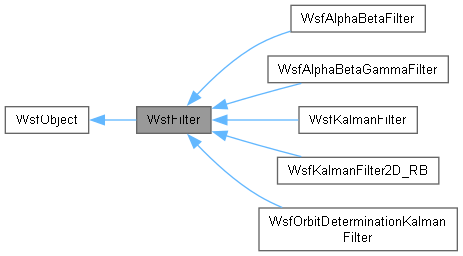
Implemented in WsfAlphaBetaFilter, WsfAlphaBetaGammaFilter, WsfKalmanFilter2D_RB, WsfKalmanFilter, and WsfOrbitDeterminationKalmanFilter.
References GetAverageTrackScore(), GetCurrentMeasurementTrackScore(), GetKinematicEstimate(), GetPredictedResidualCovariance(), GetPredictedStateCovariance(), GetResidualCovariance(), GetStateCovariance(), Initialize(), IsStable(), NoDetectUpdate(), Reset(), SetFrameTime(), and WsfFilter().
Referenced by WsfLocalTrack::operator=(), and WsfFilter().
◆ GetAverageTrackScore()
| bool WsfFilter::GetAverageTrackScore | ( | double & | aAverageScore | ) |
Returns the AVERAGE Normalized Residual Square Produced by the Filter Done by means of computing a weighted average of the last several individual Distance Functions produced by the filter
- Parameters
-
aAverageScore [output]
- Returns
- true if this is received from a KalmanFilter If the filter is not a Kalman filter this data is not valid and should not be used.
References mFilterPtr.
Referenced by Clone().
◆ GetCurrentMeasurementTrackScore()
| bool WsfFilter::GetCurrentMeasurementTrackScore | ( | double & | aCurrentScore | ) |
Returns the Normalized Residual Square Produced by the Filter Also called Distance Function, or Track Score
- Parameters
-
aCurrentScore [output]
- Returns
- true if this is received from a KalmanFilter If the filter is not a Kalman filter this data is not valid and should not be used.
References mFilterPtr.
Referenced by Clone().
◆ GetKinematicEstimate()
| void WsfFilter::GetKinematicEstimate | ( | double | aSimTime, |
| UtMeasurementData & | aDataOut ) |
◆ GetPredictedResidualCovariance()
| bool WsfFilter::GetPredictedResidualCovariance | ( | double | aSimTime, |
| UtCovariance & | aCovariance ) |
If the filter has a residual covariance matrix, return the predicted residual covariance.
- Parameters
-
aSimTime The current simulation time, used to extrapolate the covariance. aCovariance [output] A reference to the predicted covariance.
- Returns
- true if the filter is able to provide the estimate.
References mFilterPtr.
Referenced by Clone(), and WsfDefaultSensorTracker::TargetUndetected().
◆ GetPredictedStateCovariance()
| bool WsfFilter::GetPredictedStateCovariance | ( | double | aSimTime, |
| UtCovariance & | aCovariance ) |
If the filter has a state covariance matrix, return the predicted state covariance.
- Parameters
-
aSimTime The current simulation time, used to extrapolate the covariance. aCovariance [output] A reference to the predicted covariance.
- Returns
- true if the filter is able to provide the estimate.
References mFilterPtr.
Referenced by Clone(), and WsfDefaultSensorTracker::TargetUndetected().
◆ GetResidualCovariance()
| const UtCovariance * WsfFilter::GetResidualCovariance | ( | ) |
References mFilterPtr.
Referenced by Clone(), WsfDefaultSensorTracker::TargetDetected(), and WsfDefaultSensorTracker::TargetUndetected().
◆ GetStateCovariance()
| const UtCovariance * WsfFilter::GetStateCovariance | ( | ) |
Returns the State Covariance.
- Returns
- A pointer to the state covariance matrix. This will be zero if the filter does not compute a covariance matrix.
References mFilterPtr.
Referenced by Clone(), WsfDefaultSensorTracker::TargetDetected(), and WsfDefaultSensorTracker::TargetUndetected().
◆ Initialize()
|
virtual |
Initialize the filter with the option of providing simulation and / or scenario specific data, and an initial state.
- Parameters
-
aSimTime The simulation time at which the initial state (if any) is valid; otherwise, the current simulation time. aSimulationPtr The simulation object pointer. aInitialStatePtr An optional initial state (6x1) vector, consisting of a WCS location vector (first three values), and a WCS velocity vector (second three values).
Reimplemented in WsfOrbitDeterminationKalmanFilter.
References mFilterPtr.
Referenced by WsfDirectionFinderProcessor::AddFilterToFusedTrack(), Clone(), and WsfDefaultSensorTracker::TargetDetected().
◆ IsStable()
| bool WsfFilter::IsStable | ( | ) | const |
Is the filter stable?
- Returns
- true if the filter is stable and producing 'accurate' state estimates.
- false if the filter is simply absorbing measurements.
- Note
- This method should be checked as true before attempting to retrieve or use filter state information. A stable filter must be able to provide valid WCS location and velocity estimates.
References mFilterPtr.
Referenced by Clone(), wsf::space::KinematicStateExtrapolation::Extrapolate(), WsfDefaultSensorTracker::GetTargetState(), and WsfOrbitDeterminationFusion::UpdateLocalTrackFromNonLocalTrack().
◆ NoDetectUpdate()
| void WsfFilter::NoDetectUpdate | ( | double | aSimTime, |
| UtMeasurementData & | aDataOut ) |
References mFilterPtr.
Referenced by Clone(), and WsfDefaultSensorTracker::TargetUndetected().
◆ operator=()
References mFilterPtr, WsfObject::operator=(), and WsfFilter().
◆ ProcessInput()
|
overridevirtual |
Process input from a generic source.
Examine the current input command. If it is NOT one of the commands recognized by this class then it simply returns 'false'. If it is one of the commands recognized by this class then it processes the command and returns 'true'.
- Parameters
-
aInput a reference to a UtInput object.
- Returns
- 'true' if the command was one recognized by the class or 'false' if not.
- Exceptions
-
UtInput::ExceptionBase (or an object derived from it) if the command was recognized but contains some sort of error.
- Note
- If a derived class does not recognize the command (i.e.: the return value is false) then it should call the base class ProcessInput method. This chain should continue until either the command is recognized or the top-level base class is encountered.
Reimplemented from WsfObject.
Reimplemented in WsfOrbitDeterminationKalmanFilter.
References mFilterPtr.
◆ Reset()
| void WsfFilter::Reset | ( | double | aSimTime, |
| const UtMatrixd * | aInitialStatePtr = nullptr ) |
Reset the filter back to an initialized state.
- Parameters
-
aSimTime The simulation time at which the initial state (if any) is valid; otherwise, the current simulation time. aInitialStatePtr An optional initial state (6x1) vector, consisting of a WCS location vector (first three values), and a WCS velocity vector (second three values).
References mFilterPtr.
Referenced by Clone(), and WsfDefaultSensorTracker::TargetDetected().
◆ SetFrameTime()
| void WsfFilter::SetFrameTime | ( | double | aFrameTime | ) |
Set the 'frame time' for the sensor, which is the typical time to complete a scan.
References mFilterPtr.
Referenced by Clone().
◆ Update()
| void WsfFilter::Update | ( | double | aSimTime, |
| const UtMeasurementData & | aDataIn, | ||
| UtMeasurementData & | aDataOut ) |
References mFilterPtr.
Referenced by WsfDefaultSensorTracker::TargetDetected(), and WsfOrbitDeterminationFusion::UpdateLocalTrackFromNonLocalTrack().
Member Data Documentation
◆ mFilterPtr
|
protected |
Referenced by GetAverageTrackScore(), GetCurrentMeasurementTrackScore(), GetKinematicEstimate(), GetPredictedResidualCovariance(), GetPredictedStateCovariance(), GetResidualCovariance(), GetStateCovariance(), Initialize(), IsStable(), NoDetectUpdate(), operator=(), ProcessInput(), Reset(), WsfKalmanFilter::SetFilterProcessNoise(), SetFrameTime(), Update(), WsfFilter(), WsfFilter(), and ~WsfFilter().
The documentation for this class was generated from the following files: