#include <WsfWeapon.hpp>

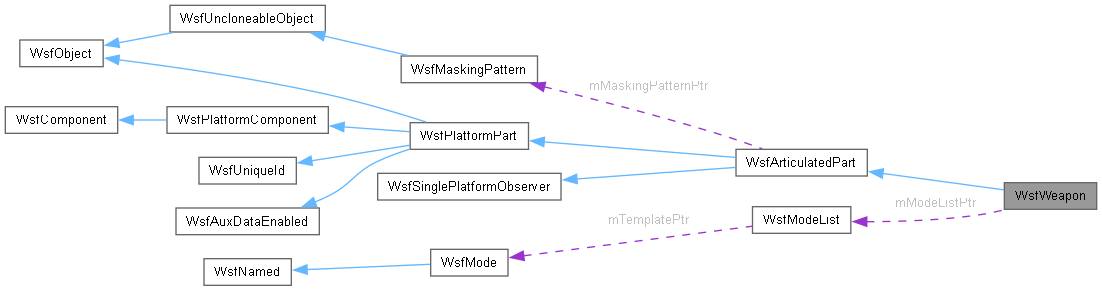
Classes | |
| class | WsfWeaponMode |
| A 'mode' of the weapon. More... | |
| class | FireTarget |
| A target for a weapon to fire upon. More... | |
| class | FireOptions |
| Weapon firing options. More... | |
| class | SalvoOptions |
| Salvoing options. More... | |
| class | FireResult |
| Result of WsfWeapon::Fire(). More... | |
| class | SalvoEvent |
| class | CompleteReloadEvent |
| struct | SalvoRequest |
| struct | ActiveWeapon |
| struct | WeaponStatus |
Static Public Attributes | |
| static const double | cUNDEFINED_DOUBLE = 1.0E+30 |
| Static Public Attributes inherited from WsfArticulatedPart | |
| static constexpr double | cINFINITE_SLEW_RATE = 1.0E+12 * UtMath::cRAD_PER_DEG |
| static constexpr double | cALMOST_FULL_CIRCLE = 359.999 * UtMath::cRAD_PER_DEG |
| Static Public Attributes inherited from WsfAuxDataEnabled | |
| static UtCallbackListN< void(const WsfAuxDataEnabled *)> | AuxDataAccessed |
| static UtCallbackListN< void(const WsfAuxDataEnabled *)> | AuxDataDestroyed |
Component list support. | |
A processor contains a list of components. | |
| using | ComponentList = WsfComponentListT<WsfWeaponComponent> |
| ComponentList & | GetComponents () |
| const ComponentList & | GetComponents () const |
Weapon server support. | |
| using | WeaponStatusMap = std::map<WsfTrackId, WeaponStatus> |
| using | WeaponStatusMapIter = WeaponStatusMap::iterator |
| using | WeaponStatusMapConstIter = WeaponStatusMap::const_iterator |
| using | WeaponStatusVal = std::pair<WsfTrackId, WeaponStatus> |
| WsfModeList * | mModeListPtr |
| The pointer to the list of modes (for things like jammers). | |
| WeaponStatusMap | mWeaponStatusMap |
| virtual bool | AllocateTheWeapon (double aSimTime, WsfTrack *aTrackPtr, int aStoreId) |
| Begin the weapon server allocation sequence. | |
| void | SetState (WeaponState aState) |
| WeaponState | GetState () const |
| Return weapon state. | |
| WsfWeapon (const WsfWeapon &aSrc) | |
| Copy constructor (for Clone()). | |
| WsfWeapon & | operator= (const WsfWeapon &)=delete |
| bool | IsQuantitySpecified () const |
| virtual void | ProcessReloading (double aSimTime) |
| void | SetIsReloading (bool aValue) |
| Method used for derived classes to set or clear the IsReloading Flag. | |
| void | SetModeList (WsfModeList *aModeListPtr) |
| void | SetTimeLastFired (double aTimeLastFired) |
| void | SetMaximumRequestCount (unsigned int aMaximumRequestCount) |
| double | GetReloadInterval () const |
| virtual void | WeaponFireAborted (double aSimTime, const WsfTrack *aTargetTrackPtr, double aQuantity) |
Weapon status methods | |
| static double | TimeWeaponLastFiredFor (const WsfPlatform &aPlatform, const WsfTrackId &aTrackId, WsfStringId aWeaponName=WsfStringId()) |
| static double | TimeWeaponLastTerminatedFor (const WsfPlatform &aPlatform, const WsfTrackId &aTrackId, WsfStringId aWeaponName=WsfStringId()) |
| static int | WeaponsPendingFor (const WsfPlatform &aPlatform, const WsfTrackId &aTrackId, WsfStringId aWeaponName=WsfStringId()) |
| static int | WeaponsActiveFor (const WsfPlatform &aPlatform, const WsfTrackId &aTrackId, WsfStringId aWeaponName=WsfStringId()) |
| Returns number of weapons that have been fired at the track and are still alive. | |
| static int | RoundsCompleteFor (const WsfPlatform &aPlatform, const WsfTrackId &aTrackId, WsfStringId aWeaponName=WsfStringId()) |
| Returns number of weapons that were fired at the track and are now terminated. | |
| static int | WeaponsActiveAndPendingFor (const WsfPlatform &aPlatform, const WsfTrackId &aTrackId, WsfStringId aWeaponName=WsfStringId()) |
| Equivalent to WeaponsActiveFor() plus WeaponsPendingFor(). | |
| static int | RoundsFiredAt (const WsfPlatform &aPlatform, const WsfTrackId &aTrackId, WsfStringId aWeaponName=WsfStringId()) |
| Equivalent to WeaponsActiveFor() plus RoundsCompleteFor(). | |
| static int | SalvosFiredAt (const WsfPlatform &aPlatform, const WsfTrackId &aTrackId, WsfStringId aWeaponName=WsfStringId()) |
| Returns number of salvo fire requests requested, and not the actual number of salvos fired. | |
| static std::vector< size_t > | ActiveWeaponPlatformsFor (const WsfPlatform &aPlatform, const WsfTrackId &aTrackId, WsfStringId aWeaponName=WsfStringId()) |
| static void | DetermineFirepowerStatus (WsfPlatform &aPlatform) |
| Decide whether to set or clear the Firepower appearance bit. | |
| WsfWeapon (const WsfScenario &aScenario) | |
| ~WsfWeapon () override | |
Component infrastructure methods not provided by WsfPlatformPart. | |
| WsfComponent * | CloneComponent () const override |
| const int * | GetComponentRoles () const override |
| void * | QueryInterface (int aRole) override |
| int | GetComponentInitializationOrder () const override |
Common infrastructure methods. | |
| const char * | GetScriptClassName () const override |
| WsfWeapon * | Clone () const override=0 |
| bool | PreInitialize (double aSimTime) override |
| bool | Initialize (double aSimTime) override |
| bool | Initialize2 (double aSimTime) override |
| void | PreInput () override |
| bool | ProcessInput (UtInput &aInput) override |
| void | Update (double aSimTime) override |
| Update the state of the weapon to the supplied time value. | |
Status methods. | |
| void | TurnOff (double aSimTime) override |
| void | TurnOn (double aSimTime) override |
| void | SetNonOperational (double aSimTime) override |
| void | SetOperational (double aSimTime) override |
| void | PartBroken (double aSimTime) override |
| void | Restore (double aSimTime) override |
| double | GetUpdateInterval () const override |
| Get the update interval. | |
Receiver/Transmitter access methods. | |
These methods support accessing the underlying receiver and transmitter components. | |
| virtual size_t | GetEM_RcvrCount () const |
| virtual WsfEM_Rcvr & | GetEM_Rcvr (size_t aIndex) |
| virtual size_t | GetEM_XmtrCount () const |
| virtual WsfEM_Xmtr & | GetEM_Xmtr (size_t aIndex) |
| virtual size_t | GetEM_XmtrCount (size_t aModeIndex) const |
| virtual WsfEM_Xmtr & | GetEM_Xmtr (size_t aModeIndex, size_t aIndex) |
| virtual WsfEM_Xmtr & | GetEM_Xmtr (size_t aModeIndex, size_t aBeamIndex, size_t aIndex) |
Mode selection methods. | |
These methods support the control of a multi-mode weapons (particularly jammers).
| |
| virtual WsfStringId | GetCurrentModeName () const |
| Return the string ID of the string associated with the name of the current mode. | |
| virtual WsfWeaponMode * | GetCurrentMode () |
| virtual size_t | GetModeCount () |
| Get the number of modes associated with the weapon. | |
| virtual WsfWeaponMode * | GetModeEntry (size_t aModeIndex) |
| virtual size_t | GetModeIndex (WsfStringId aModeNameId) |
| virtual WsfStringId | GetModeName (size_t aModeIndex) |
| virtual void | DeselectMode (double aSimTime, WsfStringId aModeNameId) |
| virtual void | SelectMode (double aSimTime, WsfStringId aModeNameId) |
Launch Computer Set/Get methods. | |
| WsfLaunchComputer * | GetLaunchComputer () const |
| void | SetLaunchComputer (WsfLaunchComputer *aLaunchComputerPtr) |
Weapon Effects methods | |
| WsfStringId | GetWeaponEffectsType () const |
| Get the string ID of the weapon effects to be used. | |
| void | SetWeaponEffectsType (WsfStringId aWeaponEffect) |
| Set the string ID of the weapon effects to be used. | |
Firing and cueing methods | |
| virtual void | CueToTarget (double aSimTime, const WsfTrack *aTrackPtr) |
| virtual FireResult | Fire (double aSimTime, const FireTarget &aTarget, const FireOptions &aSettings) |
| virtual bool | FireSalvo (double aSimTime, const FireTarget &aTarget, const SalvoOptions &aSettings) |
| virtual void | ContinueSalvo (double aSimTime, unsigned int aRequestId) |
| virtual void | AbortSalvo (double aSimTime, const WsfTrackId &aTrackId) |
| virtual void | CeaseFire (double aSimTime) |
| virtual unsigned int | GetActiveRequestCount () const |
| Return the number of 'FireSalvo' calls that are in process. | |
| virtual unsigned int | GetMaximumRequestCount () const |
Time methods. | |
| double | GetTimeLastFired () const |
| Get the simulation time when the weapon was last fired. | |
| virtual double | GetFiringDelay () |
| void | SetFiringDelay (const WsfRandomVariable &aFiringDelay) |
| virtual double | GetSalvoInterval () |
| double | GetFiringInterval () const |
| void | SetFiringInterval (double aFiringInterval) |
Launched platform type methods. | |
| WsfStringId | GetLaunchedPlatformType () const |
| Get the type of the platform that will be launched. | |
| void | SetLaunchedPlatformType (WsfStringId aLaunchedPlatformType) |
| Set the type of the platform that will be launched. | |
Inventory methods. | |
The definition of quantity depends on the type of weapon. For some weapons it might be 'rounds', for others it might be 'Joules'. | |
| double | GetInitialStateQuantityRemaining () const |
| virtual double | GetQuantityRemaining () const |
| virtual double | GetQuantityCommitted () const |
| Return the quantity that is currently committed. | |
| virtual double | GetMaximumQuantity () const |
| Return the maximum quantity that may be 'loaded'. | |
| virtual double | GetTotalQuantityUsed () const |
| Return the cumulative running total of the quantity used (fired). | |
| virtual void | SetQuantityRemaining (double aQuantity) |
| void | ChangeQuantity (double aDeltaQuantity) |
Reload specification methods. | |
These methods support the control of weapon inventory replenishment. For maximum user flexibility, the IsReloading() flag is accessible via script, the user must determine whether salvo firing will be interrupted during reload.
| |
| bool | IsReloading () const |
| bool | InhibitWhileReloading () const |
| Flag indicating that when a weapon reload is in progress, any firing will be inhibited. | |
| virtual void | CompleteReloading (double aSimTime, double aQuantity) |
| double | GetReloadInventory () const |
| double | GetReloadThreshold () const |
| Returns the depleted value of inventory at which a reload is attempted. | |
| double | GetReloadIncrement () const |
Helpers for working with target data. | |
Sometimes a weapon needs a track against which to fire and the track has to have location data. These methods help dealing with cases where the required data may not be available, but other mechanisms may have been defined that indicate how to construct a location. | |
| WsfTrack * | CreateTargetTrack (double aSimTime, const WsfTrack *aTrackPtr) |
| bool | GetTargetLocationWCS (double aSimTime, const WsfTrack *aTrackPtr, double aTargetLocWCS[3]) |
Target cueing data methods. | |
Currently used in WsfRF_Jammer::JammerXmtr's functionalities for DIS operations, other future implementations are possible. The target data is stored in the inheriting classes. | |
| virtual void | SetTargetIndex (int aId, size_t aTargetIndex) |
| virtual size_t | GetTargetIndex (int aId) const |
| virtual void | SetTargetedLocationWCS (int aId, const double aTargetedLocationWCS[3]) |
| virtual void | GetTargetedLocationWCS (int aId, double aTargetedLocationWCS[3]) const |
| virtual bool | TargetedLocationValid (int aId) const |
Field of view methods. | |
Determines if the platform is within the weapons field of view. | |
| virtual bool | WithinFieldOfView (double aSimTime, WsfPlatform *aPlatformPtr) |
| virtual bool | WithinFieldOfView (double aSimTime, WsfTrack *aTrackPtr) |
Jammer methods. | |
These methods support jammer tasking. | |
| virtual bool | StartJamming (double aSimTime, double aFrequency, double aBandwidth, size_t aBeamNumber, WsfStringId aTechniqueId, WsfTrackId aTrackId, size_t aTargetIndex) |
| virtual bool | StartJammingTrack (double aSimTime, WsfStringId aTechniqueId, const WsfTrack *aTrackPtr) |
| virtual bool | StopJamming (double aSimTime, double aFrequency, double aBandwidth, size_t aBeamNumber, WsfTrackId aTrackId) |
| virtual bool | UpdateJamming (double aSimTime, size_t aXmtrIndex, double aFrequency, double aBandwidth, WsfStringId aTechniqueId, WsfTrackId aTrackId, size_t aTargetIndex) |
| virtual size_t | GetActiveBeamCount () const |
| virtual size_t | GetMaximumBeamCount () const |
| virtual size_t | GetActiveSpotCount (size_t aBeamNumber) const |
| virtual size_t | GetMaximumSpotCount (size_t aBeamNumber) const |
EA methods | |
These methods support EA jammer tasking. | |
| virtual bool | SelectEA_Technique (double aSimTime, double aFrequency, double aBandwidth, size_t aBeamNumber, WsfStringId aTechniqueId, WsfTrackId aTrackId) |
| virtual bool | DeselectEA_Technique (double aSimTime, double aFrequency, double aBandwidth, size_t aBeamNumber, WsfStringId aTechniqueId, WsfTrackId aTrackId) |
| virtual bool | SetEA_DeltaGainTechnique (double aSimTime, WsfStringId aTechniqueId, bool aOnOff, WsfStringId aEffectId, double aJammingDeltaGain_dB, WsfStringId aSystemTypeId, WsfStringId aFunctionTypeId) |
| virtual bool | SetEA_DeltaGainTechnique (double aSimTime, WsfStringId aTechniqueId, bool aOnOff, WsfStringId aEffectId, double aJammingDeltaGain_dB, WsfStringId aSystemTypeId, WsfStringId aFunctionTypeId, double aFrequency, double aBandwidth, size_t aBeamNumber, WsfTrackId aTrackId) |
Methods for simulation control of the update interval. | |
| |
| void | SetUpdateInterval (double aUpdateInterval) override |
Query methods | |
| double | TimeWeaponLastFiredFor (const WsfTrackId &aTrackId) const |
| Return the simulation time of the most recent weapon firing against the specified track. | |
| double | TimeWeaponLastTerminatedFor (const WsfTrackId &aTrackId) const |
| Return the simulation time of the most recent weapon termination against the specified track. | |
| int | WeaponsPendingFor (const WsfTrackId &aTrackId) const |
| int | WeaponsActiveFor (const WsfTrackId &aTrackId) const |
| int | RoundsCompleteFor (const WsfTrackId &aTrackId) const |
| Returns number of weapons that were fired at the track and are now terminated. | |
| int | WeaponsActiveAndPendingFor (const WsfTrackId &aTrackId) const |
| int | RoundsFiredAt (const WsfTrackId &aTrackId) const |
| int | SalvosFiredAt (const WsfTrackId &aTrackId) const |
| std::vector< size_t > | ActiveWeaponPlatformsFor (const WsfTrackId &aTrackId) const |
| virtual void | EngagementComplete (double aSimTime, WsfWeaponEngagement *aEngagementPtr) |
| void | SetIFCEnabled (bool aEnabled) |
| Set to true is IFC is supported. | |
| bool | GetIFCEnabled () const |
| Returns 'true' if the platform supports IFC (Integrated Fire Control). | |
Additional Inherited Members | |
| Public Member Functions inherited from WsfArticulatedPart | |
| WsfArticulatedPart (const WsfScenario &aScenario, int aPartType) | |
| WsfArticulatedPart (const WsfArticulatedPart &aSrc) | |
| ~WsfArticulatedPart () override | |
| void | SetPositionRateECS (const double aDX, const double aDY, const double aDZ) |
| void | GetCurrentPositionRateECS (double &aDX, double &aDY, double &aDZ) const |
| double | GetDX () const |
| double | GetDY () const |
| double | GetDZ () const |
| void | EnableArticulationUpdates (double aSimTime, double aInterval) |
| void | DisableArticulationUpdates (double aSimTime) |
| void | SetArticulationUpdateInterval (double aUpdateInterval) |
| double | GetArticulationUpdateInterval () const |
| unsigned int | GetArticulationUpdateEventEpoch () const |
| void | IncrementArticulationUpdateEventEpoch () |
| bool | ArticulationUpdateEventActive () const |
| Is an 'Update' event active? | |
| void | SetArticulationUpdateEventActive (bool aUpdateEventActive) |
| Indicate if the 'Update' event is active. | |
| virtual double | TimeToCue (double aDesiredAz, double aDesiredEl) const |
| const char * | GetScriptClassName () const override |
| void | SetPlatform (WsfPlatform *aPlatformPtr) override |
| virtual void | UpdatePosition (double aSimTime) |
| void | OnPlatformUpdated (double, WsfPlatform *) override |
| SlewMode | GetSlewMode () const |
| Get the allowed slewing mode. | |
| double | GetAzSlewRate () const |
| Get the current azimuth slew rate. | |
| double | GetElSlewRate () const |
| Get the current elevation slew rate. | |
| double | GetMaxAzSlewRate () const |
| Get the maximum allowable azimuth slew rate. | |
| double | GetMaxElSlewRate () const |
| Get the maximum allowable elevation slew rate. | |
| double | GetMinAzSlew () const |
| Gets the minimum azimuth slew limit. | |
| double | GetMaxAzSlew () const |
| Gets the maximum azimuth slew limit. | |
| double | GetMinElSlew () const |
| Gets the minimum elevation slew limit. | |
| double | GetMaxElSlew () const |
| Gets the maximum elevation slew limit. | |
| int | GetSlewState () const |
| Get the slew limit state. | |
| void | SetSlewMode (SlewMode aSlewMode) |
| Set the allowed slewing mode. | |
| void | SetSlewRates (double aAzSlewRate, double aElSlewRate) |
| Set the angular slew rates, limited by the maximum slew rates. | |
| void | SetAzSlewLimits (double aMinAzSlew, double aMaxAzSlew) |
| Set the azimuth slew limits. | |
| void | SetElSlewLimits (double aMinElSlew, double aMaxElSlew) |
| Set the elevation slew limits. | |
| void | SetAzimuthSlewDirection (SlewDirection aAzSlewDirection) |
| Set the azimuth slew direction. | |
| bool | IsSlewing () const |
| bool | WithinSlewLimits (double aThisToTgtAz, double aThisToTgtEl) const |
| SlewMode | GetCueMode () const |
| Get the allowed cueing mode. | |
| double | GetAzCueRate () const |
| Get the azimuth cue rate. | |
| double | GetElCueRate () const |
| Get the elevation cue rate. | |
| double | GetMinAzCue () const |
| Gets the minimum azimuth cue limit. | |
| double | GetMaxAzCue () const |
| Gets the maximum azimuth cue limit. | |
| double | GetMinElCue () const |
| Gets the minimum elevation cue limit. | |
| double | GetMaxElCue () const |
| Gets the maximum elevation cue limit. | |
| void | SetCueMode (SlewMode aCueMode) |
| Set the allowed cueing mode. | |
| void | SetCueRates (double aAzCueRate, double aElCueRate) |
| Set the angular cueing rates. | |
| void | SetAzCueLimits (double aMinAzCue, double aMaxAzCue) |
| Set the azimuth cueing limits. | |
| void | SetElCueLimits (double aMinElCue, double aMaxElCue) |
| Set the elevation cueing limits. | |
| double | GetRoll () const |
| void | SetRoll (double aRoll) |
| Set the platform-relative (ECS) roll angle of the articulated part. | |
| double | GetPitch () const |
| void | SetPitch (double aPitch) |
| double | GetYaw () const |
| void | SetYaw (double aYaw) |
| Set the platform-relative (ECS) yaw angle of the articulated part. | |
| double | GetTilt () const |
| void | SetTilt (double aTilt) |
| void | GetCurrentOrientationECS (double &aYaw, double &aPitch, double &aRoll) |
| void | GetLOS_UnitVectorWCS (double aUnitLOS_WCS[3]) |
| Get the current WCS Frame Line-Of-Sight unit vector. | |
| CueType | GetCueType () const |
| bool | IsCued () const |
| Get the cued status. | |
| void | ClearCueing () |
| bool | GetActualCuedOrientation (double &aAzimuth, double &aElevation) const |
| void | GetCurrentCuedOrientation (double &aAzimuth, double &aElevation) const |
| bool | GetCuedLocationWCS (double aCuedLocationWCS[3]) const |
| void | SetCuedLocationWCS (const double aCuedLocationWCS[3]) |
| bool | GetCuedOrientation (double &aAzimuth, double &aElevation) const |
| void | SetCuedOrientation (double aAzimuth, double aElevation) |
| void | GetAbsoluteCuedOrientation (double &aAzimuth, double &aElevation, double aBaseNED[3]) |
| void | ClearTransientCue () |
| bool | TransientCueActive () const |
| bool | GetTransientCuedLocationWCS (double aCuedLocationWCS[3]) const |
| void | SetTransientCuedLocationWCS (const double aCuedLocationWCS[3]) |
| WsfStringId | GetMaskingPatternState () const |
| void | SetMaskingPatternState (WsfStringId aMaskingPatternStateId) |
| double | GetMaskingPatternFactor (double aViewAzPCS, double aViewElPCS, const double aViewVecWCS[3]) |
| void | SetIsPrivate (bool aIsPrivate) |
| bool | IsPrivate () const |
| Public Member Functions inherited from WsfPlatformPart | |
| WsfPlatformPart (const WsfScenario &aScenario, int aPartType) | |
| WsfPlatformPart & | operator= (const WsfPlatformPart &aRhs)=delete |
| ~WsfPlatformPart () override | |
| bool | DebugEnabled () const |
| Returns 'true' if debugging is enabled for this instance. | |
| void | SetDebugEnabled (bool aDebugEnabled) |
| unsigned int | GetDebugMask () |
| bool | IsExternallyControlled () const |
| virtual void | SetExternallyControlled (double aSimTime, bool aIsExternallyControlled) |
| int | GetPartType () const |
| const char * | GetScriptClassName () const override |
| WsfSimulation * | GetSimulation () const |
| const WsfScenario & | GetScenario () const |
| WsfStringId | GetComponentName () const override |
| void | ComponentParentChanged (WsfPlatform *aPlatformPtr) override |
| WsfPlatform * | GetPlatform () const |
| virtual void | PlatformAdded (double aSimTime, WsfPlatform *aPlatformPtr) |
| virtual void | PlatformDeleted (WsfPlatform *aPlatformPtr) |
| double | GetLastStatusChangeTime () const |
| void | SetLastStatusChangeTime (double aSimTime) |
| Allows a system to set the time at which the device was initialized. | |
| bool | CanBeMadeOperational () const |
| Returns an indication that this system can be made operational. | |
| bool | CanBeMadeNonOperational () const |
| Returns an indication that this system can be made non-operational. | |
| bool | CanBeTurnedOn () const |
| Returns an indication that this system can be turned on. | |
| bool | CanBeTurnedOff () const |
| Returns an indication that this system can be turned off. | |
| bool | IsTurnedOn () const |
| bool | InitiallyTurnedOn () const |
| Is the system to be turned 'on' when added to the simulation? | |
| void | SetInitiallyTurnedOn (bool aInitiallyTurnedOn) |
| Sets if the system is turned on when added to the simulation. | |
| bool | IsOperational () const |
| bool | SetOperational (double aSimTime, bool aMakeOperational) |
| double | GetDamageFactor () const |
| bool | SetDamageFactor (double aSimTime, double aDamageFactor) |
| bool | IsCritical () const |
| void | SetCritical (bool aValue) |
| virtual void | OnPlatformBrokenEvent (double aSimTime) |
| Owning platform has issued a broken event. | |
| bool | IsBroken () const |
| WsfInternalLinks & | GetInternalLinks () |
| Return the internal links for this part. | |
| virtual bool | HasInternalLinks () const |
| Does this platform part have a communication link to other platform parts? | |
| virtual bool | ProcessMessage (double aSimTime, const WsfMessage &aMessage) |
| virtual bool | ReceiveMessage (double aSimTime, const WsfMessage &aMessage) |
| virtual void | SendMessage (double aSimTime, const WsfMessage &aMessage) |
| virtual void | SendMessageTo (double aSimTime, const WsfMessage &aMessage, WsfStringId aRecipientId) |
| void | SendMessageToProcessor (double aSimTime, const WsfMessage &aMessage, WsfStringId aRecipientId) |
| virtual void | SendQueuedMessages (double aSimTime) |
| const WsfCategoryList & | GetCategories () const |
| Get the categories to which this part belongs. | |
| void | AddCategory (WsfStringId aCategoryId) |
| Adds the provided category to the platform part's category list. | |
| bool | IsCategoryMember (WsfStringId aCategoryId) const |
| const WsfGroupList & | GetGroups () const |
| Get the groups to which this platform part belongs. | |
| void | JoinGroup (WsfGroup *aGroupPtr) |
| Join the given group. | |
| void | LeaveGroup (WsfGroup *aGroupPtr) |
| Leave the given group. | |
| bool | IsGroupMember (WsfStringId aGroupId) |
| unsigned int | GetUpdateEventEpoch () const |
| void | IncrementUpdateEventEpoch () |
| bool | UpdateEventActive () const |
| Is an 'Update' event active? | |
| void | SetUpdateEventActive (bool aUpdateEventActive) |
| Indicate if the 'Update' event is active. | |
| Public Member Functions inherited from WsfObject | |
| WsfObject () | |
| This is the constructor for the WsfObject class. | |
| ~WsfObject () override | |
| This is the destructor for the WsfObject class. | |
| const char * | GetScriptClassName () const override |
| const std::string & | GetType () const |
| WsfStringId | GetTypeId () const |
| Get the string ID of the 'type' of the object. | |
| void | SetType (WsfStringId aType) |
| const std::string & | GetBaseType () const |
| WsfStringId | GetBaseTypeId () const |
| const TypeList & | GetTypeList () const |
| bool | IsA_TypeOf (WsfStringId aType) const |
| WsfObject & | operator= (const WsfObject &aRhs) |
| Assignment operator. | |
| template<typename T> | |
| void | Serialize (T &aBuff) |
| For XIO (de)serialization. | |
| const std::string & | GetName () const |
| WsfStringId | GetNameId () const |
| void | SetName (WsfStringId aName) |
| Public Member Functions inherited from WsfComponentT< WsfPlatform > | |
| WsfComponentT () | |
| WsfComponentT (const WsfComponentT &) noexcept | |
| WsfComponentT & | operator= (const WsfComponentT &) noexcept |
| ~WsfComponentT () override=default | |
| ParentType * | GetComponentParent () const |
| void | SetComponentParent (ParentType *aParentPtr) |
| Public Member Functions inherited from WsfComponent | |
| virtual | ~WsfComponent ()=default |
| template<typename T> | |
| bool | QueryInterfaceT (T *&aRolePtr) |
| bool | ComponentHasRole (int aRole) |
| Returns true if the component has the specified role. | |
| Public Member Functions inherited from WsfUniqueId | |
| WsfUniqueId () | |
| Construtor initializes the unique identifier to 0. | |
| WsfUniqueId (const WsfUniqueId &) | |
| Copy constructor initializes the unique identifier to 0. | |
| WsfUniqueId & | operator= (const WsfUniqueId &) |
| unsigned int | GetUniqueId () const |
| Get the unique identifier assigned to this object. | |
| template<typename T> | |
| void | Serialize (T &aBuff) |
| For XIO (de)serialization. | |
| Public Member Functions inherited from WsfAuxDataEnabled | |
| WsfAuxDataEnabled ()=default | |
| WsfAuxDataEnabled (const WsfAuxDataEnabled &aSrc)=default | |
| WsfAuxDataEnabled & | operator= (const WsfAuxDataEnabled &aRhs) |
| WsfAuxDataEnabled (WsfAuxDataEnabled &&)=default | |
| WsfAuxDataEnabled & | operator= (WsfAuxDataEnabled &&)=default |
| virtual | ~WsfAuxDataEnabled () noexcept |
| void | SetAuxData (const WsfAttributeContainer &aAuxData) |
| void | DeleteAuxData () |
| Delete the aux data container from the object. | |
| void | MergeAuxData (const WsfAuxDataEnabled &aSrc) |
| Merge the object's aux data with aux data from an existing object. | |
| void | UpdateAuxData (const WsfAuxDataEnabled &aSrc) |
| Update the object's aux data with aux data from an existing object. | |
| bool | HasAuxData () const |
| Returns true if this object has aux data. | |
| bool | ProcessInput (UtInput &aInput) |
| template<typename T> | |
| void | Serialize (T &aBuff) |
| (De)serialization for XIO | |
| WsfAttributeContainer & | GetAuxData () |
| const WsfAttributeContainer & | GetAuxData () const noexcept |
| const WsfAttributeContainer & | GetAuxDataConst () const noexcept |
| Public Member Functions inherited from WsfSinglePlatformObserver | |
| virtual | ~WsfSinglePlatformObserver () |
| virtual void | OnPlatformDeleting (double aSimTime, WsfPlatform *aPlatformPtr) |
| Called before the platform is actually deleted. | |
| virtual void | OnPlatformDeleted (double aSimTime, WsfPlatform *aPlatformPtr) |
| Called just before the platform is removed from the simulation. | |
| UtCallbackListN< void(double)> | SlewComplete |
| bool | FullCircle () const |
| virtual double | GetAzimuthRotationRate () const |
| virtual double | GetElevationRotationRate () const |
| void | SlewToOrientation (double aSimTime, double aDesiredAz, double aDesiredEl) |
| virtual void | TimeToRotate (double &aDeltaAz, double &aDeltaEl, double &aAzRate, double &aElRate, double &aTimeToAz, double &aTimeToEl) const |
| void | UpdateCuedOrientation (double aSimTime) |
| bool | UpdateOrientation (double aSimTime) |
| WsfPlatformPart (const WsfPlatformPart &aSrc) | |
| Copy constructor (for Clone()). | |
| WsfObject (const WsfObject &aSrc) | |
| Copy constructor (for Clone()). | |
| Protected Member Functions inherited from WsfUniqueId | |
| void | AssignUniqueId (WsfSimulation *aSimulationPtr) |
| WsfMaskingPattern * | mMaskingPatternPtr |
| The masking factor. | |
| WsfStringId | mMaskingPatternName |
| WsfStringId | mMaskingPatternStateId |
| double | mYaw |
| The orientation of the device coordinate system. | |
| double | mPitch |
| double | mRoll |
| double | mDX |
| The velocity of the part. | |
| double | mDY |
| double | mDZ |
| double | mTilt |
| The tilt angle above below the scan plane. | |
| double | mAzSlewRate |
| The slewing rates and limits of the device with respect to the device coordinate system. | |
| double | mElSlewRate |
| double | mMaxAzSlewRate |
| double | mMaxElSlewRate |
| double | mMinAzSlew |
| double | mMaxAzSlew |
| double | mMinElSlew |
| double | mMaxElSlew |
| SlewMode | mSlewMode |
| SlewDirection | mAzSlewDirection |
| int | mSlewState |
| double | mAzCueRate |
| The cueing rates and limits of the device with respect to the device coordinate system. | |
| double | mElCueRate |
| double | mMinAzCue |
| double | mMaxAzCue |
| double | mMinElCue |
| double | mMaxElCue |
| SlewMode | mCueMode |
| The directions (az and/or el) in which cueing can be performed. | |
| CueType | mCueType |
| bool | mTransientCueActive |
| 'true' if the transient cue is defined | |
| double | mCuedLocationWCS [3] |
| The cued location if mCueType is cCUED_TO_LOCATION. | |
| double | mCuedAz |
| The cued azimuth if mCueType == cCUED_TO_ANGLE. | |
| double | mCuedEl |
| The cued elevation if mCueType == cCUED_TO_ANGLE. | |
| double | mTransientCuedLocationWCS [3] |
| The transient cue, if mTransientCueActive is true. | |
| double | mActualCuedAz |
| The actual cued location, subject to the slewing limits. | |
| double | mActualCuedEl |
| double | mCurrentAz |
| double | mCurrentEl |
| double | mLastAzElUpdateTime |
| The time when the current az/el were last updated. | |
| double | mLastUpdateTime |
| The time when the x/y/z position was last updated. | |
| bool | mSlewMethodCoordinated |
| 'true' if slcue rates are dynamically adjusted so the target angles are reached simultaneously. | |
| bool | mIsSlewing |
| 'true' if the part is slewing to satisfy a cueing request. | |
| bool | mIsPrivate |
| 'true' if the part is considered 'private' and not to visible to external simulations. | |
Detailed Description
A base class for all types of weapon systems.
A weapon is defined to be something that is in some way meant to prevent the operation of some other object (either permanently or temporarily). The base class only provides an abstract definition of a weapon. It is up to derived classes to provide the actual implementation of the weapon.
Weapons come in two basic forms:
- Explicit weapons. These result in the creation of a new platform that causes the intended effect. (Such as a missile or a bomb that is modeled as a separate platform).
- Implicit weapons. These do not result in the creation of a new platform. Directed energy weapons could be considered implicit weapons. Bombs and missiles could also be modeled implicitly by using geometry and probabilities to determine effect.
The state of a weapon engagement is contained within the WsfWeaponEngagement class.
The effect of a weapon on a target is modeled by derived classes of the WsfWeaponEffects class.
- Note
- Derived classes should invoke the methods ChangeQuantity() and SetTimeLastFired() to ensure external decision makers have the correct data.
Member Typedef Documentation
◆ ComponentList
◆ WeaponStatusMap
|
protected |
◆ WeaponStatusMapConstIter
|
protected |
◆ WeaponStatusMapIter
|
protected |
◆ WeaponStatusVal
|
protected |
Member Enumeration Documentation
◆ WeaponState
Constructor & Destructor Documentation
◆ WsfWeapon() [1/2]
| WsfWeapon::WsfWeapon | ( | const WsfScenario & | aScenario | ) |
References cWEAPON_STATE_UNALLOCATED, mModeListPtr, WsfPlatformPart::SetInitiallyTurnedOn(), WsfArticulatedPart::WsfArticulatedPart(), and WsfWeapon().
Referenced by ActiveWeaponPlatformsFor(), wsf::six_dof::ExplicitWeapon::Clone(), WsfChaffWeapon::Clone(), WsfDirectedEnergyWeapon::Clone(), WsfExplicitWeapon::Clone(), WsfImplicitWeapon::Clone(), WsfLaserWeapon::Clone(), WsfP6DOF_ExplicitWeapon::Clone(), WsfRF_Jammer::Clone(), Clone(), WsfWeapon::WsfWeaponMode::Clone(), WsfWeapon::CompleteReloadEvent::CompleteReloadEvent(), DetermineFirepowerStatus(), WsfWeapon::WsfWeaponMode::GetWeapon(), WsfRF_Jammer::JammerMode::Initialize(), WsfWeapon::WsfWeaponMode::Initialize(), WsfLaserWeapon::operator=(), WsfRF_Jammer::JammerMode::operator=(), operator=(), WsfDirectedEnergyWeapon::QueryInterface(), RoundsCompleteFor(), RoundsFiredAt(), WsfWeapon::SalvoEvent::SalvoEvent(), SalvosFiredAt(), TimeWeaponLastFiredFor(), TimeWeaponLastTerminatedFor(), WeaponsActiveAndPendingFor(), WeaponsActiveFor(), WeaponsPendingFor(), WsfExplicitWeapon::WsfExplicitWeapon(), WsfExplicitWeapon::WsfExplicitWeapon(), WsfImplicitWeapon::WsfImplicitWeapon(), WsfImplicitWeapon::WsfImplicitWeapon(), WsfRF_Jammer::WsfRF_Jammer(), WsfRF_Jammer::WsfRF_Jammer(), WsfWeapon(), WsfWeapon(), WsfWeapon::CompleteReloadEvent::~CompleteReloadEvent(), WsfWeapon::SalvoEvent::~SalvoEvent(), and WsfRF_Jammer::~WsfRF_Jammer().
◆ ~WsfWeapon()
|
override |
References mModeListPtr.
◆ WsfWeapon() [2/2]
|
protected |
Copy constructor (for Clone()).
References if(), mModeListPtr, WsfArticulatedPart::WsfArticulatedPart(), and WsfWeapon().
Member Function Documentation
◆ AbortSalvo()
|
virtual |
Abort any pending rounds from a salvo.
- Parameters
-
aSimTime The current simulation time. aTrackId The track ID of the track that was passed to the FireSalvo request whose salvo is to be aborted. If the track ID is Null() then all pending salvos will be aborted.
- Note
- This only aborts rounds that have not yet been fired.
Reimplemented in WsfExplicitWeapon.
References WsfPlatformPart::GetSimulation(), WsfTrackId::IsNull(), WsfObserver::WeaponFireAborted(), and WeaponFireAborted().
Referenced by WsfExplicitWeapon::AbortSalvo(), CeaseFire(), WsfWeaponTaskManager::TaskCanceled(), and TurnOff().
◆ ActiveWeaponPlatformsFor() [1/2]
|
static |
Returns all platform indices for weapon platforms that were fired from this platform and... ...are still active against the track
References ActiveWeaponPlatformsFor(), WsfComponentList::RoleIterator< T >::AtEnd(), WsfComponentList::GetComponent(), and WsfWeapon().
Referenced by WsfWeaponTaskManager::AbortFiring(), ActiveWeaponPlatformsFor(), and WsfPlatformScriptMethods::UT_DEFINE_SCRIPT_METHOD_EXT().
◆ ActiveWeaponPlatformsFor() [2/2]
| std::vector< size_t > WsfWeapon::ActiveWeaponPlatformsFor | ( | const WsfTrackId & | aTrackId | ) | const |
Returns all platform indices for weapon platforms that were fired from this platform and... ...are still active against the track
References WsfTrackId::IsNull(), and mWeaponStatusMap.
◆ AllocateTheWeapon()
|
virtual |
Begin the weapon server allocation sequence.
References cWEAPON_STATE_READY, WsfPlatformPart::GetSimulation(), ok, and WsfObserver::WeaponSelected().
◆ CeaseFire()
|
virtual |
Reimplemented in WsfCuedLaserWeapon, WsfDirectedEnergyWeapon, WsfImplicitWeapon, and WsfLaserWeapon.
References AbortSalvo().
Referenced by WsfImplicitWeapon::CeaseFire().
◆ ChangeQuantity()
| void WsfWeapon::ChangeQuantity | ( | double | aDeltaQuantity | ) |
Change the quantity of the weapon resource that has been used and is remaining by a delta amount.
- Note
- Negative delta values decrement the quantity remaining, while positive values increment the quantity remaining. The total quantity used will also be modified inversely.
- Parameters
-
aDeltaQuantity The change in quantity remaining and (inversely) total quantity used.
References SetQuantityRemaining().
Referenced by WsfExplicitWeapon::AddWeaponToSimulation(), WsfImplicitWeapon::BeginEngagement(), and WsfExplicitWeapon::ProcessDeferredLaunchEvent().
◆ Clone()
|
overridepure virtual |
Clone this object.
- Returns
- a pointer to the new object.
Implements WsfObject.
Implemented in wsf::six_dof::ExplicitWeapon, WsfChaffWeapon, WsfCuedLaserWeapon, WsfDirectedEnergyWeapon, WsfExplicitWeapon, WsfImplicitWeapon, WsfLaserWeapon, WsfP6DOF_ExplicitWeapon, and WsfRF_Jammer.
References WsfWeapon().
Referenced by WsfMilExtInterface::AddWeapon().
◆ CloneComponent()
|
inlineoverridevirtual |
Clones a component. May return null if component does not support clone.
Implements WsfComponent.
References WsfObject::Clone().
◆ CompleteReloading()
|
virtual |
Utility method called by the nested CompleteReloadEvent class to trigger the completion of a reload. (This method has to be made public, but is not to be called directly.)
References WsfPlatformPart::GetSimulation(), WsfObserver::WeaponQuantityChanged(), and WsfObserver::WeaponReloadEnded().
◆ ContinueSalvo()
|
virtual |
Fire the next round of the current salvo. This is an internal method that is invoked via SalvoEvent.
References WsfSimulation::AddEvent(), CueToTarget(), Fire(), GetFiringInterval(), GetSalvoInterval(), WsfPlatformPart::GetSimulation(), GetTimeLastFired(), WsfWeapon::SalvoOptions::mQuantity, WsfWeapon::SalvoOptions::mSalvoInterval, WsfWeapon::SalvoRequest::mSettings, WsfWeapon::SalvoRequest::mTarget, WsfWeapon::FireTarget::mTrackPtr, ProcessReloading(), trackPtr, WsfObserver::WeaponFireAborted(), WeaponFireAborted(), and WsfObserver::WeaponFireRequested().
◆ CreateTargetTrack()
Attempt to create a target track for hand-off to the weapon.
This method attempts to create a track to hand off to the weapon. If a track has been provided and it has a valid location then a clone of the track will be returned. If the track does not have a valid location or if no track was provided AND if the user defined an 'unknown_target_range' then a new track will be created that has a location that is at the indicated range directly in front of the launching platform.
- Parameters
-
aSimTime The current simulation time. aTrackPtr Pointer to the source track (may be 0).
- Returns
- A pointer to the newly created hand-off track. This may be zero!
References WsfTrack::Clone(), WsfTrack::cPROCESSED, WsfPlatformPart::GetPlatform(), WsfPlatformPart::GetSimulation(), GetTargetLocationWCS(), and trackPtr.
Referenced by WsfExplicitWeapon::FireP().
◆ CueToTarget()
|
virtual |
Cue the weapon to a target.
- Parameters
-
aSimTime The current simulation time. aTrackPtr The track that represents the target. If aTrackPtr is 0, will attempt to use WsfPlatform::GetCurrentTarget().
References WsfLaunchComputer::cFOREVER, computerPtr, WsfArticulatedPart::cSLEW_FIXED, WsfTrackManager::GetCurrentTarget(), GetFiringDelay(), GetLaunchComputer(), WsfPlatformPart::GetPlatform(), WsfArticulatedPart::GetSlewMode(), GetTargetLocationWCS(), WsfPlatform::GetTrackManager(), WsfArticulatedPart::SetCuedLocationWCS(), and trackPtr.
Referenced by ContinueSalvo().
◆ DeselectEA_Technique()
|
inlinevirtual |
Reimplemented in WsfRF_Jammer.
◆ DeselectMode()
|
virtual |
Deselect the mode given the string ID of the name of the desired mode.
- Parameters
-
aSimTime The current simulation time. aModeNameId The string ID of the mode to be deselected.
- Note
- This method does nothing unless the weapon is a multi-mode weapon. Deselecting a mode with a single-mode weapon is accomplished by selecting a new mode.
References GetModeCount(), WsfPlatformPart::GetSimulation(), mModeListPtr, and WsfObserver::WeaponModeDeactivated().
Referenced by WsfXIO_WeaponComponent::HandleStateChangeRequest().
◆ DetermineFirepowerStatus()
|
static |
Decide whether to set or clear the Firepower appearance bit.
References WsfComponentList::RoleIterator< T >::AtEnd(), WsfComponentList::GetComponentCount(), WsfPlatform::SetAppearance(), and WsfWeapon().
Referenced by PartBroken(), and Restore().
◆ EngagementComplete()
|
virtual |
Method used by the weapon engagement when the weapon platform terminates or the engagement is about to be marked "complete" (which is not the same as "ended"). This is not an observer callback but is used to update weapon and engagement status prior to the WsfObserver::WeaponTerminated call.
Reimplemented in WsfDirectedEnergyWeapon, and WsfImplicitWeapon.
References WsfWeaponEngagement::GetInitialTargetTrackId(), WsfWeaponEngagement::GetSerialNumber(), WsfTrackId::IsNull(), and mWeaponStatusMap.
Referenced by WsfDirectedEnergyWeapon::EngagementComplete(), and WsfImplicitWeapon::EngagementComplete().
◆ Fire()
|
virtual |
Attempt to fire a weapon. WsfPlatform::GetCurrentTarget() will be used as the target if it is defined.
- Parameters
-
aSimTime The current simulation time. aTarget The target of the weapon. aSettings Options for firing the weapon.
- Note
- This is the only virtual Fire() method, it should be implemented by derived classes.
Reimplemented in wsf::six_dof::ExplicitWeapon, WsfChaffWeapon, WsfCuedLaserWeapon, WsfDirectedEnergyWeapon, WsfExplicitWeapon, WsfImplicitWeapon, WsfLaserWeapon, and WsfP6DOF_ExplicitWeapon.
Referenced by ContinueSalvo(), WsfDisWeaponEvents::InitiateWeaponTransfer(), and WsfWeaponServer::ProcessCommand().
◆ FireSalvo()
|
virtual |
Fire a salvo at the specified target.
This method is intended to be used to fire a salvo of one or more discrete rounds subject to the firing_delay and salvo_delay values. It is not intended continuous weapons like lasers.
This method only schedules events which will call Fire() at the appropriate times. Even if all the delays are zero, the Fire() for the first round will not be called until the next call to the event dispatcher.
- Parameters
-
aSimTime The current simulation time. aTarget The target of the weapon. aSettings Options for firing the weapon.
- Returns
- 'true' if successfully initiated, 'false' otherwise (salvo already in progress).
References WsfSimulation::AddEvent(), GetFiringDelay(), GetFiringInterval(), WsfPlatformPart::GetSimulation(), GetTimeLastFired(), WsfWeapon::SalvoOptions::mQuantity, WsfWeapon::FireTarget::mTrackId, WsfWeapon::FireTarget::mTrackPtr, mWeaponStatusMap, and WsfObserver::WeaponFireRequested().
Referenced by WsfWeaponTaskManager::AcquireResource(), WsfWMAIEngagementMod::AddBehaviorsToStack(), and WsfChaffWeapon::DropChaffCloud().
◆ GetActiveBeamCount()
|
inlinevirtual |
Reimplemented in WsfRF_Jammer.
◆ GetActiveRequestCount()
|
inlinevirtual |
Return the number of 'FireSalvo' calls that are in process.
Reimplemented in WsfRF_Jammer.
Referenced by WsfAssetPerception::AssetSystem::AssetSystem(), WsfBMStatusMessage::SetWeaponStatus(), and WsfRIPRProcessor::WeaponFired().
◆ GetActiveSpotCount()
|
inlinevirtual |
Reimplemented in WsfRF_Jammer.
◆ GetComponentInitializationOrder()
|
inlineoverridevirtual |
Forces a specific initialization order. Components are initialized in increasing initialization order value.
Reimplemented from WsfComponent.
References cWSF_INITIALIZE_ORDER_WEAPON.
◆ GetComponentRoles()
|
overridevirtual |
Returns a zero-terminated array of component roles. Note that the array should be in decreasing order of specificity and should generally the inheritance hierarchy. The first entry should be the components 'primary' role. For example a sensor would do the following:
Reimplemented from WsfArticulatedPart.
References cWSF_COMPONENT_ARTICULATED_PART, cWSF_COMPONENT_NULL, cWSF_COMPONENT_PLATFORM_PART, and cWSF_COMPONENT_WEAPON.
◆ GetComponents() [1/2]
|
inline |
Referenced by WsfChaffWeapon::Initialize().
◆ GetComponents() [2/2]
|
inline |
◆ GetCurrentMode()
|
virtual |
References GetModeEntry(), and mModeListPtr.
◆ GetCurrentModeName()
|
virtual |
Return the string ID of the string associated with the name of the current mode.
References WsfModeList::GetDefaultModeNameId(), and mModeListPtr.
Referenced by WsfXIO_WeaponComponent::FillPartState(), and WsfMilDisPlatform::UpdateJammerSystem().
◆ GetEM_Rcvr()
|
virtual |
Get the attributes for the receiver with a specified index.
- Parameters
-
aIndex The index of the receiver whose attributes are being requested. This must be in the range [0, GetEM_RcvrCount() - 1].
- Note
- It is an error to call this method if the weapon does not have any receivers (i.e.: GetEM_RcvrCount() == 0).
References WsfEM_Rcvr::cRF_INTERFERER.
Referenced by WithinFieldOfView(), and WithinFieldOfView().
◆ GetEM_RcvrCount()
|
virtual |
Return the number of receivers associated with the weapon.
- Returns
- The number of receivers associated with the weapon. This can be zero.
Referenced by WithinFieldOfView(), and WithinFieldOfView().
◆ GetEM_Xmtr() [1/3]
|
virtual |
Get the attributes for the transmitter with a specified index.
- Parameters
-
aIndex The index of the transmitter whose attributes are being requested. This must be in the range [0, GetEM_XmtrCount() - 1].
- Note
- It is an error to call this method if the weapon does not have any transmitters (i.e.: GetEM_XmtrCount() == 0).
Reimplemented in WsfRF_Jammer.
References WsfEM_Xmtr::cXF_INTERFERER.
Referenced by WsfRF_Jammer::GetEM_Xmtr(), WsfRF_Jammer::GetEM_Xmtr(), WsfRF_Jammer::GetJammerXmtr(), WsfXIO_WeaponComponent::HandleStateChangeRequest(), WsfMilDisInterface::RemoveXmtrs(), WsfMilDisPlatform::UpdateJammerSystem(), WsfMilDisInterface::UpdateSystemFromWeapon(), and WsfMilDisInterface::UpdateWeapon().
◆ GetEM_Xmtr() [2/3]
|
virtual |
Get the attributes for the transmitter on the specified beam and spot index.
- Parameters
-
aModeIndex The index of the mode containing the beam with the transmitter. aBeamIndex The index of the beam containing the transmitter. aSpotIndex The index of the transmitter whose attributes are being requested. This must be in the range [0, GetEM_XmtrCount() - 1] for the specified beam.
- Note
- It is an error to call this method if the weapon does not have any transmitters (i.e.: GetEM_XmtrCount() == 0).
Reimplemented in WsfRF_Jammer.
References WsfEM_Xmtr::cXF_INTERFERER.
◆ GetEM_Xmtr() [3/3]
|
virtual |
Get the attributes for the transmitter with a specified index.
- Parameters
-
aModeIndex The index of the mode containing the transmitter. aIndex The index of the transmitter whose attributes are being requested. This must be in the range [0, GetEM_XmtrCount() - 1].
- Note
- It is an error to call this method if the weapon does not have any transmitters (i.e.: GetEM_XmtrCount() == 0).
Reimplemented in WsfRF_Jammer.
References WsfEM_Xmtr::cXF_INTERFERER.
◆ GetEM_XmtrCount() [1/2]
|
virtual |
Return the number of transmitters associated with the weapon.
- Returns
- The number of transmitters associated with the weapon. This can be zero.
Reimplemented in WsfRF_Jammer.
Referenced by WsfAssetPerception::AssetSystem::AssetSystem(), WsfXIO_WeaponComponent::HandleStateChangeRequest(), WsfMilDisInterface::RemoveXmtrs(), WsfMilDisPlatform::UpdateJammerSystem(), WsfMilDisInterface::UpdateSystemFromWeapon(), WsfMilDisInterface::UpdateWeapon(), and WsfMilEventPipe::UpdateWeaponArticulation().
◆ GetEM_XmtrCount() [2/2]
|
virtual |
Return the number of transmitters associated with the weapon.
- Parameters
-
aModeIndex The index of the mode containing the transmitter.
- Returns
- The number of transmitters associated with the weapon. This can be zero.
Reimplemented in WsfRF_Jammer.
◆ GetFiringDelay()
|
inlinevirtual |
Get the amount of time that must elapse from the time a request is made until the first round can be fired.
- Note
- This may be a statistical distribution. Each call causes a new draw and may be zero.
Referenced by CueToTarget(), and FireSalvo().
◆ GetFiringInterval()
|
inline |
Get the amount of time that must elapse between firings. Time from the completion of the last request until the start of the next request (trailing edge to leading edge).
Referenced by ContinueSalvo(), WsfExplicitWeapon::Fire(), WsfImplicitWeapon::Fire(), and FireSalvo().
◆ GetIFCEnabled()
|
inline |
Returns 'true' if the platform supports IFC (Integrated Fire Control).
Referenced by WsfExplicitWeapon::FireP().
◆ GetInitialStateQuantityRemaining()
|
inline |
Get the initial state of the weapon layout. Return the initial quantities.
Referenced by WsfTowedMover::CleanUpStowedAsset(), and WsfChaffWeapon::GetQuantityRemaining().
◆ GetLaunchComputer()
|
inline |
Get the launch computer pointer.
- Returns
- The launch computer pointer.
Referenced by WsfImplicitWeapon::BeginEngagement(), CueToTarget(), WsfExplicitWeapon::FireP(), WsfLaunchComputerTypes::LoadInstance(), and WsfExplicitWeapon::SetLaunchState().
◆ GetLaunchedPlatformType()
|
inline |
Get the type of the platform that will be launched.
Referenced by WsfExplicitWeapon::Fire(), WsfChaffWeapon::Initialize(), WsfExplicitWeapon::Initialize(), Fires::FiresLaunchComputer::InitializeTTIData(), Fires::DisObserver::ProcessFirePDU(), and Fires::Observer::WeaponFired().
◆ GetMaximumBeamCount()
|
inlinevirtual |
Reimplemented in WsfRF_Jammer.
◆ GetMaximumQuantity()
|
virtual |
Return the maximum quantity that may be 'loaded'.
Referenced by WsfImplicitWeapon::Initialize(), and SetQuantityRemaining().
◆ GetMaximumRequestCount()
|
inlinevirtual |
Return the maximum number of 'FireSalvo' calls that may be in process at a time. For RF jammers, this represents the maximum number of spots per mode.
Reimplemented in WsfRF_Jammer.
Referenced by WsfAssetPerception::AssetSystem::AssetSystem(), WsfBMStatusMessage::SetWeaponStatus(), and WsfMilDisInterface::UpdateWeapon().
◆ GetMaximumSpotCount()
|
inlinevirtual |
Reimplemented in WsfRF_Jammer.
◆ GetModeCount()
|
virtual |
Get the number of modes associated with the weapon.
References mModeListPtr.
Referenced by WsfAssetPerception::AssetSystem::AssetSystem(), DeselectMode(), WsfXIO_WeaponComponent::FillPartState(), GetModeName(), and SelectMode().
◆ GetModeEntry()
|
virtual |
◆ GetModeIndex()
|
virtual |
Return the index of the mode with the specified name (ID).
- Parameters
-
aModeNameId The string ID of the name whose index is requested. If this value is zero then 0 will be returned.
- Returns
- If 0 was specified for aModeNameId then 0 will be returned. If the mode exists the value will be the index of the mode in the range 0 <= index < GetModeCount(). If the mode does not exist then the value of GetModeCount() will be returned.
References mModeListPtr.
◆ GetModeName()
|
virtual |
Return the string ID of the string associated with the name of the mode with the specified index.
- Parameters
-
aModeIndex The index of the desired mode such that 0 <= aModeIndex < GetModeCount().
References WsfModeList::GetDefaultModeNameId(), GetModeCount(), and mModeListPtr.
◆ GetQuantityCommitted()
|
virtual |
Return the quantity that is currently committed.
◆ GetQuantityRemaining()
|
virtual |
Return the quantity (rounds, bombs, units) remaining.
This includes the number of units that have been committed via 'FireSalvo'.
- Note
- The quantity is expressed as real value rather than an integer value to provide for weapons that expend themselves in a continuous manner rather than a discrete manner). For example, "quantity" might be a unitless discrete number representing the number of JDAM remaining, or it could mean the (more or less continuous) number of joules available to a high-energy laser (HEL). The derived class should maintain the quantity as desired and implement this method to return the current remaining quantity.
Reimplemented in WsfChaffWeapon, WsfExplicitWeapon, WsfLaserWeapon, and WsfRF_Jammer.
Referenced by WsfWMAIEngagementMod::AddBehaviorsToStack(), WsfAssetPerception::AssetSystem::AssetSystem(), WsfXIO_WeaponComponent::FillPartState(), WsfImplicitWeapon::Fire(), WsfExplicitWeapon::GetQuantityRemaining(), WsfWeaponServer::ProcessCommand(), WsfBMStatusMessage::SetWeaponStatus(), WsfL16::SystemStatusPart::WeaponQuantity(), and WsfMilEventPipe::WeaponQuantityChanged().
◆ GetReloadIncrement()
|
inline |
Flag indicating the (nominal) amount of inventory replenished during a reload event. The nominal reload increment will be reduced if the 'external inventory' contains less than this amount, or if the full increment would exceed the maximum capacity of the weapon.
◆ GetReloadInterval()
|
inlineprotected |
◆ GetReloadInventory()
|
inline |
Returns the quantity available in 'external inventory' This amount will not be consumed during weapon firing, but will be during a reload.
Referenced by ProcessReloading().
◆ GetReloadThreshold()
|
inline |
Returns the depleted value of inventory at which a reload is attempted.
Referenced by ProcessReloading().
◆ GetSalvoInterval()
|
inlinevirtual |
Get the amount of time that must elapse between rounds in a multi-round salvo.
- Note
- This may be a statistical distribution. Each call causes a new draw and may be zero.
Referenced by ContinueSalvo().
◆ GetScriptClassName()
|
override |
◆ GetState()
|
inline |
Return weapon state.
Referenced by WsfExplicitWeapon::AddWeaponToSimulation().
◆ GetTargetedLocationWCS()
|
inlinevirtual |
Reimplemented in WsfRF_Jammer.
◆ GetTargetIndex()
|
inlinevirtual |
Reimplemented in WsfLaserWeapon, and WsfRF_Jammer.
Referenced by WsfMilDisPlatform::UpdateJammerSystem().
◆ GetTargetLocationWCS()
| bool WsfWeapon::GetTargetLocationWCS | ( | double | aSimTime, |
| const WsfTrack * | aTrackPtr, | ||
| double | aTargetLocWCS[3] ) |
Return the target location from the track.
- Parameters
-
aSimTime The current simulation time. aTrackPtr The pointer to the track from which the location is to be extracted (may be 0) aTargetLocWCS The resulting target location. This will be valid only if the return value from this method is 'true'.
- Returns
- 'true' if 'aTargetLocWCS' contains valid data.
References wsf::Terrain::GetElevInterp(), WsfMeasurement::GetExtrapolatedLocationWCS(), WsfPlatformPart::GetPlatform(), and WsfPlatformPart::GetSimulation().
Referenced by CreateTargetTrack(), and CueToTarget().
◆ GetTimeLastFired()
|
inline |
Get the simulation time when the weapon was last fired.
Referenced by ContinueSalvo(), WsfExplicitWeapon::Fire(), WsfImplicitWeapon::Fire(), and FireSalvo().
◆ GetTotalQuantityUsed()
|
virtual |
Return the cumulative running total of the quantity used (fired).
Referenced by WsfExplicitWeapon::FireP(), and WsfChaffWeapon::GetQuantityRemaining().
◆ GetUpdateInterval()
|
inlineoverridevirtual |
Get the update interval.
Implements WsfPlatformPart.
Referenced by WsfATG_LaunchComputer::Initialize().
◆ GetWeaponEffectsType()
|
inline |
Get the string ID of the weapon effects to be used.
Referenced by WsfImplicitWeapon::BeginEngagement(), WsfExplicitWeapon::FireP(), and WsfDisDirectedEnergyFire::Process().
◆ InhibitWhileReloading()
|
inline |
Flag indicating that when a weapon reload is in progress, any firing will be inhibited.
Referenced by WsfAssetPerception::AssetSystem::AssetSystem(), WsfExplicitWeapon::Fire(), and WsfImplicitWeapon::Fire().
◆ Initialize()
|
overridevirtual |
Perform phase 1 initialization. This is called by WsfPlatform::Initialize() during phase 1 initialization of the platform. The component should complete validation of input data that could not be done by ProcessInput, as well as any other functions to prepare for simulation use (subject to the next paragraph).
The order in which components are initialized is defined by GetComponentInitializationOrder. In general a component implementation of this method should not be dependent on the state of another component, i.e.: it should not assume that the other components Initialize() method has been called. If such a dependency exists one should use Initialize2() if possible, or specify a value GetComponentInitializationOrder to force things to initialize in a particular order.
- Parameters
-
aSimTime The current simulation time.
- Returns
- true if successful or false if unsuccessful (bad input data, etc.)
- Note
- This method should NOT add any other components to the platform. This MUST be done in PreInitialize().
Reimplemented from WsfArticulatedPart.
References WsfWeaponEffectsTypes::Get(), WsfObject::GetName(), WsfPlatformPart::GetPlatform(), WsfPlatformPart::GetScenario(), WsfPlatform::GetScriptContext(), WsfSimulation::GetScriptContext(), WsfPlatformPart::GetSimulation(), WsfArticulatedPart::Initialize(), mModeListPtr, ok, and SetQuantityRemaining().
Referenced by WsfMilExtInterface::AddWeapon(), WsfExplicitWeapon::Initialize(), WsfImplicitWeapon::Initialize(), WsfLaserWeapon::Initialize(), WsfRF_Jammer::Initialize(), WsfDisWeaponEvents::InitiateWeaponTransfer(), and WsfWeaponServer::ProcessCommand().
◆ Initialize2()
|
overridevirtual |
Perform phase 2 initialization of the part. This is invoked by WsfPlatform::Initialize() during phase 2 initialization of the platform. During phase 2, platform components may assume that the platform location has been defined, initial tracks have been loaded and that all components have completed phase 1 initialization.
- Parameters
-
aSimTime The current simulation time.
- Returns
- 'true' if successful or 'false' if some sort of error occurred.
Reimplemented from WsfPlatformPart.
References WsfComponent::Initialize2(), and ok.
Referenced by WsfExplicitWeapon::Initialize2().
◆ IsQuantitySpecified()
|
inlineprotected |
Referenced by WsfImplicitWeapon::Initialize().
◆ IsReloading()
|
inline |
Flag indicating that weapon reload is in progress. If true a weapon reload is in progress and the amount of inventory in 'external' replenishment storage has been decremented, but the weapon quantity has not yet been incremented.
Referenced by WsfAssetPerception::AssetSystem::AssetSystem(), WsfExplicitWeapon::Fire(), and WsfImplicitWeapon::Fire().
◆ operator=()
References WsfWeapon().
◆ PartBroken()
|
overridevirtual |
Set the status to Broken.
- Parameters
-
aSimTime The current simulation time.
- Note
- This method should not be invoked directly by application code.
Reimplemented from WsfPlatformPart.
References DetermineFirepowerStatus(), WsfPlatformPart::GetPlatform(), WsfPlatformPart::GetSimulation(), WsfPlatformPart::PartBroken(), and WsfObserver::WeaponKilled().
◆ PreInitialize()
|
overridevirtual |
Perform pre-initializion function. This is called by WsfPlatform::Initialize prior to actually initializing the components on a platform (i.e.: calling Initialize and Initialize2 for each component). The primary reason for this method is to allow components to add other components that will then be subsequently initialized. The component may examine the component list and add components, but it must not assume ANYTHING about the actual state of the component.
- Parameters
-
aSimTime The current simulation time.
- Returns
- true if successful or false if unsuccessful (bad input data, etc.)
Reimplemented from WsfComponent.
References WsfPlatformPart::GetScenario(), ok, WsfComponent::PreInitialize(), and WsfComponentFactoryList< PARENT_TYPE >::PreInitialize().
◆ PreInput()
|
overridevirtual |
Perform pre-input processing. This is called in certain contexts just before input processing is FIRST done for a component (See WsfObjectTypeListBase::LoadComponentP.) The primary motivation is to allow the newly created component to invoke the type/role-specific PreInput method in the component factories, which may in turn add any sub-components that MAY be required for input processing or for run-time.
This is currently implemented only for platform level components such as WsfComm, WsfProcessor, WsfSensor and some components implemented in optional projects. You can look at the PreInput methods in each of these and see they are very simple.
The reason for this is that WsfObjectTypeListBase::LoadComponentP cannot simply invoke the PreInput methods in the component factories. PreInput is only defined in the template WsfComponentFactoryT<>, and the PreInput method in the template defines a method whose argument is a reference to the object being created. There is no way for LoadComponentP to do this in general. Delegating it to to component solves the problem.
- Note
- This method may get called more than once as input objects derive from other input type-objects.
Reimplemented from WsfComponent.
References WsfPlatformPart::GetScenario(), and WsfComponentFactoryList< PARENT_TYPE >::PreInput().
◆ ProcessInput()
|
overridevirtual |
Process input from a generic source.
Examine the current input command. If it is NOT one of the commands recognized by this class then it simply returns 'false'. If it is one of the commands recognized by this class then it processes the command and returns 'true'.
- Parameters
-
aInput a reference to a UtInput object.
- Returns
- 'true' if the command was one recognized by the class or 'false' if not.
- Exceptions
-
UtInput::ExceptionBase (or an object derived from it) if the command was recognized but contains some sort of error.
- Note
- If a derived class does not recognize the command (i.e.: the return value is false) then it should call the base class ProcessInput method. This chain should continue until either the command is recognized or the top-level base class is encountered.
Reimplemented from WsfArticulatedPart.
References WsfLaunchComputerTypes::Get(), WsfPlatformPart::GetScenario(), mModeListPtr, WsfArticulatedPart::ProcessInput(), WsfAuxDataEnabled::ProcessInput(), and WsfComponentFactoryList< PARENT_TYPE >::ProcessInput().
Referenced by WsfExplicitWeapon::ProcessInput(), WsfLaserWeapon::ProcessInput(), and WsfRF_Jammer::ProcessInput().
◆ ProcessReloading()
|
protectedvirtual |
After a successful weapon Fire(), this method checks to see if the reload threshold has been reached, and will initiate reloading, as needed, and if possible.
References WsfSimulation::AddEvent(), GetReloadInventory(), GetReloadThreshold(), WsfPlatformPart::GetSimulation(), and WsfObserver::WeaponReloadStarted().
Referenced by WsfExplicitWeapon::AddWeaponToSimulation(), WsfImplicitWeapon::BeginEngagement(), and ContinueSalvo().
◆ QueryInterface()
|
overridevirtual |
Requests a component's role interface. A component can support one or more roles.
- Parameters
-
aRole The role whose interface is to be returned.
- Returns
- A pointer to the object if it supports the indicated role, or 'null' if it does not. Usage: WsfProcessor* procPtrOrNull = (WsfProcessor*)componentPtr->QueryComponentInterface(cWSF_COMPONENT_PROCESSOR);
Reimplemented from WsfArticulatedPart.
References cWSF_COMPONENT_WEAPON, and WsfArticulatedPart::QueryInterface().
Referenced by WsfRF_Jammer::QueryInterface().
◆ Restore()
|
overridevirtual |
Perform process of Restoring a part (return to Operational from non-Operational). This virtual function will usually be a response to a time-queued event. If the Damage Factor of the part is totally damaged, it will be set to "slightly" less than totally damaged, to permit the part to become Operational again.
- Parameters
-
aSimTime The current simulation time.
Reimplemented from WsfPlatformPart.
References DetermineFirepowerStatus(), WsfPlatformPart::GetPlatform(), and WsfPlatformPart::Restore().
◆ RoundsCompleteFor() [1/2]
|
static |
Returns number of weapons that were fired at the track and are now terminated.
References WsfComponentList::RoleIterator< T >::AtEnd(), WsfComponentList::GetComponent(), RoundsCompleteFor(), and WsfWeapon().
Referenced by RoundsCompleteFor(), RoundsFiredAt(), and WsfPlatformScriptMethods::UT_DEFINE_SCRIPT_METHOD_EXT().
◆ RoundsCompleteFor() [2/2]
| int WsfWeapon::RoundsCompleteFor | ( | const WsfTrackId & | aTrackId | ) | const |
Returns number of weapons that were fired at the track and are now terminated.
References WsfTrackId::IsNull(), and mWeaponStatusMap.
◆ RoundsFiredAt() [1/2]
|
static |
Equivalent to WeaponsActiveFor() plus RoundsCompleteFor().
References WsfComponentList::RoleIterator< T >::AtEnd(), WsfComponentList::GetComponent(), RoundsFiredAt(), and WsfWeapon().
Referenced by RoundsFiredAt(), WsfWeaponTaskManager::RoundsFiredAt(), and WsfPlatformScriptMethods::UT_DEFINE_SCRIPT_METHOD_EXT().
◆ RoundsFiredAt() [2/2]
| int WsfWeapon::RoundsFiredAt | ( | const WsfTrackId & | aTrackId | ) | const |
Return the count of the number of rounds that have been fired at the specified track .
- Parameters
-
aTrackId The local track ID of the track of interest.
References RoundsCompleteFor(), and WeaponsActiveFor().
◆ SalvosFiredAt() [1/2]
|
static |
Returns number of salvo fire requests requested, and not the actual number of salvos fired.
References WsfComponentList::RoleIterator< T >::AtEnd(), WsfComponentList::GetComponent(), SalvosFiredAt(), and WsfWeapon().
Referenced by SalvosFiredAt(), WsfWeaponTaskManager::SalvosFiredAt(), and WsfPlatformScriptMethods::UT_DEFINE_SCRIPT_METHOD_EXT().
◆ SalvosFiredAt() [2/2]
| int WsfWeapon::SalvosFiredAt | ( | const WsfTrackId & | aTrackId | ) | const |
Return the count of the number of salvos that have been fired at the specified track.
- Parameters
-
aTrackId The local track ID of the track of interest.
References WsfTrackId::IsNull(), and mWeaponStatusMap.
◆ SelectEA_Technique()
|
inlinevirtual |
Reimplemented in WsfRF_Jammer.
◆ SelectMode()
|
virtual |
Set the weapon mode given the string ID of the name of the desired mode.
- Parameters
-
aSimTime The current simulation time. aModeNameId The string ID of the desired mode.
References GetModeCount(), WsfPlatformPart::GetSimulation(), mModeListPtr, and WsfObserver::WeaponModeActivated().
Referenced by WsfXIO_WeaponComponent::HandleStateChangeRequest().
◆ SetEA_DeltaGainTechnique() [1/2]
|
inlinevirtual |
Reimplemented in WsfRF_Jammer.
◆ SetEA_DeltaGainTechnique() [2/2]
|
inlinevirtual |
Reimplemented in WsfRF_Jammer.
◆ SetFiringDelay()
|
inline |
Set the amount of time that must elapse from the time a request is made until the first round can be fired.
- Note
- This may be a statistical distribution.
◆ SetFiringInterval()
|
inline |
Set the amount of time that must elapse between firings. Time from the completion of the last request until the start of the next request (trailing edge to leading edge).
◆ SetIFCEnabled()
|
inline |
Set to true is IFC is supported.
◆ SetIsReloading()
|
inlineprotected |
Method used for derived classes to set or clear the IsReloading Flag.
◆ SetLaunchComputer()
| void WsfWeapon::SetLaunchComputer | ( | WsfLaunchComputer * | aLaunchComputerPtr | ) |
Set the launch computer pointer.
- Parameters
-
aLaunchComputerPtr pointer to the aggregated instance.
Referenced by WsfLaunchComputerTypes::LoadInstance().
◆ SetLaunchedPlatformType()
|
inline |
Set the type of the platform that will be launched.
Referenced by wsf::six_dof::ExplicitWeapon::ExplicitWeapon(), WsfChaffWeapon::Initialize(), and WsfP6DOF_ExplicitWeapon::WsfP6DOF_ExplicitWeapon().
◆ SetMaximumRequestCount()
|
inlineprotected |
Referenced by WsfChaffWeapon::Initialize().
◆ SetModeList()
|
protected |
Set the pointer to the 'mode list'.
- Parameters
-
aModeListPtr Pointer to the new mode list object. The weapon assumes ownership of the object. Any existing mode list will be deleted.
References mModeListPtr.
Referenced by WsfRF_Jammer::WsfRF_Jammer().
◆ SetNonOperational()
|
overridevirtual |
Set the status to non-Operational.
- Parameters
-
aSimTime The current simulation time.
- Note
- This method should not be invoked directly by application code.
Reimplemented from WsfPlatformPart.
References WsfPlatformPart::GetSimulation(), WsfPlatformPart::SetNonOperational(), and WsfObserver::WeaponNonOperational().
◆ SetOperational()
|
overridevirtual |
Set the status to Operational.
- Parameters
-
aSimTime The current simulation time.
- Note
- This method should not be invoked directly by application code.
Reimplemented from WsfPlatformPart.
References WsfPlatformPart::GetSimulation(), WsfPlatformPart::SetOperational(), and WsfObserver::WeaponOperational().
◆ SetQuantityRemaining()
|
virtual |
Update the quantity remaining. This method can be used to 'reload' the weapon.
- Parameters
-
aQuantity The number of units that will be available for firing. This value will be silently clamped to the range [0.0, GetMaximumQuantity()].
References GetMaximumQuantity(), WsfSimulation::GetSimTime(), WsfPlatformPart::GetSimulation(), and WsfObserver::WeaponQuantityChanged().
Referenced by ChangeQuantity(), WsfTowedMover::CleanUpStowedAsset(), WsfChaffWeapon::Initialize(), WsfImplicitWeapon::Initialize(), Initialize(), WsfDisWeaponEvents::InitiateWeaponTransfer(), WsfWeaponServer::ProcessCommand(), wsf::six_dof::ExplicitWeapon::ProcessInput(), WsfP6DOF_ExplicitWeapon::ProcessInput(), and UT_DEFINE_SCRIPT_METHOD().
◆ SetState()
| void WsfWeapon::SetState | ( | WeaponState | aState | ) |
============================================================================================== Used primarily by the weapon server to set the state of the weapon during allocation and weapon data setup. A series of two SetData/Data pdus are sent/received, the first is the Allocation SetData Pdu/Data Acknowledge Pdu, the second is the Umbilical Set Data Pdu/Data Acknowledge Pdu. When the first is sent/received the weapon is put into the cWPN_ALLOCATE state, when the umbilical data is send/received the weapon is then put into the cWPN_READY state, then a fire pdu can be sent when a fire command is issued. If a NACK was received back in the first Data pdu or any of the acknowledge Data Pdus were not received, then the weapon would not have been allocated.
Referenced by WsfExplicitWeapon::AddWeaponToSimulation().
◆ SetTargetedLocationWCS()
|
inlinevirtual |
Reimplemented in WsfRF_Jammer.
◆ SetTargetIndex()
|
inlinevirtual |
Reimplemented in WsfRF_Jammer.
◆ SetTimeLastFired()
|
protected |
Set the time the weapon the was last fired. The 'last firing time' should represent when the weapon was last known to be firing. In general, a derived class should invoke this method in Fire when it fires the weapon. If the weapon is one where a firing event extends over a period of time (such as a laser) then it should also be called again when the firing event stops. The net effect is that GetLastTimeFired() + GetFiringInterval() would be the next time the weapon could be fired.
- Parameters
-
aSimTime The current simulation time.
Referenced by WsfExplicitWeapon::AddWeaponToSimulation(), and WsfImplicitWeapon::BeginEngagement().
◆ SetUpdateInterval()
|
inlineoverridevirtual |
Set the time interval between the periodic calls to Update(). A value of less than or equal to zero indicates periodic updates are not to be performed.
- Parameters
-
aUpdateInterval The new update interval.
- Note
- Users should call WsfSimulation::SetPartUpdateInterval() to set the interval.
Implements WsfPlatformPart.
◆ SetWeaponEffectsType()
|
inline |
Set the string ID of the weapon effects to be used.
◆ StartJamming()
|
inlinevirtual |
Reimplemented in WsfRF_Jammer.
Referenced by WsfWeaponTaskManager::AcquireResource(), and WsfMilDisInterface::UpdateWeapon().
◆ StartJammingTrack()
|
inlinevirtual |
Reimplemented in WsfRF_Jammer.
Referenced by WsfWeaponTaskManager::AcquireResource().
◆ StopJamming()
|
inlinevirtual |
Reimplemented in WsfRF_Jammer.
Referenced by WsfWeaponTaskManager::ReleaseResource(), and WsfMilDisInterface::RemoveXmtrs().
◆ TargetedLocationValid()
|
inlinevirtual |
Reimplemented in WsfRF_Jammer.
◆ TimeWeaponLastFiredFor() [1/2]
|
static |
◆ TimeWeaponLastFiredFor() [2/2]
| double WsfWeapon::TimeWeaponLastFiredFor | ( | const WsfTrackId & | aTrackId | ) | const |
Return the simulation time of the most recent weapon firing against the specified track.
References mWeaponStatusMap, and simTime.
◆ TimeWeaponLastTerminatedFor() [1/2]
|
static |
◆ TimeWeaponLastTerminatedFor() [2/2]
| double WsfWeapon::TimeWeaponLastTerminatedFor | ( | const WsfTrackId & | aTrackId | ) | const |
Return the simulation time of the most recent weapon termination against the specified track.
References mWeaponStatusMap, and simTime.
◆ TurnOff()
|
overridevirtual |
Turn the weapon off.
- Parameters
-
aSimTime The current simulation time.
- Note
- This method should not be invoked directly by application code. Use the WsfSimulation::TurnWeaponOff method.
Reimplemented from WsfPlatformPart.
References AbortSalvo(), WsfPlatformPart::GetSimulation(), mModeListPtr, WsfPlatformPart::TurnOff(), TurnOff(), WsfObserver::WeaponTurnedOff(), and WSF_CALL_VOID_COMPONENTS.
Referenced by WsfCuedLaserWeapon::TurnOff(), WsfExplicitWeapon::TurnOff(), WsfLaserWeapon::TurnOff(), WsfRF_Jammer::TurnOff(), and TurnOff().
◆ TurnOn()
|
overridevirtual |
Turn the weapon on.
- Parameters
-
aSimTime The current simulation time.
- Note
- This method should not be invoked directly by application code. Use the WsfSimulation::TurnWeaponOn method.
Reimplemented from WsfPlatformPart.
References WsfPlatformPart::GetSimulation(), mModeListPtr, WsfPlatformPart::TurnOn(), TurnOn(), WsfObserver::WeaponTurnedOn(), and WSF_CALL_VOID_COMPONENTS.
Referenced by WsfRF_Jammer::TurnOn(), and TurnOn().
◆ Update()
|
overridevirtual |
Update the state of the weapon to the supplied time value.
Reimplemented from WsfPlatformPart.
Referenced by WsfImplicitWeapon::Update().
◆ UpdateJamming()
|
inlinevirtual |
Reimplemented in WsfRF_Jammer.
Referenced by WsfMilDisInterface::UpdateWeapon().
◆ WeaponFireAborted()
|
protectedvirtual |
◆ WeaponsActiveAndPendingFor() [1/2]
|
static |
Equivalent to WeaponsActiveFor() plus WeaponsPendingFor().
References WsfComponentList::RoleIterator< T >::AtEnd(), WsfComponentList::GetComponent(), WeaponsActiveAndPendingFor(), and WsfWeapon().
Referenced by WsfWMAIEngagementMod::AddBehaviorsToStack(), WsfWMAIEngagementMod::TimeForSecondSalvo(), WsfWMSAMEngagementMod::TimeForSecondSalvo(), WsfBrawlerProcessor::UpdateMissileMode(), WeaponsActiveAndPendingFor(), and WsfWeaponTaskManager::WeaponsActiveFor().
◆ WeaponsActiveAndPendingFor() [2/2]
| int WsfWeapon::WeaponsActiveAndPendingFor | ( | const WsfTrackId & | aTrackId | ) | const |
Return the count of the number of weapons that are active & pending against the specified track.
- Parameters
-
aTrackId The local track ID of the track of interest.
References WeaponsActiveFor(), and WeaponsPendingFor().
◆ WeaponsActiveFor() [1/2]
|
static |
Returns number of weapons that have been fired at the track and are still alive.
References WsfComponentList::RoleIterator< T >::AtEnd(), WsfComponentList::GetComponent(), WeaponsActiveFor(), and WsfWeapon().
Referenced by RoundsFiredAt(), WsfPlatformScriptMethods::UT_DEFINE_SCRIPT_METHOD_EXT(), WeaponsActiveAndPendingFor(), and WeaponsActiveFor().
◆ WeaponsActiveFor() [2/2]
| int WsfWeapon::WeaponsActiveFor | ( | const WsfTrackId & | aTrackId | ) | const |
Return the count of the number of weapons that are active against the specified track.
- Parameters
-
aTrackId The local track ID of the track of interest.
References WsfTrackId::IsNull(), and mWeaponStatusMap.
◆ WeaponsPendingFor() [1/2]
|
static |
Returns number of weapons that will be but have not yet been fired yet at the track Typically pending for firing delays or salvo intervals
References WsfComponentList::RoleIterator< T >::AtEnd(), WsfComponentList::GetComponent(), WeaponsPendingFor(), and WsfWeapon().
Referenced by WsfPlatformScriptMethods::UT_DEFINE_SCRIPT_METHOD_EXT(), WeaponsActiveAndPendingFor(), and WeaponsPendingFor().
◆ WeaponsPendingFor() [2/2]
| int WsfWeapon::WeaponsPendingFor | ( | const WsfTrackId & | aTrackId | ) | const |
Return the count of the number of weapons that are pending against the specified track.
- Parameters
-
aTrackId The local track ID of the track of interest.
References WsfTrackId::IsNull(), and mWeaponStatusMap.
◆ WithinFieldOfView() [1/2]
|
virtual |
Reimplemented in WsfRF_Jammer.
References WsfEM_XmtrRcvr::GetAntenna(), GetEM_Rcvr(), GetEM_RcvrCount(), WsfPlatform::Update(), and WsfEM_Antenna::WithinFieldOfView().
Referenced by WsfPlatformScriptMethods::UT_DEFINE_SCRIPT_METHOD_EXT(), and WsfPlatformScriptMethods::UT_DEFINE_SCRIPT_METHOD_EXT().
◆ WithinFieldOfView() [2/2]
|
virtual |
Reimplemented in WsfRF_Jammer.
References WsfEM_XmtrRcvr::GetAntenna(), GetEM_Rcvr(), GetEM_RcvrCount(), WsfMeasurement::GetExtrapolatedLocationWCS(), and WsfEM_Antenna::WithinFieldOfView().
Member Data Documentation
◆ cUNDEFINED_DOUBLE
|
static |
◆ mModeListPtr
|
protected |
The pointer to the list of modes (for things like jammers).
Referenced by WsfRF_Jammer::DeselectEA_Technique(), DeselectMode(), WsfRF_Jammer::GetActiveBeamCount(), WsfRF_Jammer::GetActiveRequestCount(), WsfRF_Jammer::GetActiveSpotCount(), GetCurrentMode(), GetCurrentModeName(), WsfRF_Jammer::GetEM_Xmtr(), WsfRF_Jammer::GetEM_XmtrCount(), WsfRF_Jammer::GetJammerXmtr(), WsfRF_Jammer::GetMasterXmtr(), WsfRF_Jammer::GetMaximumBeamCount(), WsfRF_Jammer::GetMaximumFrequency(), WsfRF_Jammer::GetMaximumRequestCount(), WsfRF_Jammer::GetMaximumSpotCount(), WsfRF_Jammer::GetMinimumFrequency(), GetModeCount(), GetModeIndex(), GetModeName(), WsfRF_Jammer::Initialize(), Initialize(), ProcessInput(), WsfRF_Jammer::SelectEA_Technique(), SelectMode(), WsfRF_Jammer::SetEA_DeltaGainTechnique(), WsfRF_Jammer::SetEA_DeltaGainTechnique(), SetModeList(), WsfRF_Jammer::StartJamming(), WsfRF_Jammer::StartJammingTrack(), WsfRF_Jammer::StopJamming(), WsfRF_Jammer::TurnOff(), TurnOff(), WsfRF_Jammer::TurnOn(), TurnOn(), WsfRF_Jammer::UpdateJamming(), WsfWeapon(), WsfWeapon(), and ~WsfWeapon().
◆ mWeaponStatusMap
|
protected |
Referenced by ActiveWeaponPlatformsFor(), WsfExplicitWeapon::AddWeaponToSimulation(), WsfImplicitWeapon::BeginEngagement(), EngagementComplete(), FireSalvo(), RoundsCompleteFor(), SalvosFiredAt(), TimeWeaponLastFiredFor(), TimeWeaponLastTerminatedFor(), WeaponFireAborted(), WeaponsActiveFor(), and WeaponsPendingFor().
The documentation for this class was generated from the following files: